Malware Devil

Friday, January 29, 2021

XDR and Vitamins – Michael Roytman – PSW #681

What is XDR? How do we know the security protections we’re investing in are working? All this and Paul’s CBD Pineapple Pizza Drink on this week’s show.

This segment is sponsored by Kenna Security.

Visit https://securityweekly.com/kennasecurity to learn more about them!

Visit https://www.securityweekly.com/psw for all the latest episodes!

Show Notes: https://securityweekly.com/psw681

The post XDR and Vitamins – Michael Roytman – PSW #681 appeared first on Malware Devil.


https://malwaredevil.com/2021/01/29/xdr-and-vitamins-michael-roytman-psw-681/?utm_source=rss&utm_medium=rss&utm_campaign=xdr-and-vitamins-michael-roytman-psw-681

Network Security News Summary for Friday January 29th, 2021

A brief daily summary of what is important in cybersecurity. The podcast is published every weekday and designed to get you ready for the day with a brief, usually about 5 minutes long, summary of current network security-related events. The content is late breaking, educational and based on listener input as well as on input received by the SANS Internet Storm Center. You may submit questions and comments via our contact form at https://isc.sans.edu/contact.html .

The post Network Security News Summary for Friday January 29th, 2021 appeared first on Malware Devil.


https://malwaredevil.com/2021/01/29/network-security-news-summary-for-friday-january-29th-2021/?utm_source=rss&utm_medium=rss&utm_campaign=network-security-news-summary-for-friday-january-29th-2021

Thursday, January 28, 2021

Digital Demand Generation Specialist

Position description: Location: United States Eclypsium is seeking a skilled digital marketer to create and manage new B2B demand generation programs to grow our opportunity pipeline. This is an exciting opportunity to join an award-winning cybersecurity startup that is growing rapidly. In this role, you will work with agencies and suppliers to deliver marketing qualified […]

The post Digital Demand Generation Specialist appeared first on Security Boulevard.

Read More

The post Digital Demand Generation Specialist appeared first on Malware Devil.


https://malwaredevil.com/2021/01/28/digital-demand-generation-specialist/?utm_source=rss&utm_medium=rss&utm_campaign=digital-demand-generation-specialist

Why IDC named IronNet a “Vendor Who Shaped the Year”

IDC recently released its Worldwide Network Intelligence and Threat Analytics Market Shares, 2019: How the Network is Used to Unmatched Adversary (doc # US46351020, December 2020), which highlights the rise of Network Intelligence and Threat Analytics (NITA). In the report, IDC details the fast growth of NITA solutions — projected to reach nearly $1.3B worldwide at a 24% year-over-year growth rate — and takes a look at how products such as IronNet’s IronDefense Network Detection and Response and IronDome Collective Defense solutions represent an important new category of cyber defenses. The goal of these advancements is to level the playing field for enterprise security teams tasked with defending against advanced, stealthy cyber threats. 

The post Why IDC named IronNet a “Vendor Who Shaped the Year” appeared first on Security Boulevard.

Read More

The post Why IDC named IronNet a “Vendor Who Shaped the Year” appeared first on Malware Devil.


https://malwaredevil.com/2021/01/28/why-idc-named-ironnet-a-vendor-who-shaped-the-year/?utm_source=rss&utm_medium=rss&utm_campaign=why-idc-named-ironnet-a-vendor-who-shaped-the-year

Best Browser Extensions for Security

Best Free Browser Extensions and Add-ons for cyber security and privacy that you should download and use today. These are our top browser extensions for cybersecurity.
Brought to you by Malwarebytes Privacy: https://www.malwarebytes.com/vpn/

🔥 Buy the best antivirus/security products with exclusive discounts and support this channel:
https://www.thepcsecuritychannel.com/buy

🔥 Want to join the community and participate? Join us on Discord.
https://discord.com/invite/y7q3qMM

⭐Want us involved in the cybersecurity of your business? Interested to sponsor or work with us? Contact us at: https://www.thepcsecuritychannel.com

The post Best Browser Extensions for Security appeared first on Malware Devil.


https://malwaredevil.com/2021/01/28/best-browser-extensions-for-security-5/?utm_source=rss&utm_medium=rss&utm_campaign=best-browser-extensions-for-security-5

Best Browser Extensions for Security

Best Free Browser Extensions and Add-ons for cyber security and privacy that you should download and use today. These are our top browser extensions for cybersecurity.
Brought to you by Malwarebytes Privacy: https://www.malwarebytes.com/vpn/

🔥 Buy the best antivirus/security products with exclusive discounts and support this channel:
https://www.thepcsecuritychannel.com/buy

🔥 Want to join the community and participate? Join us on Discord.
https://discord.com/invite/y7q3qMM

⭐Want us involved in the cybersecurity of your business? Interested to sponsor or work with us? Contact us at: https://www.thepcsecuritychannel.com

The post Best Browser Extensions for Security appeared first on Malware Devil.


https://malwaredevil.com/2021/01/28/best-browser-extensions-for-security-4/?utm_source=rss&utm_medium=rss&utm_campaign=best-browser-extensions-for-security-4

Best Browser Extensions for Security

Best Free Browser Extensions and Add-ons for cyber security and privacy that you should download and use today. These are our top browser extensions for cybersecurity.
Brought to you by Malwarebytes Privacy: https://www.malwarebytes.com/vpn/

🔥 Buy the best antivirus/security products with exclusive discounts and support this channel:
https://www.thepcsecuritychannel.com/buy

🔥 Want to join the community and participate? Join us on Discord.
https://discord.com/invite/y7q3qMM

⭐Want us involved in the cybersecurity of your business? Interested to sponsor or work with us? Contact us at: https://www.thepcsecuritychannel.com

The post Best Browser Extensions for Security appeared first on Malware Devil.


https://malwaredevil.com/2021/01/28/best-browser-extensions-for-security-3/?utm_source=rss&utm_medium=rss&utm_campaign=best-browser-extensions-for-security-3

Best Browser Extensions for Security

Best Free Browser Extensions and Add-ons for cyber security and privacy that you should download and use today. These are our top browser extensions for cybersecurity.
Brought to you by Malwarebytes Privacy: https://www.malwarebytes.com/vpn/

🔥 Buy the best antivirus/security products with exclusive discounts and support this channel:
https://www.thepcsecuritychannel.com/buy

🔥 Want to join the community and participate? Join us on Discord.
https://discord.com/invite/y7q3qMM

⭐Want us involved in the cybersecurity of your business? Interested to sponsor or work with us? Contact us at: https://www.thepcsecuritychannel.com

The post Best Browser Extensions for Security appeared first on Malware Devil.


https://malwaredevil.com/2021/01/28/best-browser-extensions-for-security-2/?utm_source=rss&utm_medium=rss&utm_campaign=best-browser-extensions-for-security-2

Best Browser Extensions for Security

Best Free Browser Extensions and Add-ons for cyber security and privacy that you should download and use today. These are our top browser extensions for cybersecurity.
Brought to you by Malwarebytes Privacy: https://www.malwarebytes.com/vpn/

🔥 Buy the best antivirus/security products with exclusive discounts and support this channel:
https://www.thepcsecuritychannel.com/buy

🔥 Want to join the community and participate? Join us on Discord.
https://discord.com/invite/y7q3qMM

⭐Want us involved in the cybersecurity of your business? Interested to sponsor or work with us? Contact us at: https://www.thepcsecuritychannel.com

The post Best Browser Extensions for Security appeared first on Malware Devil.


https://malwaredevil.com/2021/01/28/best-browser-extensions-for-security/?utm_source=rss&utm_medium=rss&utm_campaign=best-browser-extensions-for-security

Data Privacy Day

Today is Data Privacy Day, a perfect opportunity to learn how to keep your smartphone from being used for tracking purposes. While it can feel like a daunting challenge to escape the intrusive tracking practices employed by tech companies, advertisers and other players in the surveillance economy, use the four tips below to start taking back control of your digital privacy.

The post Data Privacy Day appeared first on Security Boulevard.

Read More

The post Data Privacy Day appeared first on Malware Devil.


https://malwaredevil.com/2021/01/28/data-privacy-day/?utm_source=rss&utm_medium=rss&utm_campaign=data-privacy-day

Rocke Group’s Malware Now Has Worm Capabilities

The Pro-Ocean cryptojacking malware now comes with the ability to spread like a worm, as well as harboring new detection-evasion tactics.
Read More

The post Rocke Group’s Malware Now Has Worm Capabilities appeared first on Malware Devil.


https://malwaredevil.com/2021/01/28/rocke-groups-malware-now-has-worm-capabilities/?utm_source=rss&utm_medium=rss&utm_campaign=rocke-groups-malware-now-has-worm-capabilities

Top 5 healthcare security and privacy events of 2020

Here is a list of the top five information security and privacy events of 2020 that happened in the healthcare space, as rated by the Chief Information Security Officer the premier provider of Vendor Privileged Access Management (VPAM) software to the healthcare sector, along with lessons learned to apply in 2021 so that we can grow from […]

The post Top 5 healthcare security and privacy events of 2020 appeared first on SecureLink.

The post Top 5 healthcare security and privacy events of 2020 appeared first on Security Boulevard.

Read More

The post Top 5 healthcare security and privacy events of 2020 appeared first on Malware Devil.


https://malwaredevil.com/2021/01/28/top-5-healthcare-security-and-privacy-events-of-2020/?utm_source=rss&utm_medium=rss&utm_campaign=top-5-healthcare-security-and-privacy-events-of-2020

BSidesSF 2020 – Maria Mora’s, Chloé Messdaghi’s, Jeff Boothby’s, Tanner Emek’s & Ben Sadighepour’s ‘Panel: Let’s Get 360 With Bug Bounty!’

Many thanks to BSidesSF and Conference Speakers for publishing their outstanding presentations; of which, originally appeared at the organization’s BSidesSF 2020, and on the DEF CON YouTube channel. Additionally, the BSidesSF 2021 will take place on March 6 – 9, 2021 – with no cost to participate. Enjoy!

Permalink

The post BSidesSF 2020 – Maria Mora’s, Chloé Messdaghi’s, Jeff Boothby’s, Tanner Emek’s & Ben Sadighepour’s ‘Panel: Let’s Get 360 With Bug Bounty!’ appeared first on Security Boulevard.

Read More

The post BSidesSF 2020 – Maria Mora’s, Chloé Messdaghi’s, Jeff Boothby’s, Tanner Emek’s & Ben Sadighepour’s ‘Panel: Let’s Get 360 With Bug Bounty!’ appeared first on Malware Devil.


https://malwaredevil.com/2021/01/28/bsidessf-2020-maria-moras-chloe-messdaghis-jeff-boothbys-tanner-emeks-ben-sadighepours-panel-lets-get-360-with-bug-bo/?utm_source=rss&utm_medium=rss&utm_campaign=bsidessf-2020-maria-moras-chloe-messdaghis-jeff-boothbys-tanner-emeks-ben-sadighepours-panel-lets-get-360-with-bug-bo

Dumb as Rocks: How California Caught a WWI German Spymaster

History really does repeat. Just this week a story broke of a man arrested near San Francisco who was plotting domestic terror attacks, inspired by “America First” speeches of Trump. Napa resident Ian Benjamin Rogers, 44, was taken into custody by federal agents earlier this month following a tip that he was in possession of … Continue reading Dumb as Rocks: How California Caught a WWI German Spymaster

The post Dumb as Rocks: How California Caught a WWI German Spymaster appeared first on Security Boulevard.

Read More

The post Dumb as Rocks: How California Caught a WWI German Spymaster appeared first on Malware Devil.


https://malwaredevil.com/2021/01/28/dumb-as-rocks-how-california-caught-a-wwi-german-spymaster/?utm_source=rss&utm_medium=rss&utm_campaign=dumb-as-rocks-how-california-caught-a-wwi-german-spymaster

$12m Grindr fine shows GDPR’s got teeth

As thoughts turn to Data Privacy this week in a big way, GDPR illustrates it isn’t an afterthought. Grindr, the popular social network and dating platform, will likely suffer a $12 million USD fine due to privacy related complaints. What happened here, and what are the implications for future cases?

What is GDPR?

The General Data Protection Regulation is a robust set of rules for data protection created by the European Union (EU), replacing much older rules from the 1990s. It was adopted in 2016 and enforcement began in 2018. It’s not a static thing, and is often updated. There’s plenty of rules and requirements for things such as data breaches or poor personal data notifications. Crucially, should you get your data protection wrong somewhere along the way, big fines may follow.

Although mostly spoken of in terms of the EU, its impact is global. Your data may be sitting under the watchful eye of GDPR right now without you knowing it, which…would be somewhat ironic. Anyway.

The complaint

On the 24th January, Norway’s Data Protection Authority (NDPA) gave Grindr advance notification [PDF] of its intention to levy a fine. This is because they claim Grindr shared user data to third parties “without legal basis”. From the document:

Pursuant to Article 58(2)(i) GDPR, we impose an administrative fine against Grindr LLC of 100 000 000 – one hundred million – NOK for

– having disclosed personal data to third party advertisers without a legal basis, which constitutes a violation of Article 6(1) GDPR and

– having disclosed special category personal data to third party advertisers without a valid exemption from the prohibition in Article 9(1) GDPR

That doesn’t sound good. What does it mean in practice?

Noticing the notification

The Norwegian Consumer Council, in collaboration with the European Center for Digital Rights, put forward 3 complaints on behalf of a complainant. The complaints themselves related to third-party advertising partners. The privacy policy stated that Grindr shared a variety of data with third-party advertising companies, such as:

[…] your hashed Device ID, your device’s advertising identifier, a portion of your Profile Information, Location Information, and some of your demographic information with our advertising partners

Personal data shared included the below:

Hardware and Software Information; Profile Information (excluding HIV Status and Last Tested Date and Tribe); Location and Distance Information; Cookies; Log Files and Other Tracking Technologies.

Additional Personal Data we receive about you, including: Third-Party Tracking Technologies.

Where this all goes wrong for Grindr, is that NDPA object to how consent was gained for the various advertising partners. Users were “forced to accept the privacy policy in its entirety to use the app”. They weren’t asked specifically if they wanted to share with third parties. Your mileage may vary if this is worth the fine currently on the table or not, but it is a valid question.

Untangling the multitude of privacy policies

Privacy policies can cause headaches for developers and users alike, in lots of different areas besides dating. For example, there are games in mobile land with an incredible amount of linked privacy policies and data sharing agreements. Realistically there’s no way to genuinely read all of it [PDF, p.4], because it’s too complicated to understand.

Does the developer roll with a “blanket” agreement via one privacy policy to combat this, because thousands of words across multiple policies is too much? If so, how do they cope at a granular level where smaller decisions exist for each individual advertiser?

Removing an advertiser from a specific network might warrant a notification from an app, to let the user know things have changed. Even more so if replaced by another advertiser, entirely unannounced. Does the developer pop notifications every single time an ad network changes, or hope that their blanket policy covers the alteration?

Considering the imminent fine, many organisations may be racing to their policy teams to carve out an answer. A loss of approximately 10% of estimated global revenue isn’t the best of news for Grindr. It seems likely the fine will stick.

Batten down the data privacy hatches

Data privacy, and privacy policies, are an “uncool” story for many. Everyone wants to see the latest hacks, or terrifying takeovers. Yet much of the bad old days of Adware/spyware from 2005 – 2008 was dependent on bad policies and leaky data sharing. While companies would occasionally be brought before the FTC, this was rare.

GDPR is a lot more omnipresent than the FTC is in terms of showing up at your door and passing you a fine. With data being so crucial to regulatory requirements and basic security hygiene, GDPR couldn’t be clearer: its here, and it isn’t going away.

The post $12m Grindr fine shows GDPR’s got teeth appeared first on Malwarebytes Labs.

The post $12m Grindr fine shows GDPR’s got teeth appeared first on Malware Devil.


https://malwaredevil.com/2021/01/28/12m-grindr-fine-shows-gdprs-got-teeth/?utm_source=rss&utm_medium=rss&utm_campaign=12m-grindr-fine-shows-gdprs-got-teeth

This is HUGE: Cops Nuke Emotet Crimeware C2

Emotet

Police from eight countries have shut down all three of the Emotet malware’s “epoch” C2 server clusters. Incredible.

The post This is HUGE: Cops Nuke Emotet Crimeware C2 appeared first on Security Boulevard.

Read More

The post This is HUGE: Cops Nuke Emotet Crimeware C2 appeared first on Malware Devil.


https://malwaredevil.com/2021/01/28/this-is-huge-cops-nuke-emotet-crimeware-c2/?utm_source=rss&utm_medium=rss&utm_campaign=this-is-huge-cops-nuke-emotet-crimeware-c2

Wednesday, January 27, 2021

Arrest, Seizures Tied to Netwalker Ransomware

U.S. and Bulgarian authorities this week seized the darkweb site used by the NetWalker ransomware cybercrime group to publish data stolen from its victims. In connection with the seizure, a Canadian national suspected of extorting more than $27 million through the spreading of NetWalker was charged in a Florida court.
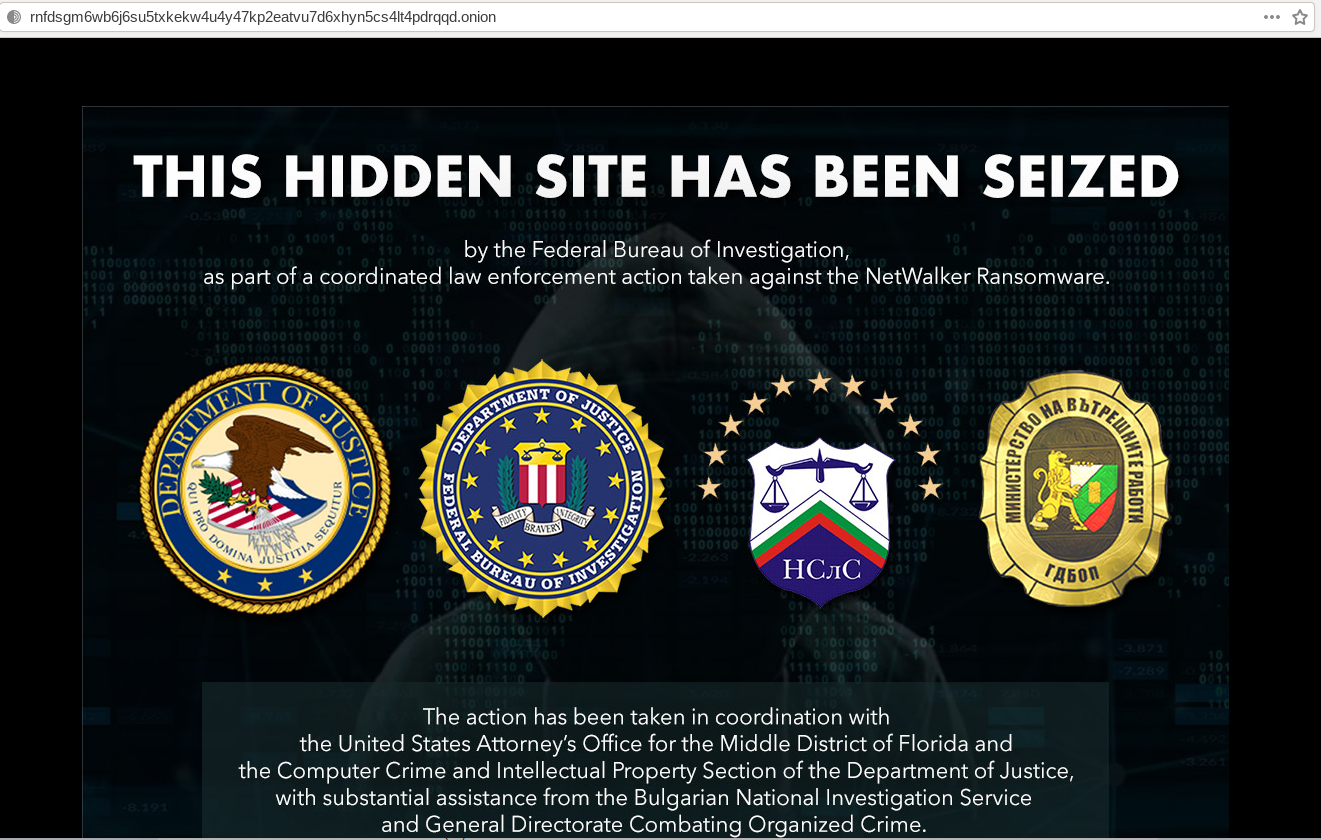
The victim shaming site maintained by the NetWalker ransomware group, after being seized by authorities this week.

NetWalker is a ransomware-as-a-service crimeware product in which affiliates rent access to the continuously updated malware code in exchange for a percentage of any funds extorted from victims. The crooks behind NetWalker used the now-seized website to publish personal and proprietary data stolen from their prey, as part of a public pressure campaign to convince victims to pay up.

NetWalker has been among the most rapacious ransomware strains, hitting at least 305 victims from 27 countries — the majority in the United States, according to Chainalysis, a company that tracks the flow virtual currency payments.

“Chainalysis has traced more than $46 million worth of funds in NetWalker ransoms since it first came on the scene in August 2019,” the company said in a blog post detailing its assistance with the investigation. “It picked up steam in mid-2020, growing the average ransom to $65,000 last year, up from $18,800 in 2019.”
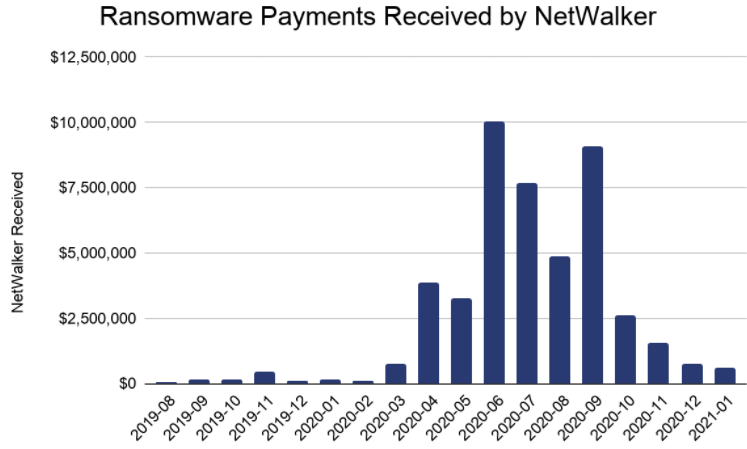
Image: Chainalysis

In a statement on the seizure, the Justice Department said the NetWalker ransomware has impacted numerous victims, including companies, municipalities, hospitals, law enforcement, emergency services, school districts, colleges, and universities. For example, the University of California, San Francisco paid $1.4 million last summer in exchange for a digital key needed to unlock files encrypted by the ransomware.

“Attacks have specifically targeted the healthcare sector during the COVID-19 pandemic, taking advantage of the global crisis to extort victims,” the DOJ said.

U.S. prosecutors say one of NetWalker’s top affiliates was Sebastien Vachon-Desjardins, of Gatineau, in Ottawa, Canada. An indictment unsealed today in Florida alleges Vachon-Desjardins obtained at least $27.6 million from the scheme.

The DOJ’s media advisory doesn’t mention the defendant’s age, but a 2015 report in the Gatineau local news website ledroit.com suggests this may not be his first offense. According to the story, a then-27-year-old Sebastien Vachon-Desjardins was sentenced to more than three years in prison for drug trafficking: He was reportedly found in possession of more than 50,000 methamphetamine tablets.

The NetWalker action came on the same day that European authorities announced a coordinated takedown targeting the Emotet crimeware-as-a-service network. Emotet is a pay-per-install botnet that is used by several distinct cybercrime groups to deploy secondary malware — most notably the ransomware strain Ryuk and Trickbot, a powerful banking trojan.

The NetWalker ransomware affiliate program kicked off in March 2020, when the administrator of the crimeware project began recruiting people on the dark web. Like many other ransomware programs, NetWalker does not permit affiliates to infect systems physically located in Russia or in any other countries that are part of the Commonwealth of Independent States (CIS) — which includes most of the nations in the former Soviet Union. This is a prohibition typically made by cybercrime operations that are coordinated out of Russia and/or other CIS nations because it helps minimize the chances that local authorities will investigate their crimes.

The following advertisement (translated into English by cybersecurity firm Intel 471) was posted by the NetWalker affiliate program manager last year to a top cybercrime forum. It illustrates the allure of the ransomware affiliate model, which handles everything from updating the malware to slip past the latest antivirus updates, to leasing space on the dark web where affiliates can interact with victims and negotiate payment. The affiliate, on the other hand, need only focus on finding new victims.

We are recruiting affiliates for network processing and spamming.
We are interested in people whose priority is quality and not quantity.
We prefer candidates who can work with large networks and have their own access to them.
We are going to recruit a limited number of affiliates and then close the openings until they are available again.

We offer you prompt and flexible ransomware, a user-friendly admin panel in Tor, an automated service.

Encryption of shared accesses: if several users are logged in to the target computer, the ransomware will infect their mapped drives, as well as network resources where those users are logged in — shared accesses/NAS etc.

Powershell build. Each build is unique, in that the malware is inside the script – it is not downloaded from the internet. This makes bypassing antivirus protection easier, including Windows Defender (cloud+).

A fully automated blog where the victim’s dumped data is directed. The data is published according to your settings. Instant and automated payouts: initially 20 percent, no less than 16 percent.

Accessibility of a crypting service to avoid AV detections.

The ransomware has been in use since September 2019 and proved to be reliable. The files encrypted with it cannot be decrypted.

Targeting Russia or the CIS is prohibited.

You’ll get all the information about the ransomware as well as terms and conditions after you place an application via PM.

Application form:
1) The field you specialize in.
2) Your experience. What other affiliate programs have you been in and what was your profit?
3) How many accesses [to networks] do you have? When are you ready to start? How many accesses do you plan on monetizing?

Read More

The post Arrest, Seizures Tied to Netwalker Ransomware appeared first on Malware Devil.


https://malwaredevil.com/2021/01/27/arrest-seizures-tied-to-netwalker-ransomware-2/?utm_source=rss&utm_medium=rss&utm_campaign=arrest-seizures-tied-to-netwalker-ransomware-2

Arrest, Seizures Tied to Netwalker Ransomware

U.S. and Bulgarian authorities this week seized the darkweb site used by the NetWalker ransomware cybercrime group to publish data stolen from its victims. In connection with the seizure, a Canadian national suspected of extorting more than $27 million through the spreading of NetWalker was charged in a Florida court.

The victim shaming site maintained by the NetWalker ransomware group, after being seized by authorities this week.

NetWalker is a ransomware-as-a-service crimeware product in which affiliates rent access to the continuously updated malware code in exchange for a percentage of any funds extorted from victims. The crooks behind NetWalker used the now-seized website to publish personal and proprietary data stolen from their prey, as part of a public pressure campaign to convince victims to pay up.

NetWalker has been among the most rapacious ransomware strains, hitting at least 305 victims from 27 countries — the majority in the United States, according to Chainalysis, a company that tracks the flow virtual currency payments.

“Chainalysis has traced more than $46 million worth of funds in NetWalker ransoms since it first came on the scene in August 2019,” the company said in a blog post detailing its assistance with the investigation. “It picked up steam in mid-2020, growing the average ransom to $65,000 last year, up from $18,800 in 2019.”

Image: Chainalysis

In a statement on the seizure, the Justice Department said the NetWalker ransomware has impacted numerous victims, including companies, municipalities, hospitals, law enforcement, emergency services, school districts, colleges, and universities. For example, the University of California, San Francisco paid $1.4 million last summer in exchange for a digital key needed to unlock files encrypted by the ransomware.

“Attacks have specifically targeted the healthcare sector during the COVID-19 pandemic, taking advantage of the global crisis to extort victims,” the DOJ said.

U.S. prosecutors say one of NetWalker’s top affiliates was Sebastien Vachon-Desjardins, of Gatineau, in Ottawa, Canada. An indictment unsealed today in Florida alleges Vachon-Desjardins obtained at least $27.6 million from the scheme.

The DOJ’s media advisory doesn’t mention the defendant’s age, but a 2015 report in the Gatineau local news website ledroit.com suggests this may not be his first offense. According to the story, a then-27-year-old Sebastien Vachon-Desjardins was sentenced to more than three years in prison for drug trafficking: He was reportedly found in possession of more than 50,000 methamphetamine tablets.

The NetWalker action came on the same day that European authorities announced a coordinated takedown targeting the Emotet crimeware-as-a-service network. Emotet is a pay-per-install botnet that is used by several distinct cybercrime groups to deploy secondary malware — most notably the ransomware strain Ryuk and Trickbot, a powerful banking trojan.

The NetWalker ransomware affiliate program kicked off in March 2020, when the administrator of the crimeware project began recruiting people on the dark web. Like many other ransomware programs, NetWalker does not permit affiliates to infect systems physically located in Russia or in any other countries that are part of the Commonwealth of Independent States (CIS) — which includes most of the nations in the former Soviet Union. This is a prohibition typically made by cybercrime operations that are coordinated out of Russia and/or other CIS nations because it helps minimize the chances that local authorities will investigate their crimes.

The following advertisement (translated into English by cybersecurity firm Intel 471) was posted by the NetWalker affiliate program manager last year to a top cybercrime forum. It illustrates the allure of the ransomware affiliate model, which handles everything from updating the malware to slip past the latest antivirus updates, to leasing space on the dark web where affiliates can interact with victims and negotiate payment. The affiliate, on the other hand, need only focus on finding new victims.

We are recruiting affiliates for network processing and spamming.
We are interested in people whose priority is quality and not quantity.
We prefer candidates who can work with large networks and have their own access to them.
We are going to recruit a limited number of affiliates and then close the openings until they are available again.

We offer you prompt and flexible ransomware, a user-friendly admin panel in Tor, an automated service.

Encryption of shared accesses: if several users are logged in to the target computer, the ransomware will infect their mapped drives, as well as network resources where those users are logged in — shared accesses/NAS etc.

Powershell build. Each build is unique, in that the malware is inside the script – it is not downloaded from the internet. This makes bypassing antivirus protection easier, including Windows Defender (cloud+).

A fully automated blog where the victim’s dumped data is directed. The data is published according to your settings. Instant and automated payouts: initially 20 percent, no less than 16 percent.

Accessibility of a crypting service to avoid AV detections.

The ransomware has been in use since September 2019 and proved to be reliable. The files encrypted with it cannot be decrypted.

Targeting Russia or the CIS is prohibited.

You’ll get all the information about the ransomware as well as terms and conditions after you place an application via PM.

Application form:
1) The field you specialize in.
2) Your experience. What other affiliate programs have you been in and what was your profit?
3) How many accesses [to networks] do you have? When are you ready to start? How many accesses do you plan on monetizing?

Read More

The post Arrest, Seizures Tied to Netwalker Ransomware appeared first on Malware Devil.


https://malwaredevil.com/2021/01/27/arrest-seizures-tied-to-netwalker-ransomware/?utm_source=rss&utm_medium=rss&utm_campaign=arrest-seizures-tied-to-netwalker-ransomware

Intl. Law Enforcement Operation Disrupts Emotet Botnet

Global law enforcement agencies have seized control of Emotet infrastructure, disrupting one of the world’s most pervasive and dangerous cyber threats.

The post Intl. Law Enforcement Operation Disrupts Emotet Botnet appeared first on Malware Devil.


https://malwaredevil.com/2021/01/27/intl-law-enforcement-operation-disrupts-emotet-botnet/?utm_source=rss&utm_medium=rss&utm_campaign=intl-law-enforcement-operation-disrupts-emotet-botnet

Critical Vulnerability Patched in ‘sudo’ Utility for Unix-Like OSes

Flaw exists in versions of sudo going back nearly 10 years; USCYBERCOM recommends organizations patch immediately.

The post Critical Vulnerability Patched in ‘sudo’ Utility for Unix-Like OSes appeared first on Malware Devil.


https://malwaredevil.com/2021/01/27/critical-vulnerability-patched-in-sudo-utility-for-unix-like-oses/?utm_source=rss&utm_medium=rss&utm_campaign=critical-vulnerability-patched-in-sudo-utility-for-unix-like-oses

Barbary Pirates and Russian Cybercrime

In 1801, the United States had a small Navy. Thomas Jefferson deployed almost half that Navy—three frigates and a schooner—to the Barbary C...