Malware Devil

Thursday, February 4, 2021

Facebook, Instagram, TikTok and Twitter Target Resellers of Hacked Accounts

Facebook, Instagram, TikTok, and Twitter this week all took steps to crack down on users involved in trafficking hijacked user accounts across their platforms. The coordinated action seized hundreds of accounts the companies say have played a major role in facilitating the trade and often lucrative resale of compromised, highly sought-after usernames.
At the center of the account ban wave are some of the most active members of OGUsers, a forum that caters to thousands of people selling access to hijacked social media and other online accounts.

Particularly prized by this community are short usernames, which can often be resold for thousands of dollars to those looking to claim a choice vanity name.

Facebook told KrebsOnSecurity it seized hundreds of accounts — mainly on Instagram — that have been stolen from legitimate users through a variety of intimidation and harassment tactics, including hacking, coercion, extortion, sextortion, SIM swapping, and swatting.

THE MIDDLEMEN

Facebook said it targeted a number of accounts tied to key sellers on OGUsers, as well as those who advertise the ability to broker stolen account sales.

Like most cybercrime forums, OGUsers is overrun with shady characters who are there mainly to rip off other members. As a result, some of the most popular denizens of the community are those who’ve earned a reputation as trusted “middlemen.”

These core members offer escrow services that – in exchange for a cut of the total transaction cost (usually five percent) — will hold the buyer’s funds until he is satisfied that the seller has delivered the credentials and any email account access needed to control the hijacked social media account.

For example, one of the most active accounts targeted in this week’s social network crackdown is the Instagram profileTrusted,” self-described as “top-tier professional middleman/escrow since 2014.”

Trusted’s profile included several screenshots of his OGUsers persona, “Beam,” who warns members about an uptick in the number of new OGUsers profiles impersonating him and other middlemen on the forum. Beam currently has more reputation points or “vouches” than almost anyone on the forum, save for perhaps the current and former site administrators.
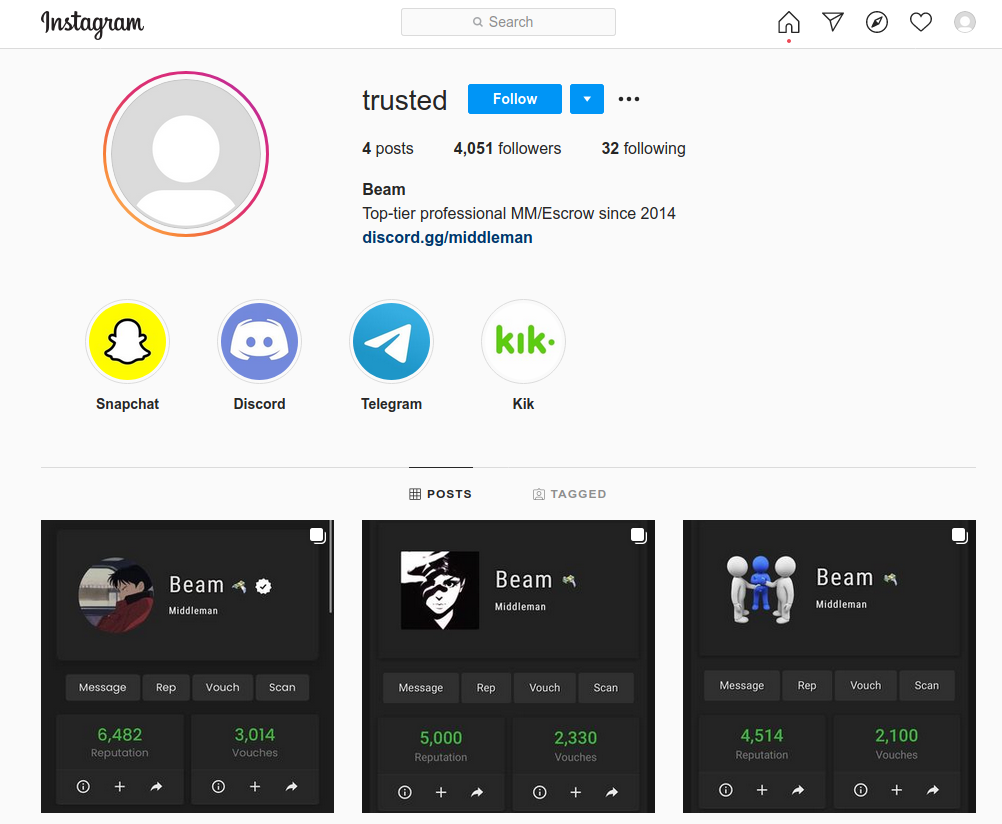
The now-banned Instagram account for the middleman @trusted/beam.

Helpfully, OGUsers has been hacked multiple times over the years, and its database of user details and private messages posted on competing crime forums. Those databases show Beam was just the 12th user account created on OGUsers back in 2014.

In his posts, Beam says he has brokered well north of 10,000 transactions. Indeed, the leaked OGUsers databases — which include private messages on the forum prior to June 2020 — offer a small window into the overall value of the hijacked social media account industry.

In each of Beam’s direct messages to other members who hired him as a middleman he would include the address of the bitcoin wallet to which the buyer was to send the funds. Just two of the bitcoin wallets Beam used for middlemanning over the past of couple of years recorded in excess of 6,700 transactions totaling more than 243 bitcoins — or roughly $8.5 million by today’s valuation (~$35,000 per coin)Beam would have earned roughly $425,000 in commissions on those sales.

Beam, a Canadian whose real name is Noah Hawkins, declined to be interviewed when contacted earlier this week. But his “Trusted” account on Instagram was taken down by Facebook today, as were “@Killer,” — a personal Instagram account he used under the nickname “noah/beam.” Beam’s Twitter account — @NH — has been deactivated by Twitter; it was hacked and stolen from its original owner back in 2014.

Reached for comment, Twitter confirmed that it worked in tandem with Facebook to seize accounts tied to top members of OGUsers, citing its platform manipulation and spam policy. Twitter said its investigation into the people behind these accounts is ongoing.

TikTok confirmed it also took action to target accounts tied to top OGUusers members, although it declined to say how many accounts were reclaimed.

“As part of our ongoing work to find and stop inauthentic behavior, we recently reclaimed a number of TikTok usernames that were being used for account squatting,” TikTok said in a written statement. “We will continue to focus on staying ahead of the ever-evolving tactics of bad actors, including cooperating with third parties and others in the industry.”

‘SOCIAL MEDIA SPECIALISTS’

Other key middlemen who’ve brokered thousands more social media account transactions via OGUsers that were part of this week’s ban wave included Farzad (OGUser #81), who used the Instagram accounts @middleman and @frzd; and @rl, a.k.a. “Amp,” a major middleman and account seller on OGUusers.

Naturally, the top middlemen in the OGUsers community get much of their business from sellers of compromised social media and online gaming accounts, and these two groups tend to cross-promote one another. Among the top seller accounts targeted in the ban wave was the Instagram account belonging to Ryan Zanelli (@zanelli), a 22-year-old self-described “social media marketing specialist” from Melbourne, Australia.
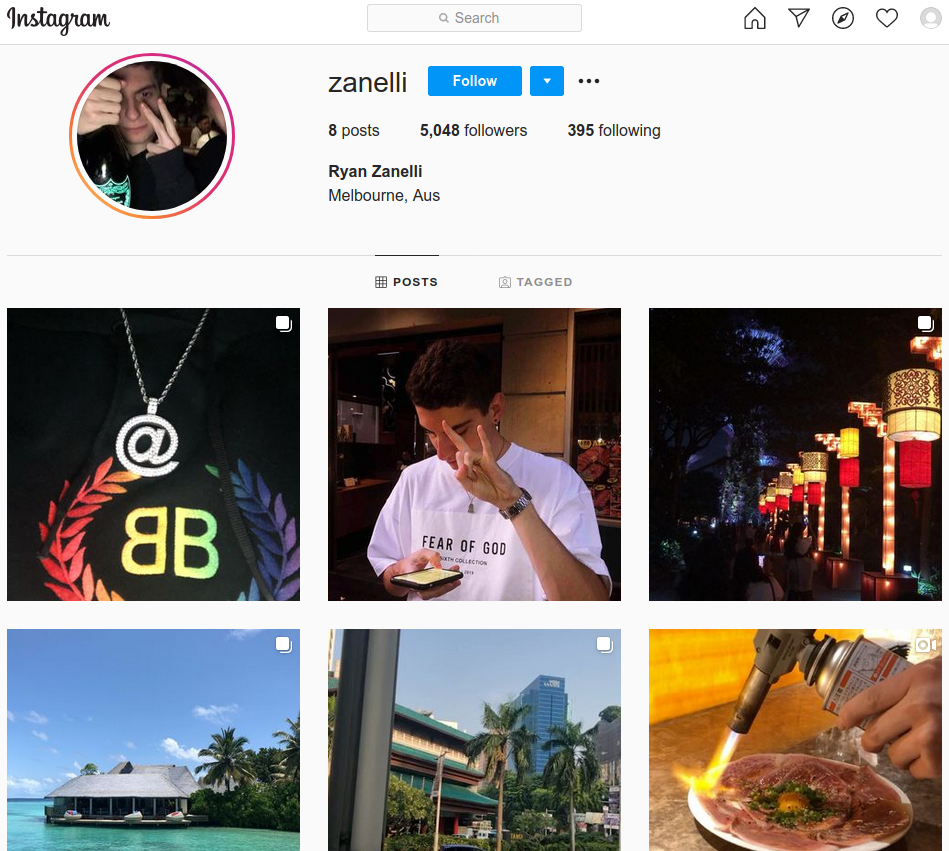
The leaked OGusers databases suggest Zanelli is better known to the OGusers community as “Verdict,” the fifth profile created on the forum and a longtime administrator of the site.

Reached via Telegram, Zanelli acknowledged he was an administrator of OGUsers, but denied being involved in anything illegal.

“I’m an early adaptor to the forum yes just like other countless members, and no social media property I sell is hacked or has been obtained through illegitimate means,” he said. “If you want the truth, I don’t even own any of the stock, I just resell off of people who do.”

This is not the first time Instagram has come for his accounts: As documented in this story in The Atlantic, some of his accounts totaling more than 1 million followers were axed in late 2018 when the platform took down 500 usernames that were stolen, resold, and used for posting memes.

“This is my full-time income, so it’s very detrimental to my livelihood,” Zanelli told The Atlantic, which identified him only by his first name. “I was trying to eat dinner and socialize with my family, but knowing behind the scenes everything I’ve built, my entire net worth, was just gone before my eyes.”

Another top seller account targeted in the ban wave was the Instagram account @h4ck, whose Telegram sales channel also advertises various services to get certain accounts banned and unbanned from differed platforms, including Snapchat and Instagram.
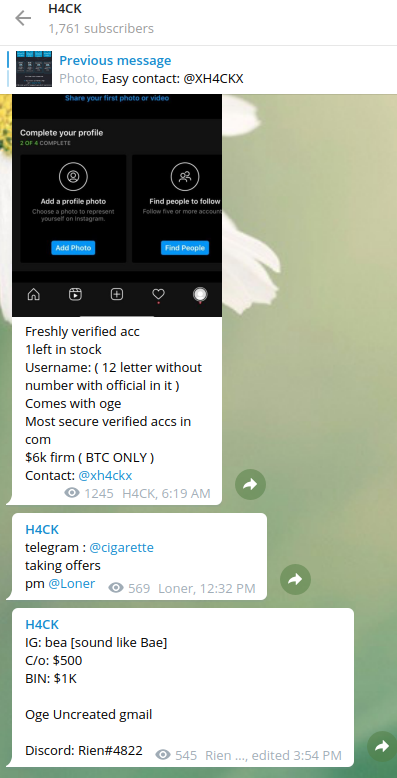
Snippets from the Telegram sales channel for @h4ck, one of the Instagram handles seized by Facebook today.

Facebook said while this is hardly the first time it has reclaimed accounts associated with hijackers, it is the first time it has done so publicly. The company says it has no illusions that this latest enforcement action is going to put a stop to the rampant problem of account hijacking for resale, but views the effort as part of an ongoing strategy to drive up costs for account traffickers, and to educate potential account buyers about the damage inflicted on people whose accounts are hijacked.

In recognition of the scale of the problem, Instagram today rolled out a new feature called “Recently Deleted,” which seeks to help victims undo the damage wrought by an account takeover.

“We know hackers sometimes delete content when they gain access to an account, and until now people had no way of easily getting their photos and videos back,” Instagram explained in a blog post. “Starting today, we will ask people to first verify that they are the rightful account holders when permanently deleting or restoring content from Recently Deleted.”

Facebook wasn’t exaggerating about the hijacking community’s use of extortion and other serious threats to gain control over highly prized usernames. I wish I could get back the many hours spent reading private messages from the OGUsers community, but it is certainly not uncommon for targets to be threatened with swatting attacks, or to have their deeply personal and/or financial information posted publicly online unless they relinquish control over a desired account.

WHAT YOU CAN DO

Any accounts that you value should be secured with a unique and strong password, as well the most robust form of multi-factor authentication available. Usually, this is a mobile app that generates a one-time code, but some sites like Twitter and Facebook now support even more robust options — such as physical security keys.

Whenever possible, avoid opting to receive the second factor via text message or automated phone calls, as these methods are prone to compromise via SIM swapping — a crime that is prevalent among people engaged in stealing social media accounts. SIM swapping involves convincing mobile phone company employees to transfer ownership of the target’s phone number to a device the attackers control.

These precautions are even more important for any email accounts you may have. Sign up with any service online, and it will almost certainly require you to supply an email address. In nearly all cases, the person who is in control of that address can reset the password of any associated services or accounts –merely by requesting a password reset email. Unfortunately, many email providers still let users reset their account passwords by having a link sent via text to the phone number on file for the account.

Most online services require users to supply a mobile phone number when setting up the account, but do not require the number to remain associated with the account after it is established. I advise readers to remove their phone numbers from accounts wherever possible, and to take advantage of a mobile app to generate any one-time codes for multifactor authentication.

Read More

The post Facebook, Instagram, TikTok and Twitter Target Resellers of Hacked Accounts appeared first on Malware Devil.


https://malwaredevil.com/2021/02/04/facebook-instagram-tiktok-and-twitter-target-resellers-of-hacked-accounts-3/?utm_source=rss&utm_medium=rss&utm_campaign=facebook-instagram-tiktok-and-twitter-target-resellers-of-hacked-accounts-3

Facebook, Instagram, TikTok and Twitter Target Resellers of Hacked Accounts

Facebook, Instagram, TikTok, and Twitter this week all took steps to crack down on users involved in trafficking hijacked user accounts across their platforms. The coordinated action seized hundreds of accounts the companies say have played a major role in facilitating the trade and often lucrative resale of compromised, highly sought-after usernames.

At the center of the account ban wave are some of the most active members of OGUsers, a forum that caters to thousands of people selling access to hijacked social media and other online accounts.

Particularly prized by this community are short usernames, which can often be resold for thousands of dollars to those looking to claim a choice vanity name.

Facebook told KrebsOnSecurity it seized hundreds of accounts — mainly on Instagram — that have been stolen from legitimate users through a variety of intimidation and harassment tactics, including hacking, coercion, extortion, sextortion, SIM swapping, and swatting.

THE MIDDLEMEN

Facebook said it targeted a number of accounts tied to key sellers on OGUsers, as well as those who advertise the ability to broker stolen account sales.

Like most cybercrime forums, OGUsers is overrun with shady characters who are there mainly to rip off other members. As a result, some of the most popular denizens of the community are those who’ve earned a reputation as trusted “middlemen.”

These core members offer escrow services that – in exchange for a cut of the total transaction cost (usually five percent) — will hold the buyer’s funds until he is satisfied that the seller has delivered the credentials and any email account access needed to control the hijacked social media account.

For example, one of the most active accounts targeted in this week’s social network crackdown is the Instagram profileTrusted,” self-described as “top-tier professional middleman/escrow since 2014.”

Trusted’s profile included several screenshots of his OGUsers persona, “Beam,” who warns members about an uptick in the number of new OGUsers profiles impersonating him and other middlemen on the forum. Beam currently has more reputation points or “vouches” than almost anyone on the forum, save for perhaps the current and former site administrators.

The now-banned Instagram account for the middleman @trusted/beam.

Helpfully, OGUsers has been hacked multiple times over the years, and its database of user details and private messages posted on competing crime forums. Those databases show Beam was just the 12th user account created on OGUsers back in 2014.

In his posts, Beam says he has brokered well north of 10,000 transactions. Indeed, the leaked OGUsers databases — which include private messages on the forum prior to June 2020 — offer a small window into the overall value of the hijacked social media account industry.

In each of Beam’s direct messages to other members who hired him as a middleman he would include the address of the bitcoin wallet to which the buyer was to send the funds. Just two of the bitcoin wallets Beam used for middlemanning over the past of couple of years recorded in excess of 6,700 transactions totaling more than 243 bitcoins — or roughly $8.5 million by today’s valuation (~$35,000 per coin)Beam would have earned roughly $425,000 in commissions on those sales.

Beam, a Canadian whose real name is Noah Hawkins, declined to be interviewed when contacted earlier this week. But his “Trusted” account on Instagram was taken down by Facebook today, as were “@Killer,” — a personal Instagram account he used under the nickname “noah/beam.” Beam’s Twitter account — @NH — has been deactivated by Twitter; it was hacked and stolen from its original owner back in 2014.

Reached for comment, Twitter confirmed that it worked in tandem with Facebook to seize accounts tied to top members of OGUsers, citing its platform manipulation and spam policy. Twitter said its investigation into the people behind these accounts is ongoing.

TikTok confirmed it also took action to target accounts tied to top OGUusers members, although it declined to say how many accounts were reclaimed.

“As part of our ongoing work to find and stop inauthentic behavior, we recently reclaimed a number of TikTok usernames that were being used for account squatting,” TikTok said in a written statement. “We will continue to focus on staying ahead of the ever-evolving tactics of bad actors, including cooperating with third parties and others in the industry.”

‘SOCIAL MEDIA SPECIALISTS’

Other key middlemen who’ve brokered thousands more social media account transactions via OGUsers that were part of this week’s ban wave included Farzad (OGUser #81), who used the Instagram accounts @middleman and @frzd; and @rl, a.k.a. “Amp,” a major middleman and account seller on OGUusers.

Naturally, the top middlemen in the OGUsers community get much of their business from sellers of compromised social media and online gaming accounts, and these two groups tend to cross-promote one another. Among the top seller accounts targeted in the ban wave was the Instagram account belonging to Ryan Zanelli (@zanelli), a 22-year-old self-described “social media marketing specialist” from Melbourne, Australia.

The leaked OGusers databases suggest Zanelli is better known to the OGusers community as “Verdict,” the fifth profile created on the forum and a longtime administrator of the site.

Reached via Telegram, Zanelli acknowledged he was an administrator of OGUsers, but denied being involved in anything illegal.

“I’m an early adaptor to the forum yes just like other countless members, and no social media property I sell is hacked or has been obtained through illegitimate means,” he said. “If you want the truth, I don’t even own any of the stock, I just resell off of people who do.”

This is not the first time Instagram has come for his accounts: As documented in this story in The Atlantic, some of his accounts totaling more than 1 million followers were axed in late 2018 when the platform took down 500 usernames that were stolen, resold, and used for posting memes.

“This is my full-time income, so it’s very detrimental to my livelihood,” Zanelli told The Atlantic, which identified him only by his first name. “I was trying to eat dinner and socialize with my family, but knowing behind the scenes everything I’ve built, my entire net worth, was just gone before my eyes.”

Another top seller account targeted in the ban wave was the Instagram account @h4ck, whose Telegram sales channel also advertises various services to get certain accounts banned and unbanned from differed platforms, including Snapchat and Instagram.

Snippets from the Telegram sales channel for @h4ck, one of the Instagram handles seized by Facebook today.

Facebook said while this is hardly the first time it has reclaimed accounts associated with hijackers, it is the first time it has done so publicly. The company says it has no illusions that this latest enforcement action is going to put a stop to the rampant problem of account hijacking for resale, but views the effort as part of an ongoing strategy to drive up costs for account traffickers, and to educate potential account buyers about the damage inflicted on people whose accounts are hijacked.

In recognition of the scale of the problem, Instagram today rolled out a new feature called “Recently Deleted,” which seeks to help victims undo the damage wrought by an account takeover.

“We know hackers sometimes delete content when they gain access to an account, and until now people had no way of easily getting their photos and videos back,” Instagram explained in a blog post. “Starting today, we will ask people to first verify that they are the rightful account holders when permanently deleting or restoring content from Recently Deleted.”

Facebook wasn’t exaggerating about the hijacking community’s use of extortion and other serious threats to gain control over highly prized usernames. I wish I could get back the many hours spent reading private messages from the OGUsers community, but it is certainly not uncommon for targets to be threatened with swatting attacks, or to have their deeply personal and/or financial information posted publicly online unless they relinquish control over a desired account.

WHAT YOU CAN DO

Any accounts that you value should be secured with a unique and strong password, as well the most robust form of multi-factor authentication available. Usually, this is a mobile app that generates a one-time code, but some sites like Twitter and Facebook now support even more robust options — such as physical security keys.

Whenever possible, avoid opting to receive the second factor via text message or automated phone calls, as these methods are prone to compromise via SIM swapping — a crime that is prevalent among people engaged in stealing social media accounts. SIM swapping involves convincing mobile phone company employees to transfer ownership of the target’s phone number to a device the attackers control.

These precautions are even more important for any email accounts you may have. Sign up with any service online, and it will almost certainly require you to supply an email address. In nearly all cases, the person who is in control of that address can reset the password of any associated services or accounts –merely by requesting a password reset email. Unfortunately, many email providers still let users reset their account passwords by having a link sent via text to the phone number on file for the account.

Most online services require users to supply a mobile phone number when setting up the account, but do not require the number to remain associated with the account after it is established. I advise readers to remove their phone numbers from accounts wherever possible, and to take advantage of a mobile app to generate any one-time codes for multifactor authentication.

Read More

The post Facebook, Instagram, TikTok and Twitter Target Resellers of Hacked Accounts appeared first on Malware Devil.


https://malwaredevil.com/2021/02/04/facebook-instagram-tiktok-and-twitter-target-resellers-of-hacked-accounts-2/?utm_source=rss&utm_medium=rss&utm_campaign=facebook-instagram-tiktok-and-twitter-target-resellers-of-hacked-accounts-2

Facebook, Instagram, TikTok and Twitter Target Resellers of Hacked Accounts

Facebook, Instagram, TikTok, and Twitter this week all took steps to crack down on users involved in trafficking hijacked user accounts across their platforms. The coordinated action seized hundreds of accounts the companies say have played a major role in facilitating the trade and often lucrative resale of compromised, highly sought-after usernames.

The post Facebook, Instagram, TikTok and Twitter Target Resellers of Hacked Accounts appeared first on Security Boulevard.

Read More

The post Facebook, Instagram, TikTok and Twitter Target Resellers of Hacked Accounts appeared first on Malware Devil.


https://malwaredevil.com/2021/02/04/facebook-instagram-tiktok-and-twitter-target-resellers-of-hacked-accounts/?utm_source=rss&utm_medium=rss&utm_campaign=facebook-instagram-tiktok-and-twitter-target-resellers-of-hacked-accounts

Joy Of Tech® ‘Let The Gamestops Begin!’

via the Comic Noggins of Nitrozac and Snaggy at The Joy of Tech® !

via the Comic Noggins of Nitrozac and Snaggy at The Joy of Tech®!

Permalink

The post Joy Of Tech® ‘Let The Gamestops Begin!’ appeared first on Security Boulevard.

Read More

The post Joy Of Tech® ‘Let The Gamestops Begin!’ appeared first on Malware Devil.


https://malwaredevil.com/2021/02/04/joy-of-tech-let-the-gamestops-begin/?utm_source=rss&utm_medium=rss&utm_campaign=joy-of-tech-let-the-gamestops-begin

Wednesday, February 3, 2021

Would real identities make social media safer?

“Use real identities to reduce abuse online” is a talking point you’ve almost certainly seen down the years. It also seems to come around like clockwork every other month, and is currently a hot topic in the UK after prominent journalists / media personalities raised the issue.

It’s an interesting idea, but the devil is in the details. “Verified identities solve the problem” won’t address the new problems such an approach creates. Is it possible to make this work, or is it all just pie in the sky?

Real users still behave badly

Think back to some of the worst arguments you’ve seen on social media. They almost certainly involve verified accounts somewhere in the mix. Often they initiate the aggression, or wade into replies and make it worse.

They may also utilise platform features to spread the argument further afield. Accounts with large followings on Twitter will do this via quote tweeting. They may simply retweet a stance they disagree with to initiate a so-called “pile on“, or retweet other people arguing, or quote tweet adding their own commentary along the way. They may even retweet their own replies.

Once this happens, it’s often game over for the other person whose notifications are essentially ruined with a flood of angry responses. I could be wrong, but I don’t believe I’ve ever seen a verified account banned for causing a pile on. I have, however, seen small accounts targeted by such things delete their profile completely. On balance, this doesn’t seem particularly fair.

Realness doesn’t equate to accuracy

Going back to Twitter, this is somewhat a problem of their own making. Whether an accurate assumption or not, the verified system was originally where you assumed all the celebrities you liked ended up. Twitter expanded it to include other people of note, for example authors, athletes, scientists, and so on. Then lots of folks were handed verification simply for working in news / media orgs. Alongside this, for a period of time you could submit a request to be verified and if you passed the bar, you got your checkmark.

Already, you can see how the system was torn between notions of “Is this a badge of notability, identity, or something else altogether?” Things became even more confusing as for a few years, the Twitter verification information page insisted verification was not currently happening…while new checkmarks continued to be given out.

The scheme is currently undergoing renovation, but it remains to be seen what happens with it.

Whether intentional or not, people seem to trust verified accounts as trustworthy voices of reason. This is not sensible, as people will tweet whatever they feel like. If we’re asking, “Does verification help reduce abuse or misinformation”, it can be argued that no, it does not. A drop of 73% in election misinformation after Twitter suspended Donald Trump is a frankly staggering statistic.

This alone should be a fatal blow to the “Use a real identity and things will magically be better somehow” idea.

Facebook’s foray into real names

Facebook already requires you to register an account with your legal name. The problem is if they think your name is not real, you’re locked out and have to try and regain access. This has had very mixed results, causing problems over everything from “fake” names to Star Wars.

Consider all the effort involved in policing this, and the hassle for site users, and then compare that with the number of accounts who are happily pushing large-scale propaganda campaigns via fake profiles on Facebook anyway.

Is it really worth all that effort? Is it helping?

Access denied

If we want everyone online with a real ID, there’s many privacy issues up for debate if identity documents are involved. There’s also the massive problem of access. The international gold-standard for ID is your passport. Many verification schemes ask for scans of your passport at some point.

Problem: lots of people don’t have passports, because it’s not a mandatory document. Depending on country, it might be very expensive. It could involve a complicated process or have its own barriers to entry. Live in a different country to the one you were born in? You may only have a residence permit. It’s possible your passport has expired. Will they even accept an expired passport?

In 2018, around 76% of people had a passport in the UK. That compares with 42% of Americans and 66% of Canadians. That leaves an awful lot of people out of the loop across just 3 locations. This is before you factor the rest of the world in.

Unless passports are somehow made free worldwide, or a universal form of ID is created, people will lose out. When crucial services like banking, tax, municipal services, gas and electricity are all moved online, this seems irresponsible. We typically don’t need to show our energy company a scan of our passport to use their service online. Does it make sense that the bar to entry is so much higher to post on a social network?

There are limited circumstances where a social network currently may ask to see a form of identification. That’s mostly tied to issues of death and memorialisation. Similarly, some verification processes involve passport scans.

Scanning everybody, though? That’s going to cause additional problems…

All the eggs, in the biggest basket

Any social media app containing something approaching the whole world’s passports is instantly a massive target for hacks and scams. It’s debatable if they could keep it all secure and locked down—they only have to fail once. For comparison, the UK’s Home Office deals with a frankly unimaginable volume of personal data. Passports, birth certificates, wedding certificates, photographs, personal emails, biometrics, the works. Some of this is outsourced to third parties.

It is incredibly important this data is kept under lock and key. This is now the point where we mention a 120% rise in data loss incidents. With 4,204 incidents “in the last financial year” alone, that’s an awful lot of problems related to paper documents and electronic devices. If this is the scale of the issue for UKGOV despite their best efforts, imagine the problem for a much less wealthy social media site. It just seems too much of a leap of faith to think this would end in anything but disaster.

This leads us neatly on to…

Data theft fallout

When people say that losing their anonymity online “isn’t a problem”, or “wouldn’t bug me”, that’s great for them. But just because something isn’t in their threat model, doesn’t mean it can’t hurt someone else, as the EFF’s Eva Galperin pointed out on Twitter only recently:

Some people are at risk from domestic violence or racial abuse. For some, anonymity is built into aspects of their job. For others, their stay in a country might be. conditional but they’d like to speak up on the issues affecting them without feeling they’re jeopardising their status.

“You’re not living in a repressive regime” should not be the barrier to entry for privacy. Treating your right to keep yourself safe from data abuse isn’t a special exemption, kept out of reach except in the direst of emergencies. This normalises the idea of privacy and safety as an exception. You know who loves it when privacy and safety are treated as abnormal?

People who’d rather you have as little of it as possible, that’s who.

Same again next time?

I’ve seen this discussion come around many, many times now. No matter the circumstance, it tends to fizzle out and be resurrected a few months later. In the UK, at least, “everyone should supply ID” will collapse under weight of sheer impossibility. The task there is made harder by virtue of the fact there is no nationally issued, mandatory identity card system in operation.

Things are a little more complicated in the US, where anonymous online speech is concerned. The legal provision that protects free speech online—Section 230—is under increasing scrutiny. It remains to be seen how things will play out there.

Having said that, this talking point will return. When it does, you’ll be armed with the knowledge that data privacy is incredibly important. Due to a variety of social, legal, and practical problems in this particular realm, social media sites won’t be asking you for verification any time soon.

The post Would real identities make social media safer? appeared first on Malwarebytes Labs.

The post Would real identities make social media safer? appeared first on Malware Devil.


https://malwaredevil.com/2021/02/03/would-real-identities-make-social-media-safer-3/?utm_source=rss&utm_medium=rss&utm_campaign=would-real-identities-make-social-media-safer-3

Emotet’s Takedown: Have We Seen the Last of the Malware?

A week after law enforcement agencies said they took down Emotet, there has been no sign of the prolific malware.
Read More

The post Emotet’s Takedown: Have We Seen the Last of the Malware? appeared first on Malware Devil.


https://malwaredevil.com/2021/02/03/emotets-takedown-have-we-seen-the-last-of-the-malware/?utm_source=rss&utm_medium=rss&utm_campaign=emotets-takedown-have-we-seen-the-last-of-the-malware

Second SolarWinds Attack Group Breaks into USDA Payroll — Report

A second APT, potentially linked to the Chinese government, could be behind the Supernova malware.
Read More

The post Second SolarWinds Attack Group Breaks into USDA Payroll — Report appeared first on Malware Devil.


https://malwaredevil.com/2021/02/03/second-solarwinds-attack-group-breaks-into-usda-payroll-report/?utm_source=rss&utm_medium=rss&utm_campaign=second-solarwinds-attack-group-breaks-into-usda-payroll-report

Patch Imperfect: Software Fixes Failing to Shut Out Attackers

Incomplete patches are allowing attackers to continue exploiting the same vulnerabilities, reducing the cost to compromise.

The post Patch Imperfect: Software Fixes Failing to Shut Out Attackers appeared first on Malware Devil.


https://malwaredevil.com/2021/02/03/patch-imperfect-software-fixes-failing-to-shut-out-attackers/?utm_source=rss&utm_medium=rss&utm_campaign=patch-imperfect-software-fixes-failing-to-shut-out-attackers

New Malware Hijacks Kubernetes Clusters to Mine Monero

Researchers warn that the Hildegard malware is part of ‘one of the most complicated attacks targeting Kubernetes.’
Read More

The post New Malware Hijacks Kubernetes Clusters to Mine Monero appeared first on Malware Devil.


https://malwaredevil.com/2021/02/03/new-malware-hijacks-kubernetes-clusters-to-mine-monero/?utm_source=rss&utm_medium=rss&utm_campaign=new-malware-hijacks-kubernetes-clusters-to-mine-monero

The Cyber Defense Matrix, the DIE Triad, and Cybersecurity Startups – Sounil Yu – ESW #215

The Cyber Defense Matrix is a framework to help systematically organize they many things that we buy and do in cybersecurity. The DIE Triad offers a new way of thinking about resiliency, how we secure the future, and what startups should focus on to help us get there.

Visit https://www.securityweekly.com/esw for all the latest episodes!

Show Notes: https://securityweekly.com/esw215

The post The Cyber Defense Matrix, the DIE Triad, and Cybersecurity Startups – Sounil Yu – ESW #215 appeared first on Malware Devil.


https://malwaredevil.com/2021/02/03/the-cyber-defense-matrix-the-die-triad-and-cybersecurity-startups-sounil-yu-esw-215-2/?utm_source=rss&utm_medium=rss&utm_campaign=the-cyber-defense-matrix-the-die-triad-and-cybersecurity-startups-sounil-yu-esw-215-2

The Cyber Defense Matrix, the DIE Triad, and Cybersecurity Startups – Sounil Yu – ESW #215

The Cyber Defense Matrix is a framework to help systematically organize they many things that we buy and do in cybersecurity. The DIE Triad offers a new way of thinking about resiliency, how we secure the future, and what startups should focus on to help us get there.

Visit https://www.securityweekly.com/esw for all the latest episodes!

Show Notes: https://securityweekly.com/esw215

The post The Cyber Defense Matrix, the DIE Triad, and Cybersecurity Startups – Sounil Yu – ESW #215 appeared first on Malware Devil.


https://malwaredevil.com/2021/02/03/the-cyber-defense-matrix-the-die-triad-and-cybersecurity-startups-sounil-yu-esw-215/?utm_source=rss&utm_medium=rss&utm_campaign=the-cyber-defense-matrix-the-die-triad-and-cybersecurity-startups-sounil-yu-esw-215

Attack Surface Management – Jonathan Cran – ESW #215

Attack Surface Management is an important and growing field within Information Security. In this segment, we discuss how security teams can frame the problem and what can be done to get a handle on the ever-growing attack surface of enterprises!

Visit https://www.securityweekly.com/esw for all the latest episodes!

Show Notes: https://securityweekly.com/esw215

The post Attack Surface Management – Jonathan Cran – ESW #215 appeared first on Malware Devil.


https://malwaredevil.com/2021/02/03/attack-surface-management-jonathan-cran-esw-215/?utm_source=rss&utm_medium=rss&utm_campaign=attack-surface-management-jonathan-cran-esw-215

Why a modern approach is needed to protect S3 buckets

S3, the Amazon Simple Storage Service, is an essential data repository for most organizations. Developers today rely on the flexibility and scalability of storing data …

The post Why a modern approach is needed to protect S3 buckets appeared first on Cyral.

The post Why a modern approach is needed to protect S3 buckets appeared first on Security Boulevard.

Read More

The post Why a modern approach is needed to protect S3 buckets appeared first on Malware Devil.


https://malwaredevil.com/2021/02/03/why-a-modern-approach-is-needed-to-protect-s3-buckets/?utm_source=rss&utm_medium=rss&utm_campaign=why-a-modern-approach-is-needed-to-protect-s3-buckets

Imperva Updates WAAP, SonicWall Confirms 0-Day, & Arista Zero Trust – ESW #215

This week in the Enterprise News, Mission Secure Announces Series B, Akamai Technologies Acquires Inverse, for Microsoft, Security is a $10 Billion Business, Sontiq acquires Cyberscout, IRONSCALES improves the ability to detect phishing attacks, Imperva updates its WAAP and Data Security offerings, SonicWall Confirms A Zero-Day Vulnerability with NO other details, Arista intros Multi-Domain Macro-Segmentation Service (I don’t know what it means, but its provocative), & more!

Visit https://www.securityweekly.com/esw for all the latest episodes!

Show Notes: https://securityweekly.com/esw215

The post Imperva Updates WAAP, SonicWall Confirms 0-Day, & Arista Zero Trust – ESW #215 appeared first on Malware Devil.


https://malwaredevil.com/2021/02/03/imperva-updates-waap-sonicwall-confirms-0-day-arista-zero-trust-esw-215/?utm_source=rss&utm_medium=rss&utm_campaign=imperva-updates-waap-sonicwall-confirms-0-day-arista-zero-trust-esw-215

Would real identities make social media safer?

“Use real identities to reduce abuse online” is a talking point you’ve almost certainly seen down the years. It also seems to come around like clockwork every other month, and is currently a hot topic in the UK after prominent journalists / media personalities raised the issue.

It’s an interesting idea, but the devil is in the details. “Verified identities solve the problem” won’t address the new problems such an approach creates. Is it possible to make this work, or is it all just pie in the sky?

Real users still behave badly

Think back to some of the worst arguments you’ve seen on social media. They almost certainly involve verified accounts somewhere in the mix. Often they initiate the aggression, or wade into replies and make it worse.

They may also utilise platform features to spread the argument further afield. Accounts with large followings on Twitter will do this via quote tweeting. They may simply retweet a stance they disagree with to initiate a so-called “pile on“, or retweet other people arguing, or quote tweet adding their own commentary along the way. They may even retweet their own replies.

Once this happens, it’s often game over for the other person whose notifications are essentially ruined with a flood of angry responses. I could be wrong, but I don’t believe I’ve ever seen a verified account banned for causing a pile on. I have, however, seen small accounts targeted by such things delete their profile completely. On balance, this doesn’t seem particularly fair.

Realness doesn’t equate to accuracy

Going back to Twitter, this is somewhat a problem of their own making. Whether an accurate assumption or not, the verified system was originally where you assumed all the celebrities you liked ended up. Twitter expanded it to include other people of note, for example authors, athletes, scientists, and so on. Then lots of folks were handed verification simply for working in news / media orgs. Alongside this, for a period of time you could submit a request to be verified and if you passed the bar, you got your checkmark.

Already, you can see how the system was torn between notions of “Is this a badge of notability, identity, or something else altogether?” Things became even more confusing as for a few years, the Twitter verification information page insisted verification was not currently happening…while new checkmarks continued to be given out.

The scheme is currently undergoing renovation, but it remains to be seen what happens with it.

Whether intentional or not, people seem to trust verified accounts as trustworthy voices of reason. This is not sensible, as people will tweet whatever they feel like. If we’re asking, “Does verification help reduce abuse or misinformation”, it can be argued that no, it does not. A drop of 73% in election misinformation after Twitter suspended Donald Trump is a frankly staggering statistic.

This alone should be a fatal blow to the “Use a real identity and things will magically be better somehow” idea.

Facebook’s foray into real names

Facebook already requires you to register an account with your legal name. The problem is if they think your name is not real, you’re locked out and have to try and regain access. This has had very mixed results, causing problems over everything from “fake” names to Star Wars.

Consider all the effort involved in policing this, and the hassle for site users, and then compare that with the number of accounts who are happily pushing large-scale propaganda campaigns via fake profiles on Facebook anyway.

Is it really worth all that effort? Is it helping?

Access denied

If we want everyone online with a real ID, there’s many privacy issues up for debate if identity documents are involved. There’s also the massive problem of access. The international gold-standard for ID is your passport. Many verification schemes ask for scans of your passport at some point.

Problem: lots of people don’t have passports, because it’s not a mandatory document. Depending on country, it might be very expensive. It could involve a complicated process or have its own barriers to entry. Live in a different country to the one you were born in? You may only have a residence permit. It’s possible your passport has expired. Will they even accept an expired passport?

In 2018, around 76% of people had a passport in the UK. That compares with 42% of Americans and 66% of Canadians. That leaves an awful lot of people out of the loop across just 3 locations. This is before you factor the rest of the world in.

Unless passports are somehow made free worldwide, or a universal form of ID is created, people will lose out. When crucial services like banking, tax, municipal services, gas and electricity are all moved online, this seems irresponsible. We typically don’t need to show our energy company a scan of our passport to use their service online. Does it make sense that the bar to entry is so much higher to post on a social network?

There are limited circumstances where a social network currently may ask to see a form of identification. That’s mostly tied to issues of death and memorialisation. Similarly, some verification processes involve passport scans.

Scanning everybody, though? That’s going to cause additional problems…

All the eggs, in the biggest basket

Any social media app containing something approaching the whole world’s passports is instantly a massive target for hacks and scams. It’s debatable if they could keep it all secure and locked down—they only have to fail once. For comparison, the UK’s Home Office deals with a frankly unimaginable volume of personal data. Passports, birth certificates, wedding certificates, photographs, personal emails, biometrics, the works. Some of this is outsourced to third parties.

It is incredibly important this data is kept under lock and key. This is now the point where we mention a 120% rise in data loss incidents. With 4,204 incidents “in the last financial year” alone, that’s an awful lot of problems related to paper documents and electronic devices. If this is the scale of the issue for UKGOV despite their best efforts, imagine the problem for a much less wealthy social media site. It just seems too much of a leap of faith to think this would end in anything but disaster.

This leads us neatly on to…

Data theft fallout

When people say that losing their anonymity online “isn’t a problem”, or “wouldn’t bug me”, that’s great for them. But just because something isn’t in their threat model, doesn’t mean it can’t hurt someone else, as the EFF’s Eva Galperin pointed out on Twitter only recently:

Some people are at risk from domestic violence or racial abuse. For some, anonymity is built into aspects of their job. For others, their stay in a country might be. conditional but they’d like to speak up on the issues affecting them without feeling they’re jeopardising their status.

“You’re not living in a repressive regime” should not be the barrier to entry for privacy. Treating your right to keep yourself safe from data abuse isn’t a special exemption, kept out of reach except in the direst of emergencies. This normalises the idea of privacy and safety as an exception. You know who loves it when privacy and safety are treated as abnormal?

People who’d rather you have as little of it as possible, that’s who.

Same again next time?

I’ve seen this discussion come around many, many times now. No matter the circumstance, it tends to fizzle out and be resurrected a few months later. In the UK, at least, “everyone should supply ID” will collapse under weight of sheer impossibility. The task there is made harder by virtue of the fact there is no nationally issued, mandatory identity card system in operation.

Things are a little more complicated in the US, where anonymous online speech is concerned. The legal provision that protects free speech online—Section 230—is under increasing scrutiny. It remains to be seen how things will play out there.

Having said that, this talking point will return. When it does, you’ll be armed with the knowledge that data privacy is incredibly important. Due to a variety of social, legal, and practical problems in this particular realm, social media sites won’t be asking you for verification any time soon.

The post Would real identities make social media safer? appeared first on Malwarebytes Labs.

The post Would real identities make social media safer? appeared first on Malware Devil.


https://malwaredevil.com/2021/02/03/would-real-identities-make-social-media-safer-2/?utm_source=rss&utm_medium=rss&utm_campaign=would-real-identities-make-social-media-safer-2

Responding to Microsoft 365 Attacks

Responding to the December 2020 Solarwinds Supply Chain Attack (“Solarigate”) solidified one of the most pressing security gaps of this new decade: visibility and defense against cloud application attacks. In Solarigate, attackers used the tainted Solarwinds software as an entry vector into servers and pivoted into wider network take-over, but this network take-over was not…

The post Responding to Microsoft 365 Attacks appeared first on Infocyte.

The post Responding to Microsoft 365 Attacks appeared first on Security Boulevard.

Read More

The post Responding to Microsoft 365 Attacks appeared first on Malware Devil.


https://malwaredevil.com/2021/02/03/responding-to-microsoft-365-attacks/?utm_source=rss&utm_medium=rss&utm_campaign=responding-to-microsoft-365-attacks

Would real identities make social media safer?

“Use real identities to reduce abuse online” is a talking point you’ve almost certainly seen down the years. It also seems to come around like clockwork every other month, and is currently a hot topic in the UK after prominent journalists / media personalities raised the issue.

It’s an interesting idea, but the devil is in the details. “Verified identities solve the problem” won’t address the new problems such an approach creates. Is it possible to make this work, or is it all just pie in the sky?

Real users still behave badly

Think back to some of the worst arguments you’ve seen on social media. They almost certainly involve verified accounts somewhere in the mix. Often they initiate the aggression, or wade into replies and make it worse.

They may also utilise platform features to spread the argument further afield. Accounts with large followings on Twitter will do this via quote tweeting. They may simply retweet a stance they disagree with to initiate a so-called “pile on“, or retweet other people arguing, or quote tweet adding their own commentary along the way. They may even retweet their own replies.

Once this happens, it’s often game over for the other person whose notifications are essentially ruined with a flood of angry responses. I could be wrong, but I don’t believe I’ve ever seen a verified account banned for causing a pile on. I have, however, seen small accounts targeted by such things delete their profile completely. On balance, this doesn’t seem particularly fair.

Realness doesn’t equate to accuracy

Going back to Twitter, this is somewhat a problem of their own making. Whether an accurate assumption or not, the verified system was originally where you assumed all the celebrities you liked ended up. Twitter expanded it to include other people of note, for example authors, athletes, scientists, and so on. Then lots of folks were handed verification simply for working in news / media orgs. Alongside this, for a period of time you could submit a request to be verified and if you passed the bar, you got your checkmark.

Already, you can see how the system was torn between notions of “Is this a badge of notability, identity, or something else altogether?” Things became even more confusing as for a few years, the Twitter verification information page insisted verification was not currently happening…while new checkmarks continued to be given out.

The scheme is currently undergoing renovation, but it remains to be seen what happens with it.

Whether intentional or not, people seem to trust verified accounts as trustworthy voices of reason. This is not sensible, as people will tweet whatever they feel like. If we’re asking, “Does verification help reduce abuse or misinformation”, it can be argued that no, it does not. A drop of 73% in election misinformation after Twitter suspended Donald Trump is a frankly staggering statistic.

This alone should be a fatal blow to the “Use a real identity and things will magically be better somehow” idea.

Facebook’s foray into real names

Facebook already requires you to register an account with your legal name. The problem is if they think your name is not real, you’re locked out and have to try and regain access. This has had very mixed results, causing problems over everything from “fake” names to Star Wars.

Consider all the effort involved in policing this, and the hassle for site users, and then compare that with the number of accounts who are happily pushing large-scale propaganda campaigns via fake profiles on Facebook anyway.

Is it really worth all that effort? Is it helping?

Access denied

If we want everyone online with a real ID, there’s many privacy issues up for debate if identity documents are involved. There’s also the massive problem of access. The international gold-standard for ID is your passport. Many verification schemes ask for scans of your passport at some point.

Problem: lots of people don’t have passports, because it’s not a mandatory document. Depending on country, it might be very expensive. It could involve a complicated process or have its own barriers to entry. Live in a different country to the one you were born in? You may only have a residence permit. It’s possible your passport has expired. Will they even accept an expired passport?

In 2018, around 76% of people had a passport in the UK. That compares with 42% of Americans and 66% of Canadians. That leaves an awful lot of people out of the loop across just 3 locations. This is before you factor the rest of the world in.

Unless passports are somehow made free worldwide, or a universal form of ID is created, people will lose out. When crucial services like banking, tax, municipal services, gas and electricity are all moved online, this seems irresponsible. We typically don’t need to show our energy company a scan of our passport to use their service online. Does it make sense that the bar to entry is so much higher to post on a social network?

There are limited circumstances where a social network currently may ask to see a form of identification. That’s mostly tied to issues of death and memorialisation. Similarly, some verification processes involve passport scans.

Scanning everybody, though? That’s going to cause additional problems…

All the eggs, in the biggest basket

Any social media app containing something approaching the whole world’s passports is instantly a massive target for hacks and scams. It’s debatable if they could keep it all secure and locked down—they only have to fail once. For comparison, the UK’s Home Office deals with a frankly unimaginable volume of personal data. Passports, birth certificates, wedding certificates, photographs, personal emails, biometrics, the works. Some of this is outsourced to third parties.

It is incredibly important this data is kept under lock and key. This is now the point where we mention a 120% rise in data loss incidents. With 4,204 incidents “in the last financial year” alone, that’s an awful lot of problems related to paper documents and electronic devices. If this is the scale of the issue for UKGOV despite their best efforts, imagine the problem for a much less wealthy social media site. It just seems too much of a leap of faith to think this would end in anything but disaster.

This leads us neatly on to…

Data theft fallout

When people say that losing their anonymity online “isn’t a problem”, or “wouldn’t bug me”, that’s great for them. But just because something isn’t in their threat model, doesn’t mean it can’t hurt someone else, as the EFF’s Eva Galperin pointed out on Twitter only recently:

Some people are at risk from domestic violence or racial abuse. For some, anonymity is built into aspects of their job. For others, their stay in a country might be. conditional but they’d like to speak up on the issues affecting them without feeling they’re jeopardising their status.

“You’re not living in a repressive regime” should not be the barrier to entry for privacy. Treating your right to keep yourself safe from data abuse isn’t a special exemption, kept out of reach except in the direst of emergencies. This normalises the idea of privacy and safety as an exception. You know who loves it when privacy and safety are treated as abnormal?

People who’d rather you have as little of it as possible, that’s who.

Same again next time?

I’ve seen this discussion come around many, many times now. No matter the circumstance, it tends to fizzle out and be resurrected a few months later. In the UK, at least, “everyone should supply ID” will collapse under weight of sheer impossibility. The task there is made harder by virtue of the fact there is no nationally issued, mandatory identity card system in operation.

Things are a little more complicated in the US, where anonymous online speech is concerned. The legal provision that protects free speech online—Section 230—is under increasing scrutiny. It remains to be seen how things will play out there.

Having said that, this talking point will return. When it does, you’ll be armed with the knowledge that data privacy is incredibly important. Due to a variety of social, legal, and practical problems in this particular realm, social media sites won’t be asking you for verification any time soon.

The post Would real identities make social media safer? appeared first on Malwarebytes Labs.

The post Would real identities make social media safer? appeared first on Malware Devil.


https://malwaredevil.com/2021/02/03/would-real-identities-make-social-media-safer/?utm_source=rss&utm_medium=rss&utm_campaign=would-real-identities-make-social-media-safer

2021 Cybersecurity Predictions

With a new year comes a new set of predictions for cybersecurity. We’ve developed these predictions to help corporate executives and IT leaders of small to medium sized organizations improve their risk management strategies. This has become a yearly tradition for us, and allows you to benefit from the multidisciplinary group of experts we convene each year to develop predictions.

Check out our previous predictions for 2020, here. 

The post 2021 Cybersecurity Predictions appeared first on Security Boulevard.

Read More

The post 2021 Cybersecurity Predictions appeared first on Malware Devil.


https://malwaredevil.com/2021/02/03/2021-cybersecurity-predictions-2/?utm_source=rss&utm_medium=rss&utm_campaign=2021-cybersecurity-predictions-2

BSidesSF 2020 – Geller Bedoya’s ‘Serverless Osquery Backend And Big Data Exploration’

Our thanks to BSidesSF and Conference Speakers for publishing their outstanding presentations; which originally appeared at the group’s BSidesSF 2020 Conference, and on the Organization’s YouTube Channel. Additionally, the BSidesSF 2021 Conference will take place on March 6 – 9, 2021 – with no cost to participate. Enjoy!

Permalink

The post BSidesSF 2020 – Geller Bedoya’s ‘Serverless Osquery Backend And Big Data Exploration’ appeared first on Security Boulevard.

Read More

The post BSidesSF 2020 – Geller Bedoya’s ‘Serverless Osquery Backend And Big Data Exploration’ appeared first on Malware Devil.


https://malwaredevil.com/2021/02/03/bsidessf-2020-geller-bedoyas-serverless-osquery-backend-and-big-data-exploration/?utm_source=rss&utm_medium=rss&utm_campaign=bsidessf-2020-geller-bedoyas-serverless-osquery-backend-and-big-data-exploration

Acting Skills Helped Me Become a Vishing Professional

Our readers often ask about acting skills and classes. Curt Klump is sharing how acting skills helped him become a vishing professional.

The post Acting Skills Helped Me Become a Vishing Professional appeared first on Security Through Education.

The post Acting Skills Helped Me Become a Vishing Professional appeared first on Security Boulevard.

Read More

The post Acting Skills Helped Me Become a Vishing Professional appeared first on Malware Devil.


https://malwaredevil.com/2021/02/03/acting-skills-helped-me-become-a-vishing-professional/?utm_source=rss&utm_medium=rss&utm_campaign=acting-skills-helped-me-become-a-vishing-professional

Barbary Pirates and Russian Cybercrime

In 1801, the United States had a small Navy. Thomas Jefferson deployed almost half that Navy—three frigates and a schooner—to the Barbary C...