Malware Devil

Thursday, February 18, 2021

Oracle is Said to Help China Find Dissidents and Jail Minorities

Oracle Corp. stands accused of selling analytics to Chinese police forces that’s being used to hunt down political dissidents and lock up Uyghur Muslims.

The post Oracle is Said to Help China Find Dissidents and Jail Minorities appeared first on Security Boulevard.

Read More

The post Oracle is Said to Help China Find Dissidents and Jail Minorities appeared first on Malware Devil.


https://malwaredevil.com/2021/02/18/oracle-is-said-to-help-china-find-dissidents-and-jail-minorities/?utm_source=rss&utm_medium=rss&utm_campaign=oracle-is-said-to-help-china-find-dissidents-and-jail-minorities

Kia Motors Hit With $20M Ransomware Attack – Report

So far, Kia Motors America has publicly acknowledged an “extended system outage,” but ransomware gang DoppelPaymer claimed it has locked down the company’s files in a cyberattack that includes a $20 million ransom demand. That $20 million will gain Kia a decryptor and a guarantee to not to publish sensitive data bits on the gang’s […]
Read More

The post Kia Motors Hit With $20M Ransomware Attack – Report appeared first on Malware Devil.


https://malwaredevil.com/2021/02/18/kia-motors-hit-with-20m-ransomware-attack-report/?utm_source=rss&utm_medium=rss&utm_campaign=kia-motors-hit-with-20m-ransomware-attack-report

2021-02-01 thru 2021-02-18 – Quick post: 46 malicious emails

Read More

The post 2021-02-01 thru 2021-02-18 – Quick post: 46 malicious emails appeared first on Malware Devil.


https://malwaredevil.com/2021/02/18/2021-02-01-thru-2021-02-18-quick-post-46-malicious-emails/?utm_source=rss&utm_medium=rss&utm_campaign=2021-02-01-thru-2021-02-18-quick-post-46-malicious-emails

Microsoft Azure Front Door Gets a Security Upgrade

New SKUs in Standard and Premium preview beef up the security of the content delivery network platform.

The post Microsoft Azure Front Door Gets a Security Upgrade appeared first on Malware Devil.


https://malwaredevil.com/2021/02/18/microsoft-azure-front-door-gets-a-security-upgrade-2/?utm_source=rss&utm_medium=rss&utm_campaign=microsoft-azure-front-door-gets-a-security-upgrade-2

Microsoft Azure Front Door Gets a Security Upgrade

New SKUs in Standard and Premium preview beef up the security of the content delivery network platform.

Microsoft today is launching Azure Front Door Standard and Premium in preview with two new SKUs that add threat detection, application security, and additional security protections to the content delivery network (CDN).

Azure already offers two edge networking tools: Azure Front Door, which focuses on global load-balancing and site acceleration, and Azure CDN Standard, which offers static content caching and acceleration. The new Azure Front Door brings together security with CDN technology for a cloud-based CDN with threat protection and additional capabilities.

These updates stem from Microsoft’s efforts to bring zero-trust principles to businesses using Azure network security tools, says Ann Johnson, Microsoft’s corporate vice president of Security, Compliance, and Identity (SCI) Business Development. Its zero-trust strategy has underpinned several initiatives as it believes this is how companies will become more secure.

Johnson uses three principles to describe zero trust, the first of which involves adopting explicit verification for every transaction during a session: “So not just verifying the human, but the device, the data, the location, if it’s an IoT device, the application – everything that happens in the session should be verified and anomalous behavior should be flagged,” she explains.

The second principle is ensuring least privilege access. Many organizations still provide too much privileged access to employees, Johnson says. One of the steps Microsoft is taking with its content and application delivery is implementing more controls around access.

The third principle: “Then, finally, assume you’ve been breached,” she says. Assumed breach is a topic the security industry has discussed for years, but with zero trust, they have to assume they have been breached, and that anything within the organization could potentially be breached.

These principles have grown essential as application-delivery networks undergo a massive transformation to the cloud, Johnson explains. The new capabilities in Azure Front Door aim to provide organizations with one platform that meets availability, scalability, and security needs.

The new Azure Front Door SKU offers both static and dynamic content acceleration, global load-balancing, SSL offload, domain and certificate management, improved traffic analytics, and basic security capabilities, Microsoft writes in a blog post. The Azure Front Door Premium SKU builds on these with more security capabilities: Web application firewall (WAF), bot protection, private link support, and integration with Microsoft threat intelligence and security analytics.

In addition to supporting all the features available via Azure CDN Standard, Azure Front Door, and Azure Web Application Firewall, the new standard and premium SKUs bring a few new capabilities, Microsoft officials write in a blog post. These include a simplified user experience, simplified management experience, and TLS certificate management: both standard and premium SKUs offer Azure managed TLS certificates by default for all custom domains at no additional cost. More details on the capabilities of standard and premium can be found here.

“I’m encouraging our customers to encrypt all their communication channels across the cloud and hybrid networks,” says Johnson. “This means they would need to secure user to app, and site to site, and we have leading encryption capabilities such as TLS within our VPN.”

A Proactive Approach

She notes today’s updates are not a reaction to attacker activity, but a proactive step given how businesses have transitioned to the cloud in recent years; especially in 2020. As Microsoft CEO Satya Nadella said last April, “We’ve seen two years’ worth of digital transformation in two months.”

“They’re moving a ton of apps … and they need to deliver them globally, at scale, and we want to make sure we can do that from an app delivery standpoint, and an API standpoint, or even a website standpoint in a secure manner.” The ability of Azure Front Door to combine security and CDN creates an opportunity to improve the way businesses deploy and secure content.

While there are cloud network security vendors with “a range of maturity in their solutions,” Johnson notes that everyone is playing “just a little bit of catchup” because businesses are moving to the cloud faster than many network security capabilities can be built. Some Microsoft customers say that even after the pandemic slows, they will keep roughly half of their employees at home, Johnson says.

“That just means they’re going to continue to operate in the way that they do,” she continues. “And that need to move so many applications so quickly to the cloud … really drove the need to improve solutioning in this space.”

Businesses that already subscribe to Microsoft’s network security capabilities, depending on which they have, will automatically be able to try the SKUs in preview. Those who don’t use Microsoft for CDN and some of these capabilities will need to subscribe, Johnson says.

This week Microsoft also announced Azure Firewall Premium is now available in preview, which is designed to provide next-gen firewall capabilities required for sensitive and regulated environments. This release brings capabilities including TLS inspection, a signature-based intrusion detection and prevention system (IDPS), URL filtering, and the ability for admins to filter outbound user access to the Internet based on specific Web categories. More details here.

Kelly Sheridan is the Staff Editor at Dark Reading, where she focuses on cybersecurity news and analysis. She is a business technology journalist who previously reported for InformationWeek, where she covered Microsoft, and Insurance & Technology, where she covered financial … View Full Bio

Recommended Reading:

Comment |

Email This |

Print |

RSS

More Insights

The post Microsoft Azure Front Door Gets a Security Upgrade appeared first on Malware Devil.


https://malwaredevil.com/2021/02/18/microsoft-azure-front-door-gets-a-security-upgrade/?utm_source=rss&utm_medium=rss&utm_campaign=microsoft-azure-front-door-gets-a-security-upgrade

Romance scams: FTC reveals $304 million of heartache

In 2020, reported losses to the FTC for romance scams went up by 50% from 2019, totalling $304 million. And things weren’t exactly good before: Romance scams have cost people a fortune for 3 years running, according to the FTC. Their latest report suggests a steady rise in these kind of scams generally and ponders the impact of the pandemic. If nobody can go out, it stands to reason that dating in the virtual world would experience a surge of interest.

Love is most definitely in the air for people up to no good.

Some key findings

  • Scams often begin on social media but are unexpected. Potential victims aren’t necessarily on a site for dating in the first place.
  • The use of gift cards for sending money to scammers increased 70%.
  • Reports of money lost increased across every age group in 2020.

Many of the old tricks are still in play, because they’re tried and tested. Throw enough of them out there and a scammer snags a bite eventually. It only takes one or two direct hits to make a small fortune. Meanwhile, people face losing huge sums of money which is often not recoverable.

Sending all my love…and my money

The report mentions many reports of large losses involve scammers claiming to send a victim money. Once the victim receives it, the scammer invents a reason why they need it sent back, or forwarded to a third party. This is how people end up as money mules. As we often mention, this is a bad situation to be in. While the mule ends up in various degrees of legal trouble, the anonymous scammer pulling the strings gets away with it.

It’s unfair, and very cruel for people who would naturally assume they’d done nothing wrong.

We see a variety of romance con-tricks involving requests to move funds. One we examined recently adds a small spin to proceedings. The scam works as follows:

  • The scammer connects with a victim on a dating app, and supplies photos and audio recordings.
  • After some small talk, the scammer says they want to send the victim some money. The scammer “can’t use their account” from their location, but they’re happy to give login details so the victim can do it themselves.
  • The scammer sends a link to a fake banking website where the victim is likely to be asked to complete a transaction, to increase their trust in the scammer, or for their own personal or banking details.

Gift cards: a wealth of opportunity

As mentioned already, gift cards are an attractive proposition for people up to no good. They’re easy to obtain and can be bought in small amounts. Unlike a few years back, they’re not limited to a narrow selection of items or stores. This is good for fakers, because they’re less likely to make victims feel like they’re being sent on a wild goose chase. They can pretty much buy anything and it’ll be of value to the scammer, either through usage or selling on. If gift cards are ever mentioned on dating apps or on social media, you’ve every right to be suspicious.

Steering victims away from the theoretical safety of their online space is a common tactic, not specific to dating scams. (Gaming scams will often take victims away from their gaming console ecosystem to third party sites, for example.) Romance scammers often try to lure people away from the dating apps where they met. This is good for the scammer, problematic for the victim: The digital paper trail becomes muddied, certain protections and safety mechanisms may not apply or be usable, and so on.

A trick of the eye

Catfishing romance scams use fictional personas that often rely on stolen images. People will use photos of models from different parts of the world, or pretend to be U.S. Army soldiers, or even celebrities, to get the job done. All they care about is grabbing the cash, and it doesn’t matter how much the victim on the other side of the screen is impacted.

To combat this, people should make use of reverse image search to see where else the images appear. AI generated images are also common in this realm though, so reverse image search is useful but not foolproof.

On a similar note, refusing to do video calls could be suspicious. They may simply be shy, but one would probably expect video for dating is a reasonable expectation a year into the pandemic.

Tips for avoiding romance scams

Attempts to get you away from the platform where you met, requests for cash, or requests for a lot of personal information / logins should set alarm bells ringing. Asking for money for a visa / travel, or sudden medical aid, should too. Sending scans of passport pages is also a bit unusual. Anything which goes from 0 to 60 in the blink of an eye or seems too good to be true should definitely cause you to be very careful.

Be sure to check out our tips for dating safety and security before you next delve into the world of digital dating. The last thing anybody needs right now is financial fallout caused by a bogus romantic interlude. The more you can reduce the odds of that happening, the better everyone using dating platforms will be for it. Let’s consign these fakers to the digital rubbish bin, where they belong.

The post Romance scams: FTC reveals $304 million of heartache appeared first on Malwarebytes Labs.

The post Romance scams: FTC reveals $304 million of heartache appeared first on Malware Devil.


https://malwaredevil.com/2021/02/18/romance-scams-ftc-reveals-304-million-of-heartache-2/?utm_source=rss&utm_medium=rss&utm_campaign=romance-scams-ftc-reveals-304-million-of-heartache-2

BSidesSF 2020 – Alethe Denis’s ‘Phishy Little Liars – Pretexts That Kill’

Our thanks to BSidesSF and Conference Speakers for publishing their outstanding presentations; which originally appeared at the group’s BSidesSF 2020 Conference, and on the Organization’s YouTube Channel. Additionally, the BSidesSF 2021 Conference will take place on March 6 – 9, 2021 – with no cost to participate. Enjoy!

Permalink

The post BSidesSF 2020 – Alethe Denis’s ‘Phishy Little Liars – Pretexts That Kill’ appeared first on Security Boulevard.

Read More

The post BSidesSF 2020 – Alethe Denis’s ‘Phishy Little Liars – Pretexts That Kill’ appeared first on Malware Devil.


https://malwaredevil.com/2021/02/18/bsidessf-2020-alethe-deniss-phishy-little-liars-pretexts-that-kill/?utm_source=rss&utm_medium=rss&utm_campaign=bsidessf-2020-alethe-deniss-phishy-little-liars-pretexts-that-kill

The Rise of Software Supply Chain Attacks

Software supply chain attacks are back in the news. Last week, security researcher Alex Birsan executed a novel attack against Microsoft, Apple, PayPal, Shopify, Netflix, Tesla, Yelp, and Uber by leveraging a design flaw in automated build and installation tools. Along with the recent SolarWinds breach, this most recent attack is renewing attention on software supply chain security.

What Is a Software Supply Chain Attack?

A software supply chain attack occurs when a malicious actor gains access to an organization’s system through malware installed on the software of a trusted third-party partner or provider. 

In a software supply chain attack, Malicious actors infiltrate a legitimate application then change source code and hide malware in build and update processes with the intention of distributing that malware downstream automatically to a wider audience. In this type of attack, the original victim is not the final target, but rather a stepping stone to many other potential networks. The trusted vendor is unaware that they are sending malicious code to their customers.

These types of attacks work because they occur when users update software built by a vendor that they already have a relationship with and trust. When malicious code is installed on the target organization’s site, it runs with the same permissions as the trusted application. Depending on the popularity of the infected application, software supply chain attacks have the potential to reach a large number of victims.

The SolarWinds Breach

Perhaps the biggest breach of 2020 was a supply chain attack involving SolarWinds’ Orion platform, which monitors network performance, log files, storage, config files, databases, and more. A malicious actor – evidence points to hackers backed by Russian intelligence – injected malware into one of the Orion tools during the build process. That software update was then automatically distributed downstream to Orion customers, including Cisco, Intel, Nvidia, VMware, and numerous US federal government agencies. 

This attack was successful and went unnoticed for months because the software update appeared to be legitimate. Updates were signed off by SolarWinds, and customers had no reason to suspect a compromise had occurred. The malware contained in the SolarWinds update opened a backdoor to infected systems, giving hackers access to the infrastructure of any company using the Orion platform. In the SolarWinds breach, the supply chain was the attack vector used to distribute the malware. SolarWinds’ customers, and not SolarWinds itself, were the intended targets.

The Dependency Confusion Breach

The most recent software supply chain attack was the work of researcher and ethical hacker Alex Birsan. In a nutshell, Birsan took advantage of a design flaw in the way open source systems handle dependencies to push malware into targeted systems.

It began when another researcher shared a manifest file, package.json, from an npm package used internally by PayPal. Birsan noticed PayPal’s file contained a mix of public npm and private dependencies. He surmised that the private package names were most likely hosted internally by PayPal because they did not exist in the public npm registry. Birsan wondered what would happen if malicious code was uploaded to npm under the private package names. Would PayPal’s internal projects start defaulting to the new (now malicious) public packages instead of the private ones?

To test his theory, Birsan uploaded duplicate packages to open source repositories including PyPI, npm, and RubyGems. It turned out that if a dependency package used by an application existed in both a public open-source repository and a private build, the public package was given priority and was pulled instead – without requiring any action from the developer. Birsan also realized that in some cases, packages with higher version numbers would be prioritized regardless of whether they were public or private. This allowed Birsan to launch a supply chain attack against multiple high-profile enterprises.

One way to think about this attack is to imagine you’re shopping for cereal. You’re in the grocery store aisle and you reach for your favorite – a box of Lucky Loops in its signature purple box. You toss the box in your cart and head on down to the milk cooler without a second thought. You don’t open the box to check that it actually contains those sweet and crunchy green cereal loops. You just assume it does. Now imagine you get home, open the box, and discover that it contains muesli. This is essentially what is happening in this supply chain attack. Birsan uploaded packages that looked the same on the outside, but contained malware on the inside. Automated build and update tools are designed to look only at the packaging. They’re not looking inside to check the contents of the box.

Dependency confusion where the package looks the same but the contents are different.

It should be noted that Birsan uploaded these packages from his own account with the disclaimer, “This package is meant for security research purposes and does not contain any useful code.” For his efforts, Birsan earned USD 130,000 from four different bug bounty programs.

The Impact of New Attack Vectors on Open Source 

Though Alex Birsan’s software supply chain attack involves open source repositories, it is not directly related to open source code. The attack was more about exploiting how automated build or installation tools install dependencies.

Despite the attention and subsequent fixes raised by these recent breaches, software supply chain attacks are expected to grow, especially on open source platforms still struggling to deal with issues like dependency confusion. Thankfully, malicious open source packages are far less common than accidental open source security vulnerabilities, which are disclosed and announced publicly, usually along with a fix.

As the saying goes, an ounce of prevention is worth a pound of cure. To that end, Microsoft published a white paper that details three ways to prevent this type of breach, which the company calls a substitution attack: 

  • Reference one private feed, not multiple

  • Protect your packages using controlled scopes 

  • Utilize client-side verification features

The software we use today has become a mix of proprietary, third party, and open source. While we understand the security risks associated with each on their own – and do our best to prevent vulnerabilities through extensive security scanning and testing – we have not yet learned enough about the risks that come with this hybrid approach to software. Until we learn more about the risks inherent to today’s complex software ecosystems, novel attacks will continue to surface.

The post The Rise of Software Supply Chain Attacks appeared first on Security Boulevard.

Read More

The post The Rise of Software Supply Chain Attacks appeared first on Malware Devil.


https://malwaredevil.com/2021/02/18/the-rise-of-software-supply-chain-attacks/?utm_source=rss&utm_medium=rss&utm_campaign=the-rise-of-software-supply-chain-attacks

Romance scams: FTC reveals $304 million of heartache

In 2020, reported losses to the FTC for romance scams went up by 50% from 2019, totalling $304 million. And things weren’t exactly good before: Romance scams have cost people a fortune for 3 years running, according to the FTC. Their latest report suggests a steady rise in these kind of scams generally and ponders the impact of the pandemic. If nobody can go out, it stands to reason that dating in the virtual world would experience a surge of interest.

Love is most definitely in the air for people up to no good.

Some key findings

  • Scams often begin on social media but are unexpected. Potential victims aren’t necessarily on a site for dating in the first place.
  • The use of gift cards for sending money to scammers increased 70%.
  • Reports of money lost increased across every age group in 2020.

Many of the old tricks are still in play, because they’re tried and tested. Throw enough of them out there and a scammer snags a bite eventually. It only takes one or two direct hits to make a small fortune. Meanwhile, people face losing huge sums of money which is often not recoverable.

Sending all my love…and my money

The report mentions many reports of large losses involve scammers claiming to send a victim money. Once the victim receives it, the scammer invents a reason why they need it sent back, or forwarded to a third party. This is how people end up as money mules. As we often mention, this is a bad situation to be in. While the mule ends up in various degrees of legal trouble, the anonymous scammer pulling the strings gets away with it.

It’s unfair, and very cruel for people who would naturally assume they’d done nothing wrong.

We see a variety of romance con-tricks involving requests to move funds. One we examined recently adds a small spin to proceedings. The scam works as follows:

  • The scammer connects with a victim on a dating app, and supplies photos and audio recordings.
  • After some small talk, the scammer says they want to send the victim some money. The scammer “can’t use their account” from their location, but they’re happy to give login details so the victim can do it themselves.
  • The scammer sends a link to a fake banking website where the victim is likely to be asked to complete a transaction, to increase their trust in the scammer, or for their own personal or banking details.

Gift cards: a wealth of opportunity

As mentioned already, gift cards are an attractive proposition for people up to no good. They’re easy to obtain and can be bought in small amounts. Unlike a few years back, they’re not limited to a narrow selection of items or stores. This is good for fakers, because they’re less likely to make victims feel like they’re being sent on a wild goose chase. They can pretty much buy anything and it’ll be of value to the scammer, either through usage or selling on. If gift cards are ever mentioned on dating apps or on social media, you’ve every right to be suspicious.

Steering victims away from the theoretical safety of their online space is a common tactic, not specific to dating scams. (Gaming scams will often take victims away from their gaming console ecosystem to third party sites, for example.) Romance scammers often try to lure people away from the dating apps where they met. This is good for the scammer, problematic for the victim: The digital paper trail becomes muddied, certain protections and safety mechanisms may not apply or be usable, and so on.

A trick of the eye

Catfishing romance scams use fictional personas that often rely on stolen images. People will use photos of models from different parts of the world, or pretend to be U.S. Army soldiers, or even celebrities, to get the job done. All they care about is grabbing the cash, and it doesn’t matter how much the victim on the other side of the screen is impacted.

To combat this, people should make use of reverse image search to see where else the images appear. AI generated images are also common in this realm though, so reverse image search is useful but not foolproof.

On a similar note, refusing to do video calls could be suspicious. They may simply be shy, but one would probably expect video for dating is a reasonable expectation a year into the pandemic.

Tips for avoiding romance scams

Attempts to get you away from the platform where you met, requests for cash, or requests for a lot of personal information / logins should set alarm bells ringing. Asking for money for a visa / travel, or sudden medical aid, should too. Sending scans of passport pages is also a bit unusual. Anything which goes from 0 to 60 in the blink of an eye or seems too good to be true should definitely cause you to be very careful.

Be sure to check out our tips for dating safety and security before you next delve into the world of digital dating. The last thing anybody needs right now is financial fallout caused by a bogus romantic interlude. The more you can reduce the odds of that happening, the better everyone using dating platforms will be for it. Let’s consign these fakers to the digital rubbish bin, where they belong.

The post Romance scams: FTC reveals $304 million of heartache appeared first on Malware Devil.


https://malwaredevil.com/2021/02/18/romance-scams-ftc-reveals-304-million-of-heartache/?utm_source=rss&utm_medium=rss&utm_campaign=romance-scams-ftc-reveals-304-million-of-heartache

Feature Release 21.1

With the first few weeks of January underway, we were excited to ramp up after the holidays and end of the year. Our first release of 2021 was packed with updates after the longest release break we had taken in … Read more

The post Feature Release 21.1 appeared first on DivvyCloud.

The post Feature Release 21.1 appeared first on Security Boulevard.

Read More

The post Feature Release 21.1 appeared first on Malware Devil.


https://malwaredevil.com/2021/02/18/feature-release-21-1/?utm_source=rss&utm_medium=rss&utm_campaign=feature-release-21-1

How Your Organization Can Eliminate Entitlement Creep

The Growth of Artificial Intelligence in Identity Governance

Organizations are facing increasing pressure to provide employees and contractors with the right access to the right applications and systems at the right time. But how can they do this with their existing, manually-driven Identity Governance and Administration (IGA) solutions and processes? How can security and IT professionals address the needs of the new remote workforce and its demands for access to new cloud applications and services? Combined with new machine identity types, accelerated DevOps/Agile development methodologies, and unplanned organizational changes, static IGA solutions and processes need to become more flexible, more dynamic, and more automated. 

With the introduction of artificial intelligence (AI) and machine learning (ML) into IGA, organizations have a clear path to hyper-automating their existing identity governance solution and processes. By applying AI and ML, enterprises can further streamline and automate intelligence across all identity governance use cases, including access requests and approvals, access reviews, and role engineering. Here are a few examples of how AI and ML can hyper-automate IGA solutions and processes to help combat your organization’s entitlement creep problems: 

  • Identify access risks across the entire organization and provide actionable insights to help accelerate the removal of overprivileged access
  • Identify excessive privileges, orphaned accounts, and provide confidence scoring (example: low, medium, and high) in order to provide the right level of security risk context 
  • Enable micro-certifications, where only a small set of entitlements and roles are approved between annual or biannual certification campaigns

While no new technology is 100% foolproof, the introduction of AI and ML capabilities into identity governance solutions and processes provides organizations with the most promising way to address the silent access challenge known as entitlement creep.

ForgeRock’s Modern Approach: Autonomous Identity  

ForgeRock Autonomous Identity provides real-time, continuous enterprise-wide user access visibility. The solution allows organizations to accelerate secure workforce access, achieve regulatory compliance, mitigate risks, and reduce costs. By leveraging AI and  ML techniques, Autonomous Identity collects and analyzes all identity data to identify security access and risk blind spots. The solution provides organizations with a complete user access landscape view what good and bad access looks like across the entire enterprise. It provides organizations with wider and deeper insight into the risks associated with user access by providing enterprise-wide contextual insights, high-risk user access awareness, and remediation recommendations, such as the removal of overprivileged access, excessive permissions, and orphaned accounts. 

How it Works

ForgeRock Autonomous Identity links users to entitlements at the lowest attribute level. The solution uses profile data to determine the likelihood that an individual will need an entitlement, based on how entitlements are currently distributed across the organization. By applying AI and ML techniques, Autonomous Identity can quickly analyze all your organization’s identity data and identify overprivileged access, excessive permissions, and orphaned accounts. All are key contributors to your organization’s entitlement creep challenges. 

ForgeRock Autonomous Identity - How It Works.png


Why ForgeRock Autonomous Identity?

Here’s how Autonomous Identity’s unique and highly differentiated capabilities address entitlement creep: 

  • Global Visibility: By leveraging AI-driven identity analytics, you can collect and analyze identity data (example: accounts, roles, assignments, entitlements, and more) from diverse identity, governance, and infrastructure data sources in order to provide enterprise-wide visibility to all identities and what they have access to, including over privileged user access. This approach provides your security and risk teams with contextual insights into low-, medium-, and high-risk user access at scale.
  • Data Agnostic: ForgeRock Autonomous Identity works with all identity data types to develop a complete view of the user access landscape. By consuming and analyzing tens of millions of data points quickly, Autonomous Identity can predict and recommend user access rights and highlight potential risks. Total landscape visibility provides highly accurate models based on what good access should and shouldn’t look like, including excessive permissions. Unlike other “black box” identity analytics solutions that are based on static rules, roles, and peer group analysis, Autonomous Identity relies strictly on organizational data to develop an analysis that is free from bias originating from human-derived rules and roles that exist in your existing identity governance solution.
  • Transparent AI: Unlike other “black box” identity analytics solutions, ForgeRock Autonomous Identity allows you to fully comprehend how and why risk confidence scores are determined. By visually presenting low-, medium-, and high-risk confidence scores together, security and risk professionals can contextually understand what key risk indicators were met and, more importantly, why they were met. For example, why are certain employee and contractor accounts orphaned? This AI-driven approach recommends risk-based identity governance remediation updates based on enterprise-wide confidence scores.

Eliminate Entitlement Creep with AI-Driven Identity Analytics

In today’s new reality, organizations have dynamic business challenges. They need a dynamic solution to help them achieve their business goals and grow the business. By applying AI-driven identity analytics, organizations can hyper-automate their existing identity governance solutions and processes, thereby eliminating entitlement creep. By detecting user access patterns identity analytics can quickly highlight inappropriate user access. In turn, AI-driven identity analytics can automate the removal of high-confidence and low-risk access rights, lowering the risk of entitlement creep across your organization. 

To learn more about ForgeRock Autonomous Identity, read the new KuppingerCole white paper “Overcoming Identity Governance Challenges with ForgeRock Autonomous Identity.”


The post How Your Organization Can Eliminate Entitlement Creep appeared first on Security Boulevard.

Read More

The post How Your Organization Can Eliminate Entitlement Creep appeared first on Malware Devil.


https://malwaredevil.com/2021/02/18/how-your-organization-can-eliminate-entitlement-creep/?utm_source=rss&utm_medium=rss&utm_campaign=how-your-organization-can-eliminate-entitlement-creep

North Korean Hackers Charged in WannaCry Ransomware & $1.3 Billion Cybercrime Spree

North Korean hackers charged by feds for WannaCry ransomware & 1.3 B cybercrime spree plus ransomware defense tips.

The post North Korean Hackers Charged in WannaCry Ransomware & $1.3 Billion Cybercrime Spree appeared first on Security Boulevard.

Read More

The post North Korean Hackers Charged in WannaCry Ransomware & $1.3 Billion Cybercrime Spree appeared first on Malware Devil.


https://malwaredevil.com/2021/02/18/north-korean-hackers-charged-in-wannacry-ransomware-1-3-billion-cybercrime-spree/?utm_source=rss&utm_medium=rss&utm_campaign=north-korean-hackers-charged-in-wannacry-ransomware-1-3-billion-cybercrime-spree

Hiding in Plain Sight: What the SolarWinds Attack Revealed About Efficacy

Multilayered infiltration involved custom malicious tooling, backdoors, and cloaked code, far beyond the skills of script kiddies.

If ever there was something to ruin Christmas in the cybersecurity industry, it’s a devastating data breach that is on track to becoming the largest cyberespionage event affecting the US government on record.

The SolarWinds attack is far reaching, with threat actors having initially breached the software as early as mid-2019. This months-long heist was discovered in December 2020 after the scheme was used to infiltrate prominent cybersecurity firm, FireEye, and the nightmare unraveled from there. The full scope of the breach is still being investigated, but key areas of infiltration include US Departments of State, Homeland Security, Commerce, and the Treasury, in addition to the National Institutes of Health.

This incident is going to have ongoing aftershocks, but the sheer sophistication of it is fascinating. At a technical level, it is a multilayered infiltration involving custom malicious tooling, backdoors, and cloaked code, far beyond the skill of script kiddies we so often see exploiting more obvious errors.

Code Laundering at Its Best Worst
CrowdStrike has done more of their genius work in reverse-engineering the exploit, and detailing the findings for all to see. It has now come to light that SolarWinds was the victim of an infrastructure breach, allowing malicious code injection into system updates, resulting in at least four separate malware tools opening up unprecedented access for the threat actors.

The method was covert, allowing for a strategic precision that seems straight out of a Jason Bourne novel. It bought time to sniff around, plan, and strike victims outside of the SolarWinds network exactly when they wanted, in a comprehensive supply chain attack. And it was all carried out with code that looked completely benign.

Cyberattacks are often the result of simple, yet costly, errors. Once discovered, the mistakes are fairly obvious; think a poorly configured network, passwords stored in plaintext, or unpatched software that sits vulnerable to known exploits. In this case, the code didn’t stand out at all, and not just to developers and security engineers. A wide myriad of expensive, complex security technology failed to detect it too.

Tools Rendered Virtually Useless
Security professionals are aided in their quest to safeguard enormous amounts of company data, software, and infrastructure, by a technology stack that is customized to the security needs of the business. This usually takes the form of components like network firewalls, automated penetration testing, monitoring and scanning tools, with the latter soaking up a lot of time in the software development process. This tooling can quickly spiral and become unruly to manage and execute, with many companies using upward of 300 different products and services.

SolarWinds would have an eye-watering array of tools to find and highlight security bugs in code, attempted unauthorized network access, potential compromise in any part of the infrastructure, and even pick up on signs of detection evasion. It is unprecedented that these threat actors were able to inject malicious code that went undiscovered even by the most advanced security stack.

Infrastructure hardening — especially access control — is a fundamental component of general cybersecurity best practice, but if an attacker can quietly exploit a tiny window of opportunity, then a network can be compromised just the same as a vulnerability in stand-alone software.

This breach is a reminder that, in general, any company that relies heavily on tools alone to secure its network infrastructure and software is taking an enormous risk. It’s not always enough to protect code; everything storing, running, and compiling it must be equally as fortified. The ideal state is a balance of tools and people, executing a robust strategy that goes deep in assessing and reducing the potential attack surface.

Benefits of Cross-Team Security Awareness
The SolarWinds breach has already started to make a significant impact on security operations, especially at a government level. Experts are touting that this could reshape cybersecurity practices forever.

An increasingly digital infrastructure powers our lives, and while it can be vulnerable to attack if not meticulously managed, our general strategy is flawed. We are wildly understaffed when it comes to security expertise, yet we’re not doing a whole lot to close the gap. Human-driven security awareness is an underutilized element of cybersecurity, as is making prevention rather than reaction a priority.

Infrastructure security is a complex undertaking with many moving parts, but, similar to how they are positioned in software creation, developers can be an asset in reducing structural risk if properly trained and security-aware.

Threat modeling rarely accounts for supply-chain attacks, despite this type of attack being highlighted as early as 2012 as a key risk that is difficult to prevent with current techniques, and it leaves many companies underprepared. Software developers could absolutely play a role in prevention, and it starts with ensuring they are upskilled and able to assess their code integrity from the inside out. Have they built the update mechanism securely? Is the software running with unnecessary connectivity that could allow for easier malicious compromise?

When security is synonymous with software quality, it is easy to see the immense value a security-aware engineer can bring to the table.

Pieter Danhieux is a globally recognised security expert, with over 12 years experience as a security consultant and 8 years as a Principal Instructor for SANS teaching offensive techniques on how to target and assess organisations, systems and individuals for security … View Full Bio

Recommended Reading:

Comment |

Email This |

Print |

RSS

More Insights

The post Hiding in Plain Sight: What the SolarWinds Attack Revealed About Efficacy appeared first on Malware Devil.


https://malwaredevil.com/2021/02/18/hiding-in-plain-sight-what-the-solarwinds-attack-revealed-about-efficacy-2/?utm_source=rss&utm_medium=rss&utm_campaign=hiding-in-plain-sight-what-the-solarwinds-attack-revealed-about-efficacy-2

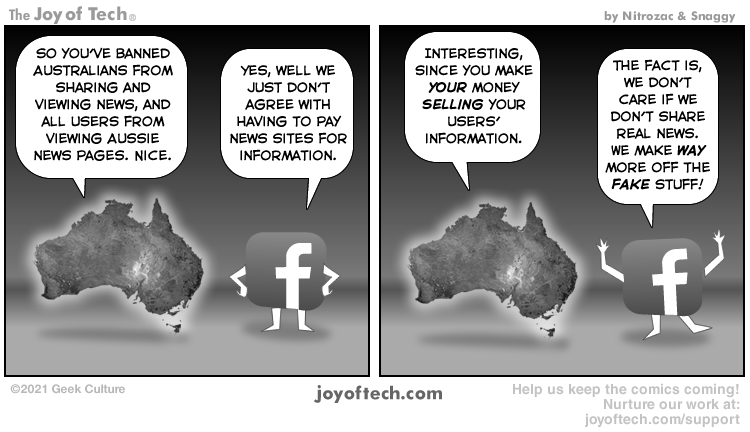
Joy Of Tech®’s ‘Facebook VS Australia!’

via the Comic Noggins of Nitrozac and Snaggy at The Joy of Tech® !

via the Comic Noggins of Nitrozac and Snaggy at The Joy of Tech®!

Permalink

The post Joy Of Tech®’s ‘Facebook VS Australia!’ appeared first on Security Boulevard.

Read More

The post Joy Of Tech®’s ‘Facebook VS Australia!’ appeared first on Malware Devil.


https://malwaredevil.com/2021/02/18/joy-of-techs-facebook-vs-australia/?utm_source=rss&utm_medium=rss&utm_campaign=joy-of-techs-facebook-vs-australia

Hiding in Plain Sight: What the SolarWinds Attack Revealed About Efficacy

Multilayered infiltration involved custom malicious tooling, backdoors, and cloaked code, far beyond the skills of script kiddies.

The post Hiding in Plain Sight: What the SolarWinds Attack Revealed About Efficacy appeared first on Malware Devil.


https://malwaredevil.com/2021/02/18/hiding-in-plain-sight-what-the-solarwinds-attack-revealed-about-efficacy/?utm_source=rss&utm_medium=rss&utm_campaign=hiding-in-plain-sight-what-the-solarwinds-attack-revealed-about-efficacy

Exploit Details Emerge for Unpatched Microsoft Bug

A malicious website or malicious ad can trigger an exploit for the IE zero-day bug, opening the door for data theft and code execution, new analysis notes.
Read More

The post Exploit Details Emerge for Unpatched Microsoft Bug appeared first on Malware Devil.


https://malwaredevil.com/2021/02/18/exploit-details-emerge-for-unpatched-microsoft-bug/?utm_source=rss&utm_medium=rss&utm_campaign=exploit-details-emerge-for-unpatched-microsoft-bug

Wednesday, February 17, 2021

Learn How to Make Your Dream Business a Reality

It is the start of a brand-new year! For many of us, that means, new aspirations, new goals, and new hobbies. Chances are, you or somebody you know, is looking to make a change. And if we learned anything from the year 2020, we learned that life is unpredictable and always changing. The COVID – […]

The post Learn How to Make Your Dream Business a Reality appeared first on Phoenix TS.

The post Learn How to Make Your Dream Business a Reality appeared first on Security Boulevard.

Read More

The post Learn How to Make Your Dream Business a Reality appeared first on Malware Devil.


https://malwaredevil.com/2021/02/17/learn-how-to-make-your-dream-business-a-reality/?utm_source=rss&utm_medium=rss&utm_campaign=learn-how-to-make-your-dream-business-a-reality

2021-02-17 – Pcap and malware for an ISC diary (Trickbot gtag rob13)

Read More

The post 2021-02-17 – Pcap and malware for an ISC diary (Trickbot gtag rob13) appeared first on Malware Devil.


https://malwaredevil.com/2021/02/17/2021-02-17-pcap-and-malware-for-an-isc-diary-trickbot-gtag-rob13/?utm_source=rss&utm_medium=rss&utm_campaign=2021-02-17-pcap-and-malware-for-an-isc-diary-trickbot-gtag-rob13

White House Says 100 Private Sector Orgs Hit in SolarWinds Campaign

Anne Neuberger, a top Biden cybersecurity official, provided an update on the government’s investigation into the massive breach.

The post White House Says 100 Private Sector Orgs Hit in SolarWinds Campaign appeared first on Malware Devil.


https://malwaredevil.com/2021/02/17/white-house-says-100-private-sector-orgs-hit-in-solarwinds-campaign-2/?utm_source=rss&utm_medium=rss&utm_campaign=white-house-says-100-private-sector-orgs-hit-in-solarwinds-campaign-2

White House Says 100 Private Sector Orgs Hit in SolarWinds Campaign

Register for Dark Reading Newsletters

Subscribe to Newsletters

White Papers

Video

Cartoon Contest

Current Issue

image2021 Top Enterprise IT TrendsWe’ve identified the key trends that are poised to impact the IT landscape in 2021. Find out why they’re important and how they will affect you today!
image

Flash Poll

Building the SOC of the Future
Digital transformation, cloud-focused attacks, and a worldwide pandemic. The past year has changed the way business works and the way security teams operate. There is no going back.
image

Twitter Feed

Dark Reading - Bug Report

Bug Report

Enterprise Vulnerabilities
From DHS/US-CERT’s National Vulnerability Database
CVE-2020-13550
PUBLISHED: 2021-02-17

A local file inclusion vulnerability exists in the installation functionality of Advantech WebAccess/SCADA 9.0.1. A specially crafted application can lead to information disclosure. An attacker can send an authenticated HTTP request to trigger this vulnerability.

CVE-2020-13551
PUBLISHED: 2021-02-17

An exploitable local privilege elevation vulnerability exists in the file system permissions of Advantech WebAccess/SCADA 9.0.1 installation. In privilege escalation via PostgreSQL executable, an attacker can either replace binary or loaded modules to execute code with NT SYSTEM privilege.

CVE-2020-13552
PUBLISHED: 2021-02-17

An exploitable local privilege elevation vulnerability exists in the file system permissions of Advantech WebAccess/SCADA 9.0.1 installation. In privilege escalation via multiple service executables in installation folder of WebAccess, an attacker can either replace binary or loaded modules to execu…

CVE-2020-13553
PUBLISHED: 2021-02-17

An exploitable local privilege elevation vulnerability exists in the file system permissions of Advantech WebAccess/SCADA 9.0.1 installation. In webvrpcs Run Key Privilege Escalation in installation folder of WebAccess, an attacker can either replace binary or loaded modules to execute code with NT …

CVE-2020-13555
PUBLISHED: 2021-02-17

An exploitable local privilege elevation vulnerability exists in the file system permissions of Advantech WebAccess/SCADA 9.0.1 installation. In COM Server Application Privilege Escalation, an attacker can either replace binary or loaded modules to execute code with NT SYSTEM privilege.

The post White House Says 100 Private Sector Orgs Hit in SolarWinds Campaign appeared first on Malware Devil.


https://malwaredevil.com/2021/02/17/white-house-says-100-private-sector-orgs-hit-in-solarwinds-campaign/?utm_source=rss&utm_medium=rss&utm_campaign=white-house-says-100-private-sector-orgs-hit-in-solarwinds-campaign

Barbary Pirates and Russian Cybercrime

In 1801, the United States had a small Navy. Thomas Jefferson deployed almost half that Navy—three frigates and a schooner—to the Barbary C...