Malware Devil

Sunday, February 21, 2021

BSidesSF 2020 – Atul Gaikwad’s & Moses Schwartz’ ‘Mistakes Made Integrating Security Scanning Into CI/CD’

Our thanks to BSidesSF and Conference Speakers for publishing their outstanding presentations; which originally appeared at the group’s BSidesSF 2020 Conference, and on the Organization’s YouTube Channel. Additionally, the BSidesSF 2021 Conference will take place on March 6 – 9, 2021 – with no cost to participate. Enjoy!

Permalink

The post BSidesSF 2020 – Atul Gaikwad’s & Moses Schwartz’ ‘Mistakes Made Integrating Security Scanning Into CI/CD’ appeared first on Security Boulevard.

Read More

The post BSidesSF 2020 – Atul Gaikwad’s & Moses Schwartz’ ‘Mistakes Made Integrating Security Scanning Into CI/CD’ appeared first on Malware Devil.


https://malwaredevil.com/2021/02/21/bsidessf-2020-atul-gaikwads-moses-schwartz-mistakes-made-integrating-security-scanning-into-ci-cd/?utm_source=rss&utm_medium=rss&utm_campaign=bsidessf-2020-atul-gaikwads-moses-schwartz-mistakes-made-integrating-security-scanning-into-ci-cd

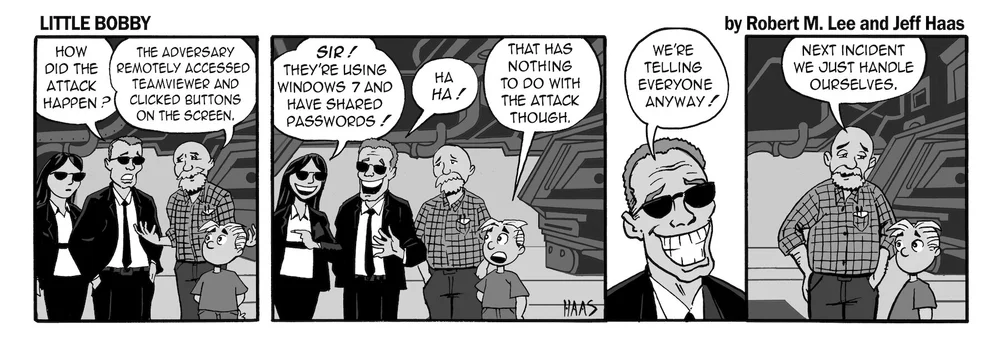
Robert M. Lee’s & Jeff Haas’ Little Bobby Comics – ‘WEEK 317’

via the respected information security capabilities of Robert M. Lee & the superlative illustration talents of Jeff Haas at Little Bobby Comics

via the respected information security capabilities of Robert M. Lee & the superlative illustration talents of Jeff Haas at Little Bobby Comics

Permalink

The post Robert M. Lee’s & Jeff Haas’ Little Bobby Comics – ‘WEEK 317’ appeared first on Security Boulevard.

Read More

The post Robert M. Lee’s & Jeff Haas’ Little Bobby Comics – ‘WEEK 317’ appeared first on Malware Devil.


https://malwaredevil.com/2021/02/21/robert-m-lees-jeff-haas-little-bobby-comics-week-317/?utm_source=rss&utm_medium=rss&utm_campaign=robert-m-lees-jeff-haas-little-bobby-comics-week-317

BSidesSF 2020 – Yu-Jye Tung’s ‘An Effective Approach To Software Obfuscation’

Our thanks to BSidesSF and Conference Speakers for publishing their outstanding presentations; which originally appeared at the group’s BSidesSF 2020 Conference, and on the Organization’s YouTube Channel. Additionally, the BSidesSF 2021 Conference will take place on March 6 – 9, 2021 – with no cost to participate. Enjoy!

Permalink

The post BSidesSF 2020 – Yu-Jye Tung’s ‘An Effective Approach To Software Obfuscation’ appeared first on Security Boulevard.

Read More

The post BSidesSF 2020 – Yu-Jye Tung’s ‘An Effective Approach To Software Obfuscation’ appeared first on Malware Devil.


https://malwaredevil.com/2021/02/21/bsidessf-2020-yu-jye-tungs-an-effective-approach-to-software-obfuscation/?utm_source=rss&utm_medium=rss&utm_campaign=bsidessf-2020-yu-jye-tungs-an-effective-approach-to-software-obfuscation

6 Security Methods to Protect You and Your Customers

The fastest way to lose credibility with your customers is to breach their sense of security. Your clients trust you to protect them and their information whether you are interacting with them online or in person. You must consider their safety as one of the top priorities of every transaction you complete. Often your customers […]

The post 6 Security Methods to Protect You and Your Customers appeared first on TechSpective.

The post 6 Security Methods to Protect You and Your Customers appeared first on Security Boulevard.

Read More

The post 6 Security Methods to Protect You and Your Customers appeared first on Malware Devil.


https://malwaredevil.com/2021/02/21/6-security-methods-to-protect-you-and-your-customers/?utm_source=rss&utm_medium=rss&utm_campaign=6-security-methods-to-protect-you-and-your-customers

Innovation, Agility and Securing the Mobile World in 2021

As the use of mobile devices has become ubiquitous around the world, the cybersecurity imperative for a wide range of devices and mobile apps has become a central issue for most organizations. So how do leading global companies address mobile security for clients and staff? Where have we been over the past few years and..

The post Innovation, Agility and Securing the Mobile World in 2021 appeared first on Security Boulevard.

Read More

The post Innovation, Agility and Securing the Mobile World in 2021 appeared first on Malware Devil.


https://malwaredevil.com/2021/02/21/innovation-agility-and-securing-the-mobile-world-in-2021/?utm_source=rss&utm_medium=rss&utm_campaign=innovation-agility-and-securing-the-mobile-world-in-2021

Saturday, February 20, 2021

Quickie: Extracting HTTP URLs With tshark, (Sat, Feb 20th)

After I posted diary entry “Quickie: tshark & Malware Analysis“, someone asked me how to extract HTTP URLs from capture files with tshark.

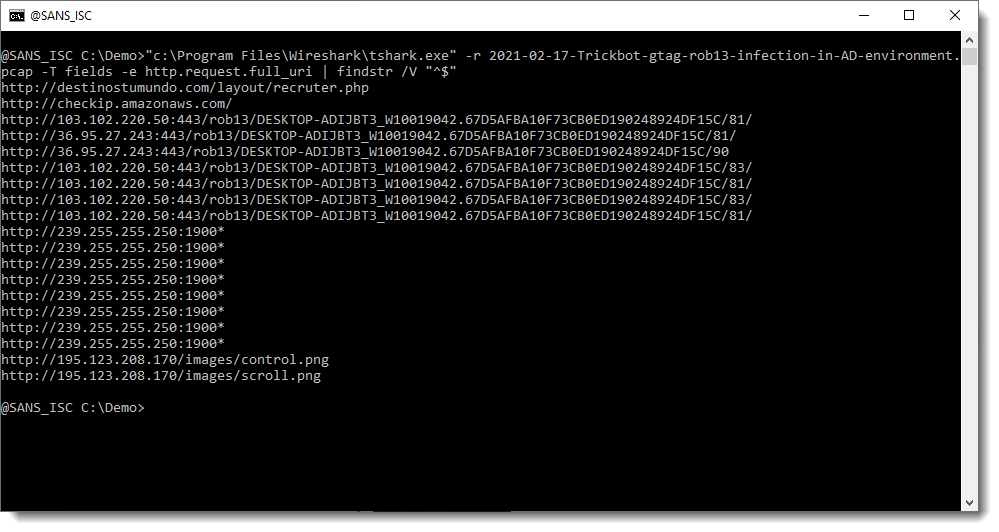
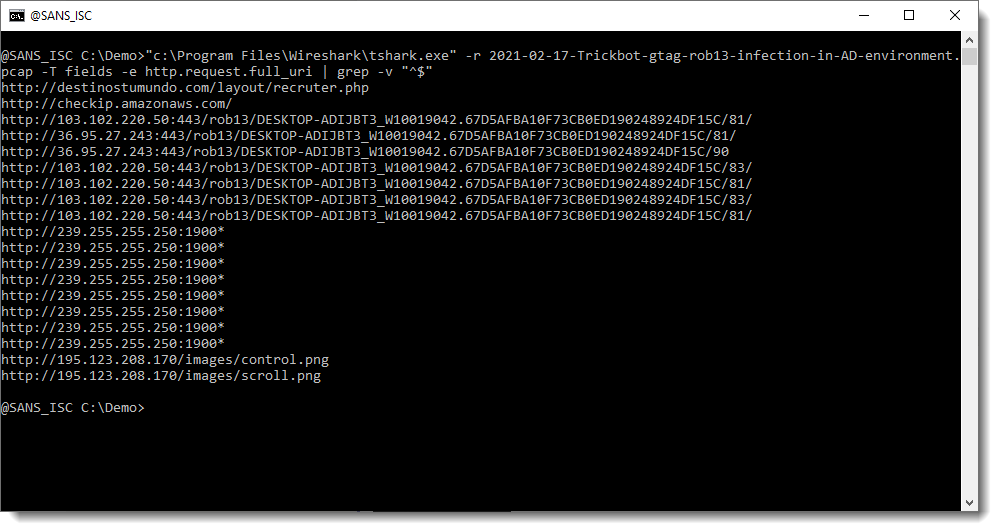
Use option -r to read a capture file, and options -T fields and -e http.request.full_uri to let tshark print the full URL of HTTP requests. Problem is that tshark will also output an empty line for each packet. I filter these out with findstr or grep:

Please post a comment if you know how you can avoid these empty lines with a tshark option.

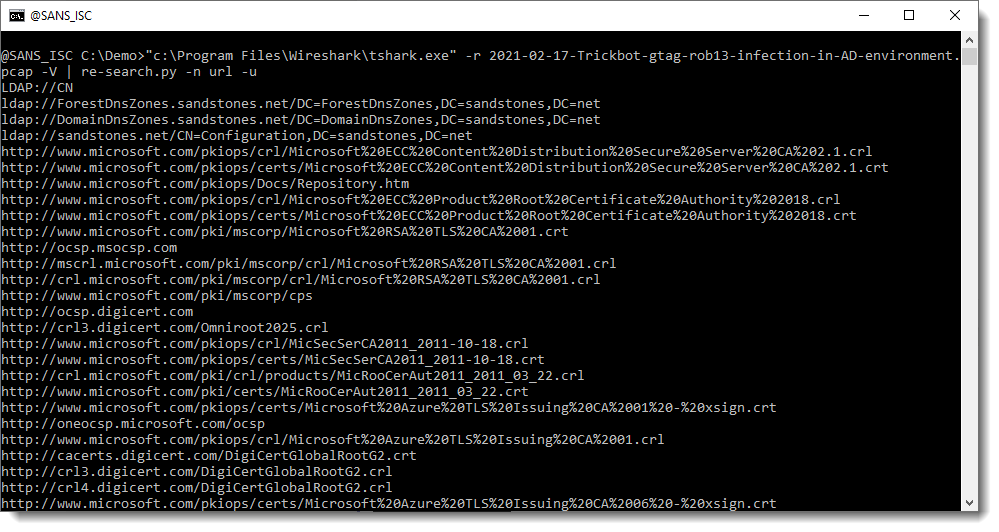
It’s also possible to print the full protocol packet tree with packet details, and search this for URLs with my re-search.py tool. The difference here, is that you will find all kinds op URLs, not only for HTTP requests.

For example, many of the URLs seen in this screenshot, are found inside certificates.


Didier Stevens
Senior handler
Microsoft MVP
blog.DidierStevens.com DidierStevensLabs.com

(c) SANS Internet Storm Center. https://isc.sans.edu Creative Commons Attribution-Noncommercial 3.0 United States License. Read More

The post Quickie: Extracting HTTP URLs With tshark, (Sat, Feb 20th) appeared first on Malware Devil.


https://malwaredevil.com/2021/02/20/quickie-extracting-http-urls-with-tshark-sat-feb-20th/?utm_source=rss&utm_medium=rss&utm_campaign=quickie-extracting-http-urls-with-tshark-sat-feb-20th

BSidesSF 2020 – Sourya Biswas’ ‘How The Coasts Approach Information Security Differently’

Our thanks to BSidesSF and Conference Speakers for publishing their outstanding presentations; which originally appeared at the group’s BSidesSF 2020 Conference, and on the Organization’s YouTube Channel. Additionally, the BSidesSF 2021 Conference will take place on March 6 – 9, 2021 – with no cost to participate. Enjoy!

Permalink

The post BSidesSF 2020 – Sourya Biswas’ ‘How The Coasts Approach Information Security Differently’ appeared first on Security Boulevard.

Read More

The post BSidesSF 2020 – Sourya Biswas’ ‘How The Coasts Approach Information Security Differently’ appeared first on Malware Devil.


https://malwaredevil.com/2021/02/20/bsidessf-2020-sourya-biswas-how-the-coasts-approach-information-security-differently/?utm_source=rss&utm_medium=rss&utm_campaign=bsidessf-2020-sourya-biswas-how-the-coasts-approach-information-security-differently

Weekly News Roundup — February 14 to February 20

Hello and welcome to Sec Soup, where the weekly newsletter has a collection of infosec links to Tools & Tips, Threat Research, and more! The focus trends toward DFIR and threat intelligence, but general information security and hacking-related topics are included as well. This list is not vetted nor intended to be an exhaustive source. Keeping up with the enormous volume of security-related information is a daunting task, but this is my way of filtering the most useful items and improving the signal to noise ratio. Happy Reading!

Industry Reports, News, and Miscellany

Threat Research 

Tools and Tips

Breaches, Government, and Law Enforcement 

Vulnerabilities and Exploits

Read More

The post Weekly News Roundup — February 14 to February 20 appeared first on Malware Devil.


https://malwaredevil.com/2021/02/20/weekly-news-roundup-february-14-to-february-20/?utm_source=rss&utm_medium=rss&utm_campaign=weekly-news-roundup-february-14-to-february-20

XKCD ‘Perseverance Microphones’

via the comic delivery system monikered Randall Munroe resident at XKCD !

via the comic delivery system monikered Randall Munroe resident at XKCD!

Permalink

The post XKCD ‘Perseverance Microphones’ appeared first on Security Boulevard.

Read More

The post XKCD ‘Perseverance Microphones’ appeared first on Malware Devil.


https://malwaredevil.com/2021/02/20/xkcd-perseverance-microphones/?utm_source=rss&utm_medium=rss&utm_campaign=xkcd-perseverance-microphones

BSidesSF 2020 – Jacob Brackett’s ‘RIS-ky Business: Exploiting Medical Information Systems’

Our thanks to BSidesSF and Conference Speakers for publishing their outstanding presentations; which originally appeared at the group’s BSidesSF 2020 Conference, and on the Organization’s YouTube Channel. Additionally, the BSidesSF 2021 Conference will take place on March 6 – 9, 2021 – with no cost to participate. Enjoy!

Permalink

The post BSidesSF 2020 – Jacob Brackett’s ‘RIS-ky Business: Exploiting Medical Information Systems’ appeared first on Security Boulevard.

Read More

The post BSidesSF 2020 – Jacob Brackett’s ‘RIS-ky Business: Exploiting Medical Information Systems’ appeared first on Malware Devil.


https://malwaredevil.com/2021/02/20/bsidessf-2020-jacob-bracketts-ris-ky-business-exploiting-medical-information-systems/?utm_source=rss&utm_medium=rss&utm_campaign=bsidessf-2020-jacob-bracketts-ris-ky-business-exploiting-medical-information-systems

Robot Detained a Google AI Ethicist, Terminated Her

In 2011 at BSidesLV I gave a presentation about the danger of big cloud companies operating like the movie 2001 by Stanley Kubrick — ship automation systems with too much authority detaining and terminating their own crew. That presentation was the genesis of the book I have been writing since that time (and in 2012 … Continue reading Robot Detained a Google AI Ethicist, Terminated Her

The post Robot Detained a Google AI Ethicist, Terminated Her appeared first on Security Boulevard.

Read More

The post Robot Detained a Google AI Ethicist, Terminated Her appeared first on Malware Devil.


https://malwaredevil.com/2021/02/20/robot-detained-a-google-ai-ethicist-terminated-her/?utm_source=rss&utm_medium=rss&utm_campaign=robot-detained-a-google-ai-ethicist-terminated-her

Privacy Bug in Brave Browser Exposes Dark-Web Browsing History of Its Users

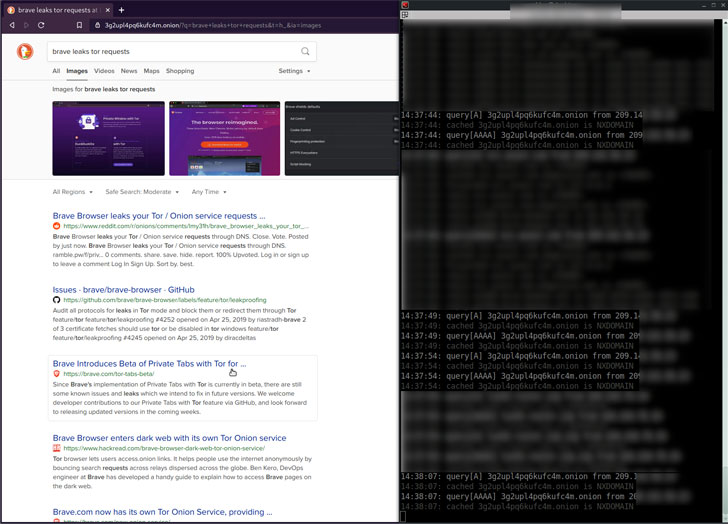
Brave has fixed a privacy issue in its browser that sent queries for .onion domains to public internet DNS resolvers rather than routing them through Tor nodes, thus exposing users’ visits to dark web websites.
The bug was addressed in a hotfix release (V1.20.108) made available yesterday.
Brave ships with a built-in feature called “Private Window with Tor” that integrates the Tor anonymity
Read More

The post Privacy Bug in Brave Browser Exposes Dark-Web Browsing History of Its Users appeared first on Malware Devil.


https://malwaredevil.com/2021/02/20/privacy-bug-in-brave-browser-exposes-dark-web-browsing-history-of-its-users-2/?utm_source=rss&utm_medium=rss&utm_campaign=privacy-bug-in-brave-browser-exposes-dark-web-browsing-history-of-its-users-2

Privacy Bug in Brave Browser Exposes Dark-Web Browsing History of Its Users

Brave has fixed a privacy issue in its browser that sent queries for .onion domains to public internet DNS resolvers rather than routing them through Tor nodes, thus exposing users’ visits to dark web websites.

The bug was addressed in a hotfix release (V1.20.108) made available yesterday.

Brave ships with a built-in feature called “Private Window with Tor” that integrates the Tor anonymity network into the browser, allowing users to access .onion websites, which are hosted on the darknet, without revealing the IP address information to internet service providers (ISPs), Wi-Fi network providers, and the websites themselves. The feature was added in June 2018.

password auditor

This is achieved by relaying users’ requests for an onion URL through a network of volunteer-run Tor nodes. At the same time, it’s worth noting that the feature uses Tor just as a proxy and does not implement most of the privacy protections offered by Tor Browser.

But according to a report first disclosed on Ramble, the privacy-defeating bug in the Tor mode of the browser made it possible to leak all the .onion addresses visited by a user to public DNS resolvers.

“Your ISP or DNS provider will know that a request made to a specific Tor site was made by your IP,” the post read.

DNS requests, by design, are unencrypted, meaning that any request to access .onion sites in Brave can be tracked, thereby defeating the very purpose of the privacy feature.

This issue stems from the browser’s CNAME ad-blocking feature that blocks third-party tracking scripts that use CNAME DNS records to impersonate the first-party script when it is not and avoid detection by content blockers. In doing so, a website can cloak third-party scripts using sub-domains of the main domain, which are then redirected automatically to a tracking domain.

Brave, for its part, already had prior knowledge of the issue, for it was reported on the bug bounty platform HackerOne on January 13, following which the security issue was resolved in a Nightly release 15 days ago.

It appears that the patch was originally scheduled to roll out in Brave Browser 1.21.x, but in the wake of public disclosure, the company said it’s pushing it to the stable version of the browser released yesterday.

Brave browser users can head to Menu on the top right > About Brave to download and install the latest update.

Found this article interesting? Follow THN on Facebook, Twitter and LinkedIn to read more exclusive content we post.

Read More

The post Privacy Bug in Brave Browser Exposes Dark-Web Browsing History of Its Users appeared first on Malware Devil.


https://malwaredevil.com/2021/02/20/privacy-bug-in-brave-browser-exposes-dark-web-browsing-history-of-its-users/?utm_source=rss&utm_medium=rss&utm_campaign=privacy-bug-in-brave-browser-exposes-dark-web-browsing-history-of-its-users

Why is Wikepedia So Racist?

I recently had to explain that someone edited the Wikipedia entry on Woodrow Wilson to falsely claim that the very man who called for a return of the KKK, restarted the KKK as President, and led its rise to humanitarian disasters across America… was opposed to the KKK. Click image to enlarge: This would be … Continue reading Why is Wikepedia So Racist?

The post Why is Wikepedia So Racist? appeared first on Security Boulevard.

Read More

The post Why is Wikepedia So Racist? appeared first on Malware Devil.


https://malwaredevil.com/2021/02/20/why-is-wikepedia-so-racist/?utm_source=rss&utm_medium=rss&utm_campaign=why-is-wikepedia-so-racist

New Hack Lets Attackers Bypass MasterCard PIN by Using Them As Visa Card

Bypass MasterCard PIN

Cybersecurity researchers have disclosed a novel attack that could allow criminals to trick a point of sale terminal into transacting with a victim’s Mastercard contactless card while believing it to be a Visa card.

The research, published by a group of academics from ETH Zurich, builds on a study detailed last September that delved into a PIN bypass attack, permitting bad actors to leverage a victim’s stolen or lost Visa EMV-enabled credit card for making high-value purchases without knowledge of the card’s PIN, and even fool the terminal into accepting unauthentic offline card transactions.

“This is not just a mere card brand mixup but it has critical consequences,” researchers David Basin, Ralf Sasse, and Jorge Toro said. “For example, criminals can use it in combination with the previous attack on Visa to also bypass the PIN for Mastercard cards. The cards of this brand were previously presumed protected by PIN.”

password auditor

Following responsible disclosure, ETH Zurich researchers said Mastercard implemented defense mechanisms at the network level to thwart such attacks. The findings will be presented at the 30th USENIX Security Symposium in August later this year.

A Card Brand Mixup Attack

Just like the previous attack involving Visa cards, the latest research too exploits “serious” vulnerabilities in the widely used EMV contactless protocol, only this time the target is a Mastercard card.

At a high level, this is achieved using an Android application that implements a man-in-the-middle (MitM) attack atop a relay attack architecture, thereby allowing the app to not only initiate messages between the two ends — the terminal and the card — but also to intercept and manipulate the NFC (or Wi-Fi) communications to maliciously introduce a mismatch between the card brand and the payment network.

Put differently, if the card issued is Visa or Mastercard branded, then the authorization request needed for facilitating EMV transactions is routed to the respective payment network. The payment terminal recognizes the brand using a combination of what’s called a primary account number (PAN, also known as the card number) and an application identifier (AID) that uniquely identifies the type of card (e.g., Mastercard Maestro or Visa Electron), and subsequently makes use of the latter to activate a specific kernel for the transaction.

An EMV Kernel is a set of functions that provides all the necessary processing logic and data that is required to perform an EMV contact or contactless transaction.

The attack, dubbed “card brand mixup,” takes advantage of the fact that these AIDs are not authenticated to the payment terminal, thus making it possible to deceive a terminal into activating a flawed kernel, and by extension, the bank that processes payments on behalf of the merchant, into accepting contactless transactions with a PAN and an AID that indicate different card brands.

“The attacker then simultaneously performs a Visa transaction with the terminal and a Mastercard transaction with the card,” the researchers outlined.

The attack, however, necessitates that it meets a number of prerequisites in order to be successful. Notably, the criminals must have access to the victim’s card, besides being able to modify the terminal’s commands and the card’s responses before delivering them to the corresponding recipient. What it doesn’t require is the need to have root privileges or exploit flaws in Android so as to use the proof-of-concept (PoC) application.

But the researchers note a second shortcoming in the EMV contactless protocol could let an attacker “build all necessary responses specified by the Visa protocol from the ones obtained from a non-Visa card, including the cryptographic proofs needed for the card issuer to authorize the transaction.”

Mastercard Adds Countermeasures

Using the PoC Android app, ETH Zurich researchers said they were able to bypass PIN verification for transactions with Mastercard credit and debit cards, including two Maestro debit and two Mastercard credit cards, all issued by different banks, with one of the transactions exceeding $400.

In response to the findings, Mastercard has added a number of countermeasures, including mandating financial institutions to include the AID in the authorization data, allowing card issuers to check the AID against the PAN.

Additionally, the payment network has rolled out checks for other data points present in the authorization request that could be used to identify an attack of this kind, thereby declining a fraudulent transaction right at the outset.

Found this article interesting? Follow THN on Facebook, Twitter and LinkedIn to read more exclusive content we post.

Read More

The post New Hack Lets Attackers Bypass MasterCard PIN by Using Them As Visa Card appeared first on Malware Devil.


https://malwaredevil.com/2021/02/20/new-hack-lets-attackers-bypass-mastercard-pin-by-using-them-as-visa-card-3/?utm_source=rss&utm_medium=rss&utm_campaign=new-hack-lets-attackers-bypass-mastercard-pin-by-using-them-as-visa-card-3

Update To Popular Android App Included Malware Infection

Do you use the popular Android app, “Barcode Scanner?” If so, you’re certainly not alone. The app has racked up more than 10 million downloads on Google’s Play Store and is one of the most popular apps in its class.

It’s a simple, straightforward bit of code that does exactly what it sounds like it does, which is why so many people have come to rely on it over the years.

Unfortunately, Google recently pulled the plug, removing the app from the store after it had been there for years. The reason? Sometime during December 2020, an update to the code saw the injection of malware.

Many users give the apps they use regularly a fairly free hand when it comes to downloading and installing updates. In this case, if you let your Barcode Scanner auto-update, the update installed a nasty Trojan on your smartphone that allows hackers complete control over the device. Not good.

Among other things being reported by users who have been impacted by the update are:

  • Default browser changing
  • New default browser opening with no user intervention and surfing to different, usually ad-intensive pages.
  • And displaying ads touting the supposed benefits of other apps that are thought to contain malware.

As bad as those things are, they’re not as bad as they could be. Had the malware’s owners wished, they could have done significantly more damage than that.

Even so, the app has rightly been pulled from the Play Store and if you have it installed on your phone but haven’t allowed it an update in a while, your best bet is to uninstall it and find an alternative that’s not brimming with malicious code. Kudos to Google for taking swift action, even if it meant the sudden end of an app with a multi-year history as a safe, reliable product.

Used with permission from Article Aggregator

Read More

The post Update To Popular Android App Included Malware Infection appeared first on Malware Devil.


https://malwaredevil.com/2021/02/20/update-to-popular-android-app-included-malware-infection/?utm_source=rss&utm_medium=rss&utm_campaign=update-to-popular-android-app-included-malware-infection

Omegle investigation raises new concerns for kids’ safety

Social media site Omegle is under fire after an investigation found boys using the platform to expose themselves on camera, and adults exposing themselves to minors.

Omegle users are paired with a random stranger who they can socialize with via text or video chat. An investigation by the British Broadcasting Corporation (BBC) found boys and adults exposing themselves on camera, after its founder, Lief K-Brooks, claimed that he had increased moderation efforts months ago.

Just like TikTok, Omegle’s popularity has exploded during the pandemic. According to data collected by Semrush, an online visibility management platform, Omegle has enjoyed a global growth of 65 million visits from January 2020 to January 2021–a staggering 91 percent growth. Users from the US, the UK, India, and Mexico have helped spark interest.

What contributed to Omegle finding fame is that TikTok users started sharing Omegle videos to their friends and followers. TikTok now has a very active #omegle hashtag, which has been viewed 9.4 billion times as of this writing.

MEL magazine’s Magdalene Taylor theorized that it’s the allure of talking to strangers–or being exposed what our parents warned us about: “stranger danger”–that is fuelling this growth. “People wanted to experience what the Internet was like when people were still afraid,” Taylor wrote.


Read: Stranger Danger and the Sociable Child


Investigators from the BBC, who had monitored Omegle for approximately 10 hours, were paired with dozens of other users who appeared to be under 18 years of age, even as young as seven or eight. But within one two hour period they were connected with 12 men performing sexual acts (“a common occurrence”, the BBC noted), eight naked males, and a handful of pornographic ads. In instances wherein BBC investigators were paired with people who appeared to be, or identified themselves as, underaged Omegle user performing sexual acts, the broadcaster says “These instances were not recorded, and we ended both chats swiftly before reporting them to the authorities.”

Keira, a 15-year-old Omegle user from the US told the BBC that “Men being gross is something me and my friends see a lot. It should be better monitored. It’s like the dark web but for everyone.”

Like most popular social media platforms, Omegle has a minimum age limit of 13, and its terms of use say that users under 18 should only use it with a parent or guardian’s permission. It’s home page also features a prominent warning: “Video is monitored. Keep it clean!”. It does not attempt to verify users’ age, however.

Omegle login controls
Omegle’s home page asks users to “Keep it clean”

The Internet Watch Foundation (IWF), an international charity based in the UK that aims to minimize available abuse content against children, expressed concern over what the investigators have unearthed but are not surprised as this follows a trend. According to Chris Hughes, hotline director for IWF, they have found self-abuse material that were recorded from Omegle and distributed by predators online. They also know that such acts happen in a household where parents are present as evidence of background conversations they can hear in the videos.

“I’m absolutely appalled. This sort of site has to take its responsibilities seriously,” says Julian Knight MP, the House of Commons Digital, Culture, Media, and Sport Select Committee chairman in an interview with the BBC. “What we need to do is to have a series of fines and even potentially business interruption if necessary, which would involve the blocking of websites which offer no protection at all to children.”

The saga exposes some familiar fault lines. Age verification is fine in theory but it is difficult to do. Even if it’s implemented effectively it can simply replace one set of potential harms with a different one.

The history of social media suggests that if Omegle tried to tackle the problem by increasing the number of human moderators, it’s unlikely it could ever hire enough to effectively police the platform effectively.

Until (and perhaps even if) these intractable problems find a solution, parents who want to protect their children will have to educate themselves, and their children, to the hazards they might face online.

The post Omegle investigation raises new concerns for kids’ safety appeared first on Malware Devil.


https://malwaredevil.com/2021/02/20/omegle-investigation-raises-new-concerns-for-kids-safety/?utm_source=rss&utm_medium=rss&utm_campaign=omegle-investigation-raises-new-concerns-for-kids-safety

2021-02-19 – Mensagem “Pascholotto” empurra malware

Read More

The post 2021-02-19 – Mensagem “Pascholotto” empurra malware appeared first on Malware Devil.


https://malwaredevil.com/2021/02/20/2021-02-19-mensagem-pascholotto-empurra-malware/?utm_source=rss&utm_medium=rss&utm_campaign=2021-02-19-mensagem-pascholotto-empurra-malware

Friday, February 19, 2021

Cybercrime Undercover: Phishing Attacks Imitating Famous Brands Proliferate

Phishing attacks imitating famous brands is a favorite trick of clever cybercriminals. See the most imitated brands & how to not be fooled!

The post Cybercrime Undercover: Phishing Attacks Imitating Famous Brands Proliferate appeared first on Security Boulevard.

Read More

The post Cybercrime Undercover: Phishing Attacks Imitating Famous Brands Proliferate appeared first on Malware Devil.


https://malwaredevil.com/2021/02/19/cybercrime-undercover-phishing-attacks-imitating-famous-brands-proliferate/?utm_source=rss&utm_medium=rss&utm_campaign=cybercrime-undercover-phishing-attacks-imitating-famous-brands-proliferate

Kia Denies Ransomware Attack as IT Outage Continues

Kia Motors America states there is no evidence its recent systems outage was caused by a ransomware attack.

The post Kia Denies Ransomware Attack as IT Outage Continues appeared first on Malware Devil.


https://malwaredevil.com/2021/02/19/kia-denies-ransomware-attack-as-it-outage-continues-2/?utm_source=rss&utm_medium=rss&utm_campaign=kia-denies-ransomware-attack-as-it-outage-continues-2

Barbary Pirates and Russian Cybercrime

In 1801, the United States had a small Navy. Thomas Jefferson deployed almost half that Navy—three frigates and a schooner—to the Barbary C...