Malware Devil

Monday, February 22, 2021

Zero Trust Framework: A Guide to Implementation

Implementing a Zero Trust framework across an organization requires leading with a “never trust and always verify” mindset to secure your data and resources. Over the years, organizations have increasingly implemented Zero Trust frameworks into their environment because technological advancements…

The post Zero Trust Framework: A Guide to Implementation appeared first on LogRhythm.

The post Zero Trust Framework: A Guide to Implementation appeared first on Security Boulevard.

Read More

The post Zero Trust Framework: A Guide to Implementation appeared first on Malware Devil.


https://malwaredevil.com/2021/02/22/zero-trust-framework-a-guide-to-implementation/?utm_source=rss&utm_medium=rss&utm_campaign=zero-trust-framework-a-guide-to-implementation

Despite COVID-19 pandemic, Imperva reports number of vulnerabilities decreased in 2020

Imperva’s report, The State of Vulnerabilities in 2020 has revealed that unlike in previous years, researchers observed a fall in the number of vulnerabilities last year, even as businesses were compelled to accelerate digital transformation processes due to the COVID-19 pandemic. Vulnerabilities are defined as the gaps or weaknesses that undermine an organization’s IT security […]

The post Despite COVID-19 pandemic, Imperva reports number of vulnerabilities decreased in 2020 appeared first on Blog.

The post Despite COVID-19 pandemic, Imperva reports number of vulnerabilities decreased in 2020 appeared first on Security Boulevard.

Read More

The post Despite COVID-19 pandemic, Imperva reports number of vulnerabilities decreased in 2020 appeared first on Malware Devil.


https://malwaredevil.com/2021/02/22/despite-covid-19-pandemic-imperva-reports-number-of-vulnerabilities-decreased-in-2020-3/?utm_source=rss&utm_medium=rss&utm_campaign=despite-covid-19-pandemic-imperva-reports-number-of-vulnerabilities-decreased-in-2020-3

Discussing Cybersecurity Outcomes (Not Features) with CIOs

As a newcomer within the cybersecurity industry, having joined ActZero/IntelliGO just over eight months ago, there have been many learning opportunities to come my way. One of the biggest lessons when selling technology is learning how to talk to your prospects, and gearing the conversation towards what is important to a prospective buyer. 

In talking to CIOs virtually every day, I have gotten to know their main concerns fairly well, and what seems most compelling to them when it comes to evaluating a cybersecurity service. I have noticed that oftentimes I do not need to get overly technical with fancy features we can supply, but focus instead on the outcomes our MDR service can provide to their organization – to innovatively better their current processes.

Of course, having amazing product features to offer businesses is a crucial part of the selling process.  There would be no selling if there wasn’t any value to be sold. And we have built a pretty great service. Our MDR service provides an enterprise-grade tech stack and expert threat hunters to proactively detect and respond to threats on your behalf, 24/7, using both human and machine learning, to continually improve your security posture. But, as I have learned from many conversations with heads of IT, all these great features don’t mean much if it isn’t something that resonates with the buyer. Your product and service must be a solution to a problem the organization faces, or something that makes their day-to-day work life considerably easier. 

One of the most important lessons my Head of Sales taught me was distinguishing the difference between two buying situations – a leaky roof, or a kitchen renovation. This scenario describes how your prospect sees the product you are selling. If you strive to simply sell features, they are going to see it as a ‘kitchen renovation’ – something that is nice to have, but won’t be an urgent need to purchase.

A leaky roof scenario describes a situation where there is an identifiable area of improvement that must be fixed, and with an outcome we can deliver (like proactive 24/7 threat responses). If you take the time to really understand a CIO’s needs and focus on the outcomes that can be achieved, you can show their leaky roof scenario, even if their leaky roof wasn’t apparent to them prior to that cold outreach to talk about IntelliGO MDR. 

In order to be able to focus your conversation on outcomes with a CIO, or any prospective customer for that matter, I have found that I must first understand their needs. I ask questions, and figure out where there are gaps in their current process or a potential for improvement. There sometimes can be a very apparent outcome the CIO is after. When I spoke with a CIO of a hardware retail company, let’s call him Mr. Hardware, I discovered he was unhappy with his current MDR provider who claimed to respond to threats on their behalf, but fell short of this when they conducted a penetration test. He was looking for a more proactive approach. Sometimes the outcome isn’t so straightforward or directly in the CIO’s mind – You need to ask more questions to help them find what outcomes they care most about when it comes to their security posture. Also, you won’t always be able to shed light on a desired outcome because the customer’s desired state doesn’t fit within your deliverable outcomes… and that is okay, too. Identifying where there’s not a good fit (right now) can be just as important as suspecting that there is one.

Once you have identified the desired outcome, construct a story of how you can link their present situation to their desired outcome. For Mr. Hardware, it was most important to focus on how our MDR platform provides a 24/7 proactive response to any potential threats within his environment. 

The most common outcomes I have heard in my conversation with CIOs typically seem to fall within four main categories: saving money, saving time, peace of mind, and having quick incident response time. 

Saving money, decreasing potential downtime and reducing money lost during a breach are often crucial outcomes for an organization when evaluating a new service. I have found that many small- to medium-sized companies have limited money to spend on cybersecurity efforts, so ensuring that I am transparent on how we can achieve these all desired outcomes, while maintaining a low cost, is critical. 

Within the SMB market particularly, IT teams are often at maximum capacity when it comes to their workload. One CIO within the education field told me there often are “not enough hours in the week”… “if anything happened that needs extra attention, like a security breach, it means working many, many unpaid overtime hours, or neglecting all other projects until things are resolved”. Being able to demonstrate how our cyber experts will manage the monitoring, detection, and response to a threat at any hour of the day not only saves the customer time to focus on other projects, but also their peace of mind to know that they can be protected while their focus is elsewhere – like when they go home at night, over the weekend, or during the holidays. No matter what, our focus remains on securing their environment.

Focusing and delivering on the desired outcomes of your customer is paramount – you need to put the prospective client’s vision above all else in order to drive a good relationship with them. Myself, and the ActZero/IntelliGO team, strive to continually help CIOs and their organizations deliver on their desired security outcomes. 

If you are an outcome-focused IT leader looking to continually improve your security posture, check out our website for more information on how we can help you achieve your desired state.  Or book a meeting with me to learn more about the outcomes our MDR service can provide your organization. 

The post Discussing Cybersecurity Outcomes (Not Features) with CIOs appeared first on Security Boulevard.

Read More

The post Discussing Cybersecurity Outcomes (Not Features) with CIOs appeared first on Malware Devil.


https://malwaredevil.com/2021/02/22/discussing-cybersecurity-outcomes-not-features-with-cios-8/?utm_source=rss&utm_medium=rss&utm_campaign=discussing-cybersecurity-outcomes-not-features-with-cios-8

Despite COVID-19 pandemic, Imperva reports number of vulnerabilities decreased in 2020

Imperva’s report, The State of Vulnerabilities in 2020 has revealed that unlike in previous years, researchers observed a fall in the number of vulnerabilities last year, even as businesses were compelled to accelerate digital transformation processes due to the COVID-19 pandemic. Vulnerabilities are defined as the gaps or weaknesses that undermine an organization’s IT security […]

The post Despite COVID-19 pandemic, Imperva reports number of vulnerabilities decreased in 2020 appeared first on Blog.

The post Despite COVID-19 pandemic, Imperva reports number of vulnerabilities decreased in 2020 appeared first on Security Boulevard.

Read More

The post Despite COVID-19 pandemic, Imperva reports number of vulnerabilities decreased in 2020 appeared first on Malware Devil.


https://malwaredevil.com/2021/02/22/despite-covid-19-pandemic-imperva-reports-number-of-vulnerabilities-decreased-in-2020-2/?utm_source=rss&utm_medium=rss&utm_campaign=despite-covid-19-pandemic-imperva-reports-number-of-vulnerabilities-decreased-in-2020-2

Discussing Cybersecurity Outcomes (Not Features) with CIOs

As a newcomer within the cybersecurity industry, having joined ActZero/IntelliGO just over eight months ago, there have been many learning opportunities to come my way. One of the biggest lessons when selling technology is learning how to talk to your prospects, and gearing the conversation towards what is important to a prospective buyer. 

In talking to CIOs virtually every day, I have gotten to know their main concerns fairly well, and what seems most compelling to them when it comes to evaluating a cybersecurity service. I have noticed that oftentimes I do not need to get overly technical with fancy features we can supply, but focus instead on the outcomes our MDR service can provide to their organization – to innovatively better their current processes.

Of course, having amazing product features to offer businesses is a crucial part of the selling process.  There would be no selling if there wasn’t any value to be sold. And we have built a pretty great service. Our MDR service provides an enterprise-grade tech stack and expert threat hunters to proactively detect and respond to threats on your behalf, 24/7, using both human and machine learning, to continually improve your security posture. But, as I have learned from many conversations with heads of IT, all these great features don’t mean much if it isn’t something that resonates with the buyer. Your product and service must be a solution to a problem the organization faces, or something that makes their day-to-day work life considerably easier. 

One of the most important lessons my Head of Sales taught me was distinguishing the difference between two buying situations – a leaky roof, or a kitchen renovation. This scenario describes how your prospect sees the product you are selling. If you strive to simply sell features, they are going to see it as a ‘kitchen renovation’ – something that is nice to have, but won’t be an urgent need to purchase.

A leaky roof scenario describes a situation where there is an identifiable area of improvement that must be fixed, and with an outcome we can deliver (like proactive 24/7 threat responses). If you take the time to really understand a CIO’s needs and focus on the outcomes that can be achieved, you can show their leaky roof scenario, even if their leaky roof wasn’t apparent to them prior to that cold outreach to talk about IntelliGO MDR. 

In order to be able to focus your conversation on outcomes with a CIO, or any prospective customer for that matter, I have found that I must first understand their needs. I ask questions, and figure out where there are gaps in their current process or a potential for improvement. There sometimes can be a very apparent outcome the CIO is after. When I spoke with a CIO of a hardware retail company, let’s call him Mr. Hardware, I discovered he was unhappy with his current MDR provider who claimed to respond to threats on their behalf, but fell short of this when they conducted a penetration test. He was looking for a more proactive approach. Sometimes the outcome isn’t so straightforward or directly in the CIO’s mind – You need to ask more questions to help them find what outcomes they care most about when it comes to their security posture. Also, you won’t always be able to shed light on a desired outcome because the customer’s desired state doesn’t fit within your deliverable outcomes… and that is okay, too. Identifying where there’s not a good fit (right now) can be just as important as suspecting that there is one.

Once you have identified the desired outcome, construct a story of how you can link their present situation to their desired outcome. For Mr. Hardware, it was most important to focus on how our MDR platform provides a 24/7 proactive response to any potential threats within his environment. 

The most common outcomes I have heard in my conversation with CIOs typically seem to fall within four main categories: saving money, saving time, peace of mind, and having quick incident response time. 

Saving money, decreasing potential downtime and reducing money lost during a breach are often crucial outcomes for an organization when evaluating a new service. I have found that many small- to medium-sized companies have limited money to spend on cybersecurity efforts, so ensuring that I am transparent on how we can achieve these all desired outcomes, while maintaining a low cost, is critical. 

Within the SMB market particularly, IT teams are often at maximum capacity when it comes to their workload. One CIO within the education field told me there often are “not enough hours in the week”… “if anything happened that needs extra attention, like a security breach, it means working many, many unpaid overtime hours, or neglecting all other projects until things are resolved”. Being able to demonstrate how our cyber experts will manage the monitoring, detection, and response to a threat at any hour of the day not only saves the customer time to focus on other projects, but also their peace of mind to know that they can be protected while their focus is elsewhere – like when they go home at night, over the weekend, or during the holidays. No matter what, our focus remains on securing their environment.

Focusing and delivering on the desired outcomes of your customer is paramount – you need to put the prospective client’s vision above all else in order to drive a good relationship with them. Myself, and the ActZero/IntelliGO team, strive to continually help CIOs and their organizations deliver on their desired security outcomes. 

If you are an outcome-focused IT leader looking to continually improve your security posture, check out our website for more information on how we can help you achieve your desired state.  Or book a meeting with me to learn more about the outcomes our MDR service can provide your organization. 

The post Discussing Cybersecurity Outcomes (Not Features) with CIOs appeared first on Security Boulevard.

Read More

The post Discussing Cybersecurity Outcomes (Not Features) with CIOs appeared first on Malware Devil.


https://malwaredevil.com/2021/02/22/discussing-cybersecurity-outcomes-not-features-with-cios-7/?utm_source=rss&utm_medium=rss&utm_campaign=discussing-cybersecurity-outcomes-not-features-with-cios-7

Despite COVID-19 pandemic, Imperva reports number of vulnerabilities decreased in 2020

Imperva’s report, The State of Vulnerabilities in 2020 has revealed that unlike in previous years, researchers observed a fall in the number of vulnerabilities last year, even as businesses were compelled to accelerate digital transformation processes due to the COVID-19 pandemic. Vulnerabilities are defined as the gaps or weaknesses that undermine an organization’s IT security […]

The post Despite COVID-19 pandemic, Imperva reports number of vulnerabilities decreased in 2020 appeared first on Blog.

The post Despite COVID-19 pandemic, Imperva reports number of vulnerabilities decreased in 2020 appeared first on Security Boulevard.

Read More

The post Despite COVID-19 pandemic, Imperva reports number of vulnerabilities decreased in 2020 appeared first on Malware Devil.


https://malwaredevil.com/2021/02/22/despite-covid-19-pandemic-imperva-reports-number-of-vulnerabilities-decreased-in-2020/?utm_source=rss&utm_medium=rss&utm_campaign=despite-covid-19-pandemic-imperva-reports-number-of-vulnerabilities-decreased-in-2020

Discussing Cybersecurity Outcomes (Not Features) with CIOs

As a newcomer within the cybersecurity industry, having joined ActZero/IntelliGO just over eight months ago, there have been many learning opportunities to come my way. One of the biggest lessons when selling technology is learning how to talk to your prospects, and gearing the conversation towards what is important to a prospective buyer. 

In talking to CIOs virtually every day, I have gotten to know their main concerns fairly well, and what seems most compelling to them when it comes to evaluating a cybersecurity service. I have noticed that oftentimes I do not need to get overly technical with fancy features we can supply, but focus instead on the outcomes our MDR service can provide to their organization – to innovatively better their current processes.

Of course, having amazing product features to offer businesses is a crucial part of the selling process.  There would be no selling if there wasn’t any value to be sold. And we have built a pretty great service. Our MDR service provides an enterprise-grade tech stack and expert threat hunters to proactively detect and respond to threats on your behalf, 24/7, using both human and machine learning, to continually improve your security posture. But, as I have learned from many conversations with heads of IT, all these great features don’t mean much if it isn’t something that resonates with the buyer. Your product and service must be a solution to a problem the organization faces, or something that makes their day-to-day work life considerably easier. 

One of the most important lessons my Head of Sales taught me was distinguishing the difference between two buying situations – a leaky roof, or a kitchen renovation. This scenario describes how your prospect sees the product you are selling. If you strive to simply sell features, they are going to see it as a ‘kitchen renovation’ – something that is nice to have, but won’t be an urgent need to purchase.

A leaky roof scenario describes a situation where there is an identifiable area of improvement that must be fixed, and with an outcome we can deliver (like proactive 24/7 threat responses). If you take the time to really understand a CIO’s needs and focus on the outcomes that can be achieved, you can show their leaky roof scenario, even if their leaky roof wasn’t apparent to them prior to that cold outreach to talk about IntelliGO MDR. 

In order to be able to focus your conversation on outcomes with a CIO, or any prospective customer for that matter, I have found that I must first understand their needs. I ask questions, and figure out where there are gaps in their current process or a potential for improvement. There sometimes can be a very apparent outcome the CIO is after. When I spoke with a CIO of a hardware retail company, let’s call him Mr. Hardware, I discovered he was unhappy with his current MDR provider who claimed to respond to threats on their behalf, but fell short of this when they conducted a penetration test. He was looking for a more proactive approach. Sometimes the outcome isn’t so straightforward or directly in the CIO’s mind – You need to ask more questions to help them find what outcomes they care most about when it comes to their security posture. Also, you won’t always be able to shed light on a desired outcome because the customer’s desired state doesn’t fit within your deliverable outcomes… and that is okay, too. Identifying where there’s not a good fit (right now) can be just as important as suspecting that there is one.

Once you have identified the desired outcome, construct a story of how you can link their present situation to their desired outcome. For Mr. Hardware, it was most important to focus on how our MDR platform provides a 24/7 proactive response to any potential threats within his environment. 

The most common outcomes I have heard in my conversation with CIOs typically seem to fall within four main categories: saving money, saving time, peace of mind, and having quick incident response time. 

Saving money, decreasing potential downtime and reducing money lost during a breach are often crucial outcomes for an organization when evaluating a new service. I have found that many small- to medium-sized companies have limited money to spend on cybersecurity efforts, so ensuring that I am transparent on how we can achieve these all desired outcomes, while maintaining a low cost, is critical. 

Within the SMB market particularly, IT teams are often at maximum capacity when it comes to their workload. One CIO within the education field told me there often are “not enough hours in the week”… “if anything happened that needs extra attention, like a security breach, it means working many, many unpaid overtime hours, or neglecting all other projects until things are resolved”. Being able to demonstrate how our cyber experts will manage the monitoring, detection, and response to a threat at any hour of the day not only saves the customer time to focus on other projects, but also their peace of mind to know that they can be protected while their focus is elsewhere – like when they go home at night, over the weekend, or during the holidays. No matter what, our focus remains on securing their environment.

Focusing and delivering on the desired outcomes of your customer is paramount – you need to put the prospective client’s vision above all else in order to drive a good relationship with them. Myself, and the ActZero/IntelliGO team, strive to continually help CIOs and their organizations deliver on their desired security outcomes. 

If you are an outcome-focused IT leader looking to continually improve your security posture, check out our website for more information on how we can help you achieve your desired state.  Or book a meeting with me to learn more about the outcomes our MDR service can provide your organization. 

The post Discussing Cybersecurity Outcomes (Not Features) with CIOs appeared first on Security Boulevard.

Read More

The post Discussing Cybersecurity Outcomes (Not Features) with CIOs appeared first on Malware Devil.


https://malwaredevil.com/2021/02/22/discussing-cybersecurity-outcomes-not-features-with-cios-6/?utm_source=rss&utm_medium=rss&utm_campaign=discussing-cybersecurity-outcomes-not-features-with-cios-6

Discussing Cybersecurity Outcomes (Not Features) with CIOs

As a newcomer within the cybersecurity industry, having joined ActZero/IntelliGO just over eight months ago, there have been many learning opportunities to come my way. One of the biggest lessons when selling technology is learning how to talk to your prospects, and gearing the conversation towards what is important to a prospective buyer. 

In talking to CIOs virtually every day, I have gotten to know their main concerns fairly well, and what seems most compelling to them when it comes to evaluating a cybersecurity service. I have noticed that oftentimes I do not need to get overly technical with fancy features we can supply, but focus instead on the outcomes our MDR service can provide to their organization – to innovatively better their current processes.

Of course, having amazing product features to offer businesses is a crucial part of the selling process.  There would be no selling if there wasn’t any value to be sold. And we have built a pretty great service. Our MDR service provides an enterprise-grade tech stack and expert threat hunters to proactively detect and respond to threats on your behalf, 24/7, using both human and machine learning, to continually improve your security posture. But, as I have learned from many conversations with heads of IT, all these great features don’t mean much if it isn’t something that resonates with the buyer. Your product and service must be a solution to a problem the organization faces, or something that makes their day-to-day work life considerably easier. 

One of the most important lessons my Head of Sales taught me was distinguishing the difference between two buying situations – a leaky roof, or a kitchen renovation. This scenario describes how your prospect sees the product you are selling. If you strive to simply sell features, they are going to see it as a ‘kitchen renovation’ – something that is nice to have, but won’t be an urgent need to purchase.

A leaky roof scenario describes a situation where there is an identifiable area of improvement that must be fixed, and with an outcome we can deliver (like proactive 24/7 threat responses). If you take the time to really understand a CIO’s needs and focus on the outcomes that can be achieved, you can show their leaky roof scenario, even if their leaky roof wasn’t apparent to them prior to that cold outreach to talk about IntelliGO MDR. 

In order to be able to focus your conversation on outcomes with a CIO, or any prospective customer for that matter, I have found that I must first understand their needs. I ask questions, and figure out where there are gaps in their current process or a potential for improvement. There sometimes can be a very apparent outcome the CIO is after. When I spoke with a CIO of a hardware retail company, let’s call him Mr. Hardware, I discovered he was unhappy with his current MDR provider who claimed to respond to threats on their behalf, but fell short of this when they conducted a penetration test. He was looking for a more proactive approach. Sometimes the outcome isn’t so straightforward or directly in the CIO’s mind – You need to ask more questions to help them find what outcomes they care most about when it comes to their security posture. Also, you won’t always be able to shed light on a desired outcome because the customer’s desired state doesn’t fit within your deliverable outcomes… and that is okay, too. Identifying where there’s not a good fit (right now) can be just as important as suspecting that there is one.

Once you have identified the desired outcome, construct a story of how you can link their present situation to their desired outcome. For Mr. Hardware, it was most important to focus on how our MDR platform provides a 24/7 proactive response to any potential threats within his environment. 

The most common outcomes I have heard in my conversation with CIOs typically seem to fall within four main categories: saving money, saving time, peace of mind, and having quick incident response time. 

Saving money, decreasing potential downtime and reducing money lost during a breach are often crucial outcomes for an organization when evaluating a new service. I have found that many small- to medium-sized companies have limited money to spend on cybersecurity efforts, so ensuring that I am transparent on how we can achieve these all desired outcomes, while maintaining a low cost, is critical. 

Within the SMB market particularly, IT teams are often at maximum capacity when it comes to their workload. One CIO within the education field told me there often are “not enough hours in the week”… “if anything happened that needs extra attention, like a security breach, it means working many, many unpaid overtime hours, or neglecting all other projects until things are resolved”. Being able to demonstrate how our cyber experts will manage the monitoring, detection, and response to a threat at any hour of the day not only saves the customer time to focus on other projects, but also their peace of mind to know that they can be protected while their focus is elsewhere – like when they go home at night, over the weekend, or during the holidays. No matter what, our focus remains on securing their environment.

Focusing and delivering on the desired outcomes of your customer is paramount – you need to put the prospective client’s vision above all else in order to drive a good relationship with them. Myself, and the ActZero/IntelliGO team, strive to continually help CIOs and their organizations deliver on their desired security outcomes. 

If you are an outcome-focused IT leader looking to continually improve your security posture, check out our website for more information on how we can help you achieve your desired state.  Or book a meeting with me to learn more about the outcomes our MDR service can provide your organization. 

The post Discussing Cybersecurity Outcomes (Not Features) with CIOs appeared first on Security Boulevard.

Read More

The post Discussing Cybersecurity Outcomes (Not Features) with CIOs appeared first on Malware Devil.


https://malwaredevil.com/2021/02/22/discussing-cybersecurity-outcomes-not-features-with-cios-5/?utm_source=rss&utm_medium=rss&utm_campaign=discussing-cybersecurity-outcomes-not-features-with-cios-5

Discussing Cybersecurity Outcomes (Not Features) with CIOs

As a newcomer within the cybersecurity industry, having joined ActZero/IntelliGO just over eight months ago, there have been many learning opportunities to come my way. One of the biggest lessons when selling technology is learning how to talk to your prospects, and gearing the conversation towards what is important to a prospective buyer. 

In talking to CIOs virtually every day, I have gotten to know their main concerns fairly well, and what seems most compelling to them when it comes to evaluating a cybersecurity service. I have noticed that oftentimes I do not need to get overly technical with fancy features we can supply, but focus instead on the outcomes our MDR service can provide to their organization – to innovatively better their current processes.

Of course, having amazing product features to offer businesses is a crucial part of the selling process.  There would be no selling if there wasn’t any value to be sold. And we have built a pretty great service. Our MDR service provides an enterprise-grade tech stack and expert threat hunters to proactively detect and respond to threats on your behalf, 24/7, using both human and machine learning, to continually improve your security posture. But, as I have learned from many conversations with heads of IT, all these great features don’t mean much if it isn’t something that resonates with the buyer. Your product and service must be a solution to a problem the organization faces, or something that makes their day-to-day work life considerably easier. 

One of the most important lessons my Head of Sales taught me was distinguishing the difference between two buying situations – a leaky roof, or a kitchen renovation. This scenario describes how your prospect sees the product you are selling. If you strive to simply sell features, they are going to see it as a ‘kitchen renovation’ – something that is nice to have, but won’t be an urgent need to purchase.

A leaky roof scenario describes a situation where there is an identifiable area of improvement that must be fixed, and with an outcome we can deliver (like proactive 24/7 threat responses). If you take the time to really understand a CIO’s needs and focus on the outcomes that can be achieved, you can show their leaky roof scenario, even if their leaky roof wasn’t apparent to them prior to that cold outreach to talk about IntelliGO MDR. 

In order to be able to focus your conversation on outcomes with a CIO, or any prospective customer for that matter, I have found that I must first understand their needs. I ask questions, and figure out where there are gaps in their current process or a potential for improvement. There sometimes can be a very apparent outcome the CIO is after. When I spoke with a CIO of a hardware retail company, let’s call him Mr. Hardware, I discovered he was unhappy with his current MDR provider who claimed to respond to threats on their behalf, but fell short of this when they conducted a penetration test. He was looking for a more proactive approach. Sometimes the outcome isn’t so straightforward or directly in the CIO’s mind – You need to ask more questions to help them find what outcomes they care most about when it comes to their security posture. Also, you won’t always be able to shed light on a desired outcome because the customer’s desired state doesn’t fit within your deliverable outcomes… and that is okay, too. Identifying where there’s not a good fit (right now) can be just as important as suspecting that there is one.

Once you have identified the desired outcome, construct a story of how you can link their present situation to their desired outcome. For Mr. Hardware, it was most important to focus on how our MDR platform provides a 24/7 proactive response to any potential threats within his environment. 

The most common outcomes I have heard in my conversation with CIOs typically seem to fall within four main categories: saving money, saving time, peace of mind, and having quick incident response time. 

Saving money, decreasing potential downtime and reducing money lost during a breach are often crucial outcomes for an organization when evaluating a new service. I have found that many small- to medium-sized companies have limited money to spend on cybersecurity efforts, so ensuring that I am transparent on how we can achieve these all desired outcomes, while maintaining a low cost, is critical. 

Within the SMB market particularly, IT teams are often at maximum capacity when it comes to their workload. One CIO within the education field told me there often are “not enough hours in the week”… “if anything happened that needs extra attention, like a security breach, it means working many, many unpaid overtime hours, or neglecting all other projects until things are resolved”. Being able to demonstrate how our cyber experts will manage the monitoring, detection, and response to a threat at any hour of the day not only saves the customer time to focus on other projects, but also their peace of mind to know that they can be protected while their focus is elsewhere – like when they go home at night, over the weekend, or during the holidays. No matter what, our focus remains on securing their environment.

Focusing and delivering on the desired outcomes of your customer is paramount – you need to put the prospective client’s vision above all else in order to drive a good relationship with them. Myself, and the ActZero/IntelliGO team, strive to continually help CIOs and their organizations deliver on their desired security outcomes. 

If you are an outcome-focused IT leader looking to continually improve your security posture, check out our website for more information on how we can help you achieve your desired state.  Or book a meeting with me to learn more about the outcomes our MDR service can provide your organization. 

The post Discussing Cybersecurity Outcomes (Not Features) with CIOs appeared first on Security Boulevard.

Read More

The post Discussing Cybersecurity Outcomes (Not Features) with CIOs appeared first on Malware Devil.


https://malwaredevil.com/2021/02/22/discussing-cybersecurity-outcomes-not-features-with-cios-4/?utm_source=rss&utm_medium=rss&utm_campaign=discussing-cybersecurity-outcomes-not-features-with-cios-4

Discussing Cybersecurity Outcomes (Not Features) with CIOs

As a newcomer within the cybersecurity industry, having joined ActZero/IntelliGO just over eight months ago, there have been many learning opportunities to come my way. One of the biggest lessons when selling technology is learning how to talk to your prospects, and gearing the conversation towards what is important to a prospective buyer. 

In talking to CIOs virtually every day, I have gotten to know their main concerns fairly well, and what seems most compelling to them when it comes to evaluating a cybersecurity service. I have noticed that oftentimes I do not need to get overly technical with fancy features we can supply, but focus instead on the outcomes our MDR service can provide to their organization – to innovatively better their current processes.

Of course, having amazing product features to offer businesses is a crucial part of the selling process.  There would be no selling if there wasn’t any value to be sold. And we have built a pretty great service. Our MDR service provides an enterprise-grade tech stack and expert threat hunters to proactively detect and respond to threats on your behalf, 24/7, using both human and machine learning, to continually improve your security posture. But, as I have learned from many conversations with heads of IT, all these great features don’t mean much if it isn’t something that resonates with the buyer. Your product and service must be a solution to a problem the organization faces, or something that makes their day-to-day work life considerably easier. 

One of the most important lessons my Head of Sales taught me was distinguishing the difference between two buying situations – a leaky roof, or a kitchen renovation. This scenario describes how your prospect sees the product you are selling. If you strive to simply sell features, they are going to see it as a ‘kitchen renovation’ – something that is nice to have, but won’t be an urgent need to purchase.

A leaky roof scenario describes a situation where there is an identifiable area of improvement that must be fixed, and with an outcome we can deliver (like proactive 24/7 threat responses). If you take the time to really understand a CIO’s needs and focus on the outcomes that can be achieved, you can show their leaky roof scenario, even if their leaky roof wasn’t apparent to them prior to that cold outreach to talk about IntelliGO MDR. 

In order to be able to focus your conversation on outcomes with a CIO, or any prospective customer for that matter, I have found that I must first understand their needs. I ask questions, and figure out where there are gaps in their current process or a potential for improvement. There sometimes can be a very apparent outcome the CIO is after. When I spoke with a CIO of a hardware retail company, let’s call him Mr. Hardware, I discovered he was unhappy with his current MDR provider who claimed to respond to threats on their behalf, but fell short of this when they conducted a penetration test. He was looking for a more proactive approach. Sometimes the outcome isn’t so straightforward or directly in the CIO’s mind – You need to ask more questions to help them find what outcomes they care most about when it comes to their security posture. Also, you won’t always be able to shed light on a desired outcome because the customer’s desired state doesn’t fit within your deliverable outcomes… and that is okay, too. Identifying where there’s not a good fit (right now) can be just as important as suspecting that there is one.

Once you have identified the desired outcome, construct a story of how you can link their present situation to their desired outcome. For Mr. Hardware, it was most important to focus on how our MDR platform provides a 24/7 proactive response to any potential threats within his environment. 

The most common outcomes I have heard in my conversation with CIOs typically seem to fall within four main categories: saving money, saving time, peace of mind, and having quick incident response time. 

Saving money, decreasing potential downtime and reducing money lost during a breach are often crucial outcomes for an organization when evaluating a new service. I have found that many small- to medium-sized companies have limited money to spend on cybersecurity efforts, so ensuring that I am transparent on how we can achieve these all desired outcomes, while maintaining a low cost, is critical. 

Within the SMB market particularly, IT teams are often at maximum capacity when it comes to their workload. One CIO within the education field told me there often are “not enough hours in the week”… “if anything happened that needs extra attention, like a security breach, it means working many, many unpaid overtime hours, or neglecting all other projects until things are resolved”. Being able to demonstrate how our cyber experts will manage the monitoring, detection, and response to a threat at any hour of the day not only saves the customer time to focus on other projects, but also their peace of mind to know that they can be protected while their focus is elsewhere – like when they go home at night, over the weekend, or during the holidays. No matter what, our focus remains on securing their environment.

Focusing and delivering on the desired outcomes of your customer is paramount – you need to put the prospective client’s vision above all else in order to drive a good relationship with them. Myself, and the ActZero/IntelliGO team, strive to continually help CIOs and their organizations deliver on their desired security outcomes. 

If you are an outcome-focused IT leader looking to continually improve your security posture, check out our website for more information on how we can help you achieve your desired state.  Or book a meeting with me to learn more about the outcomes our MDR service can provide your organization. 

The post Discussing Cybersecurity Outcomes (Not Features) with CIOs appeared first on Security Boulevard.

Read More

The post Discussing Cybersecurity Outcomes (Not Features) with CIOs appeared first on Malware Devil.


https://malwaredevil.com/2021/02/22/discussing-cybersecurity-outcomes-not-features-with-cios-3/?utm_source=rss&utm_medium=rss&utm_campaign=discussing-cybersecurity-outcomes-not-features-with-cios-3

Discussing Cybersecurity Outcomes (Not Features) with CIOs

As a newcomer within the cybersecurity industry, having joined ActZero/IntelliGO just over eight months ago, there have been many learning opportunities to come my way. One of the biggest lessons when selling technology is learning how to talk to your prospects, and gearing the conversation towards what is important to a prospective buyer. 

In talking to CIOs virtually every day, I have gotten to know their main concerns fairly well, and what seems most compelling to them when it comes to evaluating a cybersecurity service. I have noticed that oftentimes I do not need to get overly technical with fancy features we can supply, but focus instead on the outcomes our MDR service can provide to their organization – to innovatively better their current processes.

Of course, having amazing product features to offer businesses is a crucial part of the selling process.  There would be no selling if there wasn’t any value to be sold. And we have built a pretty great service. Our MDR service provides an enterprise-grade tech stack and expert threat hunters to proactively detect and respond to threats on your behalf, 24/7, using both human and machine learning, to continually improve your security posture. But, as I have learned from many conversations with heads of IT, all these great features don’t mean much if it isn’t something that resonates with the buyer. Your product and service must be a solution to a problem the organization faces, or something that makes their day-to-day work life considerably easier. 

One of the most important lessons my Head of Sales taught me was distinguishing the difference between two buying situations – a leaky roof, or a kitchen renovation. This scenario describes how your prospect sees the product you are selling. If you strive to simply sell features, they are going to see it as a ‘kitchen renovation’ – something that is nice to have, but won’t be an urgent need to purchase.

A leaky roof scenario describes a situation where there is an identifiable area of improvement that must be fixed, and with an outcome we can deliver (like proactive 24/7 threat responses). If you take the time to really understand a CIO’s needs and focus on the outcomes that can be achieved, you can show their leaky roof scenario, even if their leaky roof wasn’t apparent to them prior to that cold outreach to talk about IntelliGO MDR. 

In order to be able to focus your conversation on outcomes with a CIO, or any prospective customer for that matter, I have found that I must first understand their needs. I ask questions, and figure out where there are gaps in their current process or a potential for improvement. There sometimes can be a very apparent outcome the CIO is after. When I spoke with a CIO of a hardware retail company, let’s call him Mr. Hardware, I discovered he was unhappy with his current MDR provider who claimed to respond to threats on their behalf, but fell short of this when they conducted a penetration test. He was looking for a more proactive approach. Sometimes the outcome isn’t so straightforward or directly in the CIO’s mind – You need to ask more questions to help them find what outcomes they care most about when it comes to their security posture. Also, you won’t always be able to shed light on a desired outcome because the customer’s desired state doesn’t fit within your deliverable outcomes… and that is okay, too. Identifying where there’s not a good fit (right now) can be just as important as suspecting that there is one.

Once you have identified the desired outcome, construct a story of how you can link their present situation to their desired outcome. For Mr. Hardware, it was most important to focus on how our MDR platform provides a 24/7 proactive response to any potential threats within his environment. 

The most common outcomes I have heard in my conversation with CIOs typically seem to fall within four main categories: saving money, saving time, peace of mind, and having quick incident response time. 

Saving money, decreasing potential downtime and reducing money lost during a breach are often crucial outcomes for an organization when evaluating a new service. I have found that many small- to medium-sized companies have limited money to spend on cybersecurity efforts, so ensuring that I am transparent on how we can achieve these all desired outcomes, while maintaining a low cost, is critical. 

Within the SMB market particularly, IT teams are often at maximum capacity when it comes to their workload. One CIO within the education field told me there often are “not enough hours in the week”… “if anything happened that needs extra attention, like a security breach, it means working many, many unpaid overtime hours, or neglecting all other projects until things are resolved”. Being able to demonstrate how our cyber experts will manage the monitoring, detection, and response to a threat at any hour of the day not only saves the customer time to focus on other projects, but also their peace of mind to know that they can be protected while their focus is elsewhere – like when they go home at night, over the weekend, or during the holidays. No matter what, our focus remains on securing their environment.

Focusing and delivering on the desired outcomes of your customer is paramount – you need to put the prospective client’s vision above all else in order to drive a good relationship with them. Myself, and the ActZero/IntelliGO team, strive to continually help CIOs and their organizations deliver on their desired security outcomes. 

If you are an outcome-focused IT leader looking to continually improve your security posture, check out our website for more information on how we can help you achieve your desired state.  Or book a meeting with me to learn more about the outcomes our MDR service can provide your organization. 

The post Discussing Cybersecurity Outcomes (Not Features) with CIOs appeared first on Security Boulevard.

Read More

The post Discussing Cybersecurity Outcomes (Not Features) with CIOs appeared first on Malware Devil.


https://malwaredevil.com/2021/02/22/discussing-cybersecurity-outcomes-not-features-with-cios-2/?utm_source=rss&utm_medium=rss&utm_campaign=discussing-cybersecurity-outcomes-not-features-with-cios-2

Discussing Cybersecurity Outcomes (Not Features) with CIOs

As a newcomer within the cybersecurity industry, having joined ActZero/IntelliGO just over eight months ago, there have been many learning opportunities to come my way. One of the biggest lessons when selling technology is learning how to talk to your prospects, and gearing the conversation towards what is important to a prospective buyer. 

In talking to CIOs virtually every day, I have gotten to know their main concerns fairly well, and what seems most compelling to them when it comes to evaluating a cybersecurity service. I have noticed that oftentimes I do not need to get overly technical with fancy features we can supply, but focus instead on the outcomes our MDR service can provide to their organization – to innovatively better their current processes.

Of course, having amazing product features to offer businesses is a crucial part of the selling process.  There would be no selling if there wasn’t any value to be sold. And we have built a pretty great service. Our MDR service provides an enterprise-grade tech stack and expert threat hunters to proactively detect and respond to threats on your behalf, 24/7, using both human and machine learning, to continually improve your security posture. But, as I have learned from many conversations with heads of IT, all these great features don’t mean much if it isn’t something that resonates with the buyer. Your product and service must be a solution to a problem the organization faces, or something that makes their day-to-day work life considerably easier. 

One of the most important lessons my Head of Sales taught me was distinguishing the difference between two buying situations – a leaky roof, or a kitchen renovation. This scenario describes how your prospect sees the product you are selling. If you strive to simply sell features, they are going to see it as a ‘kitchen renovation’ – something that is nice to have, but won’t be an urgent need to purchase.

A leaky roof scenario describes a situation where there is an identifiable area of improvement that must be fixed, and with an outcome we can deliver (like proactive 24/7 threat responses). If you take the time to really understand a CIO’s needs and focus on the outcomes that can be achieved, you can show their leaky roof scenario, even if their leaky roof wasn’t apparent to them prior to that cold outreach to talk about IntelliGO MDR. 

In order to be able to focus your conversation on outcomes with a CIO, or any prospective customer for that matter, I have found that I must first understand their needs. I ask questions, and figure out where there are gaps in their current process or a potential for improvement. There sometimes can be a very apparent outcome the CIO is after. When I spoke with a CIO of a hardware retail company, let’s call him Mr. Hardware, I discovered he was unhappy with his current MDR provider who claimed to respond to threats on their behalf, but fell short of this when they conducted a penetration test. He was looking for a more proactive approach. Sometimes the outcome isn’t so straightforward or directly in the CIO’s mind – You need to ask more questions to help them find what outcomes they care most about when it comes to their security posture. Also, you won’t always be able to shed light on a desired outcome because the customer’s desired state doesn’t fit within your deliverable outcomes… and that is okay, too. Identifying where there’s not a good fit (right now) can be just as important as suspecting that there is one.

Once you have identified the desired outcome, construct a story of how you can link their present situation to their desired outcome. For Mr. Hardware, it was most important to focus on how our MDR platform provides a 24/7 proactive response to any potential threats within his environment. 

The most common outcomes I have heard in my conversation with CIOs typically seem to fall within four main categories: saving money, saving time, peace of mind, and having quick incident response time. 

Saving money, decreasing potential downtime and reducing money lost during a breach are often crucial outcomes for an organization when evaluating a new service. I have found that many small- to medium-sized companies have limited money to spend on cybersecurity efforts, so ensuring that I am transparent on how we can achieve these all desired outcomes, while maintaining a low cost, is critical. 

Within the SMB market particularly, IT teams are often at maximum capacity when it comes to their workload. One CIO within the education field told me there often are “not enough hours in the week”… “if anything happened that needs extra attention, like a security breach, it means working many, many unpaid overtime hours, or neglecting all other projects until things are resolved”. Being able to demonstrate how our cyber experts will manage the monitoring, detection, and response to a threat at any hour of the day not only saves the customer time to focus on other projects, but also their peace of mind to know that they can be protected while their focus is elsewhere – like when they go home at night, over the weekend, or during the holidays. No matter what, our focus remains on securing their environment.

Focusing and delivering on the desired outcomes of your customer is paramount – you need to put the prospective client’s vision above all else in order to drive a good relationship with them. Myself, and the ActZero/IntelliGO team, strive to continually help CIOs and their organizations deliver on their desired security outcomes. 

If you are an outcome-focused IT leader looking to continually improve your security posture, check out our website for more information on how we can help you achieve your desired state.  Or book a meeting with me to learn more about the outcomes our MDR service can provide your organization. 

The post Discussing Cybersecurity Outcomes (Not Features) with CIOs appeared first on Security Boulevard.

Read More

The post Discussing Cybersecurity Outcomes (Not Features) with CIOs appeared first on Malware Devil.


https://malwaredevil.com/2021/02/22/discussing-cybersecurity-outcomes-not-features-with-cios/?utm_source=rss&utm_medium=rss&utm_campaign=discussing-cybersecurity-outcomes-not-features-with-cios

Evolving Risks, Insecure Defaults, Watering Hole Threats: New Research from Accurics Uncovers Developing Sources of Cloud Risk

Pleasanton, CA, February 22, 2021 – Accurics, the cloud cyber resilience specialist, today unveiled its latest research, “Accurics Cloud Cyber Resilience Report,” which highlights security risks identified in cloud native environments. The findings reveal an increased adoption of managed infrastructure services and the emergence of new cloud watering hole attacks. Of all violations identified, 23 percent correspond..

The post Evolving Risks, Insecure Defaults, Watering Hole Threats: New Research from Accurics Uncovers Developing Sources of Cloud Risk appeared first on Security Boulevard.

Read More

The post Evolving Risks, Insecure Defaults, Watering Hole Threats: New Research from Accurics Uncovers Developing Sources of Cloud Risk appeared first on Malware Devil.


https://malwaredevil.com/2021/02/22/evolving-risks-insecure-defaults-watering-hole-threats-new-research-from-accurics-uncovers-developing-sources-of-cloud-risk/?utm_source=rss&utm_medium=rss&utm_campaign=evolving-risks-insecure-defaults-watering-hole-threats-new-research-from-accurics-uncovers-developing-sources-of-cloud-risk

New ‘Silver Sparrow’ Malware Infected Nearly 30,000 Apple Macs

Days after the first malware targeting Apple M1 chips were discovered in the wild, researchers have disclosed yet another previously undetected piece of malicious software that has already infected 29,139 Macs running Intel x86_64 and the iPhone maker’s M1 processors.

However, the ultimate goal of the operation remains something of a conundrum, what with the lack of a next-stage or final payload leaving researchers unsure of its distribution timeline and whether the threat is just under active development.

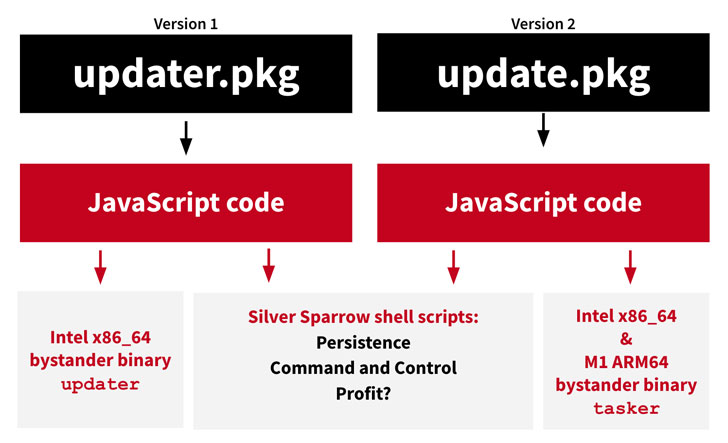
Calling the malware “Silver Sparrow,” cybersecurity firm Red Canary said it identified two different versions of the malware — one compiled only for Intel x86_64 and uploaded to VirusTotal on August 31, 2020 (version 1), and a second variant submitted to the database on January 22 that’s compatible with both Intel x86_64 and M1 ARM64 architectures (version 2).

password auditor

Adding to the mystery, the x86_64 binary, upon execution, simply displays the message “Hello, World!” whereas the M1 binary reads “You did it!,” which the researchers suspect is being used as a placeholder.

“The Mach-O compiled binaries don’t seem to do all that much […] and so we’ve been calling them ‘bystander binaries,'” Red Canary’s Tony Lambert said.

“We have no way of knowing with certainty what payload would be distributed by the malware, if a payload has already been delivered and removed, or if the adversary has a future timeline for distribution,” Lambert added.

The macOS endpoints are located across 153 countries as of February 17, including high volumes of detection in the U.S., the U.K., Canada, France, and Germany, according to data from Malwarebytes.

Despite the difference in the targeting macOS platform, the two samples follow the same modus operandi: using the macOS Installer JavaScript API to execute attack commands by dynamically generating two shell scripts that are written to the target’s file system.

While “agent.sh” executes immediately at the end of the installation to inform an AWS command-and-control (C2) server of a successful installation, “verx.sh” runs once every hour, contacting the C2 server for additional content to download and execute.

Additionally, the malware also comes with the capabilities to completely erase its presence from the compromised host, suggesting the actors associated with the campaign may be motivated by stealth techniques.

In response to the findings, Apple has revoked the binaries that were signed with the Apple Developer ID’s Saotia Seay (v1) and Julie Willey (v2), thus preventing further installations.

Silver Sparrow is the second piece of malware to contain code that runs natively on Apple’s new M1 chip. A Safari adware extension called GoSearch22 was identified last week to have been ported to run on the latest generation of Macs powered by the new processors.

“Though we haven’t observed Silver Sparrow delivering additional malicious payloads yet, its forward-looking M1 chip compatibility, global reach, relatively high infection rate, and operational maturity suggest Silver Sparrow is a reasonably serious threat, uniquely positioned to deliver a potentially impactful payload at a moment’s notice,” Lambert said.

Found this article interesting? Follow THN on Facebook, Twitter and LinkedIn to read more exclusive content we post.

Read More

The post New ‘Silver Sparrow’ Malware Infected Nearly 30,000 Apple Macs appeared first on Malware Devil.


https://malwaredevil.com/2021/02/22/new-silver-sparrow-malware-infected-nearly-30000-apple-macs/?utm_source=rss&utm_medium=rss&utm_campaign=new-silver-sparrow-malware-infected-nearly-30000-apple-macs

A New Book to Learn About Application Security

If you’re just starting out as an application developer or you’re a seasoned developer looking for a good review guide, there’s a new book from Wiley titled “Alice and Bob Learn Application Security” to assist with learning about the fundamentals of application security.

The post A New Book to Learn About Application Security appeared first on K2io.

The post A New Book to Learn About Application Security appeared first on Security Boulevard.

Read More

The post A New Book to Learn About Application Security appeared first on Malware Devil.


https://malwaredevil.com/2021/02/22/a-new-book-to-learn-about-application-security/?utm_source=rss&utm_medium=rss&utm_campaign=a-new-book-to-learn-about-application-security

How to Secure Your Cloud Investment

investment cloud security

Cloud adoption was already a safe bet in 2020, but the pandemic drove a rapid acceleration of this trend last year. Enterprises’ average cloud spend went up 59% from 2018 according to IDG’s 2020 State of Cloud report. That same report found that security is the greatest obstacle organizations are facing when attempting to take..

The post How to Secure Your Cloud Investment appeared first on Security Boulevard.

Read More

The post How to Secure Your Cloud Investment appeared first on Malware Devil.


https://malwaredevil.com/2021/02/22/how-to-secure-your-cloud-investment/?utm_source=rss&utm_medium=rss&utm_campaign=how-to-secure-your-cloud-investment

Mitigating Third-Party Supply Chain Breaches

supply chain foreign made software

The recent SolarWinds data breach was so pervasive it sent shivers through the industry. Who exactly was affected? How deep were the incursions? What are the long-term implications? How will this impact critical areas of the global supply chain? The unfortunate reality is that while the SolarWinds hack was shocking, it shouldn’t have come as..

The post Mitigating Third-Party Supply Chain Breaches appeared first on Security Boulevard.

Read More

The post Mitigating Third-Party Supply Chain Breaches appeared first on Malware Devil.


https://malwaredevil.com/2021/02/22/mitigating-third-party-supply-chain-breaches/?utm_source=rss&utm_medium=rss&utm_campaign=mitigating-third-party-supply-chain-breaches

Framing ZTNA and Security Parameters: Risks, Tenets and Best Practices

The Growing Need for Zero Trust Network Access As we set the stage for wider adoption of Zero Trust Remote Access methodology and solutions, it’s worth a quick look back at the traditional mindset. Traditional perimeters were obviously created on the assumption that all devices and users inside the network or security perimeter could be […]

The post Framing ZTNA and Security Parameters: Risks, Tenets and Best Practices appeared first on CipherCloud.

The post Framing ZTNA and Security Parameters: Risks, Tenets and Best Practices appeared first on Security Boulevard.

Read More

The post Framing ZTNA and Security Parameters: Risks, Tenets and Best Practices appeared first on Malware Devil.


https://malwaredevil.com/2021/02/22/framing-ztna-and-security-parameters-risks-tenets-and-best-practices/?utm_source=rss&utm_medium=rss&utm_campaign=framing-ztna-and-security-parameters-risks-tenets-and-best-practices

Apple’s Safe Browsing Request Proxy, BEC Attacks, LastPass Updates

In episode 161: Apple will start to proxy Safe Browsing requests to hide IP addresses from Google, the rise of Business Email Compromise attacks, and changes to the free version of LastPass. ** Links mentioned on the show ** Apple will proxy Safe Browsing requests to hide iOS users’ IP from Google https://thehackernews.com/2021/02/apple-will-proxy-safe-browsing-requests.html This cybersecurity […]

The post Apple’s Safe Browsing Request Proxy, BEC Attacks, LastPass Updates appeared first on The Shared Security Show.

The post Apple’s Safe Browsing Request Proxy, BEC Attacks, LastPass Updates appeared first on Security Boulevard.

Read More

The post Apple’s Safe Browsing Request Proxy, BEC Attacks, LastPass Updates appeared first on Malware Devil.


https://malwaredevil.com/2021/02/22/apples-safe-browsing-request-proxy-bec-attacks-lastpass-updates/?utm_source=rss&utm_medium=rss&utm_campaign=apples-safe-browsing-request-proxy-bec-attacks-lastpass-updates

CipherCloud Chronicles 9: Docs Journey-Reassuring Data Classification with CipherCloud

Every document’s journey into the cloud world is different. Files containing corporate sensitive data have to be treated with extreme caution because loss of data from a well-orchestrated data breach can incur heavy penalties for the targeted organization, while resulting in loss of credibility.             Previous Next Document’s Journey into […]

The post CipherCloud Chronicles 9: Docs Journey-Reassuring Data Classification with CipherCloud appeared first on CipherCloud.

The post CipherCloud Chronicles 9: Docs Journey-Reassuring Data Classification with CipherCloud appeared first on Security Boulevard.

Read More

The post CipherCloud Chronicles 9: Docs Journey-Reassuring Data Classification with CipherCloud appeared first on Malware Devil.


https://malwaredevil.com/2021/02/22/ciphercloud-chronicles-9-docs-journey-reassuring-data-classification-with-ciphercloud/?utm_source=rss&utm_medium=rss&utm_campaign=ciphercloud-chronicles-9-docs-journey-reassuring-data-classification-with-ciphercloud

Barbary Pirates and Russian Cybercrime

In 1801, the United States had a small Navy. Thomas Jefferson deployed almost half that Navy—three frigates and a schooner—to the Barbary C...