Malware Devil

Monday, March 15, 2021

How your iPhone could tell you if you’re being stalked

The latest iOS beta suggests that Apple’s next big update will include an iPhone feature that warns users about hidden, physical surveillance of their location. The feature detects AirTags, Apple’s answer to trackable fobs made by Tile, and serves to block the potential abuse of the much-rumored product.

While the feature represents great potential, digital surveillance experts said that they were left with more questions than answers, including whether surveilled iPhone users will be pointed to helpful resources after receiving a warning, how the feature will integrate with non-Apple products–if at all–and whether Apple coordinated with any domestic abuse advocates on the actual language included in the warnings.

Erica Olsen, director of Safety Net at the National Network to End Domestic Violence, emphasized the sensitivities of telling anyone–particularly domestic abuse survivors–about unknown surveillance that relies on a hidden device.

“It could be extremely scary to get a notification about a device and have no idea where to start to locate and disable it,” Olsen said. “That’s not to say that it’s a bad thing; it just needs to be thorough.”

Apple did not respond to questions regarding the language of its notifications or about the company’s potential outreach to external domestic abuse advocates in crafting the feature. Members of the Coalition Against Stalkerware–of which Malwarebytes is a founding partner–said they were open to collaborate with Apple on the feature.

New “Item Safety Alerts”

According to 9to5Mac, the latest beta version for iOS 14.5 includes an update to the “Find My” app, which helps users locate iPhones, iPads, iPod Touches, and Mac computers that may have been lost or stolen. Importantly, while each of those devices can run the Find My app for their respective operating systems, it is only the iPhone version of the app–as witnessed in the iOS 14.5 beta–that includes a new setting called “Item Safety Alerts.”

The setting is turned on by default, and, according to Apple blogger and iOS developer Benjamin Mayo, any attempts to turn off the setting will result in a warning that reads:

“The owner of an unknown item will be able to see your location and you will no longer receive notifications when an unknown item is found moving with you.”

As the iOS update is still in beta, there is limited information, and the “notifications” referenced in the Item Safety Alerts advisory have not been revealed. However, the advisory itself reveals the purpose of the alerts: To warn iPhone users in the future about whether separate, unknown devices are being tracked that are in close, frequent proximity to their iPhone.

In theory, this type of surveillance has been possible for years. By abusing the intentions of Apple’s Find My app, a stalker or a domestic abuser could plant a device that can be tracked by Find My, such as an iPhone or an iPod touch, onto a victim and track their movements. But, while this type of location monitoring was possible, it also had some obvious obstacles. One, purchasing a capable device could be expensive, and two, the actual devices that can be tracked are rather easy to find, even to unsuspecting victims. After all, it isn’t every day that someone just happens to find an entirely different phone in their gym bag.

Those obstacles could fade away, though, if Apple follows through on releasing its next, rumored product.

According to multiple tech news outlets, Apple will release physical location-tracking tags in 2021, dubbed “AirTags.” The devices could directly compete with the company Tile, which makes small, physical squares of plastic which can slipped into personal items likes luggage, purses, backpacks, wallets, and other important items that could be lost or stolen.

Unfortunately, the smaller a location-tracking device is, the easier it is to use it against someone without their consent, as revealed by a woman in Houston who said her ex stalked her after planting a Tile device in her car. The woman, who remained anonymous for her safety, told ABC 13 news in an interview:

“It was shocking. In a million years, it never occurred to me that could be possible and instantly everything made sense. I think that’s what’s important that for people who are in a domestic violence situation or stalking situation to know that should be a consideration.”

The iOS 14.5 beta feature, then, makes much more sense when accounting for a potential future with Apple’s AirTags. Malicious users could purchase AirTags and sneak them into a person’s purse or their backpack without their knowledge.

The new “Item Safety Alerts” could curb that type of abuse, though, warning users about unrecognized devices that are located in the same vicinity as their current device, but are not registered through their own Find My app.

Important considerations for Apple

Several representatives from members of the Coalition Against Stalkerware said that Apple’s new feature has real potential to help users, but without more details, many questions remain.

Tara Hairston, head of public affairs for North America at Kaspersky, said she wanted to know more about how Find My could work with third-party devices, so that clandestine surveillance could be detected beyond the use of Apple’s rumored AirTags, and beyond the use of an iPhone, too. According to 9to5Mac, the updates to Find My include a new “Item” tab to track third-party accessories, but questions from Malwarebytes Labs to Apple about the extent of that cross-functionality went unanswered.

Hairston also expressed concerns about the development of the feature.

“A question I have is whether Apple has discussed the alert’s language with professionals and advocates that work with domestic violence survivors to ensure that it is not re-traumatizing for them,” Hairstone said. “Furthermore, does Apple plan to provide information regarding what someone should do if they confirm that they are being tracked, especially if they are a survivor? Accounting for these types of safety considerations would result in more holistic support for vulnerable populations.”

These are routine considerations for the Coalition Against Stalkerware, which was intentionally built as a cross-disciplinary group to help protect users from the threats of stalkerware. For the same reason that the coalition’s domestic violence advocates are not the experts on technological sample detection, the coalition’s cybersecurity vendors are not the experts on protecting survivors from domestic abuse. But when the members work together, they can do informed, great things, like developing a new way to detect stalkerware which can happen outside of a compromised device–a critical need that many cybersecurity vendors did not know about until joining the coalition.

At Malwarebytes Labs, we await the release of Apple’s feature, and we are eager to learn about the work that went into it. Any company taking steps to limit non-consensual surveillance is a good thing. Let’s work together to make it great.

The post How your iPhone could tell you if you’re being stalked appeared first on Malware Devil.


https://malwaredevil.com/2021/03/15/how-your-iphone-could-tell-you-if-youre-being-stalked/?utm_source=rss&utm_medium=rss&utm_campaign=how-your-iphone-could-tell-you-if-youre-being-stalked

Importance of Culture, Engaging The Board, & 8 New Roles! – BSW #209

This week, in the Leadership and Communications section, The importance of culture in digital transformation, 4 ways to keep the cybersecurity conversation going after the crisis has passed, 8 new roles today’s security team needs, and more!
Visit https://www.securityweekly.com/bsw for all the latest episodes!
Show Notes: https://securityweekly.com/bsw209

The post Importance of Culture, Engaging The Board, & 8 New Roles! – BSW #209 appeared first on Malware Devil.


https://malwaredevil.com/2021/03/15/importance-of-culture-engaging-the-board-8-new-roles-bsw-209/?utm_source=rss&utm_medium=rss&utm_campaign=importance-of-culture-engaging-the-board-8-new-roles-bsw-209

The Nine Cybersecurity Habits – George Finney – BSW #209

In 1989, Stephen Covey first published “The 7 Habits of Highly Effective People,” empowering and inspiring leaders for over 25 years. Is there an equivalent or new set of habits for CISOs? George Finney, Chief Security Officer at Southern Methodist University, joins Business Security Weekly to discuss the Nine Cybersecurity Habits.
Visit https://www.securityweekly.com/bsw for all the latest episodes!
Show Notes: https://securityweekly.com/bsw209

The post The Nine Cybersecurity Habits – George Finney – BSW #209 appeared first on Malware Devil.


https://malwaredevil.com/2021/03/15/the-nine-cybersecurity-habits-george-finney-bsw-209/?utm_source=rss&utm_medium=rss&utm_campaign=the-nine-cybersecurity-habits-george-finney-bsw-209

Finding Metasploit & Cobalt Strike URLs, (Mon, Mar 15th)

Metasploit and Cobalt Strike generate shellcode for http(s) shells. The URLs found in this shellcode have a path that consist of 4 random alphanumeric characters. But they are not completely random: their 8-bit checksum is a member of a small set of constants.

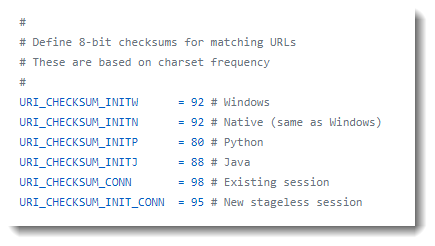
The 8-bit checksum is the sum of the ASCII value of the 4 characters of the path. Take the least significant byte of the sum, and compare it with this table:

If the checksum is equal to one of these values, the URL could be generated by Metasploit or Cobalt Strike.

I illustrate this with Brad’s capture file of Qakbot & Cobalt Strike traffic and my tool metatool.py.

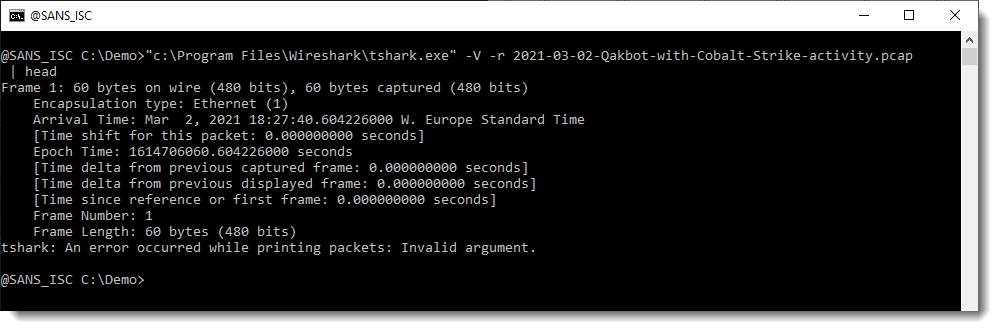
Wireshark’s command-line tool tshark is what I used to produce a complete packet tree for each packet. The URLs we are looking for will be somewhere in this output:

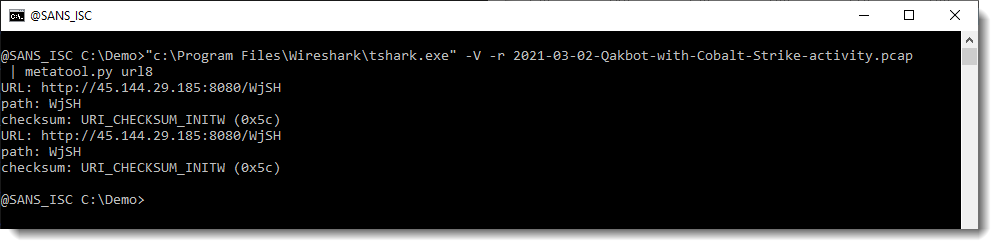
And then I pipe this output into my metatool.py with command url8:

metatool found 2 (identical) URLs whose path has an 8-bit checksum equal to 0x5C (92), or URI_CHECKSUM_INITW, i.e. the 8-bit checksum for a Windows payload.


Didier Stevens
Senior handler
Microsoft MVP
blog.DidierStevens.com DidierStevensLabs.com

(c) SANS Internet Storm Center. https://isc.sans.edu Creative Commons Attribution-Noncommercial 3.0 United States License. Read More

The post Finding Metasploit & Cobalt Strike URLs, (Mon, Mar 15th) appeared first on Malware Devil.


https://malwaredevil.com/2021/03/15/finding-metasploit-cobalt-strike-urls-mon-mar-15th/?utm_source=rss&utm_medium=rss&utm_campaign=finding-metasploit-cobalt-strike-urls-mon-mar-15th

DDoS’s Evolution Doesn’t Require a Security Evolution

They may have grown in sophistication, with more widespread consequences, yet today’s distributed denial-of-service attacks can still be fought with conventional tools.
(Image: Alexey Novikov via Adobe Stock)

(Image: Alexey Novikov via Adobe Stock)

Distributed denial-of-service (DDoS) attacks that take down online systems are nearly as old as the public Internet. But over the years, they have morphed and evolved into larger and more destructive forms — increasingly focused on monetization. Today, as organizations expand partnerships and supply chains — and with employees working from home due to the pandemic — the stakes are higher than ever.

“DDoS attacks have grown in sophistication as well as in bandwidth and throughput,” says Roland Dobbins, principal engineer for network performance firm NetScout. “We see new DDoS vectors discovered or developed by more skilled attackers, more rapidly weaponized, incorporated into DDoS-for-hire services, and made accessible to anyone who can click a mouse and is intent on wreaking havoc.”

However, the fundamental techniques used to deliver a DDoS attack haven’t changed much, adds Carlos Morales, CTO at network analysis and cybersecurity firm Neustar.

“But how they are used and how well they can be customized to the victim certainly has,” he says.

For example, dozens of Mirai variants have resulted in millions of Internet of Things (IoT) devices being compromised and used to generate botnets, along with mature booter and stressor services, he notes.

Yet, contrary to popular belief, today’s DDoS attacks are neither particularly surgical nor precise. In many cases, the collateral impact is greater than the damage to the intended target.

“Shared Internet infrastructure, cloud resources, supporting ancillary infrastructure such as DNS servers, and bystander traffic are examples of resources that can be disrupted by DDoS attacks, thus greatly magnifying their impact,” Dobbins explains.

How Attack Methods Have Changed
The idea of monetizing DDoS attacks dates back to the 1990s. But the rise of DDoS-for-hire services and cryptocurrencies has radically changed things.

“It’s never been easier for non-specialists to become DDoS extortionists,” Dobbins explains.

This has led to a sharp uptick in well-organized, prolific, and high-profile DDoS extortion campaigns. Today, cybercrime groups deliver ransom demands in emails that threaten targets with DDoS attacks. Most of these are large attacks above 500 gigabytes per second, and a few top out at 2 terabytes per second. Ransom demands may hit 20 Bitcoin (approximately $1 million).

Attacks that revolve around ideological conflicts, geopolitical disputes, personal revenge, and other factors haven’t disappeared. But the focus on monetization has led attackers to increasingly target Internet service providers, software-as-a-service firms and hosting/virtual private server/infrastructure providers. This includes wireless and broadband companies.

“We’ve seen the DDoS attacker base both broaden and shift toward an even younger demographic,” Dobbins says.

According to Neustar’s Morales, reflection and amplification attacks continue to be the most prominent because of their inherent anonymity and ability to reach very high bandwidth without requiring a lot of attacking hosts. Applications susceptible to a reflection attack are routinely discovered.

“So there are now dozens for attackers to choose from, although DNS and TCP SYN reflection remain the most impactful because they cannot be easily filtered,” Morales notes.

In July 2020, the FBI issued an alert that attackers are using common network protocols like ARMS (Apple Remote Management Services), WS-DD (Web Services Dynamic Discovery), and CoAP (Constrained Application Protocol) to initiate DDoS reflection and amplification attacks. However, the agency cautioned that disabling these services could cause a loss in business productivity and connectivity.

Attackers are doing more reconnaissance while ratcheting up the number of attacks.

“We have seen a sharp increase in the number of attack vectors per attack and the targeting of attacks to a customer’s specific environment,” Morales says.

In September 2020, Neustar reported that 4.83 million DDoS attacks took place in the first half of 2020. This represented an increase of 151% over the same period from 2019. Incredibly, one attack lasted five days and 18 hours.

Mitigating an Attack Is Complicated
Conventional tools for battling DDoS attacks are particularly effective in the current environment. The complex and highly distributed nature of today’s botnet attacks combined with huge traffic volumes and spoofed data make it difficult, if not impossible, to trace the source. For instance, botnets connected to a command-and-control (C&C) system can be located anywhere, and many device owners aren’t even aware that their device has been compromised.

Internet-facing servers that inadvertently respond to spoofed requests further complicate things.

“The actual attackers may connect to the C&C layer, but may do so over anonymous proxy networks like TOR,” Morales explains.

As a result, organizations must work with a DDoS mitigation provider that has deep visibility into IT and Internet infrastructure — and can collaborate with peers, customers, and transit providers to further trace spoofed DDoS attack traffic.

Flow telemetry-based monitoring and analysis is typically used to detect, classify, and trace back DDoS attack traffic to its point of origin. It can identify bot behavior at the peering, customer aggregation, and/or transit edges, Dobbins notes. It’s critical to ascertain whether an attack is taking place based on known patterns or whether there’s simply a big uptick in legitimate traffic. Once there’s an understanding of the attack pattern, the provider can use tools to filter and drop malicious bot traffic, intelligently route traffic, and adapt the network to better analyze traffic by looking for specific clues, such as threatening IP blocks or the point of origin.

Preparation is key, Dobbins says. This includes having a holistic DDoS defense plan in place, keeping it updated, and testing the framework at least once per quarter. A service provider must have the tools, expertise, and scale to detect and analyze an attack and automate the response, including managing ancillary services such as DNS. Without a defense framework, “it may take hours to contract with an outside service on an emergency basis,” Dobbins warns. What’s more, that’s just the starting point. It may require additional hours or possibly even days to regain control of the infrastructure,” he says.

After an attack, it’s wise to conduct a postmortem and understand what went well and what could be improved. It’s also important to report an incident to the FBI or other relevant law enforcement agency — even if it’s not a legal requirement.

Says Morales: “It’s about being a good citizen. It’s good hygiene.”

Samuel Greengard writes about business, technology, and cybersecurity for numerous magazines and websites. He is author of the books “The Internet of Things” and “Virtual Reality” (MIT Press). View Full Bio

Recommended Reading:

Comment |

Email This |

Print |

RSS

More Insights

Webcasts
More Webcasts

The post DDoS’s Evolution Doesn’t Require a Security Evolution appeared first on Malware Devil.


https://malwaredevil.com/2021/03/15/ddoss-evolution-doesnt-require-a-security-evolution-2/?utm_source=rss&utm_medium=rss&utm_campaign=ddoss-evolution-doesnt-require-a-security-evolution-2

DDoS’s Evolution Doesn’t Require a Security Evolution

They may have grown in sophistication, with more widespread consequences, yet today’s distributed denial-of-service attacks can still be fought with conventional tools.

The post DDoS’s Evolution Doesn’t Require a Security Evolution appeared first on Malware Devil.


https://malwaredevil.com/2021/03/15/ddoss-evolution-doesnt-require-a-security-evolution/?utm_source=rss&utm_medium=rss&utm_campaign=ddoss-evolution-doesnt-require-a-security-evolution

Buffalo Public Schools Cancel Classes Due to Ransomware

Register for Dark Reading Newsletters

Subscribe to Newsletters

White Papers

Video

Cartoon Contest

Current Issue

image2021 Top Enterprise IT TrendsWe’ve identified the key trends that are poised to impact the IT landscape in 2021. Find out why they’re important and how they will affect you today!
image

Flash Poll

How Enterprises are Developing Secure Applications
Recent breaches of third-party apps are driving many organizations to think harder about the security of their off-the-shelf software as they continue to move left in secure software development practices.
image

Twitter Feed

Dark Reading - Bug Report

Bug Report

Enterprise Vulnerabilities
From DHS/US-CERT’s National Vulnerability Database
CVE-2020-29553
PUBLISHED: 2021-03-15

The Scheduler in Grav CMS through 1.7.0-rc.17 allows an attacker to execute a system command by tricking an admin into visiting a malicious website (CSRF).

CVE-2021-23879
PUBLISHED: 2021-03-15

Unquoted service path vulnerability in McAfee Endpoint Product Removal (EPR) Tool prior to 21.2 allows local administrators to execute arbitrary code, with higher-level privileges, via execution from a compromised folder. The tool did not enforce and protect the execution path. Local admin privilege…

CVE-2021-3150
PUBLISHED: 2021-03-15

A cross-site scripting (XSS) vulnerability on the Delete Personal Data page in Cryptshare Server before 4.8.0 allows an attacker to inject arbitrary web script or HTML via the user name. The issue is fixed with the version 4.8.1

CVE-2021-28363
PUBLISHED: 2021-03-15

The urllib3 library 1.26.x before 1.26.4 for Python omits SSL certificate validation in some cases involving HTTPS to HTTPS proxies. The initial connection to the HTTPS proxy (if an SSLContext isn’t given via proxy_config) doesn’t verify the hostname of the certificate. This means certificates for d…

CVE-2021-27890
PUBLISHED: 2021-03-15

SQL Injection vulnerablity in MyBB before 1.8.26 via theme properties included in theme XML files.

The post Buffalo Public Schools Cancel Classes Due to Ransomware appeared first on Malware Devil.


https://malwaredevil.com/2021/03/15/buffalo-public-schools-cancel-classes-due-to-ransomware-2/?utm_source=rss&utm_medium=rss&utm_campaign=buffalo-public-schools-cancel-classes-due-to-ransomware-2

Buffalo Public Schools Cancel Classes Due to Ransomware

The post Buffalo Public Schools Cancel Classes Due to Ransomware appeared first on Malware Devil.


https://malwaredevil.com/2021/03/15/buffalo-public-schools-cancel-classes-due-to-ransomware/?utm_source=rss&utm_medium=rss&utm_campaign=buffalo-public-schools-cancel-classes-due-to-ransomware

Be Prepared for Anything with EDRP

Recently, a historic snowstorm hit in the south affecting millions of people throughout Mississippi, Louisiana, Kentucky, West Virginia and Texas. Areas not usually accustomed to elements associated with snowstorms including freezing temperatures, snow and ice were devastated by the affects. An article by, The New York Times titled, “Texas Winter Snowstorm: What to Know”, detailed […]

The post Be Prepared for Anything with EDRP appeared first on Phoenix TS.

The post Be Prepared for Anything with EDRP appeared first on Security Boulevard.

Read More

The post Be Prepared for Anything with EDRP appeared first on Malware Devil.


https://malwaredevil.com/2021/03/15/be-prepared-for-anything-with-edrp/?utm_source=rss&utm_medium=rss&utm_campaign=be-prepared-for-anything-with-edrp

Another S3 Bucket Leads to Breach of 50k Patient Records

A privacy advocate at Comparitech reported on the discovery of over 50,000 records stored on two publicly accessible AWS S3 […]

The post Another S3 Bucket Leads to Breach of 50k Patient Records appeared first on Sonrai Security.

The post Another S3 Bucket Leads to Breach of 50k Patient Records appeared first on Security Boulevard.

Read More

The post Another S3 Bucket Leads to Breach of 50k Patient Records appeared first on Malware Devil.


https://malwaredevil.com/2021/03/15/another-s3-bucket-leads-to-breach-of-50k-patient-records/?utm_source=rss&utm_medium=rss&utm_campaign=another-s3-bucket-leads-to-breach-of-50k-patient-records

Microsoft Exchange Server Remote Code Execution (RCE) Vulnerability

The post Microsoft Exchange Server Remote Code Execution (RCE) Vulnerability appeared first on Digital Defense, Inc..

The post Microsoft Exchange Server Remote Code Execution (RCE) Vulnerability appeared first on Security Boulevard.

Read More

The post Microsoft Exchange Server Remote Code Execution (RCE) Vulnerability appeared first on Malware Devil.


https://malwaredevil.com/2021/03/15/microsoft-exchange-server-remote-code-execution-rce-vulnerability/?utm_source=rss&utm_medium=rss&utm_campaign=microsoft-exchange-server-remote-code-execution-rce-vulnerability

CISA Updates Microsoft Exchange Advisory to Include China Chopper

US officials warn organizations of China Chopper Web shells as new data sheds light on how the Exchange Server exploits have grown.

US government officials have updated their guidance on the Microsoft Exchange Server flaws to include seven China Chopper Web shells linked to successful attacks against vulnerable servers.

The Department of Homeland Security’s Cybersecurity & Infrastructure Security Agency (CISA) has provided ongoing updates to its Mitigate Microsoft Exchange Server Vulnerabilities webpage since Microsoft released out-of-band security updates for four Exchange Server flaws on March 2. In the following weeks, attackers have begun to scan for and exploit the bugs in target organizations around the world.

On March 13, CISA updated its guidance to provide seven Malware Analysis Reports (MARs), each of which identifies a China Chopper Web shell associated with vulnerability exploitation in Microsoft Exchange Servers. After an attacker successfully exploits a target server to gain initial access in these intrusions, they typically upload a Web shell to enable remote administration.

Web shells serve several purposes in cyberattacks. Beyond achieving remote admin, attackers can use these to exfiltrate sensitive data and credentials or upload additional malware to further their activity on the network. Web shells can be used to issue commands to hosts inside the network without direct Internet access, or they can be used as command-and-control infrastructure — example, as a botnet or as support to compromise more external networks.

China Chopper is a Web shell widely observed in these ongoing attacks by Cynet, Palo Alto Networks’ Unit 42, Red Canary, and other security companies watching the threat. It’s a lightweight, one-line script that has been used by several attack groups in recent years.

Researchers with SecurityScorecard observed two types of China Chopper in these recent attacks, they explain in a blog post. The second, they say, seems to indicate an evolution in the attack techniques — perhaps to ensure the file name isn’t exposed in the Offline Address Book (OAB) file, to let attackers upload multiple files, or to let them randomly create a file name.

“The fact that China Chopper is a tool used by certain [advanced persistent threat] groups and the fact that China Chopper was specifically used to attack the vulnerable Microsoft services leads us to believe that additional APT groups are targeting these vulnerabilities,” Cynet researchers report. It has become clear that several groups are exploiting these flaws, some before a patch was released.

CISA and some private firms tracking the attacks note that China Chopper is not the only Web shell in use. SecurityScorecard found other Web shell code designed to check if security tools from FireEye, CrowdStrike, and Carbon Black were present on a network, a sign that attackers may be collecting intelligence to learn about target environments and attempt to deploy more malware.

In addition to the MARs published over the weekend, CISA has also added information on the ransomware activity tied to the exploitation of vulnerable Exchange servers. Microsoft last week said it’s tracking a form of ransomware called DearCry targeting compromised servers.

Attacks Grow Tenfold, Researchers Report
As analysts continue to track and report on these attacks, a larger picture has emerged of where these flaws are being exploited and how fast the activity is growing. Check Point Research has observed the number of attempted attacks quickly grow from 700 on March 11, 2021, to more than 7,200 on March 15.

The most heavily targeted country is the United States, which accounts for 17% of all exploit attempts, followed by Germany (6%), the United Kingdom (5%), the Netherlands (5%), and Russia (4%). Government and military is the most targeted sector, at 23% of all attempts, followed by manufacturing (15%), banking and financial services (14%), software vendors (7%), and healthcare (6%).

It remains unclear just how many organizations have been targeted with these exploits. ESET researchers have detected Web shells on more than 5,000 email servers as of March 10; so far, high-profile victims include the Norwegian Parliament and the European Banking Authority. Some reports indicate as many as 30,000 organizations in the US could potentially be affected.

Patching is underway, but vulnerable businesses still have work to do. In an update published March 12, Microsoft reported about 82,000 Exchange servers need to be updated. This marks a significant drop from its count of more than 100,000 vulnerable servers on March 9.

Kelly Sheridan is the Staff Editor at Dark Reading, where she focuses on cybersecurity news and analysis. She is a business technology journalist who previously reported for InformationWeek, where she covered Microsoft, and Insurance & Technology, where she covered financial … View Full Bio

Recommended Reading:

Comment |

Email This |

Print |

RSS

More Insights

Webcasts
More Webcasts

The post CISA Updates Microsoft Exchange Advisory to Include China Chopper appeared first on Malware Devil.


https://malwaredevil.com/2021/03/15/cisa-updates-microsoft-exchange-advisory-to-include-china-chopper-2/?utm_source=rss&utm_medium=rss&utm_campaign=cisa-updates-microsoft-exchange-advisory-to-include-china-chopper-2

CISA Updates Microsoft Exchange Advisory to Include China Chopper

US officials warn organizations of China Chopper Web shells as new data sheds light on how the Exchange Server exploits have grown.

The post CISA Updates Microsoft Exchange Advisory to Include China Chopper appeared first on Malware Devil.


https://malwaredevil.com/2021/03/15/cisa-updates-microsoft-exchange-advisory-to-include-china-chopper/?utm_source=rss&utm_medium=rss&utm_campaign=cisa-updates-microsoft-exchange-advisory-to-include-china-chopper

Automate Security Policy Management for Cisco ACI for accelerated app deployment with Ansible & Tufin

The ACI Fabric aims to provide flexible and robust application-centric architecture to help you deploy apps faster and more frequently.

The post Automate Security Policy Management for Cisco ACI for accelerated app deployment with Ansible & Tufin appeared first on Security Boulevard.

Read More

The post Automate Security Policy Management for Cisco ACI for accelerated app deployment with Ansible & Tufin appeared first on Malware Devil.


https://malwaredevil.com/2021/03/15/automate-security-policy-management-for-cisco-aci-for-accelerated-app-deployment-with-ansible-tufin/?utm_source=rss&utm_medium=rss&utm_campaign=automate-security-policy-management-for-cisco-aci-for-accelerated-app-deployment-with-ansible-tufin

Cybersecurity Bug-Hunting Sparks Enterprise Confidence

A survey from Intel shows that most organizations prefer tech providers to have proactive security, but few meet security expectations.
Read More

The post Cybersecurity Bug-Hunting Sparks Enterprise Confidence appeared first on Malware Devil.


https://malwaredevil.com/2021/03/15/cybersecurity-bug-hunting-sparks-enterprise-confidence/?utm_source=rss&utm_medium=rss&utm_campaign=cybersecurity-bug-hunting-sparks-enterprise-confidence

Unauth’d RCE, “Regexploits”, Post-Spectre Web, & SigStore Signing – ASW #143

Software safety to mitigate the impact of unauthenticated RCEs, exploding regex patterns, web and browser security in the face of Spectre side-channels, signing software artifacts, 8 roles for today’s security teams.

Visit https://www.securityweekly.com/asw for all the latest episodes!

Show Notes: https://securityweekly.com/asw143

The post Unauth’d RCE, “Regexploits”, Post-Spectre Web, & SigStore Signing – ASW #143 appeared first on Malware Devil.


https://malwaredevil.com/2021/03/15/unauthd-rce-regexploits-post-spectre-web-sigstore-signing-asw-143/?utm_source=rss&utm_medium=rss&utm_campaign=unauthd-rce-regexploits-post-spectre-web-sigstore-signing-asw-143

Royal Mail scam says your parcel is waiting for delivery

Expecting a delivery? Watch out for phishing attempts warning of held packages and bogus shipping fees. This Royal Mail delivery scam begins with a text message out of the blue, claiming:

Your Royal Mail parcel is waiting for delivery. Please confirm the settlement amount of 2.99 GBP via:

Uk(dot)royalmail-bill(dot)com

Lots of folks may assume this text message is genuine, along with the URL. This would be a mistake. What we have is a simple but effective phish. It takes advantage of several real-world factors to ensure it’s possibly a bit more believable than other missives landing in mailboxes.

What are they up to? Let’s find out.

“If you do not pay this your package will be returned”

The link leads to a fake Royal Mail page which as good as repeats the message from the text, with one important addition:

If you do not pay this your package will be returned to sender

It doesn’t mention how long is left until the package is returned. (There’s nothing like a bit of sudden pressure to make people jump through some hoops.)

The phishing page has two sections. The first asks for a lot of personal details like name, address, phone number, and email address. Clicking the continue button leads to a request for payment information, in order to pay the non-existent fee.

If the victim continues, the phisher has both their personal information and their credit card.

Why this phishing attack works

This is a smart scam, for a number of reasons.

  1. The phish carries the usual markers of urgency and a request for information. It also doesn’t provide any clue about what’s in the non-existent package or who it’s from, tweaking victims’ fear of missing out, while promising to make that information available for a reasonably small and realistic fee.
  2. The endless pandemic ensures huge numbers of people are buying everything online. It’s not uncommon for households to have a steady army of delivery people at the door. A week’s shopping, clothes, entertainment items, schoolbooks for the kids, and more besides are all conveyor-belting their way into homes daily. It’s quite easy to forget which parcels have been ordered and which have already arrived.
  3. Text messages being sent from an “official” delivery company number is a practice long since abandoned, and numbers are easy to spoof anyway. If you’re waiting on a parcel, you could get a message from pretty much any number at all including the personal mobile of the driver themselves so checking if the number is official or not is no help.
  4. In the UK, Brexit is causing no end of confusion over delivery charges. People and organisations simply don’t seem to know what to expect, and this kind of phishing scam plays off that confusion to the max. If you’re waiting on something from outside the UK and find out a parcel is almost within reach? It’s likely you may be tempted to fill in the payment information request so as not to risk having the package returned to sender.

Next steps

If you or anyone you know has been caught by this, contacting banks or credit card companies is a priority. This would also be a good time to explore our in-depth look at phishing tactics. It’s a particularly unpleasant scam to be caught out by, when a majority of people are reliant on postal services. If you’re in doubt over the status of a parcel, go directly to your delivery service’s website. What you’ll lose in time, you’ll more than make back in terms of your bank account remaining safe and sound.

The post Royal Mail scam says your parcel is waiting for delivery appeared first on Malware Devil.


https://malwaredevil.com/2021/03/15/royal-mail-scam-says-your-parcel-is-waiting-for-delivery/?utm_source=rss&utm_medium=rss&utm_campaign=royal-mail-scam-says-your-parcel-is-waiting-for-delivery

Cloud Native Security Platforms – John Morello – ASW #143

Modern appsec demonstrates the importance of a cloud native strategy for enterprise security and how much that strategy must integrate with DevOps tools and workflows. Security solutions need to come from a cohesive platform that addresses the problems DevOps teams face in how they’re building apps today.

This segment is sponsored by Prisma Cloud/ Palo Alto Networks.

Visit https://securityweekly.com/PrismaCloud to learn more about them!

Visit https://www.securityweekly.com/asw for all the latest episodes!

Show Notes: https://securityweekly.com/asw143

The post Cloud Native Security Platforms – John Morello – ASW #143 appeared first on Malware Devil.


https://malwaredevil.com/2021/03/15/cloud-native-security-platforms-john-morello-asw-143/?utm_source=rss&utm_medium=rss&utm_campaign=cloud-native-security-platforms-john-morello-asw-143

Security Vendors Understate Risks in Senate Hearing on SolarWinds

Satya Gupta, Founder and CTO, Virsec


The US Senate Cyber Intelligence Committee held a hearing on the SolarWinds attack on February 24, 2021. Senator Warner (Chairman), Senator Rubio (Vice Chairman) and several other ranking Senators heard testimony from three cyber vendors, FireEye, Microsoft and CrowdStrike as well as from SolarWinds – the victim and conduit for the broader supply chain attack. Three pieces of testimony stood out:

1. It was stated that it took thousands of hours of reversing the binary code of the Sunspot malware just to begin to understand what the malware did and develop a signature that could then be disseminated to other potential victims.

2. It was also stated that the attack was the culmination of effort of about 1,000 bad actors working for at least six months from Oct 2019 to March 2020.

3. It emerged that about 18,000 enterprises including hundreds of US Government organizations became secondhand victims of the SolarWinds Supply Chain attack. These included many Fortune 100 enterprises in the US. All these victims risk losing intellectual property and economic dominance to a foreign adversary.

The Senate Committee concluded that because the foreign adversary had breached the thin red line of interfering with the sacrosanct software patching process, the attack amounted to an act of Cyber War on the US.

Comparing Testimony with Reality

As an experienced cyber researcher, I believe several facts stated by the cyber vendors are not accurate or misleading and should be examined further:

1. The Virsec Security Research team produced the equivalent of the Sunspot malware in only sixteen man-hours. This represents a tiny fraction of the time the so-called “army” of 1,000+ malware engineers had, working over a six-month period. The implication from the vendors was that this attack was highly complex, difficult to build, and therefore rare. As we demonstrated in our lab, this is simply not true.

2. Making a small cosmetic change in the malware code we developed, resulted in a completely different signature for the malware. Rather than spending thousands of hours on one piece of malware, the army of bad actors is likely producing thousands of variants, each being undetectable for months with current protection technologies that require prior knowledge.

3. If it takes 1,000s of hours to reverse malware code that takes 10s of hours to develop, then there is something gravely wrong with current cyber security technologies. If an attacker can produce malware 100 times faster than it takes to detect and analyze it, the existing knowledge-based approaches to cyber security will never keep pace and are doomed to failure.

4. While SolarWinds and Microsoft have been trading accusations, the vendors failed to inform the Senate about the root cause of the problem – a vulnerability in the code of the email server used by SolarWinds which allowed the attackers to first infiltrate and the dwell undetected for months within the SolarWinds software infrastructure.

5. The invited vendors failed to shine a light on the real danger, that even one remote code execution vulnerability in the infrastructure of a software vendor puts the entire supply chain of that vendor at risk.

6. The vendors and the victim failed to disclose the presence of the Super Nova variant of backdoor malware that generates malicious code directly in memory. With no file being written to disk, there is no signature that can be checked to stop it. This type of fileless malware bypasses most security technology

For these reasons, we believe that the situation is much more serious than the testimony portrayed. It is relatively easy for bad actors (especially from nation states) to produce millions of unique malware variants that each have the potential to insert backdoors into software, which take knowledge-based tools months or longer to detect. We also believe that remote code execution vulnerabilities will provide ample opportunities for planting backdoors into any popular software that has an extended supply chain. In fact, hundreds of remote code execution vulnerabilities are reported into the NIST National Vulnerability Database each week.

Our entire economy runs on software, and it is imperative that we treat the SolarWinds incident with the full seriousness it deserves, or our security, intellectual property and economic dominance in the tech sector will become a thing of the past. Clearly, new technologies are needed to defend our nation because existing technologies and vendors cannot meet the challenge no matter how hard they try. Spending thousands of hours developing a signature for each of the millions of variants that can come out every day is simply a fool’s errand.

Seeing is Believing

As stated previously, our security lab spent an hour studying the CrowdStrike blog on Sunspot, and then only fifteen hours developing and fine tuning a Sunspot malware variant, that is as effective as the original, but has an entirely different signature. We then produced a demo in which we leveraged a remote code execution vulnerability in the Exim Email server code to infiltrate the software infrastructure. From there we deployed the Sunspot backdoor variant on the build server of a hypothetical software vendor to inject malicious code into the vendor’s application.

Given that hundreds of new remote code execution vulnerabilities are reported in open-source libraries and closed-source applications, along with untold numbers of undisclosed vulnerabilities, we feel that a motivated attacker can insert backdoors into the code base of thousands of software vendors.

The Need for Application-Aware Security

Next-generation application-aware cybersecurity technologies run along-side the application, protecting in much the same way that a GPS helps a driver stay on course during a journey. These technologies can spot immediately when either attacker-produced, or attacker-injected code starts executing. They do so without any prior knowledge or signatures of malware or its variants. By automatically hardening the protected application, these technologies can detect and terminate an attack before the attacker can breach their victim’s software infrastructure, even if the attacker has leveraged an undisclosed vulnerability for which no patch exists. This modern approach to cybersecurity also can eliminate the long dwell time of SolarWinds attack, where attackers stayed undetected from September 2019 to December 2020.

Government Action is Needed

As the Solarium Commission evaluates new requirements for cybersecurity, and Congress weighs possible legislation, we believe it is imperative that the industry stop repeating the mistakes of the past and move to a next-generation of security technologies. While legislation rarely (or effectively) mandates specific technology, we believe the seriousness of the SolarWinds attack, and similar ones certain to come, that the government take a much more proactive approach to cybersecurity and treat this type of cyber warfare as an immediate threat to our technological economy.

Virsec’s Application-Aware Workload Protection Technology

Virsec produces application-aware security controls that can keep any software application safe at runtime even if there are unpatched or unknown vulnerabilities. At its core, Virsec’s technology uniquely recognizes the instant attacker-produced, or attacker-influenced code attempts to execute. This is the critical point where the attack kill chain can be stopped, without prior knowledge, before damage is done.

Virsec will be happy to work with NIST to augment their otherwise carefully documented security controls in the specification 800-53R4 with application-aware controls. Virsec would also be more than happy to demonstrate the efficacy of application-aware security controls to technical experts that the Solarium Committee intends to rely on.

Download our Technical Brief: Taxonomy of The Attack on SolarWinds and Its Supply Chain

The post Security Vendors Understate Risks in Senate Hearing on SolarWinds appeared first on Security Boulevard.

Read More

The post Security Vendors Understate Risks in Senate Hearing on SolarWinds appeared first on Malware Devil.


https://malwaredevil.com/2021/03/15/security-vendors-understate-risks-in-senate-hearing-on-solarwinds/?utm_source=rss&utm_medium=rss&utm_campaign=security-vendors-understate-risks-in-senate-hearing-on-solarwinds

CEO of Encrypted Chat Platform Indicted for Aiding Organised Criminals

The U.S. Department of Justice (DoJ) on Friday announced an indictment against Jean-Francois Eap, the CEO of encrypted messaging company Sky Global, and an associate for wilfully participating in a criminal enterprise to help international drug traffickers avoid law enforcement.
Eap (also known as “888888”) and Thomas Herdman, a former high-level distributor of Sky Global devices, have been
Read More

The post CEO of Encrypted Chat Platform Indicted for Aiding Organised Criminals appeared first on Malware Devil.


https://malwaredevil.com/2021/03/15/ceo-of-encrypted-chat-platform-indicted-for-aiding-organised-criminals-2/?utm_source=rss&utm_medium=rss&utm_campaign=ceo-of-encrypted-chat-platform-indicted-for-aiding-organised-criminals-2

Barbary Pirates and Russian Cybercrime

In 1801, the United States had a small Navy. Thomas Jefferson deployed almost half that Navy—three frigates and a schooner—to the Barbary C...