Malware Devil

Sunday, March 21, 2021

Network Security News Summary for Monday March 22nd, 2021

A brief daily summary of what is important in cybersecurity. The podcast is published every weekday and designed to get you ready for the day with a brief, usually about 5 minutes long, summary of current network security-related events. The content is late breaking, educational and based on listener input as well as on input received by the SANS Internet Storm Center. You may submit questions and comments via our contact form at https://isc.sans.edu/contact.html .

The post Network Security News Summary for Monday March 22nd, 2021 appeared first on Malware Devil.


https://malwaredevil.com/2021/03/21/network-security-news-summary-for-monday-march-22nd-2021/?utm_source=rss&utm_medium=rss&utm_campaign=network-security-news-summary-for-monday-march-22nd-2021

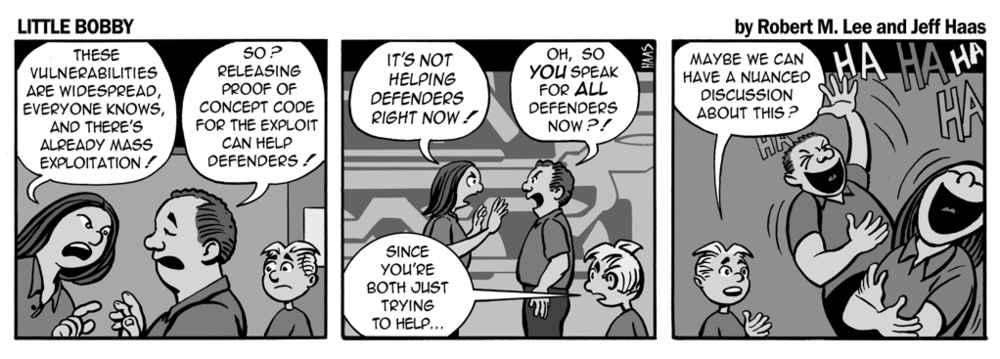
Robert M. Lee’s & Jeff Haas’ Little Bobby Comics – ‘WEEK 321’

via the respected information security capabilities of Robert M. Lee & the superlative illustration talents of Jeff Haas at Little Bobby Comics

via the respected information security capabilities of Robert M. Lee & the superlative illustration talents of Jeff Haas at Little Bobby Comics

Permalink

The post Robert M. Lee’s & Jeff Haas’ Little Bobby Comics – ‘WEEK 321’ appeared first on Security Boulevard.

Read More

The post Robert M. Lee’s & Jeff Haas’ Little Bobby Comics – ‘WEEK 321’ appeared first on Malware Devil.


https://malwaredevil.com/2021/03/21/robert-m-lees-jeff-haas-little-bobby-comics-week-321/?utm_source=rss&utm_medium=rss&utm_campaign=robert-m-lees-jeff-haas-little-bobby-comics-week-321

USENIX Enigma 2021 – Mitch Negus’ ‘No Data, No Problem—Giving Nuclear Inspectors Better Tools Without Revealing’

Many thanks to USENIX Enigma 2021 for publishing these outstanding conference videos on the YouTube USENIX Channel; don’t miss this erudite 27 video information & cybersecurity event.

Permalink

The post USENIX Enigma 2021 – Mitch Negus’ ‘No Data, No Problem—Giving Nuclear Inspectors Better Tools Without Revealing’ appeared first on Security Boulevard.

Read More

The post USENIX Enigma 2021 – Mitch Negus’ ‘No Data, No Problem—Giving Nuclear Inspectors Better Tools Without Revealing’ appeared first on Malware Devil.


https://malwaredevil.com/2021/03/21/usenix-enigma-2021-mitch-negus-no-data-no-problem-giving-nuclear-inspectors-better-tools-without-revealing/?utm_source=rss&utm_medium=rss&utm_campaign=usenix-enigma-2021-mitch-negus-no-data-no-problem-giving-nuclear-inspectors-better-tools-without-revealing

USENIX Enigma 2021 – Marcus Botacin’s ‘Does Your Threat Model Consider Country And Culture? A Case Study Of Brazilian Internet Banking Security To Show That It Should!’

Many thanks to USENIX Enigma 2021 for publishing these outstanding conference videos on the YouTube USENIX Channel; don’t miss this erudite 27 video information & cybersecurity event.

Permalink

The post USENIX Enigma 2021 – Marcus Botacin’s ‘Does Your Threat Model Consider Country And Culture? A Case Study Of Brazilian Internet Banking Security To Show That It Should!’ appeared first on Security Boulevard.

Read More

The post USENIX Enigma 2021 – Marcus Botacin’s ‘Does Your Threat Model Consider Country And Culture? A Case Study Of Brazilian Internet Banking Security To Show That It Should!’ appeared first on Malware Devil.


https://malwaredevil.com/2021/03/21/usenix-enigma-2021-marcus-botacins-does-your-threat-model-consider-country-and-culture-a-case-study-of-brazilian-internet-banking-security-to-show-that-it-should/?utm_source=rss&utm_medium=rss&utm_campaign=usenix-enigma-2021-marcus-botacins-does-your-threat-model-consider-country-and-culture-a-case-study-of-brazilian-internet-banking-security-to-show-that-it-should

SCADA Security in a Cellular World

SCADA systems have been around since the early 1970s, way back when networks were all closed systems and hacking them was the stuff of spy movies.

The post SCADA Security </br> in a Cellular World appeared first on FirstPoint.

The post SCADA Security in a Cellular World appeared first on Security Boulevard.

Read More

The post SCADA Security in a Cellular World appeared first on Malware Devil.


https://malwaredevil.com/2021/03/21/scada-security-in-a-cellular-world/?utm_source=rss&utm_medium=rss&utm_campaign=scada-security-in-a-cellular-world

How to assess cellular network vulnerabilities

If there’s anything the past year has taught us is that connectivity is critical to business continuity. Not only businesses but governments and infrastructure services rely

The post How to assess </br> cellular network vulnerabilities appeared first on FirstPoint.

The post How to assess cellular network vulnerabilities appeared first on Security Boulevard.

Read More

The post How to assess cellular network vulnerabilities appeared first on Malware Devil.


https://malwaredevil.com/2021/03/21/how-to-assess-cellular-network-vulnerabilities/?utm_source=rss&utm_medium=rss&utm_campaign=how-to-assess-cellular-network-vulnerabilities

USENIX Enigma 2021 – Gianluca Stringhini’s ‘Computational Methods To Understand And Mitigate Online Aggression’

Many thanks to USENIX Enigma 2021 for publishing these outstanding conference videos on the YouTube USENIX Channel; don’t miss this erudite 27 video information & cybersecurity event.

Permalink

The post USENIX Enigma 2021 – Gianluca Stringhini’s ‘Computational Methods To Understand And Mitigate Online Aggression’ appeared first on Security Boulevard.

Read More

The post USENIX Enigma 2021 – Gianluca Stringhini’s ‘Computational Methods To Understand And Mitigate Online Aggression’ appeared first on Malware Devil.


https://malwaredevil.com/2021/03/21/usenix-enigma-2021-gianluca-stringhinis-computational-methods-to-understand-and-mitigate-online-aggression/?utm_source=rss&utm_medium=rss&utm_campaign=usenix-enigma-2021-gianluca-stringhinis-computational-methods-to-understand-and-mitigate-online-aggression

USENIX Enigma 2021 – Julian Rrushi’s ‘A Quest For The Physics Of Cyberspace’

Many thanks to USENIX Enigma 2021 for publishing these outstanding conference videos on the YouTube USENIX Channel; don’t miss this erudite 27 video information & cybersecurity event.

Permalink

The post USENIX Enigma 2021 – Julian Rrushi’s ‘A Quest For The Physics Of Cyberspace’ appeared first on Security Boulevard.

Read More

The post USENIX Enigma 2021 – Julian Rrushi’s ‘A Quest For The Physics Of Cyberspace’ appeared first on Malware Devil.


https://malwaredevil.com/2021/03/21/usenix-enigma-2021-julian-rrushis-a-quest-for-the-physics-of-cyberspace/?utm_source=rss&utm_medium=rss&utm_campaign=usenix-enigma-2021-julian-rrushis-a-quest-for-the-physics-of-cyberspace

Vaccine Passports: Who, What, When, Where and How?

Early on Thursday morning, March 18, 2021, I was posting content on LinkedIn when I glanced over at the top story in LinkedIn news that people were talking about in the U.S. I was intrigued when I saw the hottest comments coming in were on vaccine passports. But what shocked me even more was the..

The post Vaccine Passports: Who, What, When, Where and How? appeared first on Security Boulevard.

Read More

The post Vaccine Passports: Who, What, When, Where and How? appeared first on Malware Devil.


https://malwaredevil.com/2021/03/21/vaccine-passports-who-what-when-where-and-how/?utm_source=rss&utm_medium=rss&utm_campaign=vaccine-passports-who-what-when-where-and-how

Critical F5 BIG-IP Bug Under Active Attacks After PoC Exploit Posted Online

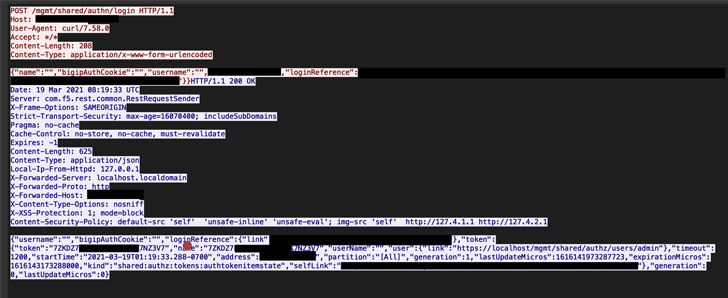
Almost 10 days after application security company F5 Networks released patches for critical vulnerabilities in its BIG-IP and BIG-IQ products, adversaries have begun opportunistically mass scanning and targeting exposed and unpatched networking devices to break into enterprise networks.

News of in the wild exploitation comes on the heels of a proof-of-concept exploit code that surfaced online earlier this week by reverse-engineering the Java software patch in BIG-IP. The mass scans are said to have spiked since March 18.

The flaws affect BIG-IP versions 11.6 or 12.x and newer, with a critical remote code execution (CVE-2021-22986) also impacting BIG-IQ versions 6.x and 7.x. CVE-2021-22986 (CVSS score: 9.8) is notable for the fact that it’s an unauthenticated, remote command execution vulnerability affecting the iControl REST interface, allowing an attacker to execute arbitrary system commands, create or delete files, and disable services without the need for any authentication.

Successful exploitation of these vulnerabilities could lead to a full compromise of susceptible systems, including the possibility of remote code execution as well as trigger a buffer overflow, leading to a denial of service (DoS) attack.

While F5 said it wasn’t aware of any public exploitation of these issues on March 10, researchers from NCC Group said they have now found evidence of “full chain exploitation of F5 BIG-IP/BIG-IQ iControl REST API vulnerabilities CVE-2021-22986” in the wake of multiple exploitation attempts against its honeypot infrastructure.

Additionally, Palo Alto Networks’ Unit 42 threat intelligence team said it found attempts to exploit CVE-2021-22986 to install a variant of the Mirai botnet. But it’s not immediately clear if those attacks were successful.

Given the popularity of BIG-IP/BIG-IQ in corporate and government networks, it should come as no surprise that this is the second time in a year F5 appliances have become a lucrative target for exploitation.

Last July, the company addressed a similar critical flaw (CVE-2020-5902), following which it was abused by Iranian and Chinese state-sponsored hacking groups, prompting the U.S. Cybersecurity and Infrastructure Security Agency (CISA) to issue an alert cautioning of a “broad scanning activity for the presence of this vulnerability across federal departments and agencies.”

“The bottom line is that [the flaws] affect all BIG-IP and BIG-IQ customers and instances — we urge all customers to update their BIG-IP and BIG-IQ deployments to the fixed versions as soon as possible,” F5 Senior Vice President Kara Sprague noted last week.

Found this article interesting? Follow THN on Facebook, Twitter and LinkedIn to read more exclusive content we post.

Read More

The post Critical F5 BIG-IP Bug Under Active Attacks After PoC Exploit Posted Online appeared first on Malware Devil.


https://malwaredevil.com/2021/03/21/critical-f5-big-ip-bug-under-active-attacks-after-poc-exploit-posted-online-3/?utm_source=rss&utm_medium=rss&utm_campaign=critical-f5-big-ip-bug-under-active-attacks-after-poc-exploit-posted-online-3

Deconstructing that $69million NFT

“NFTs” have hit the mainstream news with the sale of an NFT based digital artwork for $69 million. I thought I’d write up an explainer. Specifically, I deconstruct that huge purchase and show what actually was exchanged, down to the raw code. (The answer: almost nothing).

The reason for this post is that every other description of NFTs describe what they pretend to be. In this blogpost, I drill down on what they actually are.

Note that this example is about “NFT artwork”, the thing that’s been in the news. There are other uses of NFTs, which work very differently than what’s shown here.

tl;dr

I have long bit of text explaining things. Here is the short form that allows you to drill down to the individual pieces.

  • Beeple created a piece of art in a file
  • He created a hash that uniquely, and unhackably, identified that file
  • He created a metadata file that included the hash to the artwork
  • He created a hash to the metadata file
  • He uploaded both files (metadata and artwork) to the IPFS darknet decentralized file sharing service
  • He created, or minted a token governed by the MakersTokenV2 smart contract on the Ethereum blockchain
  • Christies created an auction for this token
  • The auction was concluded with a payment of $69 million worth of Ether cryptocurrency. However, nobody has been able to find this payment on the Ethereum blockchain, the money was probably transferred through some private means.
  • Beeple transferred the token to the winner, who transferred it again to this final Metakovan account
Each of the link above allows you to drill down to exactly what’s happening on the blockchain. The rest of this post discusses things in long form.

Why do I care?

Well, you don’t. It makes you feel stupid that you haven’t heard about it, when everyone is suddenly talking about it as if it’s been a thing for a long time. But the reality, they didn’t know what it was a month ago, either. Here is the Google Trends graph to prove this point — interest has only exploded in the last couple months:

The same applies to me. I’ve been aware of them (since the CryptoKitties craze from a couple years ago) but haven’t invested time reading source code until now. Much of this blogpost is written as notes as I discover for myself exactly what was purchased for $69 million, reading the actual transactions.

So what is it?

My definition: “Something new that can be traded on a blockchain that isn’t a fungible cryptocurrency”.
In this post, I’m going to explain in technical details. Before this, you might want to pause and see what everyone else is saying about it. You can look on Wikipedia to answer that question, or look at the following definition from CNN (the first result when I google it):


Non-fungible tokens, or NFTs, are pieces of digital content linked to the blockchain, the digital database underpinning cryptocurrencies such as bitcoin and ethereum. Unlike NFTs, those assets are fungible, meaning they can be replaced or exchanged with another identical one of the same value, much like a dollar bill.

You can also get a list of common NFT systems here. While this list of NFT systems contains a lot of things related to artwork (as described in this blogpost), a lot aren’t. For example, CryptoKiddies is an online game, not artwork (though it too allows ties to pictures of the kitties).

What is fungible?

Let’s define the word fungible first. The word refers to goods you purchase that can be replaced by an identical good, like a pound of sugar, an ounce of gold, a barrel of West Texas Intermediate crude oil. When you buy one, you don’t care which one you get.

In contrast, an automobile is a non-fungible good — if you order a Tesla Model 3, you won’t be satisfied with just any car that comes out of the factory, but one that matches the color and trim that you ordered. Art work is a well known non-fungible asset — there’s only one Mona Lisa painting in the world, for example.

Dollar bills and coins are fungible tokens — they represent the value printed on the currency. You can pay your bar bill with any dollars. 

Cryptocurrencies like Bitcoin, ZCash, and Ethereum are also “fungible tokens”. That’s where they get their value, from their fungibility.

NFTs, or non-fungible tokens, is the idea of trading something unique (non-fungible, not the same as anything else) on the blockchain. You can trade them, but each is unique, like a painting, a trading card, a rare coin, and so on.

This is a token  — it represents a thing. You aren’t trading an artwork itself on the blockchain, but a token that represents the artwork. I mention this because most descriptions about NFTs are that you are buying artwork — you aren’t. Instead, you are buying a token that points to the artwork.

The best real world example is a receipt for purchase. Let’s say you go to the Louvre and buy the Mona Lisa painting, and they give you a receipt attesting to the authenticity of the transaction. The receipt is not the artwork itself, but something that represents the artwork. It’s proof you legitimately purchased it — that you didn’t steal it. If you ever resell the painting, you’ll probably need something like this proving the provenance of the piece.

Show me an example!

So let’s look an at an example NFT, the technical details, to see how it works. We might as well use this massive $69 million purchase as our example. Some news reports describing the purchase are here: [1] [2] [3].

None of these stories say what actually happened. They say the “artwork was purchased”, but what does that actually mean? We are going to deconstruct that here. (The answer is: the artwork wasn’t actually purchased).


What was the artwork?

It’s a piece created by an artist named “Beeple” (Mike Winkelmann), called “Everydays: The First 5000 Days“. It’s a 500-megapixel image, which is about 300-megabytes in size. A thumbnail of this work is shown below.

So the obvious question is where is this artwork? Is it somewhere on the blockchain? Well, no, the file is 300-megabytes in size, much too large to put on the blockchain. Instead, the file exists somewhere out in cyberspace (described below).
What exists on the blockchain is a unique fingerprint linking to the file, known as a hash.
What is a hash?

It’s at this point we need to discuss cryptography: it’s not just about encryption, but also random numbers, public keys, and hashing.

A “hash” passes all the bytes of a file through an algorithm to generate a short signature or fingerprint unique to that file. No two files with different contents can have the same hash. The most popular algorithm is SHA-256, which produces a 256-bit hash.

We call it a cryptographic hash to differentiate it from weaker algorithms. With a strong algorithm, it’s essentially impossible for a hacker to create a different file that has the same hash — even if the hacker tried really hard.

Thus, the hash is the identity of the file. The identity of the artwork in question is not the title of the piece mentioned above, other pieces of art can also be given that title. Instead, the identity of the artwork is its hash. Other pieces of artwork cannot have the same hash.

For this artwork, that 300-megabyte file is hashed, producing a 256-bit value. Written in hex, this value is:

6314b55cc6ff34f67a18e1ccc977234b803f7a5497b94f1f994ac9d1b896a017

Hexadecimal results in long strings. There are shorter ways of representing hashes. One is a format called MultiHash. It’s value is shown below. This refers to the same 256-bits, and thus the two forms equivalent, they are simply displayed in different ways.

QmXkxpwAHCtDXbbZHUwqtFucG1RMS6T87vi1CdvadfL7qA

This is the identity of the artwork. If you want to download the entire 300-megabyte file, simply copy and paste that into google, and it’ll lead you to someplace in cyberspace where you can download it. Once you download it, you can verify the hash, such as with the command-line tool OpenSSL:

$ openssl dgst -sha256 everdays5000.jfif

SHA256(everdays5000.jfif)= 6314b55cc6ff34f67a18e1ccc977234b803f7a5497b94f1f994ac9d1b896a017

The above is exactly what I’ve done — I downloaded the file from cyberspace, named it “everydays5000.jfif”, and then calculated the hash to see if it matches. As you can tell by looking at my result with the above hash, they do match, so I know I have an exact copy of the artwork.


Where to download the image from cyberspace?

Above, I downloaded the file in order to demonstrate calculating the hash. It doesn’t live on the blockchain, so where does it live?

There’s two answers. The first answer is potentially anywhere in cyberspace. Thousands of people have downloaded the file onto the personal computers, so obviously it exists on their machines — you just can’t get at it. If you ever do come across it somewhere, you can always verify it’s the exact copy by looking at the hash.

The second answer is somewhere on the darknet. The term “darknet” refers to various systems on the Internet other than the web. Remember, the “web” is not the “Internet”, but simply one of many services on the Internet.

The most popular darknet services are decentralized file sharing systems like BitTorrent and IPFS. In much the same way that blockchains are decentralized transaction services, these two system are decentralized file services. When something is too big to live on the blockchain, it often lives on the darknet, usually via IPFS.

The way these services identify files is through their hashes. If you know their hash, you can stick it into one of these services and find it. Thus, if you want to find this file on IPFS, download some IPFS aware software, and plug in the hash.

There’s an alternative privacy-focused browser called “Brave” that includes darknet features (TOR, BitTorrent, and IPFS). To download this file using Brave, simply use the following URL:

ipfs://QmXkxpwAHCtDXbbZHUwqtFucG1RMS6T87vi1CdvadfL7qA

But an easier way is to use one of the many IPFS gateways. These are web servers that will copy a file off the darknet and make it available to you. Here is a URL using one of those gateways:

https://ipfsgateway.makersplace.com/ipfs/QmXkxpwAHCtDXbbZHUwqtFucG1RMS6T87vi1CdvadfL7qA

If you click on this link within your browser, you’ll download the 300-megabyte file from the IPFS darknet. It’ll take a while, the service is slow. Once you get it, you can verify the hashes match. But since the URL is based on the hash, of course they should match, unless there was some error in transmission.

So this hash is on the blockchain?

Well, it could’ve been, but it wasn’t. Instead, the hash that’s on the blockchain points to a file containing metadata — and it’s the metadata that points to the hash.

In other words, it’s a chain of hashes. The hash on the blockchain (as we’ll see below) is this one here (I’ve made it a link so you can click on it to see the raw data):

QmPAg1mjxcEQPPtqsLoEcauVedaeMH81WXDPvPx3VC5zUz

When you click on this, you see a bunch of JSON data. Below, I’ve stripped away the uninteresting stuff to show the meaningful bits;

title:”EVERYDAYS: THE FIRST 5000 DAYS” 

description:”I made a picture from start to finish every single day from May 1st, 2007 – January 7th, 2021.  This is every motherfucking one of those pictures.” 

digital_media_signature:”6314b55cc6ff34f67a18e1ccc977234b803f7a5497b94f1f994ac9d1b896a017” 

raw_media_file:”https://ipfsgateway.makersplace.com/ipfs/QmXkxpwAHCtDXbbZHUwqtFucG1RMS6T87vi1CdvadfL7qA

Now remember that due to the magic of cryptographic hashes, this chain can’t be broken. One hash leads to the next, such that changing any single bit breaks the chain. Indeed, that’s what a “blockchain” is — a hash chain. Changing any bit of information anywhere on the Bitcoin blockchain is immediately detectable, because it throws off the hash calculations.

So we have a chain: 

hash -> metadata -> hash -> artwork

So if you own the root, you own the entire chain.

Note that this chain seems unbreakable here, in this $69 million NFT token. However, in a lot of other tokens, it’s not. I mean, the hash chain itself doesn’t promise much (it simply points at the artwork, giving no control over it), but other NFTs promise even less.


So what, exactly, is the NFT that was bought and sold?

Here’s what Christie’s sold. Here’s how Christies describes it:

Beeple (b. 1981)
EVERYDAYS: THE FIRST 5000 DAYS
token ID: 40913
wallet address: 0xc6b0562605D35eE710138402B878ffe6F2E23807
smart contract address: 0x2a46f2ffd99e19a89476e2f62270e0a35bbf0756
non-fungible token (jpg)
21,069 x 21,069 pixels (319,168,313 bytes)
Minted on 16 February 2021. This work is unique.

The seller is the artist Beeple. The artist created the token (shown below) and assigned their wallet address as the owner. This is their wallet address:

0xc6b0562605D35eE710138402B878ffe6F2E23807

When Beeple created the token, he did so using a smart contract that governs the rules for the token. Such smart contracts is what makes Ethereum different from Bitcoin, allowing things to be created and managed on the blockchain other than simple currency transfers. Contracts have addresses on the blockchain, too, but no person controls them — they are rules for decentralized transfer of things, with nobody (other than the code) in control.

There are many smart contracts that can manage NFTs. The one Beeple chose is known as MakersTokenV2. This contract has the following address:

0x2a46f2ffd99e19a89476e2f62270e0a35bbf0756

Note that if you browse this link, you’ll eventually get to the code so that you can read the smart contract and see how it works. It’s a derivation of something known as ERC721 that defines the properties of a certain class of non-fungible tokens.

Finally, we get to the actual token being sold here. It is:

#40913

In other words, it’s the 40913rd token created and managed by the MakersTokenV2 contract. The full description of what Christies is selling is this token number governed by the named contract on the Ethereum blockchain:

Ethereum -> 0x2a46f2ffd99e19a89476e2f62270e0a35bbf0756 -> 40913

We have to search the blockchain in order to find the transaction that created this token. The transaction is identified by the hash:

0x84760768c527794ede901f97973385bfc1bf2e297f7ed16f523f75412ae772b3

The smart contract is code, so in the above transaction, Beeple calls functions within the contract to create a new token, assign digital media to it (the hash), and assign himself owner of the newly created token.

After doing this, the token #40913 now contains the following information:

creator : 0xc6b0562605d35ee710138402b878ffe6f2e23807

metadataPath : QmPAg1mjxcEQPPtqsLoEcauVedaeMH81WXDPvPx3VC5zUz
tokenURI : ipfs://ipfs/QmPAg1mjxcEQPPtqsLoEcauVedaeMH81WXDPvPx3VC5zUz

This is the thing that Christie’s auction house sold. As you can see in their description above, it all points to this token on the blockcahin.

Now after the auction, the next step is to transfer the token to the new owner. Again, the contract is code, so this is calling the “Transfer()” function in that code. Beeple is the only person who can do this transfer, because only he knows the private key that controls his wallet. This transfer is done in the transaction below:

0xa342e9de61c34900883218fe52bc9931daa1a10b6f48c506f2253c279b15e5bf 

token : 40913
from : 0xc6b0562605d35ee710138402b878ffe6f2e23807
to : 0x58bf1fbeac9596fc20d87d346423d7d108c5361a

That’s not the current owner. Instead, it was soon transferred again in the following transaction:

0x01d0967faaaf95f3e19164803a1cf1a2f96644ebfababb2b810d41a72f502d49 

token : 40913
from : 0x58bf1fbeac9596fc20d87d346423d7d108c5361a
to : 0x8bb37fb0f0462bb3fc8995cf17721f8e4a399629

That final address is known to belong to a person named “Metakovan”, who the press has identified as the buyer of the piece. I don’t know what that intermediary address between Beeple and Metakovan was, but it’s common in the cryptocurrency world to have many accounts that people transfer things between, so I bet it also belongs to Metakovan.

How are things transferred?

Like everything on the blockchain, control is transfered via public/private keys. Your wallet address is a hash of your public key, which everyone knows. Anybody can transfer something to your public address without you being involved.

But every public key has a matching private key. Both are generated together, because they are mathematically related. Only somebody who knows the private key that matches the wallet address can transfer something out of the wallet to another person.

Thus Beeple’s account as the following public address. But we don’t know his private key, which he has stored on a computer file somewhere.

0xc6b0562605D35eE710138402B878ffe6F2E23807

To summarize what was bought and sold

So that’s it. To summarize:

  • Beeple created a piece of art in a file
  • He created a hash that uniquely, and unhackably, identified that file
  • He created a metadata file that included the hash to the artwork
  • He created a hash to the metadata file
  • He uploaded both files (metadata and artwork) to the IPFS darknet decentralized file sharing service
  • He created, or minted a token governed by the MakersTokenV2 smart contract on the Ethereum blockchain
  • Christies created an auction for this token
  • The auction was concluded with a payment of $69 million worth of Ether cryptocurrency. However, nobody has been able to find this payment on the Ethereum blockchain, the money was probably transferred through some private means.
  • Beeple transferred the token to the winner, who transferred it again to this final Metakovan account
And that’s it.
Okay, I understand. But I have a question. WHAT IS AN NFT????

So if you’ve been paying attention, and understood everything I’ve said, then you should still be completely confused. What exactly was purchased that was worth $69 million?
If we are asking what Metakovan purchased for his $69 million, it comes down to this: the ability to transfer MakersTokenV2 #40913 to somebody else.
That’s it. That’s everything he purchased. He didn’t purchase the artwork, he didn’t purchase the copyrights, he didn’t purchase anything more than the ability to transfer that token. Even saying he owns the token is a misnomer, since the token lives on the blockchain. Instead, since only Metakovan knows the private key that controls his wallet, all that he possesses is the ability to transfer the token to the control of another private key.
It’s not even as unique as people claim. Beeple can mint another token for the same artwork. Anybody else can mint a token for Beeple’s artwork. Insignificant changes can be made to that artwork, and tokens can be minted for that, too. There’s nothing hard and fast controlled by the code — the relationship is in people’s minds.
If you are coming here asking why somebody thinks this is worth $69 million, I have no answer for you.
The conclusion
I think there are two things that are clear here:
  • This token is not going to be meaningful to most of us: who cares if the token points to a hash that eventually points to a file freely available on the Internet?
  • This token is meaningful to those in the “crypto” (meaning “cryptocurrency”) community, but it’s in their minds, rather than something hard and fast controlled by code or cryptography.
In other words, the work didn’t sell for $69 million of real money.
For one thing, it’s not the work that was traded, or rights or control over that work. It’s simply a token that pointed to the work.
For another thing, it was sold for 42329.453 ETH, not $dollars. Early adopters with lots of cryptocurrency are likely to believe the idea that the token is meaningful, whereas outsiders with $dollars don’t.

The post Deconstructing that $69million NFT appeared first on Security Boulevard.

Read More

The post Deconstructing that $69million NFT appeared first on Malware Devil.


https://malwaredevil.com/2021/03/21/deconstructing-that-69million-nft/?utm_source=rss&utm_medium=rss&utm_campaign=deconstructing-that-69million-nft

Video: Finding Metasploit & Cobalt Strike URLs, (Sun, Mar 21st)

I have a couple of questions on my diary entry “Finding Metasploit & Cobalt Strike URLs“, thus I made a video that shows the method and explains in detail the checksum calculation.

I don’t use this method to go hunting (in proxy logs for example), as the checksum has a low-entropy, thus prone to collisions/false positives. But I do use this when I suspect the presence of Metasploit or Cobalt Strike traffic.

Cobalt Strike beacons often use HTTPS, but the URLs I talked about in my diary entry, are not the ones used by the beacon itself. These are the URLs of the staging shellcode, that precedes the beacon.

Didier Stevens
Senior handler
Microsoft MVP
blog.DidierStevens.com DidierStevensLabs.com

(c) SANS Internet Storm Center. https://isc.sans.edu Creative Commons Attribution-Noncommercial 3.0 United States License. Read More

The post Video: Finding Metasploit & Cobalt Strike URLs, (Sun, Mar 21st) appeared first on Malware Devil.


https://malwaredevil.com/2021/03/21/video-finding-metasploit-cobalt-strike-urls-sun-mar-21st/?utm_source=rss&utm_medium=rss&utm_campaign=video-finding-metasploit-cobalt-strike-urls-sun-mar-21st

Saturday, March 20, 2021

Microsoft Expanding Fight Against Macros Based Malware

Macros have been a simple, effective means of spreading malware since the 1990’s, and some hackers still rely on them heavily to ensnare and infect unsuspecting users.

It’s a long standing issue that many companies have attempted to address over the years. Now, it seems that it’s Microsoft’s turn at bat again.

Recently, the Redmond Giant announced a new integration between its AMSI (Antimalware Scan Interface) and Office 365, aimed squarely at delivering a knockout blow to macro-based malware.

Earlier attempts to put a stop to macro abuse focused on Visual Basic Scripts and removing macro-based vulnerabilities from them.

That was effective as far as it went, but it had the unforeseen effect of pushing hackers away from using VBS and toward XLM. Those are of an older macro language that first shipped with Microsoft Excel back in 1992 and is still supported to this day. The new integration paradigm sees AMSI scanning Excel 4.0 XLM macros at runtime, which should (emphasis on should) make it virtually impossible for hackers to exploit them.

As a representative from Microsoft Security Teams explains:

“While more rudimentary than VBA, XLM is powerful enough to provide interoperability with the operating system, and many organizations and users continue to use its functionality for legitimate purposes. Cyber criminals know this, and they have been abusing XLM macros, increasingly more frequently, to call Win32 APIs and run shell commands.

Naturally, threat actors like those behind Trickbot, Zloader, and Ursnif have looked elsewhere for features to abuse and operate under the radar of security solutions, and they found a suitable alternative in XLM.”

Time will tell how effective this new approach will be. Unfortunately, even if it is wildly successful, it will simply push hackers toward some other easy exploit. Even so, kudos to Microsoft for taking the fight to the hackers.

Used with permission from Article Aggregator

Read More

The post Microsoft Expanding Fight Against Macros Based Malware appeared first on Malware Devil.


https://malwaredevil.com/2021/03/20/microsoft-expanding-fight-against-macros-based-malware/?utm_source=rss&utm_medium=rss&utm_campaign=microsoft-expanding-fight-against-macros-based-malware

YARA Pre-release v4.1.0, (Sat, Mar 20th)

There’s a new version of YARA on GitHub, a pre-release for version 4.1.0.

We can expect the actual version 4.1.0 soon.


Didier Stevens
Senior handler
Microsoft MVP
blog.DidierStevens.com DidierStevensLabs.com

(c) SANS Internet Storm Center. https://isc.sans.edu Creative Commons Attribution-Noncommercial 3.0 United States License. Read More

The post YARA Pre-release v4.1.0, (Sat, Mar 20th) appeared first on Malware Devil.


https://malwaredevil.com/2021/03/20/yara-pre-release-v4-1-0-sat-mar-20th/?utm_source=rss&utm_medium=rss&utm_campaign=yara-pre-release-v4-1-0-sat-mar-20th

Resident Evil 8 just the latest game plagued by fake demos and early access scams

There’s been a number of scams targeting fans of major upcoming video game releases over the last week or two. Why is this happening, and what can you do to ensure both you and your children avoid such fakeouts?

Preview power: the 80s and 90s

Back in the 80s, games reviews were only really found in dedicated gaming magazines like ZZap!64 or Amstrad Action. A couple of magazine publishers had the idea to distribute full games and demos on cassette tapes mounted to the cover. This led to some spectacular covertape related magazine warfare, distribution of games without permission, and copyright breach extravaganzas.

Downloadable demos: 2000s and beyond

When net-connected consoles blasted their way into homes from around the time of the original Xbox onward, this granted a second life to the old cover tapes and discs. Consoles came with demos pre-loaded, you could download demos or full games, and update purchased titles on the fly.

Consoles going digital slowly came with its own problems. Even so, the digital download revolution encouraged new funding models and ways to play games. Early access, where players are granted first look at a title by paying or for free, is where our latest scam lies.

What are the scammers doing?

Scammers are using demos and early access promises as bait for phishing and other forms of attack. The upcoming Resident Evil title, Village, currently has a spin-off demo version called “Maiden” on the Playstation 5 with other versions to follow. Enterprising phishers are distributing fake mails offering “Early access invitations” to play Village itself, which is the full game, set after the events of Maiden.

In this way, they’re trying to ride the wave of popularity for Maiden by encouraging people to get their hands on the rest of the content. The game developers, Capcom, also mention avoiding any files offered up by the phish. This sounds very much like the phishers were also dabbling in malware distribution.

We bring tidings. Bad tidings.

The full Capcom message sent to press reads as follows:

We’re sending this message as we’ve been made aware that there are currently emails circulating that pretend to contain “Early Access invitations” to Resident Evil Village. The sender address is being displayed as “no-reply(at)capcom(dot)com”.

We want to inform you that these messages are NOT from Capcom and appear to be phishing attempts by an unauthorized third party. If you have received such a message, please DO NOT download any files or reply, and delete the message immediately.

If you are unsure of the authenticity of correspondence from Capcom, please contact us directly to verify.

This is perfect bait for younger gamers who may not be aware of this type of scam attempt. No doubt it’ll have caught out many an adult gamer, too. That’s the most recent attempt at tricking people with fake early access. Shall we take a look at a slightly earlier effort?

Fake Beta build scammers come for Far Cry

Far Cry 6 is the soon to be released entry into Ubisoft’s unstoppable game series. Last month, a supposed “beta” build of the game was mentioned in emails to various influencers / content creators in the gaming space. The mail, flagged as being under embargo, comes complete with an access password. When the password is entered, and we’re not sure if they mean to open a zip or on a fake website, an infection is downloaded to the PC. According to potential victims, it “watches your screen and records everything you do”.

That’s bad enough. This is by no means the end of the wave of fake beta/early access/demo invites though.

Gaming a wide audience

In January, THQ Nordic warned of scam mails related to their game Biomutant. As with the other missives, it seems to focus on content creators / developers. Seeing developers state that no early builds of games are being mailed to people is bad news. Could one group specifically be trying this early access build gimmick? Or is everyone at it? Quite often, a new way to go on the offensive is posted to underground forums and then people go off and try it. That could be what is happening with these attacks, or it could just be coincidence.

As far as fake betas go, those have been around for a long time. A good example of this is Cyberpunk 2077, back in July of last year. How about a Fortnite Android beta scam from 2018? We can certainly round things out with a Valorant themed, malware laden closed beta key generator from last April.

Some tips to avoid fake beta/access scams

  1. At least some of these attacks are targeted towards gaming influencers or people with big platforms. As a result, this means you may not encounter a few of them. If you do fall into this category, basic security hygiene applies. Check the security of all your accounts and enable two-factor authentication if it’s available. Run up to date security software, and ensure all your devices are patched and up to date.
  2. Begin locking down your gaming accounts if you haven’t already. It might not just be your PC at risk from attacks. They could be after your console logins / details too. All major gaming consoles have plenty of security features. It’s well worth digging out their security documentation and shoring up any gaps in your defence.
  3. If a games developer emails you out of the blue, it’s fairly easy to figure out what’s real and what isn’t. Major titles announce betas, and early access programs clearly on websites, social media, and gaming portals. It isn’t left to random mail shots and mysterious attachments. If there’s no evidence of whatever you’ve been sent in some sort of official capacity, steer clear. Worst case scenario, you can always contact most developers on social media. They will likely be happy to help if what you’re showing them is a scam.

Press X to continue?

We recommend telling younger gamers in your household about these scams, and also the security solutions used to address them. The “exclusive preview build” technique aimed at influencers probably won’t remain aimed at them exclusively for very long, so watch out for that. You may as well get ahead of the game now before the inevitable next wave of beta invite scams land in mailboxes near you. There’s always something to think about in video game land.

The post Resident Evil 8 just the latest game plagued by fake demos and early access scams appeared first on Malwarebytes Labs.

The post Resident Evil 8 just the latest game plagued by fake demos and early access scams appeared first on Malware Devil.


https://malwaredevil.com/2021/03/20/resident-evil-8-just-the-latest-game-plagued-by-fake-demos-and-early-access-scams-2/?utm_source=rss&utm_medium=rss&utm_campaign=resident-evil-8-just-the-latest-game-plagued-by-fake-demos-and-early-access-scams-2

USENIX Enigma 2021 – Sanghyun Hong’s ‘A Sound Mind In A Vulnerable Body: Practical Hardware Attacks On Deep Learning’

Many thanks to USENIX Enigma 2021 for publishing these outstanding conference videos on the YouTube USENIX Channel; don’t miss this erudite 27 video information & cybersecurity event.

Permalink

The post USENIX Enigma 2021 – Sanghyun Hong’s ‘A Sound Mind In A Vulnerable Body: Practical Hardware Attacks On Deep Learning’ appeared first on Security Boulevard.

Read More

The post USENIX Enigma 2021 – Sanghyun Hong’s ‘A Sound Mind In A Vulnerable Body: Practical Hardware Attacks On Deep Learning’ appeared first on Malware Devil.


https://malwaredevil.com/2021/03/20/usenix-enigma-2021-sanghyun-hongs-a-sound-mind-in-a-vulnerable-body-practical-hardware-attacks-on-deep-learning/?utm_source=rss&utm_medium=rss&utm_campaign=usenix-enigma-2021-sanghyun-hongs-a-sound-mind-in-a-vulnerable-body-practical-hardware-attacks-on-deep-learning

XKCD ‘Solar System Cartogram’

via the comic delivery system monikered Randall Munroe resident at XKCD !

via the comic delivery system monikered Randall Munroe resident at XKCD!

Permalink

The post XKCD ‘Solar System Cartogram’ appeared first on Security Boulevard.

Read More

The post XKCD ‘Solar System Cartogram’ appeared first on Malware Devil.


https://malwaredevil.com/2021/03/20/xkcd-solar-system-cartogram/?utm_source=rss&utm_medium=rss&utm_campaign=xkcd-solar-system-cartogram

Critical F5 BIG-IP Bug Under Active Attacks After PoC Exploit Posted Online

Almost 10 days after application security company F5 Networks released patches for critical vulnerabilities in its BIG-IP and BIG-IQ products, adversaries have begun opportunistically mass scanning and targeting exposed and unpatched networking devices to break into enterprise networks.
News of in the wild exploitation development comes on the heels of a proof-of-concept exploit code that
Read More

The post Critical F5 BIG-IP Bug Under Active Attacks After PoC Exploit Posted Online appeared first on Malware Devil.


https://malwaredevil.com/2021/03/20/critical-f5-big-ip-bug-under-active-attacks-after-poc-exploit-posted-online-2/?utm_source=rss&utm_medium=rss&utm_campaign=critical-f5-big-ip-bug-under-active-attacks-after-poc-exploit-posted-online-2

Critical F5 BIG-IP Bug Under Active Attacks After PoC Exploit Posted Online

Almost 10 days after application security company F5 Networks released patches for critical vulnerabilities in its BIG-IP and BIG-IQ products, adversaries have begun opportunistically mass scanning and targeting exposed and unpatched networking devices to break into enterprise networks.

News of in the wild exploitation development comes on the heels of a proof-of-concept exploit code that surfaced online earlier this week by reverse-engineering the Java software patch in BIG-IP. The mass scans are said to have spiked since March 18.

The flaws affect BIG-IP versions 11.6 or 12.x and newer, with a critical remote code execution (CVE-2021-22986) also impacting BIG-IQ versions 6.x and 7.x. CVE-2021-22986 (CVSS score: 9.8) is notable for the fact that it’s an unauthenticated, remote command execution vulnerability affecting the iControl REST interface, allowing an attacker to execute arbitrary system commands, create or delete files, and disable services without the need for any authentication.

Successful exploitation of these vulnerabilities could lead to a full compromise of vulnerable systems, including the possibility of remote code execution as well as trigger a buffer overflow, leading to a denial of service (DoS) attack.

While F5 said it not aware of any public exploitation of these issues on March 10, researchers from NCC Group said they have now found evidence of “full chain exploitation of F5 BIG-IP/BIG-IQ iControl REST API vulnerabilities CVE-2021-22986” in the wake of multiple exploitation attempts against its honeypot infrastructure.

Additionally, Palo Alto Networks’ Unit 42 threat intelligence team said it found attempts to exploit CVE-2021-22986 to install a variant of the Mirai botnet. But it’s not immediately clear if those attacks were successful.

Given the popularity of BIG-IP/BIG-IQ in corporate and government networks, it should come as no surprise that this is the second time in a year F5 appliances have become a lucrative target for exploitation.

Last July, the company addressed a similar critical flaw (CVE-2020-5902), following which it was abused by Iranian and Chinese state-sponsored hacking groups, prompting the U.S. Cybersecurity and Infrastructure Security Agency (CISA) to issue an alert cautioning of a “broad scanning activity for the presence of this vulnerability across federal departments and agencies.”

“The bottom line is that [the flaws] affect all BIG-IP and BIG-IQ customers and instances — we urge all customers to update their BIG-IP and BIG-IQ deployments to the fixed versions as soon as possible,” F5 Senior Vice President Kara Sprague noted last week.

Found this article interesting? Follow THN on Facebook, Twitter and LinkedIn to read more exclusive content we post.

Read More

The post Critical F5 BIG-IP Bug Under Active Attacks After PoC Exploit Posted Online appeared first on Malware Devil.


https://malwaredevil.com/2021/03/20/critical-f5-big-ip-bug-under-active-attacks-after-poc-exploit-posted-online/?utm_source=rss&utm_medium=rss&utm_campaign=critical-f5-big-ip-bug-under-active-attacks-after-poc-exploit-posted-online

USENIX Enigma 2021 – Nicole Fern’s ‘Hardware: A Double-Edged Sword For Security’

Many thanks to USENIX Enigma 2021 for publishing these outstanding conference videos on the YouTube USENIX Channel; don’t miss this erudite 27 video information & cybersecurity event.

The post USENIX Enigma 2021 – Nicole Fern’s ‘Hardware: A Double-Edged Sword For Security’ appeared first on Security Boulevard.

Read More

The post USENIX Enigma 2021 – Nicole Fern’s ‘Hardware: A Double-Edged Sword For Security’ appeared first on Malware Devil.


https://malwaredevil.com/2021/03/20/usenix-enigma-2021-nicole-ferns-hardware-a-double-edged-sword-for-security/?utm_source=rss&utm_medium=rss&utm_campaign=usenix-enigma-2021-nicole-ferns-hardware-a-double-edged-sword-for-security

Barbary Pirates and Russian Cybercrime

In 1801, the United States had a small Navy. Thomas Jefferson deployed almost half that Navy—three frigates and a schooner—to the Barbary C...