Malware Devil

Wednesday, March 24, 2021

Ransomware Incidents Continue to Dominate Threat Landscape

Cisco Talos’ IR engagements found attackers relied heavily on malware like Zloader and BazarLoader to distribute ransomware in the past three months.

Ransomware operators relied heavily on a handful of commodity Trojans, open source reconnaissance tools, and legitimate Windows utilities to execute many of their attacks during the past quarter, according to data from incidents handled by the Cisco Talos Incident Response (CTIR) team.

The data, collected from customer locations between November 2020 and January 2021, showed attackers continuing to overwhelmingly use phishing emails with malicious documents to deliver Trojans for downloading ransomware on victim systems.

But unlike in the recent past where the Emotet and Trickbot malware families were the primary vehicles for distributing ransomware, many of the Trojans used for this purpose in the past quarter were commodity tools such as Zloader, BazarLoader, and IcedID. According to the CTIR team, nearly 70% of the ransomware attacks it responded to over the three-month period used these or similar Trojans to deliver ransomware.

“We saw a variety of commodity Trojans used this quarter, as opposed to previous quarters in which Trickbot and Emotet were dominant,” says Brad Garnett, general manager of the Cisco Talos Incident Response team.

For enterprises, the trend could spell even more trouble on the ransomware front.

“Commodity Trojans are easy to obtain and possess numerous capabilities for lateral movement, command-and-control communications, etc., which can increase the efficacy of a ransomware attack,” Garnett notes.

The CTIR team’s data from incident response engagements showed ransomware dominated the threat landscape during the three-month period just like it has for the past the seven straight quarters. The most prolific ransomware families included Ryuk, Vatet, WastedLocker, and variants of Egregor.

As they have in the past, ransomware operators took advantage of several open source and legitimate admin tools and utilities to facilitate attacks, move laterally in compromised networks, hide malicious activity, and take other actions. Some 65% — or nearly two-thirds — of the ransomware incidents the Cisco Talos team responded to involved the use of PowerShell, and 30% of the incidents involved the use of PsExec. Other commonly used free and commercially available and dual-use tools included Cobalt Strike, CCleaner for deleting unwanted files, the open source TightVNC for enabling remote control of Windows and Linux PCs, and compression software such as WinRAR and 7-Zip.

Abusing Legit Tools and Utilities
The CTIR team also encountered several incidents where attackers used open source reconnaissance tools such as the Active Directory (AD) search utility ADFind, the AD information-gathering tool ADRecon, and the Bloodhound tool for visualizing AD environments and finding potential attack paths.

As one example of how ransomware operators are leveraging these tools, the CTIR team pointed to an incident where the attackers, after gaining an initial foothold on the victim network, took advantage of the Group Policy replication feature in Windows AD to install Ryuk ransomware. In that instance, the adversary leveraged PsExec to move laterally and execute remote commands. They eventually obtained domain administrator (DA) credentials and used it to encrypt some 1,000 endpoints and wipe backup indexes.

“Ransomware continues to pose the greatest threat to enterprises,” Garnett says. “Phishing remains the most observed infection vector for these attacks, underscoring the importance of email security and phishing training.”

In addition, enterprises must enable multifactor authentication where possible, disable legacy protocols, and limit use of powerful Windows tools in trusted accounts.

Ransomware was the predominant threat. But the CTIR team also responded to multiple incidents involving malware distributed via poisoned updates to SolarWinds’ Orion network management technology. Some 18,000 organizations worldwide — including several Cisco Talos customers — were impacted in that breach. However, only one of the incidents that Cisco Talos investigated involved post-compromise activity. In that incident, the attackers had set up a PowerShell script that looked like it was designed to receive more code likely for executing malicious activity.

Looking at the current quarter, Garnett expects Cisco Talos will have to respond to more SolarWinds-related incidents because the full scope and impact of that incident is likely larger than what’s known so far. He also expects the CTIR team will have to respond to more incidents involving the believed China-based Hafnium group and its recent attacks targeting four critical zero-day vulnerabilities in Microsoft Exchange Server.

“For Hafnium, we are actively supporting customers globally across different sectors and continue to see an uptick in IR services requests from customers [impacted by the attacks],” he says.

Jai Vijayan is a seasoned technology reporter with over 20 years of experience in IT trade journalism. He was most recently a Senior Editor at Computerworld, where he covered information security and data privacy issues for the publication. Over the course of his 20-year … View Full Bio

Recommended Reading:

Comment |

Email This |

Print |

RSS

More Insights

The post Ransomware Incidents Continue to Dominate Threat Landscape appeared first on Malware Devil.


https://malwaredevil.com/2021/03/24/ransomware-incidents-continue-to-dominate-threat-landscape/?utm_source=rss&utm_medium=rss&utm_campaign=ransomware-incidents-continue-to-dominate-threat-landscape

Facebook Reports China-Linked Cyberattack Targeting Uyghurs

Facebook has removed accounts used to send malicious links to Uyghur people with the goal of infecting their devices.

Facebook today shared the details of an attack campaign that used its platform as part of a broader operation to spy on Uyghur Muslim journalists, activists, and dissidents around the world. Officials say a Chinese group is responsible for the advanced attack.

This group used Facebook to create fake accounts, which have now been removed, and distribute links to malicious websites and iOS and Android malware. Attackers used the social platform to target Uyghurs from Xinjiang, China, who now live in the United States, Turkey, Kazakhstan, Syria, Australia, Canada, and other countries, the company reports.

News of the attack arrives the same week that the US, Canada, European Union, and United Kingdom imposed sanctions against Chinese officials for “serious human rights abuses” against Uyghur Muslims, who have been the targets of mass detention in China.

This campaign started in 2019 and affected at least 500 targets; however, Facebook says this only accounts for parts of the attack that somehow touched the platform. Most of the attack activity did not, says Nathaniel Gleicher, head of security policy for Facebook.

Attackers built malicious third-party websites that used lookalike domains for popular Uyghur and Turkish news websites; they also seem to have compromised legitimate sites that Uyghurs visit as part of watering-hole attacks. Some sites held malicious code similar to previously reported exploits that installed Insomnia iOS malware on devices.

To distribute these malicious links, the attackers used fake Facebook accounts to pose as reporters, students, human rights advocates, and other Uyghur community members to establish trust with their victims and trick them into clicking on the malicious links.

The group was careful to hide their activity by only deploying the iOS malware when a target met specific technical criteria, such as IP address, operating system, browser, and country and language settings, says Mike Dvilyanski, Facebook’s head of cyber-espionage investigations. This activity was highly targeted and designed to collect people’s data.

Facebook also found websites designed to resemble third-party Android app stores, where attackers put fake apps that might appeal to Uyghur targets. These included a keyboard app, prayer app, and dictionary app, all of which contained the ActionSpy or PluginPhantom Android malware strains.

Analysis revealed two Chinese companies, Beijing Best United Technology and Dalian 9Rush Technology, are behind some of the Android tools. Facebook notes FireEye research contributed to their assessment.

“FireEye uncovered an operation targeting the Uyghur community and other Chinese speakers through malicious mobile applications that were designed to collect extensive personal information from victims, including GPS location, SMS, contacts lists, screenshots, audio, and keystrokes,” says Ben Read, director of analysis for Mandiant Threat Intelligence, in a statement, noting the operation FireEye has been following has been active since 2019.

Facebook did not directly attribute this attack to the Chinese government. While it can see the geographic attribution, officials say, it can’t prove who is behind the operation.

“Our industry peers have been tracking parts of this activity as being driven by a single threat actor broadly known as Earth Empusa, or Evil Eye, or PoisonCarp,” Gleicher and Dvilyanski write in a blog post on the attack. Facebook’s investigation has confirmed the activity it has disrupted so far closely aligns with the first two. While PoisonCarp shares some of the techniques, its analysis shows this is a separate cluster of activity.

Facebook has blocked the sharing of these malicious domains on its platform, removed the attack group’s fake accounts, and notified people believed to be targeted. It’s sharing its findings today to expand disruption efforts, as it expects attacks to continue.

“We saw this activity slow down at various times, likely in response to our and other companies’ actions to disrupt their activity,” the post states.

Kelly Sheridan is the Staff Editor at Dark Reading, where she focuses on cybersecurity news and analysis. She is a business technology journalist who previously reported for InformationWeek, where she covered Microsoft, and Insurance & Technology, where she covered financial … View Full Bio

Recommended Reading:

Comment |

Email This |

Print |

RSS

More Insights

The post Facebook Reports China-Linked Cyberattack Targeting Uyghurs appeared first on Malware Devil.


https://malwaredevil.com/2021/03/24/facebook-reports-china-linked-cyberattack-targeting-uyghurs/?utm_source=rss&utm_medium=rss&utm_campaign=facebook-reports-china-linked-cyberattack-targeting-uyghurs

Desktop Central foi apresentado como escolha do cliente no Gartner Peer Insights 2021 para UEM

Na ManageEngine, a satisfação do cliente não é apenas uma promessa, mas também a força por trás de tudo o que fazemos. Desde a resolução de bugs até a entrega de uma experiência perfeita, sempre estamos ansiosos para ouvir o …

The post Desktop Central foi apresentado como escolha do cliente no Gartner Peer Insights 2021 para UEM appeared first on ManageEngine Blog.

The post Desktop Central foi apresentado como escolha do cliente no Gartner Peer Insights 2021 para UEM appeared first on Security Boulevard.

Read More

The post Desktop Central foi apresentado como escolha do cliente no Gartner Peer Insights 2021 para UEM appeared first on Malware Devil.


https://malwaredevil.com/2021/03/24/desktop-central-foi-apresentado-como-escolha-do-cliente-no-gartner-peer-insights-2021-para-uem/?utm_source=rss&utm_medium=rss&utm_campaign=desktop-central-foi-apresentado-como-escolha-do-cliente-no-gartner-peer-insights-2021-para-uem

ProtonVPN CEO Blasts Apple for ‘Aiding Tyrants’ in Myanmar

CEO says Apple rejected a security update needed to protect human-rights abuse evidence.
Read More

The post ProtonVPN CEO Blasts Apple for ‘Aiding Tyrants’ in Myanmar appeared first on Malware Devil.


https://malwaredevil.com/2021/03/24/protonvpn-ceo-blasts-apple-for-aiding-tyrants-in-myanmar-2/?utm_source=rss&utm_medium=rss&utm_campaign=protonvpn-ceo-blasts-apple-for-aiding-tyrants-in-myanmar-2

ProtonVPN CEO Blasts Apple for ‘Aiding Tyrants’ in Myanmar

CEO says Apple rejected a security update needed to protect human-rights abuse evidence.
Read More

The post ProtonVPN CEO Blasts Apple for ‘Aiding Tyrants’ in Myanmar appeared first on Malware Devil.


https://malwaredevil.com/2021/03/24/protonvpn-ceo-blasts-apple-for-aiding-tyrants-in-myanmar/?utm_source=rss&utm_medium=rss&utm_campaign=protonvpn-ceo-blasts-apple-for-aiding-tyrants-in-myanmar

Axis Security, Qualys, VMware, NFTs, & Linksys/Fortinet – ESW #221

This week in the Enterprise News, Funding announcements from Security Scorecard, Secureframe, Axis Security, Orca, Cylera, and Vulcan Cyber. A non-funding announcement from Thinkst. Fortinet aquires ShieldX, VMware acquires Mesh7 and Copado aquires New Context. Knowbe4 files for IPO. Exabeam Launches First-ever Comprehensive Use Case Coverage, Linksys and Fortinet form an interesting partnership, Sonatype targets a more secure software supply chain with a 5-part announcement, CTO.ai Launches Serverless Kubernetes Platform and more!

Visit https://www.securityweekly.com/esw for all the latest episodes!

Show Notes: https://securityweekly.com/esw221

The post Axis Security, Qualys, VMware, NFTs, & Linksys/Fortinet – ESW #221 appeared first on Malware Devil.


https://malwaredevil.com/2021/03/24/axis-security-qualys-vmware-nfts-linksys-fortinet-esw-221/?utm_source=rss&utm_medium=rss&utm_campaign=axis-security-qualys-vmware-nfts-linksys-fortinet-esw-221

Active Exploits Hit WordPress Sites Vulnerable to Thrive Themes Flaws

Thrive Themes has recently patched vulnerabilities in its WordPress plugins and legacy Themes – but attackers are targeting those who haven’t yet applied security updates.
Read More

The post Active Exploits Hit WordPress Sites Vulnerable to Thrive Themes Flaws appeared first on Malware Devil.


https://malwaredevil.com/2021/03/24/active-exploits-hit-wordpress-sites-vulnerable-to-thrive-themes-flaws/?utm_source=rss&utm_medium=rss&utm_campaign=active-exploits-hit-wordpress-sites-vulnerable-to-thrive-themes-flaws

The Hacker Mind: Shellshock

Shortly after OpenSSL’s Heartbleed, Shellshock was discovered lurking in two-decades old Bash code. How could open source software be vulnerable for so long? This episode looks at how open source projects have for the most part gone untested over time, how fuzzing has evolved over the years, and how new …

The post The Hacker Mind: Shellshock appeared first on Security Boulevard.

Read More

The post The Hacker Mind: Shellshock appeared first on Malware Devil.


https://malwaredevil.com/2021/03/24/the-hacker-mind-shellshock/?utm_source=rss&utm_medium=rss&utm_campaign=the-hacker-mind-shellshock

“Jump-Start Your SOC Analyst Career” – Jarrett Rodrick – ESW #221

Jarrett Rodrick and Tyler Wall’s new book, “Jump-start Your SOC Analyst Career,” is meant to serve as a roadmap for those who wish to take their first steps into cyber security/SOC analyst. We discuss topics like introduction to investigative theory, prerequisite skill requirements, and cloud security monitoring. We included stories from real SOC analyst contributors to help the reader understand what challenges might lie before them.

The book is available on Amazon:


Visit https://www.securityweekly.com/esw for all the latest episodes!

Show Notes: https://securityweekly.com/esw221

The post “Jump-Start Your SOC Analyst Career” – Jarrett Rodrick – ESW #221 appeared first on Malware Devil.


https://malwaredevil.com/2021/03/24/jump-start-your-soc-analyst-career-jarrett-rodrick-esw-221/?utm_source=rss&utm_medium=rss&utm_campaign=jump-start-your-soc-analyst-career-jarrett-rodrick-esw-221

Most Phishing Attacks Use Compromised Domains and Free Hosting

To stage a phishing site, cybercriminals have several options. They can use a legitimate domain that has been compromised, they can abuse free hosting services, or they can register their own domain. Understanding the prevalence of each scenario is fundamental to detecting and mitigating these threats as early in the attack process as possible (including before they’ve been launched). PhishLabs recently analyzed more than 100,000 phishing sites to establish how many used compromised domains, free hosting, or maliciously-registered domains.  

The post Most Phishing Attacks Use Compromised Domains and Free Hosting appeared first on Security Boulevard.

Read More

The post Most Phishing Attacks Use Compromised Domains and Free Hosting appeared first on Malware Devil.


https://malwaredevil.com/2021/03/24/most-phishing-attacks-use-compromised-domains-and-free-hosting/?utm_source=rss&utm_medium=rss&utm_campaign=most-phishing-attacks-use-compromised-domains-and-free-hosting

USENIX Enigma 2021 – Maddie Stone’s ‘The State of 0-Day In-The-Wild Exploitation’

Many thanks to USENIX Enigma 2021 for publishing these outstanding conference videos on the YouTube USENIX Channel; don’t miss this erudite 27 video information & cybersecurity event.

Permalink

The post USENIX Enigma 2021 – Maddie Stone’s ‘The State of 0-Day In-The-Wild Exploitation’ appeared first on Security Boulevard.

Read More

The post USENIX Enigma 2021 – Maddie Stone’s ‘The State of 0-Day In-The-Wild Exploitation’ appeared first on Malware Devil.


https://malwaredevil.com/2021/03/24/usenix-enigma-2021-maddie-stones-the-state-of-0-day-in-the-wild-exploitation/?utm_source=rss&utm_medium=rss&utm_campaign=usenix-enigma-2021-maddie-stones-the-state-of-0-day-in-the-wild-exploitation

XKCD ‘Epistemic Uncertainty’

via the comic delivery system monikered Randall Munroe resident at XKCD !

via the comic delivery system monikered Randall Munroe resident at XKCD!

Permalink

The post XKCD ‘Epistemic Uncertainty’ appeared first on Security Boulevard.

Read More

The post XKCD ‘Epistemic Uncertainty’ appeared first on Malware Devil.


https://malwaredevil.com/2021/03/24/xkcd-epistemic-uncertainty/?utm_source=rss&utm_medium=rss&utm_campaign=xkcd-epistemic-uncertainty

Platform Security – PaaS & Hosting – Trey Ford – ESW #221

– What security features does Heroku offer that the customer can control and how have these evolved over time?
– How do you balance the security of the application, with the security of the deployment, with the security of the platform?
– What are some tips and/or advice for deploying applications and keeping them secure during the lifecycle? (e.g. as a developer I may run applications in a secure environment, but then down the line someone runs my container with –privileged and exposes a security hole).

The goal being our audience learns what to consider when choosing a platform (or platforms) to run applications from a security perspective.

Visit https://www.securityweekly.com/esw for all the latest episodes!

Show Notes: https://securityweekly.com/esw221

The post Platform Security – PaaS & Hosting – Trey Ford – ESW #221 appeared first on Malware Devil.


https://malwaredevil.com/2021/03/24/platform-security-paas-hosting-trey-ford-esw-221/?utm_source=rss&utm_medium=rss&utm_campaign=platform-security-paas-hosting-trey-ford-esw-221

Analysis from March 2021 Traffic Analysis Quiz, (Wed, Mar 24th)

Introduction

Yesterday’s diary provided a packet capture (pcap) of approximately 20 and 1/2 hours of traffic from an infected Windows host, which included the initial infection.  It also provided malware and artifacts recovered from the infected computer.  That was presented as a traffic analysis quiz, and today’s diary provides analysis of the activity.

This infection was from the recently updated version of IcedID (Bokbot) we started seeing in March 2021.  These types of infection are usually caused by malicious macros dressed in a Microsoft Office document like an Excel or Word file, such as this example from Friday 2021-03-19.


Shown above:  These documents are often as convincing as Spiderman is here.

Incident Report

Executive Summary:

On Tuesday 2021-03-16 at approximately 19:03 UTC, a Windows computer used by Maynard Constantino was infected With IcedID (Bokbot) malware.

Victim Details:

  • IP address: 172.16.4.213
  • MAC address: 34:64:a9:0e:b6:15
  • Host name: DESKTOP-BZQ15T8
  • User account name: maynard.constantino

Indicators of Compromise (IOCs):

Infection traffic:

  • 188.127.235[.]244 port 80 – 188.127.235[.]244 – GET /44271.7938611111.dat
  • 185.82.217[.]213 port 80 – 185.82.217[.]213 – GET /44271.7938611111.dat
  • port 443 (HTTPS traffic) – aws.amazon.com – GET /   (not inherently malicious)
  • 178.128.243.14 port 80 – 630mordorebiter[.]website – GET /
  • 165.227.28[.]47 port 443 – iporumuski[.]fun – HTTPS traffic
  • 165.227.28[.]47 port 443 – agitopinaholop[.]uno – HTTPS traffic
  • 165.227.28[.]47 port 443 – dedupomoshi[.]space – HTTPS traffic
  • 178.128.156[.]142 port 443 – mazaksaedr23[.]space – HTTPS traffic
  • 178.128.156[.]142 port 443 – kledoapkd[.]website – HTTPS traffic
  • 178.128.156[.]142 port 443 – lapoedjkeo[.]top – HTTPS traffic
  • 178.128.156[.]142 port 443 – kawepotriv[.]space – HTTPS traffic

List of files recovered from the infected user’s home directory:

  • Kiod.hod
  • Kiod.hod2
  • AppData/Local/{10D90F27-F2E2-6218-7102-7745CA868DA0}/Embiteci.dll
  • AppData/Local/Temp/warfare_32.tmp
  • AppData/Roaming/CoverReplace/license.dat

Scheduled task recovered from infected Windows host:

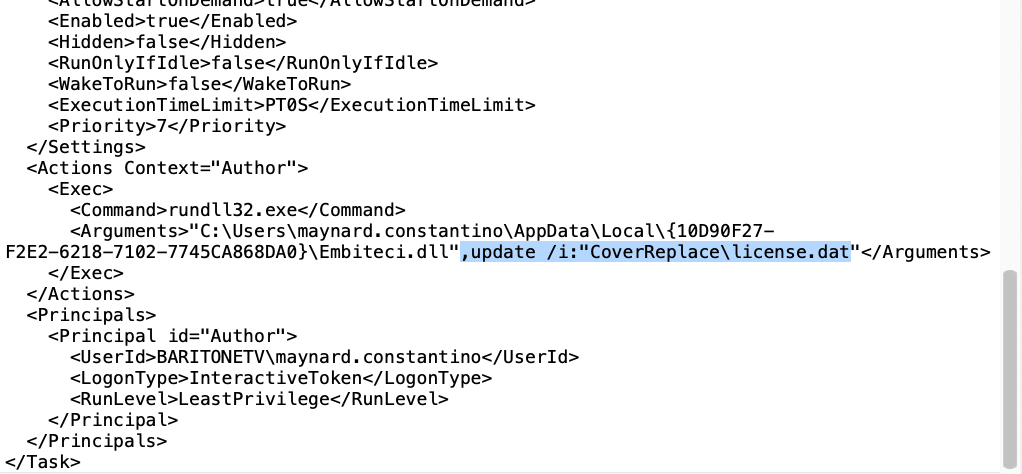
rundll32.exe “C:Usersmaynard.constantinoAppDataLocal{10D90F27-F2E2-6218-7102-7745CA868DA0}Embiteci.dll”,update /i:”CoverReplacelicense.dat”

Details on files extracted from the pcap:

SHA256 hash: 4f667f4267b2a1e90029ec3e66de84f0131e573087d4a0f50e4c9b5b9e0a8173

  • File size: 44,544 bytes
  • File location: hxxp://188.127.235[.]244/44271.7938611111.dat
  • File location: hxxp://185.82.217[.]213/44271.7938611111.dat
  • File location: C:Usersmaynard.constantinoKiod.hod
  • File location: C:Usersmaynard.constantinoKiod.hod2
  • File type: PE32+ executable (DLL) (GUI) x86-64, for MS Windows

SHA256 hash: 91cf231431ef2cc4defc4f1ad3d149c665acc317c4a89e0188f32df259b63cef

  • File size: 377,579 bytes
  • File location: hxxp://630mordorebiter[.]website
  • File type:  gzip compressed data, was “update_2533051401.msi”, from FAT filesystem (MS-DOS, OS/2, NT), original size modulo 2^32 1397480
  • Note: This is an encrypted binary masquerading as a gzip file. It’s not malicious on its own.

Details on files recovered from the infected Windows host:

SHA256 hash: 523bbb839a8c0524c0f372680e6abad3b9158fafa68865381fbd1380b7b934b9

  • File size: 36,352 bytes
  • File location: File location: C:Usersmaynard.constantinoAppDatalocalTempwarfare_32.tmp
  • File type: PE32+ executable (DLL) (GUI) x86-64, for MS Windows
  • Run method: rundll32.exe [filename],update /i:”CoverReplacelicense.dat

SHA256 hash: 47d084aab92ee591fe180613fda9ffd132b15db9b09be41ab046260cda311dc0

  • File size: 36,352 bytes
  • File location: C:Usersmaynard.constantinoAppDatalocal{10D90F27-F2E2-6218-7102-7745CA868DA0}Embiteci.dll
  • File type: PE32+ executable (DLL) (GUI) x86-64, for MS Windows
  • Run method: rundll32.exe [filename],update /i:”CoverReplacelicense.dat

SHA256 hash: 45b6349ee9d53278f350b59d4a2a28890bbe9f9de6565453db4c085bb5875865

  • File size: 341,002 bytes
  • File location: C:Usersmaynard.constantinoAppDataRoamingCoverReplacelicense.dat
  • File type: data
  • Note: This data binary is used by the above two DLL files

Analysis

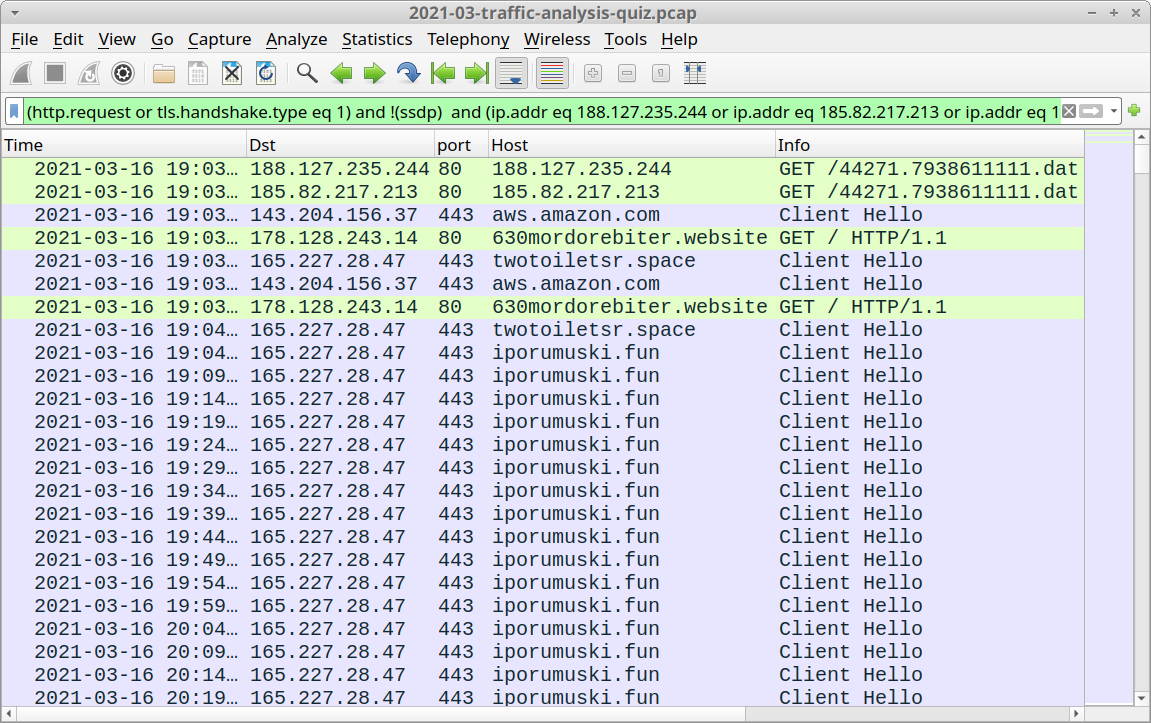
The image below shows traffic from the pcap filtered in Wireshark to focus on the initial infection and C2 traffic.


Shown above:  Traffic from the infection filtered in Wireshark (part 1 of 2).

Of note, several hours after the infection, we started seeing  different domains and IP addresses for the IcedID command and control (C2) traffic as shown below.


Shown above:  C2 domains and IP address for the IcedID infection change near the end of the pcap.

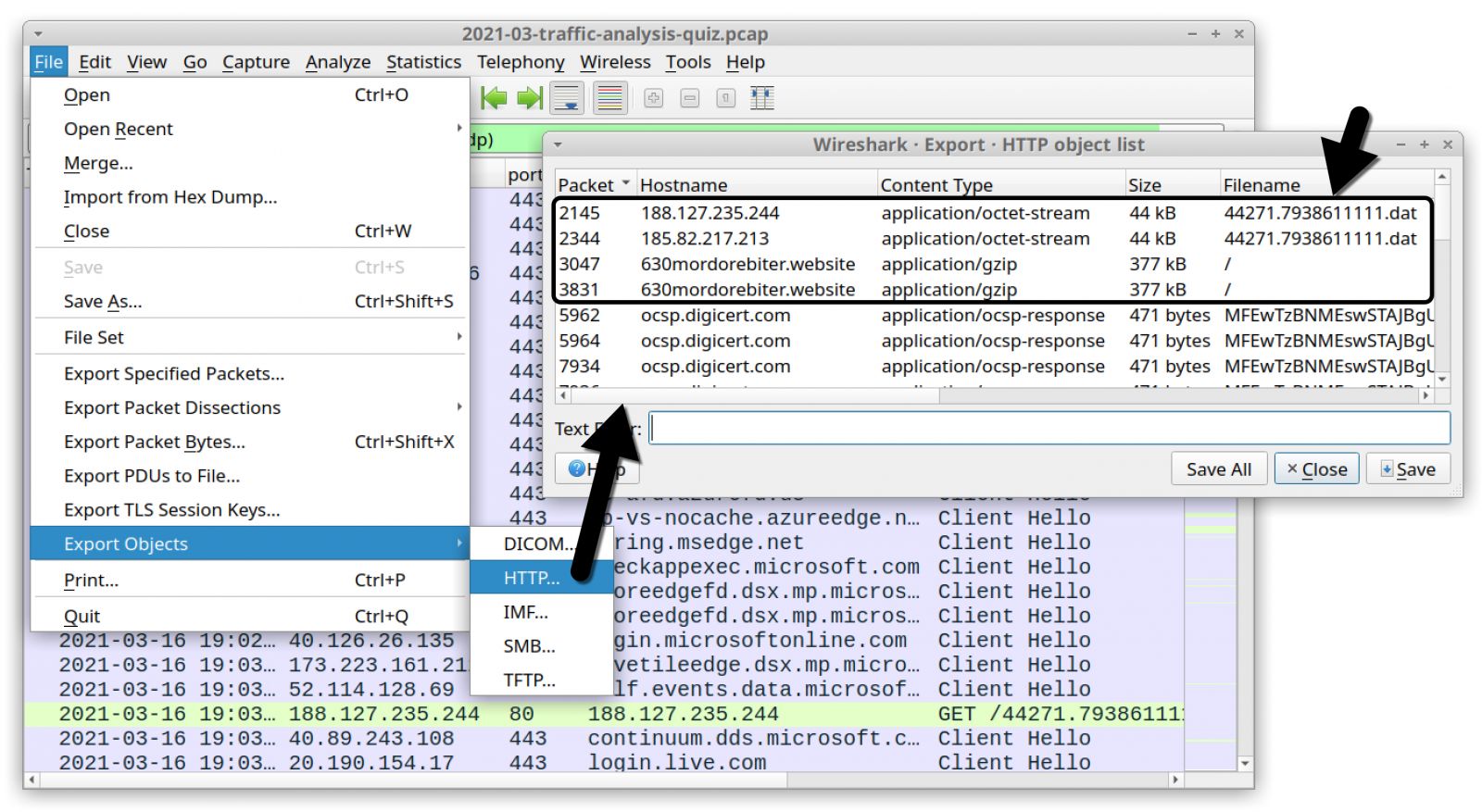
Using WIreshark’s Export HTTP Objects function, you can export the initial malware DLL and the fake gzip file used for IcedID’s new “gziploader” technique to infect the host.  There are two copies of each file in the pcap.  See the image below for details.


Shown above:  Exporting initial DLL and fake gzip file from the pcap.

Perhaps the most easily identifiable characteristic of recent IcedID infections is the license.dat file referenced in the scheduled task.  This binary data file is used by the initial and persistent IcedID DLL to infect and keep the infection persistent.


Shown above:  Action from the scheduled task, where rundll32.exe uses license.dat when running the persistent IcedID DLL.

Final Words

This “gziploader” technique used by IcedID is fairly new, so some people in the infosec community might not be fully aware of it yet.  However, post-infection activity remains noticeably similar to what we’ve seen with IcedID malware in the past few months before the update.

A zip archive with a pcap of the infection traffic is available in this Github repository, which also contains malware and artifacts from the infected computer.

Brad Duncan
brad [at] malware-traffic-analysis.net

(c) SANS Internet Storm Center. https://isc.sans.edu Creative Commons Attribution-Noncommercial 3.0 United States License. Read More

The post Analysis from March 2021 Traffic Analysis Quiz, (Wed, Mar 24th) appeared first on Malware Devil.


https://malwaredevil.com/2021/03/24/analysis-from-march-2021-traffic-analysis-quiz-wed-mar-24th/?utm_source=rss&utm_medium=rss&utm_campaign=analysis-from-march-2021-traffic-analysis-quiz-wed-mar-24th

Tuesday, March 23, 2021

BlackKingdom ransomware still exploiting insecure Exchange servers

Remember Hafnium? Here’s the bad news – it’s not over yet! Learn why and what to do…
Read More

The post BlackKingdom ransomware still exploiting insecure Exchange servers appeared first on Malware Devil.


https://malwaredevil.com/2021/03/23/blackkingdom-ransomware-still-exploiting-insecure-exchange-servers/?utm_source=rss&utm_medium=rss&utm_campaign=blackkingdom-ransomware-still-exploiting-insecure-exchange-servers

The Security Digest: #53

Hello and welcome to the 52nd TSD, your weekly blog post with top of mind security issues. TSD began as an internal newsletter 1 year …

The post The Security Digest: #53 appeared first on Cyral.

The post The Security Digest: #53 appeared first on Security Boulevard.

Read More

The post The Security Digest: #53 appeared first on Malware Devil.


https://malwaredevil.com/2021/03/23/the-security-digest-53/?utm_source=rss&utm_medium=rss&utm_campaign=the-security-digest-53

Proteger un espacio de trabajo distribuido: Una lista de control de ciberseguridad para el trabajo remoto a largo plazo

Uno de los cambios duraderos que trajo consigo la pandemia del COVID-19 es que obligó a las organizaciones a replantearse el concepto de espacio de trabajo. Ya que el trabajo remoto se volvió inevitable, los equipos de TI tuvieron …

The post Proteger un espacio de trabajo distribuido: Una lista de control de ciberseguridad para el trabajo remoto a largo plazo appeared first on ManageEngine Blog.

The post Proteger un espacio de trabajo distribuido: Una lista de control de ciberseguridad para el trabajo remoto a largo plazo appeared first on Security Boulevard.

Read More

The post Proteger un espacio de trabajo distribuido: Una lista de control de ciberseguridad para el trabajo remoto a largo plazo appeared first on Malware Devil.


https://malwaredevil.com/2021/03/23/proteger-un-espacio-de-trabajo-distribuido-una-lista-de-control-de-ciberseguridad-para-el-trabajo-remoto-a-largo-plazo/?utm_source=rss&utm_medium=rss&utm_campaign=proteger-un-espacio-de-trabajo-distribuido-una-lista-de-control-de-ciberseguridad-para-el-trabajo-remoto-a-largo-plazo

When contractors attack: two years in jail for vengeful IT admin

An IT contractor working for an IT consultancy company took it upon himself to perform an act of revenge against the firm he worked at, after they complained about his performance. The charge he faced was breaking into the network of a company in Carlsbad, California. And it got him two years in prison.

What happened?

Deepanshu Kher was helping a client to transition to a Microsoft Office 365 environment. But apparently the client company was so displeased with Kher’s performance that they complained about it to the consultancy company that despatched him. As a consequence, Kher got laid off and went back to India.

Some two months later, once he was outside of the US, Kher decided to infiltrate the California firm’s servers and deleted over 80% of employee Microsoft Office 365 accounts.

The aftermath

As employees were suddenly unable to access emails, contacts, calendars, stored documents, as well as Microsoft’s Virtual Teams remote management platform, they were unable to do their jobs. It took the company two days to get back in full swing. But all kinds of IT-related issues persisted for three more months after the cyberattack.

The arrest

The company informed the FBI about the incident and it wasn’t all that hard to figure out who the culprit was. Unaware of the outstanding warrant for his arrest, Kher was arrested while flying from India to the US. US District Court Judge Marilyn Huff charged Kher with intentional damage to a protected computer, a crime which can lead to up to 10 years in prison and a $250,000 fine.

Insider threat

The CERT Definition of an insider threat is:

“Insider Threat – the potential for an individual who has or had authorized access to an organization’s assets to use their access, either maliciously or unintentionally, to act in a way that could negatively affect the organization.”

Kher did have credentialed access to the network and the Office 365 environment as part of his job, and he certainly acted in a way that negatively affected the company. So we see this as an insider threat, even though he was no longer working for the victim.

Controlling insider incidents

While cybersecurity education and awareness are initiatives that every organization must invest in, there are times when these are simply not enough. Such initiatives may decrease the likelihood of accidental insider incidents, but not for negligence-based incidents, professional insiders, or other sophisticated attack campaigns. Organizations must implement controls and use software to minimize insider threat incidents.

The controls

Controls keep an organization’s system, network, and assets safe. They also minimize the risk of insider threats. Below are some controls organizations may want to consider adopting:

  • Block harmful activity. This includes preventing access to particular websites, or stopping employees from downloading and installing certain programs.
  • “Allow list” applications so that everything is blocked until and unless it is specifically allowed. This includes the file types of email attachments employees can open.
  • Use the principle of least privilege and give employee accounts the access they need, and nothing more.
  • Apply the same principle to data access, so data is only available to people whose job requires it–organizations should focus on this, too, when it comes to their telework or remote workers.
  • Put flags on old credentials. Former employees may attempt to use the credentials they used when they were still employed.
  • Create an employee termination process.

The last two points in particular could have helped prevent this incident. Both the consultancy company, and the victim, could have looked at this, or taken steps when they realised that Kher was unhappy about being laid off. But often when two entities are supposed to do something, they expect the other to do it. With the end result that neither did.

Worst case scenario

This was not a worst-case scenario. The contractor had access to one specific, albeit vital, part of the organization. I’m sure you can imagine someone in your organization that can do a lot more harm than that if they wanted to. Remember that when your roads part in the future. If they no longer work for you, they should not have access to your network.

Stay safe, everyone!

The post When contractors attack: two years in jail for vengeful IT admin appeared first on Malware Devil.


https://malwaredevil.com/2021/03/23/when-contractors-attack-two-years-in-jail-for-vengeful-it-admin-4/?utm_source=rss&utm_medium=rss&utm_campaign=when-contractors-attack-two-years-in-jail-for-vengeful-it-admin-4

Anti-Spoofing for Email Gains Adoption, but Enforcement Lags

More organizations adopt sender authentication, but strict quarantining or rejection of unauthenticated messages remains uncommon.

The number of domains using an anti-spoofing technology known as Domain-based Message Authentication, Reporting, and Conformance, or DMARC, topped 2.7 million in 2020, yet most domains still fail to specify a policy to delete or quarantine unauthenticated email, according to data from security firms published over the last month.

During the pandemic, email scams and phishing attacks that purported to be from the World Health Organization (WHO) widely targeted businesses and government agencies. DMARC foils one component of such attacks, when the attacker spoofs an organization in the sender line. As of December 2020, more than 2.7 million domains published a DMARC record, up 43% during the last year, according to the latest adoption report on DMARC.org, based on data from Farsight Security, a cybersecurity intelligence firm.

Still, two-thirds of those domains do not specify any policy for unauthenticated email, instead essentially monitoring the situation, according to the Farsight data. With ransomware and non-spoofed phishing attacks increasingly common, companies are tackling those issues that have the most impact on their risks, says Ben April, chief technology officer for Farsight Security.

“We will continue to see it slowly creep up for a while,” he says. “It’s a trickle of adoption mainly based on companies asking, ‘What is going to kill me next?’ That sort of risk analysis determines what important threats the company needs to focus on next.”

DMARC allows an organization to specify how recipients should handle unauthenticated messages using information inserted into its domain-name record. Using two other standards — Sender Policy Framework (SPF) and Domain Key Identified Mail (DKIM) — for verifying the authenticity of a message and checking whether the source is authorized to send email messages, the recipient has all the necessary information to check the source of email and apply the DMARC policy.

With email playing a role in more than half of malware attacks and phishing the most common vector in breaches, according to the “Verizon Data Breach Investigations Report (DBIR),” securing business messaging is a top priority.

Overall, the numbers suggest that the email authentication technologies continue to grow as a standard, but while necessary, they are not sufficient, says Olesia Klevchuk, a senior spokesperson for cybersecurity firm Barracuda Networks.

“Initially, it was primarily brand-conscious organizations adopting, but we are now seeing broader adoption as good security hygiene,” she says. “As a security control, it’s a good step, but nowhere near sufficient to protect against sophisticated phishing.”

Domains that use DMARC are less likely to be sources of suspicious email messages, with 1.9% of messages from non-DMARC domains considered suspicious, compared with only 0.4% of messages from domains enforcing DMARC, according to a report by email security provider Valimail. In its own data, the company found that nearly 1.3 million organizations have added email authentication information to their domain as a way to fight spoofing, but less than 15% strictly enforce the policy.

Other research, such as this 2018 USENIX paper, found that about 60% of domains with a mail server had an SPF record and only 6% specified a DMARC policy.

Yet volume matters as well. The absolute number of domains hides the fact that adoption by the most major sources of email — such as Google, Microsoft, Apple, and others — is a more important factor.

As far back as 2013, Google boasted that the adoption of SPF and DKIM had reached high levels. More than 95% of email messages came from an email server with an SPF record, and almost 87% have a server with a DKIM record, the company stated in an updated 2016 blog post, which represents the latest data released by the company.

While the adoption of the technologies has made it harder for attackers, they are finding ways around it, says Barracuda’s Klevchuk.

“Although hackers still use domain spoofing as a tactic — especially when DMARC is not configured properly — they are increasingly turning to domain impersonation, [where] attackers attempt to impersonate the domain of a legitimate business by using techniques such as typosquatting,” she says. “As more organizations start to adopt DMARC, hackers will start to turn more to tactics such domain impersonation to get through existing email security.”

Veteran technology journalist of more than 20 years. Former research engineer. Written for more than two dozen publications, including CNET News.com, Dark Reading, MIT’s Technology Review, Popular Science, and Wired News. Five awards for journalism, including Best Deadline … View Full Bio

Recommended Reading:

Comment |

Email This |

Print |

RSS

More Insights

The post Anti-Spoofing for Email Gains Adoption, but Enforcement Lags appeared first on Malware Devil.


https://malwaredevil.com/2021/03/23/anti-spoofing-for-email-gains-adoption-but-enforcement-lags/?utm_source=rss&utm_medium=rss&utm_campaign=anti-spoofing-for-email-gains-adoption-but-enforcement-lags

Inside the Web Shell Used in the Microsoft Exchange Server Attacks

The history and details of China Chopper – a Web shell commonly seen in the widespread Microsoft Exchange Server attacks.

China Chopper Web shells are an older threat causing new problems for many organizations targeted in ongoing attacks against vulnerable Microsoft Exchange Servers worldwide.

Since Microsoft patched a series of Exchange Server zero-days on March 2, what had previously been “limited and targeted” attacks quickly became a global issue as attackers weaponized the critical flaws. Security companies tracking the activity, including FireEye and Red Canary, noticed China Chopper Web shells played a consistent role in their observed attack patterns.

Less than two weeks after the flaws were disclosed, the DHS’ Cybersecurity and Infrastructure Security Agency (CISA) updated its guidance on the vulnerabilities to include seven China Chopper Web shells connected to successful attacks against vulnerable Exchange Servers.

China Chopper is not a new piece of malware. Researchers with FireEye first published research on the threat in 2013; Cisco Talos experts have dated samples back to 2010. It’s a fairly simple backdoor that allows criminals to remotely access a target network and gain remote control.

A Web shell typically has client-side and server-side parts. China Chopper has a command-and-control (C2) binary, and a text-based Web shell payload that acts as the server component. As FireEye researchers note in an early report on the threat, this text-based payload is so simple that an attacker could type it by hand on a target server without the need for a file transfer.

“[It] was notable at the time because it was much smaller than some of the other Web shells that were commonly used and it still had a full set of features,” says Ben Read, director of cyber espionage analysis at Mandiant. “Because it was smaller and more succinctly written, it was at the time picked up by fewer antiviruses.”

There are several ways China Chopper may get onto a target network. Some attackers employ zero-days, as seen in the Exchange Server attacks, but more often they target old versions of software running on Web-facing servers. This often includes website administration software, VPN servers, or email, he notes.

From there, it’s a small but powerful post-exploitation tool. Once on a target, China Chopper can be used to remotely execute operating system commands and conduct activities such as uploading and executing additional tools, pivoting to other systems, and exfiltrating data. It can check out where the server is, what it’s connected to, and where to pivot within the network.

“It’s less of a specific functionality that it has, than it enables full access to the machine and then the attacker can do what they want,” Read explains. Web shells work best when they’re on an Internet-facing server because the attacker can directly call out to it. A backdoor, in contrast, usually initiates a callout from the point on the corporate network where it resides.

Web servers and Exchange Servers are appealing targets because, as he notes, they’re less likely to run antivirus or endpoint detection and response (EDR) tools. “You should – it’s a best practice, but it is not uncommon for there not to be one,” Read adds. There’s less of an arms race to avoid antivirus tools in Web shells because the tools aren’t as frequently deployed.

China Chopper appeals to attackers because it’s easy to use but difficult to detect, explains Aviad Hasnis, CTO of Cynet. Its lightweight nature helps attackers fly under the radar and avoid detection.

“The back end of it, the command-and-control part, is very straightforward,” he says. “It has a graphical interface [and] it supports different types of programming languages, whether the Web shell is in PHP or ASP or Jscript.” The GUI allows the attacker to conduct activity with a point-and-click interface, as well as a command line screen.

A Global Attacker Favorite

China Chopper’s stealth and simplicity has made it an attacker tool used around the world.

In its early days, the Web shell was heavily used by Chinese groups believed to operate in support of China’s government. By now it’s no longer unique to Chinese nation-state groups, yet while they do continue to use China Chopper, it’s now traded among global attackers – both advanced and less-skilled actors use it.

“We’ve seen [it] in recent activities utilizing infrastructure located on US soil, but still there are widespread targets from the Middle East, to the far East, to Western and Eastern Europe, and of course in the United States, it’s a global operation,” says Shiran Grinberg, CyOps manager at Cynet. There is no specific country or continent targeted with the China Chopper Web shell.

Cynet has observed several advanced groups using China Chopper including Calypso, APT27, APT41, SoftCell, Leviathan, BronzeButler, and Tonto Team, among others. Grinberg notes that there has been additional use of China Chopper that hasn’t been connected to a specific group. Cynet’s data indicates much of its activity is focused on the finance and energy sectors but isn’t limited to those industries.

Its widespread nature makes China Chopper an ideal fit for the widespread Microsoft Exchange Server attacks. An attacker targeting thousands of machines will inevitably be caught; as a result, they don’t want to use a capability that people don’t know about or that they want to remain secret. There is a greater likelihood a common Web shell like China Chopper will be detected than a novel one; however, the attack group isn’t wasting a hidden novel capability.

For all the years it has been in use, the China Chopper Web shell has remained largely unchanged, says Vanja Svajcer, threat researcher with Cisco Talos, who says it’s not unusual for a Web shell to be in use for this amount of time.

“There have been modifications of its client to make its use easier for attackers but very little has changed on the server side,” he says. “The server simply receives executable code from the client component and this executable code is interpreted by the executing environment, PHP or .NET ASP.”

Most of the changes that have been made to China Chopper are intended to better conceal it, Read notes. While its functionality has remained the same, attackers may put wrappers around it or encode it to evade detection by security tools.

Kelly Sheridan is the Staff Editor at Dark Reading, where she focuses on cybersecurity news and analysis. She is a business technology journalist who previously reported for InformationWeek, where she covered Microsoft, and Insurance & Technology, where she covered financial … View Full Bio

Recommended Reading:

Comment |

Email This |

Print |

RSS

More Insights

The post Inside the Web Shell Used in the Microsoft Exchange Server Attacks appeared first on Malware Devil.


https://malwaredevil.com/2021/03/23/inside-the-web-shell-used-in-the-microsoft-exchange-server-attacks/?utm_source=rss&utm_medium=rss&utm_campaign=inside-the-web-shell-used-in-the-microsoft-exchange-server-attacks

Barbary Pirates and Russian Cybercrime

In 1801, the United States had a small Navy. Thomas Jefferson deployed almost half that Navy—three frigates and a schooner—to the Barbary C...