Malware Devil

Sunday, March 28, 2021

Network Security News Summary for Monday March 29th, 2021

A brief daily summary of what is important in cybersecurity. The podcast is published every weekday and designed to get you ready for the day with a brief, usually about 5 minutes long, summary of current network security-related events. The content is late breaking, educational and based on listener input as well as on input received by the SANS Internet Storm Center. You may submit questions and comments via our contact form at https://isc.sans.edu/contact.html .

The post Network Security News Summary for Monday March 29th, 2021 appeared first on Malware Devil.


https://malwaredevil.com/2021/03/28/network-security-news-summary-for-monday-march-29th-2021/?utm_source=rss&utm_medium=rss&utm_campaign=network-security-news-summary-for-monday-march-29th-2021

The University of Queensland’s Webinar: ‘Cyber Security – Is A Secure Future Possible?’

Permalink

The post The University of Queensland’s Webinar: ‘Cyber Security – Is A Secure Future Possible?’ appeared first on Security Boulevard.

Read More

The post The University of Queensland’s Webinar: ‘Cyber Security – Is A Secure Future Possible?’ appeared first on Malware Devil.


https://malwaredevil.com/2021/03/28/the-university-of-queenslands-webinar-cyber-security-is-a-secure-future-possible/?utm_source=rss&utm_medium=rss&utm_campaign=the-university-of-queenslands-webinar-cyber-security-is-a-secure-future-possible

No, I Did Not Hack Your MS Exchange Server

New data suggests someone has compromised more than 21,000 Microsoft Exchange Server email systems worldwide and infected them with malware that invokes both KrebsOnSecurity and Yours Truly by name.

Let’s just get this out of the way right now: It wasn’t me.

The Shadowserver Foundation, a nonprofit that helps network owners identify and fix security threats, says it has found 21,248 different Exchange servers which appear to be compromised by a backdoor and communicating with brian[.]krebsonsecurity[.]top (NOT a safe domain, hence the hobbling).

Shadowserver has been tracking wave after wave of attacks targeting flaws in Exchange that Microsoft addressed earlier this month in an emergency patch release. The group looks for attacks on Exchange systems using a combination of active Internet scans and “honeypots” — systems left vulnerable to attack so that defenders can study what attackers are doing to the devices and how.

David Watson, a longtime member and director of the Shadowserver Foundation Europe, says his group has been keeping a close eye on hundreds of unique variants of backdoors (a.k.a. “web shells”) that various cybercrime groups worldwide have been using to commandeer any unpatched Exchange servers. These backdoors give an attacker complete, remote control over the Exchange server (including any of the server’s emails).

On Mar. 26, Shadowserver saw an attempt to install a new type of backdoor in compromised Exchange Servers, and with each hacked host it installed the backdoor in the same place: “/owa/auth/babydraco.aspx.

“The web shell path that was dropped was new to us,” said Watson said. “We have been testing 367 known web shell paths via scanning of Exchange servers.”

OWA refers to Outlook Web Access, the Web-facing portion of on-premises Exchange servers. Shadowserver’s honeypots saw multiple hosts with the Babydraco backdoor doing the same thing: Running a Microsoft Powershell script that fetches the file “krebsonsecurity.exe” from the Internet address 159.65.136[.]128. Oddly, none of the several dozen antivirus tools available to scan the file at Virustotal.com currently detect it as malicious.

The Krebsonsecurity file also installs a root certificate, modifies the system registry, and tells Windows Defender not to scan the file. Watson said the Krebsonsecurity file will attempt to open up an encrypted connection between the Exchange server and the above-mentioned IP address, and send a small amount of traffic to it each minute.

Shadowserver found more than 21,000 Exchange Server systems that had the Babydraco backdoor installed. But Watson said they don’t know how many of those systems also ran the secondary download from the rogue Krebsonsecurity domain.

“Despite the abuse, this is potentially a good opportunity to highlight how vulnerable/compromised MS Exchange servers are being exploited in the wild right now, and hopefully help get the message out to victims that they need to sign up our free daily network reports,” Watson said.

There are hundreds of thousands of Exchange Server systems worldwide that were vulnerable to attack (Microsoft suggests the number is about 400,000), and most of those have been patched over the last few weeks. However, there are still tens of thousands of vulnerable Exchange servers exposed online. On Mar. 25, Shadowserver tweeted that it was tracking 73,927 unique active webshell paths across 13,803 IP addresses.
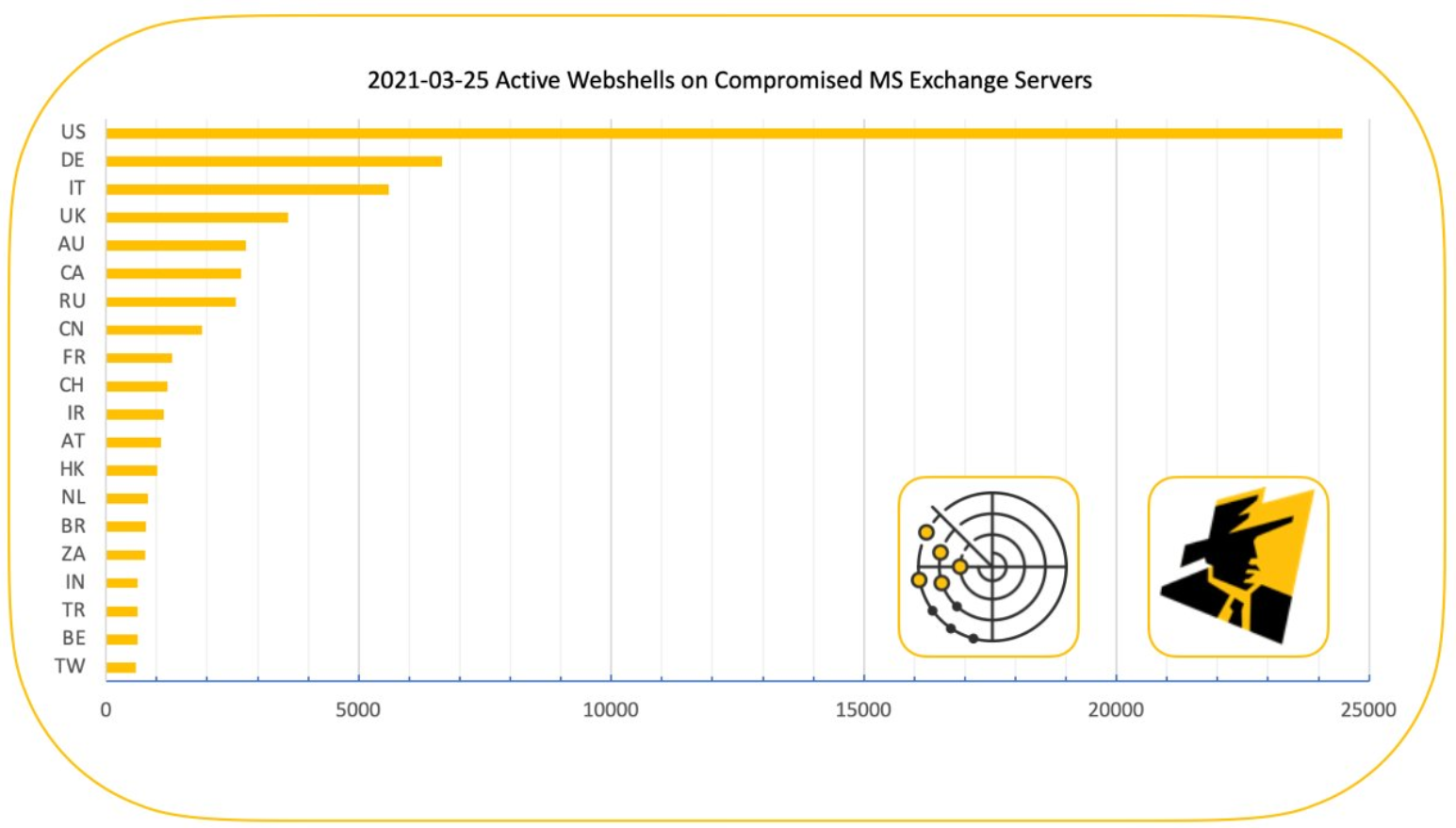
Image: Shadowserver.org

Exchange Server users that haven’t yet patched against the four flaws Microsoft fixed earlier this month can get immediate protection by deploying Microsoft’s “One-Click On-Premises Mitigation Tool.”

The motivations of the cybercriminals behind the Krebonsecurity dot top domain are unclear, but the domain itself has a recent association with other cybercrime activity — and with harassing this author. I first heard about the domain in December 2020, when a reader told me how his entire network had been hijacked by a cryptocurrency mining botnet that called home to it.

“This morning, I noticed a fan making excessive noise on a server in my homelab,” the reader said. “I didn’t think much of it at the time, but after a thorough cleaning and test, it still was noisy. After I was done with some work-related things, I checked up on it – and found that a cryptominer had been dropped on my box, pointing to XXX-XX-XXX.krebsonsecurity.top’. In all, this has infected all three linux boxes on my network.”

What was the subdomain I X’d out of his message? Just my Social Security number. I’d been doxed via DNS.

This is hardly the first time malware or malcontents have abused my name, likeness and website trademarks as a cybercrime meme, for harassment, or just to besmirch my reputation. Here are a few of the more notable examples, although all of those events are almost a decade old. That same list today would be pages long.

Further reading:

A Basic Timeline of the Exchange Mass-Hack

Warning the World of a Ticking Timebomb

At Least 30,000 U.S. Organizations Newly Hacked Via Holes in Microsoft’s Email Software

Microsoft: Chinese Cyberspies Used 4 Exchange Server Flaws to Plunder Emails

Read More

The post No, I Did Not Hack Your MS Exchange Server appeared first on Malware Devil.


https://malwaredevil.com/2021/03/28/no-i-did-not-hack-your-ms-exchange-server-2/?utm_source=rss&utm_medium=rss&utm_campaign=no-i-did-not-hack-your-ms-exchange-server-2

No, I Did Not Hack Your MS Exchange Server

New data suggests someone has compromised more than 21,000 Microsoft Exchange Server email systems worldwide and infected them with malware that invokes both KrebsOnSecurity and Yours Truly by name.

Let’s just get this out of the way right now: It wasn’t me.

The post No, I Did Not Hack Your MS Exchange Server appeared first on Security Boulevard.

Read More

The post No, I Did Not Hack Your MS Exchange Server appeared first on Malware Devil.


https://malwaredevil.com/2021/03/28/no-i-did-not-hack-your-ms-exchange-server/?utm_source=rss&utm_medium=rss&utm_campaign=no-i-did-not-hack-your-ms-exchange-server

Robert M. Lee’s & Jeff Haas’ Little Bobby Comics – ‘WEEK 322’

via the respected information security capabilities of Robert M. Lee & the superlative illustration talents of Jeff Haas at Little Bobby Comics

via the respected information security capabilities of Robert M. Lee & the superlative illustration talents of Jeff Haas at Little Bobby Comics

Permalink

The post Robert M. Lee’s & Jeff Haas’ Little Bobby Comics – ‘WEEK 322’ appeared first on Security Boulevard.

Read More

The post Robert M. Lee’s & Jeff Haas’ Little Bobby Comics – ‘WEEK 322’ appeared first on Malware Devil.


https://malwaredevil.com/2021/03/28/robert-m-lees-jeff-haas-little-bobby-comics-week-322/?utm_source=rss&utm_medium=rss&utm_campaign=robert-m-lees-jeff-haas-little-bobby-comics-week-322

Serious Security: OpenSSL fixes two high-severity crypto bugs

The bug that broke security when you turned STRICT mode on…
Read More

The post Serious Security: OpenSSL fixes two high-severity crypto bugs appeared first on Malware Devil.


https://malwaredevil.com/2021/03/28/serious-security-openssl-fixes-two-high-severity-crypto-bugs/?utm_source=rss&utm_medium=rss&utm_campaign=serious-security-openssl-fixes-two-high-severity-crypto-bugs

USENIX Enigma 2021 – Marcus Botacin’s ‘Does Your Threat Model Consider Country And Culture? A Case Study Of Brazilian Internet Banking Security To Show That It Should!’

Many thanks to USENIX Enigma 2021 for publishing these outstanding conference videos on the YouTube USENIX Channel; don’t miss this erudite 27 video information & cybersecurity event.

Permalink

The post USENIX Enigma 2021 – Marcus Botacin’s ‘Does Your Threat Model Consider Country And Culture? A Case Study Of Brazilian Internet Banking Security To Show That It Should!’ appeared first on Security Boulevard.

Read More

The post USENIX Enigma 2021 – Marcus Botacin’s ‘Does Your Threat Model Consider Country And Culture? A Case Study Of Brazilian Internet Banking Security To Show That It Should!’ appeared first on Malware Devil.


https://malwaredevil.com/2021/03/28/usenix-enigma-2021-marcus-botacins-does-your-threat-model-consider-country-and-culture-a-case-study-of-brazilian-internet-banking-security-to-show-that-it-should-2/?utm_source=rss&utm_medium=rss&utm_campaign=usenix-enigma-2021-marcus-botacins-does-your-threat-model-consider-country-and-culture-a-case-study-of-brazilian-internet-banking-security-to-show-that-it-should-2

Should Technology Product Training Be Free?

“If I buy your product, I don’t want to pay more to learn how to use your product,” said Mark Eggleston, who is CISO, chief privacy officer and vice president at Health Partners Plans. This was an excerpt that came from a CISO podcast series with several respected security and technology industry leaders, like David..

The post Should Technology Product Training Be Free? appeared first on Security Boulevard.

Read More

The post Should Technology Product Training Be Free? appeared first on Malware Devil.


https://malwaredevil.com/2021/03/28/should-technology-product-training-be-free/?utm_source=rss&utm_medium=rss&utm_campaign=should-technology-product-training-be-free

Microsoft Azure Checklist: Expert Advice on Security

Key takeaways from our recent webinar on Microsoft Azure cloud security  As we discussed in a recent webinar on Microsoft Azure security […]

The post Microsoft Azure Checklist: Expert Advice on Security appeared first on Sonrai Security.

The post Microsoft Azure Checklist: Expert Advice on Security appeared first on Security Boulevard.

Read More

The post Microsoft Azure Checklist: Expert Advice on Security appeared first on Malware Devil.


https://malwaredevil.com/2021/03/28/microsoft-azure-checklist-expert-advice-on-security/?utm_source=rss&utm_medium=rss&utm_campaign=microsoft-azure-checklist-expert-advice-on-security

Saturday, March 27, 2021

Watch Out! That Android System Update May Contain A Powerful Spyware

Researchers have discovered a new information-stealing trojan, which targets Android devices with an onslaught of data-exfiltration capabilities — from collecting browser searches to recording audio and phone calls.
While malware on Android has previously taken the guise of copycat apps, which go under names similar to legitimate pieces of software, this sophisticated new malicious app
Read More

The post Watch Out! That Android System Update May Contain A Powerful Spyware appeared first on Malware Devil.


https://malwaredevil.com/2021/03/27/watch-out-that-android-system-update-may-contain-a-powerful-spyware/?utm_source=rss&utm_medium=rss&utm_campaign=watch-out-that-android-system-update-may-contain-a-powerful-spyware

SolarWinds Experimenting With New Software Build System in Wake of Breach

CISO of SolarWinds now has complete autonomy to stop product releases if security concerns exist, CEO says.

The post SolarWinds Experimenting With New Software Build System in Wake of Breach appeared first on Malware Devil.


https://malwaredevil.com/2021/03/26/solarwinds-experimenting-with-new-software-build-system-in-wake-of-breach-2/?utm_source=rss&utm_medium=rss&utm_campaign=solarwinds-experimenting-with-new-software-build-system-in-wake-of-breach-2

A CISO’s Guide to Prevent Ransomware Attacks

The best way to avoid paying ransom to cyber criminals is to implement security measures in the first place! As mentioned in my

The post A CISO’s Guide to Prevent Ransomware Attacks appeared first on Kratikal Blog.

The post A CISO’s Guide to Prevent Ransomware Attacks appeared first on Security Boulevard.

Read More

The post A CISO’s Guide to Prevent Ransomware Attacks appeared first on Malware Devil.


https://malwaredevil.com/2021/03/27/a-cisos-guide-to-prevent-ransomware-attacks/?utm_source=rss&utm_medium=rss&utm_campaign=a-cisos-guide-to-prevent-ransomware-attacks

Apple Issues Urgent Patch Update for Another Zero‑Day Under Attack

Merely weeks after releasing out-of-band patches for iOS, iPadOS, macOS and watchOS, Apple has released yet another security update for iPhone, iPad, Apple Watch to fix a critical zero-day weakness that it says is being actively exploited in the wild.
Tracked as CVE-2021-1879, the vulnerability relates to a WebKit flaw that could enable adversaries to process maliciously crafted web content that
Read More

The post Apple Issues Urgent Patch Update for Another Zero‑Day Under Attack appeared first on Malware Devil.


https://malwaredevil.com/2021/03/27/apple-issues-urgent-patch-update-for-another-zero%e2%80%91day-under-attack/?utm_source=rss&utm_medium=rss&utm_campaign=apple-issues-urgent-patch-update-for-another-zero%25e2%2580%2591day-under-attack

SolarWinds Experimenting With New Software Build System in Wake of Breach

CISO of SolarWinds now has complete autonomy to stop product releases if security concerns exist, CEO says.

SolarWinds is experimenting with a completely new software build process that CEO Sudhakar Ramakrishna says is designed to ensure much better security against intrusions of the sort that the company disclosed last December.

In addition, SolarWinds’ CISO has been given full autonomy to stop product releases from happening purely due to time-to-market reasons. A new committee for cybersecurity has also been established at the board level, which includes the CEO and two CIOs, Ramakrishna said in comments during a virtual panel discussion this week involving security leaders from multiple organizations.

The measures are part of several changes that Ramakrishna says he has implemented since SolarWinds disclosed a breach of its systems three months ago that resulted in malware called Sunburst being distributed to some 18,000 customers worldwide. A substantially smaller number of them–including FireEye and Mimecast–were subsequently targeted for further compromise.

The intrusion involved attackers gaining access to SolarWinds’ software-build environment and injecting the Trojan into automatic updates of the company’s Orion network management software.

According to Ramakrishna, the company’s investigation shows the attackers somehow gained access to its build environment and managed to inject code dubbed Sunspot into a single source-code file that was fetched from the file system as software was being compiled. The attackers later used Sunspot to inject the Sunburst Trojan into the Orion updates.

The attack had nothing to do with SolarWinds’ source-code control systems, and neither did it result in any source code getting changed: “What simply happened was during the automated build process, the Sunspot code, which was sitting in memory quietly was watching for one file to be fetched,” Ramakrishna said. The malware then essentially flipped the file and the compilation just continued. “So, you would not find source code logs; you could not go back in time and look at it,” he said.

The entire process of modifying one file with malware happened in a window of a few milliseconds – and in memory – as the software was being compiled. The software was later digitally signed and sent out in automated fashion to customers of Orion.

Multiple Build Systems and Pipelines

To ensure that attackers cannot pull off a similar caper, SolarWinds is seeing if it can design its software-build systems and pipelines a bit differently.

Instead of a single build system in a single location, the company is looking at possibly running two or three parallel build systems through two or three parallel build chains. The goal is to see if SolarWinds can establish software integrity across multiple pipelines to avoid supply chain attacks of the kind it experienced a few months ago, Ramakrishna says. An attacker would have to be right three different times, identically, to be able to conduct an attack like the recent one with Orion. SolarWinds has also implemented a two-way hashing algorithm to further establish the integrity of its software.

The idea is to get to a point where code-signing certificates won’t be the only way to establish software integrity. SolarWinds wants to “actually build a level of non-repudiation in the code to say, ‘I underwrite and undersign what I am delivering,'” Ramakrishna said.

As part of the effort, SolarWinds is also implementing processes to ensure its CISO has more independence and authority. “We are creating an independent organization to build that level of capability and comfort,” Ramakrishna said. “Having that level of independence, confidence, and aircover is supremely important. Otherwise, [security] becomes a cost line-item and they get sidelined.”

SolarWinds is still in the process of trying to figure out how the attacker–believed to be a sophisticated nation-state-backed actor–managed to infiltrate the company’s build environment in the first place.

At one point, incident investigators had as many as 16 different hypotheses for might have happened. They have now whittled that number down to three by a process of elimination, but have not yet been able to narrow it down any further.

Ramakrishna said that the three current theories are that the attackers either got in via a very targeted spear-phishing attack; or by exploiting an unpatched vulnerability in some third-party software at that point in time; or via a credential compromise.

He said that available evidence suggests the attacker behind the operation is very sophisticated and highly organized.

Jai Vijayan is a seasoned technology reporter with over 20 years of experience in IT trade journalism. He was most recently a Senior Editor at Computerworld, where he covered information security and data privacy issues for the publication. Over the course of his 20-year … View Full Bio

Recommended Reading:

Comment |

Email This |

Print |

RSS

More Insights

The post SolarWinds Experimenting With New Software Build System in Wake of Breach appeared first on Malware Devil.


https://malwaredevil.com/2021/03/26/solarwinds-experimenting-with-new-software-build-system-in-wake-of-breach/?utm_source=rss&utm_medium=rss&utm_campaign=solarwinds-experimenting-with-new-software-build-system-in-wake-of-breach

Sonrai Dig Wins Product of the Year Award

TMC, a global, integrated media company helping clients build communities in print, in-person, and online, today announced Sonrai Dig as […]

The post Sonrai Dig Wins Product of the Year Award appeared first on Sonrai Security.

The post Sonrai Dig Wins Product of the Year Award appeared first on Security Boulevard.

Read More

The post Sonrai Dig Wins Product of the Year Award appeared first on Malware Devil.


https://malwaredevil.com/2021/03/27/sonrai-dig-wins-product-of-the-year-award/?utm_source=rss&utm_medium=rss&utm_campaign=sonrai-dig-wins-product-of-the-year-award

Friday, March 26, 2021

How to Build a Strong Information Security Policy

Editor’s note: When most workforces have become distributed due to the global coronavirus health crisis, organizations become more vulnerable …

The post How to Build a Strong Information Security Policy appeared first on Hyperproof.

The post How to Build a Strong Information Security Policy appeared first on Security Boulevard.

Read More

The post How to Build a Strong Information Security Policy appeared first on Malware Devil.


https://malwaredevil.com/2021/03/26/how-to-build-a-strong-information-security-policy/?utm_source=rss&utm_medium=rss&utm_campaign=how-to-build-a-strong-information-security-policy

Apple releases iOS 14.4.2 to address “universal cross site scripting” in Webkit https://support.apple.com/en-us/HT212256, (Fri, Mar 26th)

(c) SANS Internet Storm Center. https://isc.sans.edu Creative Commons Attribution-Noncommercial 3.0 United States License. Read More

The post Apple releases iOS 14.4.2 to address “universal cross site scripting” in Webkit https://support.apple.com/en-us/HT212256, (Fri, Mar 26th) appeared first on Malware Devil.


https://malwaredevil.com/2021/03/26/apple-releases-ios-14-4-2-to-address-universal-cross-site-scripting-in-webkit-https-support-apple-com-en-us-ht212256-fri-mar-26th/?utm_source=rss&utm_medium=rss&utm_campaign=apple-releases-ios-14-4-2-to-address-universal-cross-site-scripting-in-webkit-https-support-apple-com-en-us-ht212256-fri-mar-26th

Razões pelas quais o patch integrado e o gerenciamento de vulnerabilidade reduzem os riscos de forma rápida e eficiente

De acordo com uma pesquisa do ESG sobre gerenciamento de risco cibernético, que envolveu 340 profissionais, revelou que 40% deles sentiram que o rastreamento de patch e gestão de vulnerabilidade ao longo do tempo era seu maior desafio.

Tradicionalmente, esses …

The post Razões pelas quais o patch integrado e o gerenciamento de vulnerabilidade reduzem os riscos de forma rápida e eficiente appeared first on ManageEngine Blog.

The post Razões pelas quais o patch integrado e o gerenciamento de vulnerabilidade reduzem os riscos de forma rápida e eficiente appeared first on Security Boulevard.

Read More

The post Razões pelas quais o patch integrado e o gerenciamento de vulnerabilidade reduzem os riscos de forma rápida e eficiente appeared first on Malware Devil.


https://malwaredevil.com/2021/03/26/razoes-pelas-quais-o-patch-integrado-e-o-gerenciamento-de-vulnerabilidade-reduzem-os-riscos-de-forma-rapida-e-eficiente/?utm_source=rss&utm_medium=rss&utm_campaign=razoes-pelas-quais-o-patch-integrado-e-o-gerenciamento-de-vulnerabilidade-reduzem-os-riscos-de-forma-rapida-e-eficiente

Monitoramento de rede do Windows facilitado com OpManager

Os administradores de rede são responsáveis pela operação diária das redes de computadores em organizações de qualquer tamanho e escala. Sua principal tarefa é gerenciar, monitorar e manter vigilância sobre a infraestrutura de rede para prevenir e minimizar o tempo …

The post Monitoramento de rede do Windows facilitado com OpManager appeared first on ManageEngine Blog.

The post Monitoramento de rede do Windows facilitado com OpManager appeared first on Security Boulevard.

Read More

The post Monitoramento de rede do Windows facilitado com OpManager appeared first on Malware Devil.


https://malwaredevil.com/2021/03/26/monitoramento-de-rede-do-windows-facilitado-com-opmanager/?utm_source=rss&utm_medium=rss&utm_campaign=monitoramento-de-rede-do-windows-facilitado-com-opmanager

Why you’re going about MITRE ATT&CK coverage all wrong

MITRE ATT&CK is the defacto standard for assessing modern behavioral detection against adversary tactics and techniques. Its power resides not just in providing a common language for attacker behaviors, but also as a historical anthology of what the security community has observed during attacks. As with any framework, from Lockheed’s Cyber Kill Chain to David…

The post Why you’re going about MITRE ATT&CK coverage all wrong appeared first on Infocyte.

The post Why you’re going about MITRE ATT&CK coverage all wrong appeared first on Security Boulevard.

Read More

The post Why you’re going about MITRE ATT&CK coverage all wrong appeared first on Malware Devil.


https://malwaredevil.com/2021/03/26/why-youre-going-about-mitre-attck-coverage-all-wrong/?utm_source=rss&utm_medium=rss&utm_campaign=why-youre-going-about-mitre-attck-coverage-all-wrong

Barbary Pirates and Russian Cybercrime

In 1801, the United States had a small Navy. Thomas Jefferson deployed almost half that Navy—three frigates and a schooner—to the Barbary C...