Malware Devil

Friday, June 4, 2021

Attack Surface Discovery and Enumeration – Dan Tentler – PSW #697

We’ve let the compliance world drive security for so long there are folks that literally have no idea what ‘reasonably secure’ looks or feels like because they’ve never seen it before.

Segment Resources:
phobos.io/orbital

Visit https://www.securityweekly.com/psw for all the latest episodes!

Show Notes: https://securityweekly.com/psw697

The post Attack Surface Discovery and Enumeration – Dan Tentler – PSW #697 appeared first on Malware Devil.


https://malwaredevil.com/2021/06/04/attack-surface-discovery-and-enumeration-dan-tentler-psw-697/?utm_source=rss&utm_medium=rss&utm_campaign=attack-surface-discovery-and-enumeration-dan-tentler-psw-697

Network Security News Summary for Friday June 4th, 2021

Zoom CIS Benchmark @boeke; BIG-IP Vuln; WE.LOCK Vuln; 2xWordpress Plugin Vuln;

Script to Test CIS Zoom Benchmark
https://github.com/turbot/steampipe-mod-zoom-compliance

F5 BIG-IP Edge Client for Windows Vulnerability
https://support.f5.com/csp/article/K20346072

Fancy Product Designer WordPress Plugin Vulnerability
https://www.welivesecurity.com/2021/06/03/zero-day-popular-wordpress-plugin-exploited-take-over-websites/

WordPress Pushes Jetpack Plugin Patch
https://www.bleepingcomputer.com/news/security/wordpress-force-installs-jetpack-security-update-on-5-million-sites/

keywords: wordpress; jetpack; fancy product designer; plugin; f5; big-ip; edge client; cis; zoom; benchmark

The post Network Security News Summary for Friday June 4th, 2021 appeared first on Malware Devil.


https://malwaredevil.com/2021/06/04/network-security-news-summary-for-friday-june-4th-2021/?utm_source=rss&utm_medium=rss&utm_campaign=network-security-news-summary-for-friday-june-4th-2021

Proposed Sale Casts Cloud Over Future of FireEye’s Products

Symphony Technology Group, which is buying FireEye, already owns multiple security companies “with redundancies in numerous areas.”

The post Proposed Sale Casts Cloud Over Future of FireEye’s Products appeared first on Malware Devil.


https://malwaredevil.com/2021/06/03/proposed-sale-casts-cloud-over-future-of-fireeyes-products/?utm_source=rss&utm_medium=rss&utm_campaign=proposed-sale-casts-cloud-over-future-of-fireeyes-products

Maximizing Extractable Value from Automated Market Makers

Read More

The post Maximizing Extractable Value from Automated Market Makers appeared first on Malware Devil.


https://malwaredevil.com/2021/06/03/maximizing-extractable-value-from-automated-market-makers/?utm_source=rss&utm_medium=rss&utm_campaign=maximizing-extractable-value-from-automated-market-makers

‘Battle for the Galaxy’ Mobile Game Leaks 6M Gamer Profiles

Unprotected server exposes AMT Games user data containing user emails and purchase information.
Read More

The post ‘Battle for the Galaxy’ Mobile Game Leaks 6M Gamer Profiles appeared first on Malware Devil.


https://malwaredevil.com/2021/06/03/battle-for-the-galaxy-mobile-game-leaks-6m-gamer-profiles/?utm_source=rss&utm_medium=rss&utm_campaign=battle-for-the-galaxy-mobile-game-leaks-6m-gamer-profiles

Thursday, June 3, 2021

The effect of President Biden’s security order on web application vendors

Do you want to sell your web applications to US government agencies? We have bad news and good news. The bad news is: President Biden just made it more difficult for you. The good news is: Acunetix® can make it much easier. The SolarWinds breach…

Read more

The post The effect of President Biden’s security order on web application vendors appeared first on Acunetix.

The post The effect of President Biden’s security order on web application vendors appeared first on Security Boulevard.

Read More

The post The effect of President Biden’s security order on web application vendors appeared first on Malware Devil.


https://malwaredevil.com/2021/06/03/the-effect-of-president-bidens-security-order-on-web-application-vendors/?utm_source=rss&utm_medium=rss&utm_campaign=the-effect-of-president-bidens-security-order-on-web-application-vendors

Cloud Complexity Rattles Enterprise Security Efforts

More than 15 months after the pandemic-driven rush to remote work, enterprises are still paying the price for the faster-than-previously-planned migration to the cloud. According to the 2021 Thales Global Threat Report conducted by 451 Research, 82% of organizations maintain such concerns, especially when it comes to encrypting data stored in the cloud and the..

The post Cloud Complexity Rattles Enterprise Security Efforts appeared first on Security Boulevard.

Read More

The post Cloud Complexity Rattles Enterprise Security Efforts appeared first on Malware Devil.


https://malwaredevil.com/2021/06/03/cloud-complexity-rattles-enterprise-security-efforts/?utm_source=rss&utm_medium=rss&utm_campaign=cloud-complexity-rattles-enterprise-security-efforts

Microsoft Office 365 a Major Supply Chain Attack Vector 

Performance issues are not the only concern users have about Microsoft Office 365 and Azure cloud services: the office productivity suite also represents a major threat vector and an attractive target for network and supply chain attacks.  On a quantitative level, Office 365 draws over 250 million active users, according to Microsoft statistics. Attackers can..

The post Microsoft Office 365 a Major Supply Chain Attack Vector  appeared first on Security Boulevard.

Read More

The post Microsoft Office 365 a Major Supply Chain Attack Vector  appeared first on Malware Devil.


https://malwaredevil.com/2021/06/03/microsoft-office-365-a-major-supply-chain-attack-vector/?utm_source=rss&utm_medium=rss&utm_campaign=microsoft-office-365-a-major-supply-chain-attack-vector

DShield Data Analysis: Taking a Look at Port 45740 Activity, (Thu, Jun 3rd)

At the SANS Internet Storm Center (ISC), handlers frequently analyze data submitted from DShield participants to determine activity trends and potential attacks. A few days ago on May 31st, I observed a small anomaly for %%port:45740%% and decided to monitor it for the next 3 days or so. There was a huge spike in number of sources/day and reports/day recorded on May 31st as shown in Figure 1.

Figure 1: Port 45740 Activity (Taken June 1, 2021)

I did not receive any probes on this port on my sensors, but after digging into the DShield data, it was observed that the reported traffic to port 45740 were sent via UDP.

Over the next few days (till June 3, 2021), the number of sources/day and reports/day have dropped drastically as compared to May 31 (with reference to Figure 2). A check on Censys and Shodan did not yield any interesting findings, although there were some mentions of Distributed Hash Table (DHT) along with some IP addresses and port 45740 as a pair.

Figure 2: Port 45740 Activity (Taken June 3, 2021)

If anyone has any insights or information that could help shed light on this phenomenon, please comment down below, contact us via our contact page or e-mail us.

———–
Yee Ching Tok, ISC Handler
Personal Site
Twitter

(c) SANS Internet Storm Center. https://isc.sans.edu Creative Commons Attribution-Noncommercial 3.0 United States License. Read More

The post DShield Data Analysis: Taking a Look at Port 45740 Activity, (Thu, Jun 3rd) appeared first on Malware Devil.


https://malwaredevil.com/2021/06/03/dshield-data-analysis-taking-a-look-at-port-45740-activity-thu-jun-3rd/?utm_source=rss&utm_medium=rss&utm_campaign=dshield-data-analysis-taking-a-look-at-port-45740-activity-thu-jun-3rd

US Seizes Domains Used by SolarWinds Hackers in Cyber Espionage Attacks

Days after Microsoft, Secureworks, and Volexity shed light on a new spear-phishing activity unleashed by the Russian hackers who breached SolarWinds IT management software, the U.S. Department of Justice (DoJ) Tuesday said it intervened to take control of two command-and-control (C2) and malware distribution domains used in the campaign.

The court-authorized domain seizure took place on May 28, the DoJ said, adding the action was aimed at disrupting the threat actors’ follow-on exploitation of victims as well as block their ability to compromise new systems.

The department, however, cautioned that the adversary might have deployed additional backdoor accesses in the interim period between when the initial compromises occurred, and the seizures took place last week.

“[The] action is a continued demonstration of the Department’s commitment to proactively disrupt hacking activity prior to the conclusion of a criminal investigation,” said Assistant Attorney General John C. Demers for the Justice Department’s National Security Division.

“Law enforcement remains an integral part of the U.S. government’s broader disruption efforts against malicious cyber-enabled activities, even prior to arrest, and we will continue to evaluate all possible opportunities to use our unique authorities to act against such threats.”

The two seized domains in question — theyardservice[.]com and worldhomeoutlet[.]com — were used to communicate and control a custom Cobalt Strike loader called NativeZone (“NativeCacheSvc.dll”) that the actors implanted on the victim networks.

The wide-scale campaign, which was detected on May 25, leveraged a compromised USAID account at a mass email marketing company called Constant Contact to send phishing emails to approximately 3,000 email accounts at more than 150 different organizations.

Once the recipients clicked on the embedded hyperlink in the email message, a sub-domain of theyardservice[.]com was used to gain an initial foothold into the victim machine, exploiting it to retrieve the Cobalt Strike backdoor to maintain persistent presence and potentially deliver additional payloads.

“The actors’ instance of the Cobalt Strike tool received C2 communications via other subdomains of theyardservice[.]com, as well as the domain worldhomeoutlet[.]com,” the DoJ said.

Microsoft attributed the ongoing intrusions to the Russian threat actor it tracks as Nobelium, and by the wider cybersecurity community under the monikers APT29, UNC2452 (FireEye), SolarStorm (Unit 42), StellarParticle (Crowdstrike), Dark Halo (Volexity), and Iron Ritual (Secureworks).

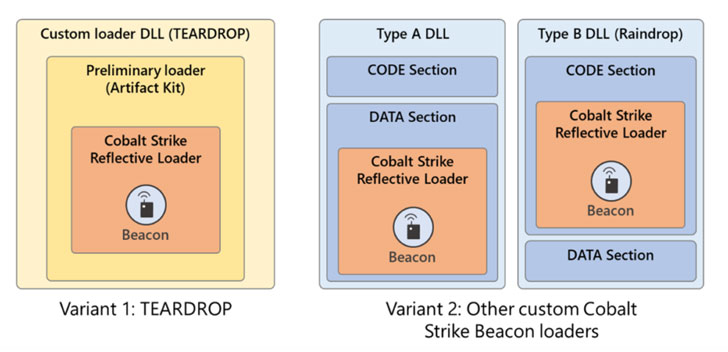
The company has since identified three more unique pieces of malware used in the infection chain, namely BoomBox, EnvyScout, and VaporRage, adding to the attackers’ growing arsenal of hacking tools such as Sunburst, Sunspot, Raindrop, Teardrop, GoldMax, GoldFinder, Sibot, and Flipflop, once again demonstrating Nobelium’s operational security priorities when targeting potentially high-risk and high-visibility environments.

While BoomBox (“BOOM.exe”) is a downloader responsible for downloading and executing next-stage components from an actor-controlled Dropbox account, VaporRage (“CertPKIProvider.dll”) is a shellcode loader used to download, decode, and execute an arbitrary payload fully in-memory.

EnvyScout (“NV.html”), on the other hand, is a malware dropper capable of de-obfuscating and writing a malicious ISO file to disk and is delivered to targets by way of HTML attachments to spear-phishing emails.

The attacker’s pattern of changing tactics several times over the course of its latest campaign underscores the widespread damage that could be inflicted on individual victims, government agencies, non-governmental organizations, and private businesses. The intrusions also highlight Nobelium’s practice of establishing access on one system or account and then using it as a jumping-off point to gain access to numerous targets.

In “significantly” differing from the SolarWinds hack by way of evolving its tools and tradecraft, the modus operandi enables a high level of stealth that allows them to remain undetected for extended periods of time, the researchers noted.

“Nobelium is an actor that operates with rapid operational tempo, often leveraging temporary infrastructure, payloads, and methods to obfuscate their activities,” Microsoft said. “Such design and deployment patterns, which also include staging of payloads on a compromised website, hamper traditional artifacts and forensic investigations, allowing for unique payloads to remain undiscovered.”

Found this article interesting? Follow THN on Facebook, Twitter and LinkedIn to read more exclusive content we post.

Read More

The post US Seizes Domains Used by SolarWinds Hackers in Cyber Espionage Attacks appeared first on Malware Devil.


https://malwaredevil.com/2021/06/03/us-seizes-domains-used-by-solarwinds-hackers-in-cyber-espionage-attacks-2/?utm_source=rss&utm_medium=rss&utm_campaign=us-seizes-domains-used-by-solarwinds-hackers-in-cyber-espionage-attacks-2

Hackers? ?Actively? ?Exploiting? ?0-Day? ?in WordPress Plugin Installed on Over ?17,000? ?Sites

Fancy Product Designer, a WordPress plugin installed on over 17,000 sites, has been discovered to contain a critical file upload vulnerability that’s being actively exploited in the wild to upload malware onto sites that have the plugin installed.

Wordfence’s threat intelligence team, which discovered the flaw, said it reported the issue to the plugin’s developer on May 31. While the flaw has been acknowledged, it’s yet to be addressed.

Fancy Product Designer is a tool that enables businesses to offer customizable products, allowing customers to design any kind of item ranging from T-shirts to phone cases by offering the ability to upload images and PDF files that can be added to the products.

“Unfortunately, while the plugin had some checks in place to prevent malicious files from being uploaded, these checks were insufficient and could easily be bypassed, allowing attackers to upload executable PHP files to any site with the plugin installed,” Wordfence said in a write-up published on Tuesday.

Armed with this capability, an attacker can achieve remote code execution on an affected website, allowing full site takeover, the researchers noted. Wordfence has not shared the technical specifics of the vulnerability as it found evidence of it being abused as early as January 30.

Wordfence said that the critical zero-day could be exploited in select configurations even if the plugin has been deactivated, urging users to completely uninstall Fancy Product Designer until a patched version becomes available.

This is far from the first time Wordfence has disclosed severe issues in WordPress plugins. In December 2017, a hidden backdoor in BestWebSoft captcha plugin was found to affect 300,000 sites.

Then earlier this year, the researchers revealed vulnerabilities in Elementor and WP Super Cache that, if successfully exploited, could allow an attacker to run arbitrary code and take over a website in certain scenarios.

Update: The maintainers of Fancy Product Designer have released an update (version 4.6.9) to remediate the aforementioned file upload vulnerability. Wordence has also shared the revised indicators of compromise (IoC) associated with the attack, which can be accessed here.

Found this article interesting? Follow THN on Facebook, Twitter and LinkedIn to read more exclusive content we post.

Read More

The post Hackers? ?Actively? ?Exploiting? ?0-Day? ?in WordPress Plugin Installed on Over ?17,000? ?Sites appeared first on Malware Devil.


https://malwaredevil.com/2021/06/03/hackers-actively-exploiting-0-day-in-wordpress-plugin-installed-on-over-17000-sites/?utm_source=rss&utm_medium=rss&utm_campaign=hackers-actively-exploiting-0-day-in-wordpress-plugin-installed-on-over-17000-sites

Securing Your Wi-Fi Access Point

The first step to creating a cybersecure home is to start by securing your Wi-Fi Access Point. Change your Wi-Fi Access Points default administrator password to something only you know. Many Wi-Fi Access Points or Wi-Fi routers are shipped with default administrator passwords that are publicly known and posted on the Internet.
Read More

The post Securing Your Wi-Fi Access Point appeared first on Malware Devil.


https://malwaredevil.com/2021/06/03/securing-your-wi-fi-access-point/?utm_source=rss&utm_medium=rss&utm_campaign=securing-your-wi-fi-access-point

#TripwireBookClub – The Crypto Dictionary

Welcome back to #TripwireBookClub. If you recall, the last book we reviewed was The Ghidra Book: The Definitive Guide, a book that I thoroughly enjoyed because I’m a huge fan of everything Chris Eagle writes. This time, we’re looking at THIS LINK DOES NOT WORK Crypto Dictionary: 500 Tasty Tidbits for the Curious Cryptographer. THIS […]… Read More

The post #TripwireBookClub – The Crypto Dictionary appeared first on The State of Security.

The post #TripwireBookClub – The Crypto Dictionary appeared first on Security Boulevard.

Read More

The post #TripwireBookClub – The Crypto Dictionary appeared first on Malware Devil.


https://malwaredevil.com/2021/06/03/tripwirebookclub-the-crypto-dictionary/?utm_source=rss&utm_medium=rss&utm_campaign=tripwirebookclub-the-crypto-dictionary

Overcoming Compliance Issues in Cloud Computing

The benefits of organizations moving some or all their IT workloads to the cloud are well-known and numerous. There are several challenges to successful cloud adoption, though, and one of the most important of them is compliance. Whether your cloud use case is low-cost data storage, scaling your infrastructure for critical business apps or disaster […]… Read More

The post Overcoming Compliance Issues in Cloud Computing appeared first on The State of Security.

The post Overcoming Compliance Issues in Cloud Computing appeared first on Security Boulevard.

Read More

The post Overcoming Compliance Issues in Cloud Computing appeared first on Malware Devil.


https://malwaredevil.com/2021/06/03/overcoming-compliance-issues-in-cloud-computing/?utm_source=rss&utm_medium=rss&utm_campaign=overcoming-compliance-issues-in-cloud-computing

U.S. Can Expect to see more Ransomware Attacks

In the cybersecurity space, there are many things we do not all agree on, but one thing I have noticed in the past year is that we all agree that the U.S. can expect to see more ransomware attacks as the nation recover from recent attacks which included the District of Columbia Police Department, The Colonial Pipeline and now the JBS meat plant. These will continue to increase, especially in the state, local environment, as well as in the critical infrastructure and manufacturing space.
There are two main reasons for this trend:
1. Organizations are not implementing the basic security controls thus allowing attackers to take advantage of easy attack vectors. A major of the critical infrastructure in the U.S. are operated by private organizations with very little IT and security regulations.

2. Many organizations are frequently deciding to pay the ransom after they have been attacked. Security researchers and law enforcement often recommend organizations not to pay the ransoms, but when stakeholders and the media are applying pressure, organizational leader must do what is best for the organization. This validates the ransomware industry and their frequency and tactics become more sophisticated.

This recent attack seems to have a Russian’s group fingerprint associated to it just like the pipeline event. Many security researchers, law enforcement officials and politicians are recommending in conjunction to increasing regulations on U.S. based organizations, the U.S. must also impose sanctions against countries that allow these types of activities to occur inside their borders.

The post U.S. Can Expect to see more Ransomware Attacks first appeared on SecurityOrb.com.

The post U.S. Can Expect to see more Ransomware Attacks appeared first on Security Boulevard.

Read More

The post U.S. Can Expect to see more Ransomware Attacks appeared first on Malware Devil.


https://malwaredevil.com/2021/06/03/u-s-can-expect-to-see-more-ransomware-attacks/?utm_source=rss&utm_medium=rss&utm_campaign=u-s-can-expect-to-see-more-ransomware-attacks

ISC Stormcast For Thursday, June 3rd, 2021 https://isc.sans.edu/podcastdetail.html?id=7526, (Thu, Jun 3rd)

(c) SANS Internet Storm Center. https://isc.sans.edu Creative Commons Attribution-Noncommercial 3.0 United States License. Read More

The post ISC Stormcast For Thursday, June 3rd, 2021 https://isc.sans.edu/podcastdetail.html?id=7526, (Thu, Jun 3rd) appeared first on Malware Devil.


https://malwaredevil.com/2021/06/03/isc-stormcast-for-thursday-june-3rd-2021-https-isc-sans-edu-podcastdetail-htmlid7526-thu-jun-3rd/?utm_source=rss&utm_medium=rss&utm_campaign=isc-stormcast-for-thursday-june-3rd-2021-https-isc-sans-edu-podcastdetail-htmlid7526-thu-jun-3rd

ESB-2021.1926 – [Linux] IBM QRadar SIEM: Access confidential data – Remote/unauthenticated

—–BEGIN PGP SIGNED MESSAGE—–
Hash: SHA256

===========================================================================
AUSCERT External Security Bulletin Redistribution

ESB-2021.1926
Security Bulletin: IBM QRadar Advisor With Watson App for IBM QRadar SIEM
is vulnerable to information exposure (CVE-2021-20380)
3 June 2021

===========================================================================

AusCERT Security Bulletin Summary
———————————

Product: IBM QRadar SIEM
Publisher: IBM
Operating System: Linux variants
Impact/Access: Access Confidential Data — Remote/Unauthenticated
Resolution: Patch/Upgrade
CVE Names: CVE-2021-20380

Original Bulletin:
https://www.ibm.com/support/pages/node/6457941

– ————————–BEGIN INCLUDED TEXT——————–

IBM QRadar Advisor With Watson App for IBM QRadar SIEM is vulnerable to
information exposure (CVE-2021-20380)

Document Information

Document number : 6457941
Modified date : 02 June 2021
Product : IBM QRadar SIEM
Software version : 7.4
Operating system(s): Linux

Summary

IBM QRadar Advisor with Watson App for IBM QRadar SIEM could allow an
unauthorized attacker to obtain sensitive information that could aid in further
attacks against the system.

Vulnerability Details

CVEID: CVE-2021-20380
DESCRIPTION: IBM QRadar could allow a remote user to obtain sensitive
information from HTTP requests that could aid in further attacks against the
system.
CVSS Base score: 5.3
CVSS Temporal Score: See: https://exchange.xforce.ibmcloud.com/vulnerabilities/
195712 for the current score.
CVSS Vector: (CVSS:3.0/AV:N/AC:L/PR:N/UI:N/S:U/C:L/I:N/A:N)

Affected Products and Versions

+——————–+———-+
|Affected Product(s) |Version(s)|
+——————–+———-+
|Qradar Advisor |1.1 – 2.5 |
+——————–+———-+

Remediation/Fixes

Update to 2.6.1

Workarounds and Mitigations

None

Acknowledgement

John Zuccato, Rodney Ryan, Chris Shepherd, Nathan Roane, Vince Dragnea, Troy
Fisher and Elaheh Samani from IBM X-Force Ethical Hacking Team

Change History

31 May 2021: Initial Publication

– ————————–END INCLUDED TEXT——————–

You have received this e-mail bulletin as a result of your organisation’s
registration with AusCERT. The mailing list you are subscribed to is
maintained within your organisation, so if you do not wish to continue
receiving these bulletins you should contact your local IT manager. If
you do not know who that is, please send an email to auscert@auscert.org.au
and we will forward your request to the appropriate person.

NOTE: Third Party Rights
This security bulletin is provided as a service to AusCERT’s members. As
AusCERT did not write the document quoted above, AusCERT has had no control
over its content. The decision to follow or act on information or advice
contained in this security bulletin is the responsibility of each user or
organisation, and should be considered in accordance with your organisation’s
site policies and procedures. AusCERT takes no responsibility for consequences
which may arise from following or acting on information or advice contained in
this security bulletin.

NOTE: This is only the original release of the security bulletin. It may
not be updated when updates to the original are made. If downloading at
a later date, it is recommended that the bulletin is retrieved directly
from the author’s website to ensure that the information is still current.

Contact information for the authors of the original document is included
in the Security Bulletin above. If you have any questions or need further
information, please contact them directly.

Previous advisories and external security bulletins can be retrieved from:

https://www.auscert.org.au/bulletins/

===========================================================================
Australian Computer Emergency Response Team
The University of Queensland
Brisbane
Qld 4072

Internet Email: auscert@auscert.org.au
Facsimile: (07) 3365 7031
Telephone: (07) 3365 4417 (International: +61 7 3365 4417)
AusCERT personnel answer during Queensland business hours
which are GMT+10:00 (AEST).
On call after hours for member emergencies only.
===========================================================================
—–BEGIN PGP SIGNATURE—–
Comment: http://www.auscert.org.au/render.html?it=1967

iQIVAwUBYLh0JuNLKJtyKPYoAQiEixAAlofucUuljpgamqHXrzhcySPEa09fnYT+
meYlbvJHO1pMeIC6oTkOIGDdEIj0MTfuYY2tW2pXT1ZbS4RRPa/kPoZ0RX8Zv3ja
1+oJ9hwEgFVOQZ7aG4pNP6QkKhHs3AFyREBgh3A+znLRueZw8zVKs+rXETWTgy/p
ZhkMNhUTxshJn9cMmDJbr18QBFnD1cWhQWHCz1KveEWlTh36lJ7eF7JXECj5yr5R
T07GQuzFTL1977OWLRk78GXGudDWnV/v4bOFjg8aEUkrlq8XCm1JMVtSuFwkG2TU
DSQHOQWcU8DiqQ5fu6+NhBtsaj8kpeC6I6cYY5lBwAX4R3AOLaTo8ZuoSaEr2nV+
I+CelholHPIBcuyZWN1jI6uZb9pPMuV9f/ec0LJklv5r0BWSuHVw78OnfEKTJCRy
b/EMxVMzvo/UmIC6VRZRNci1vkeOHHXJtfI54SkKC5eAAR0sRScZsDvWhfxWBFnL
1XkRk457LrOFQ8noKV0EZpEXWk1tH3msId4CYFy73SWs6L018YZT7rTVHwlmY2Ei
riCuBhl6VrxrObE6k7+TO9Ig2o1TIXcrYfjUq2M3Nz3lZhvdUaJeD3qk1fMs/Uht
kKXlVV/Nvu++CUu5l+HQ99rsCYO++xzdXBIvu4q+7MDTf1ZSomsfeBeQCxzMo/+d
VMDnm3MID1U=
=KfoR
—–END PGP SIGNATURE—–

Read More

The post ESB-2021.1926 – [Linux] IBM QRadar SIEM: Access confidential data – Remote/unauthenticated appeared first on Malware Devil.


https://malwaredevil.com/2021/06/03/esb-2021-1926-linux-ibm-qradar-siem-access-confidential-data-remote-unauthenticated/?utm_source=rss&utm_medium=rss&utm_campaign=esb-2021-1926-linux-ibm-qradar-siem-access-confidential-data-remote-unauthenticated

ESB-2021.1921 – [RedHat] firefox: Multiple vulnerabilities

—–BEGIN PGP SIGNED MESSAGE—–
Hash: SHA256

===========================================================================
AUSCERT External Security Bulletin Redistribution

ESB-2021.1921
firefox security update
3 June 2021

===========================================================================

AusCERT Security Bulletin Summary
———————————

Product: firefox
Publisher: Red Hat
Operating System: Red Hat
Impact/Access: Execute Arbitrary Code/Commands — Remote with User Interaction
Denial of Service — Remote with User Interaction
Resolution: Patch/Upgrade
CVE Names: CVE-2021-29967

Reference: ESB-2021.1897
ESB-2021.1896

Original Bulletin:
https://access.redhat.com/errata/RHSA-2021:2206
https://access.redhat.com/errata/RHSA-2021:2208
https://access.redhat.com/errata/RHSA-2021:2214

Comment: This bulletin contains three (3) Red Hat security advisories.

– ————————–BEGIN INCLUDED TEXT——————–

– —–BEGIN PGP SIGNED MESSAGE—–
Hash: SHA256

=====================================================================
Red Hat Security Advisory

Synopsis: Critical: firefox security update
Advisory ID: RHSA-2021:2206-01
Product: Red Hat Enterprise Linux
Advisory URL: https://access.redhat.com/errata/RHSA-2021:2206
Issue date: 2021-06-02
CVE Names: CVE-2021-29967
=====================================================================

1. Summary:

An update for firefox is now available for Red Hat Enterprise Linux 7.

Red Hat Product Security has rated this update as having a security impact
of Critical. A Common Vulnerability Scoring System (CVSS) base score, which
gives a detailed severity rating, is available for each vulnerability from
the CVE link(s) in the References section.

2. Relevant releases/architectures:

Red Hat Enterprise Linux Client (v. 7) – x86_64
Red Hat Enterprise Linux Client Optional (v. 7) – x86_64
Red Hat Enterprise Linux Server (v. 7) – ppc64, ppc64le, s390x, x86_64
Red Hat Enterprise Linux Server Optional (v. 7) – x86_64
Red Hat Enterprise Linux Workstation (v. 7) – x86_64
Red Hat Enterprise Linux Workstation Optional (v. 7) – x86_64

3. Description:

Mozilla Firefox is an open-source web browser, designed for standards
compliance, performance, and portability.

This update upgrades Firefox to version 78.11.0 ESR.

Security Fix(es):

* Mozilla: Memory safety bugs fixed in Firefox 89 and Firefox ESR 78.11
(CVE-2021-29967)

For more details about the security issue(s), including the impact, a CVSS
score, acknowledgments, and other related information, refer to the CVE
page(s) listed in the References section.

4. Solution:

For details on how to apply this update, which includes the changes
described in this advisory, refer to:

https://access.redhat.com/articles/11258

After installing the update, Firefox must be restarted for the changes to
take effect.

5. Bugs fixed (https://bugzilla.redhat.com/):

1966831 – CVE-2021-29967 Mozilla: Memory safety bugs fixed in Firefox 89 and Firefox ESR 78.11

6. Package List:

Red Hat Enterprise Linux Client (v. 7):

Source:
firefox-78.11.0-3.el7_9.src.rpm

x86_64:
firefox-78.11.0-3.el7_9.x86_64.rpm
firefox-debuginfo-78.11.0-3.el7_9.x86_64.rpm

Red Hat Enterprise Linux Client Optional (v. 7):

x86_64:
firefox-78.11.0-3.el7_9.i686.rpm

Red Hat Enterprise Linux Server (v. 7):

Source:
firefox-78.11.0-3.el7_9.src.rpm

ppc64:
firefox-78.11.0-3.el7_9.ppc64.rpm
firefox-debuginfo-78.11.0-3.el7_9.ppc64.rpm

ppc64le:
firefox-78.11.0-3.el7_9.ppc64le.rpm
firefox-debuginfo-78.11.0-3.el7_9.ppc64le.rpm

s390x:
firefox-78.11.0-3.el7_9.s390x.rpm
firefox-debuginfo-78.11.0-3.el7_9.s390x.rpm

x86_64:
firefox-78.11.0-3.el7_9.x86_64.rpm
firefox-debuginfo-78.11.0-3.el7_9.x86_64.rpm

Red Hat Enterprise Linux Server Optional (v. 7):

x86_64:
firefox-78.11.0-3.el7_9.i686.rpm

Red Hat Enterprise Linux Workstation (v. 7):

Source:
firefox-78.11.0-3.el7_9.src.rpm

x86_64:
firefox-78.11.0-3.el7_9.x86_64.rpm
firefox-debuginfo-78.11.0-3.el7_9.x86_64.rpm

Red Hat Enterprise Linux Workstation Optional (v. 7):

x86_64:
firefox-78.11.0-3.el7_9.i686.rpm

These packages are GPG signed by Red Hat for security. Our key and
details on how to verify the signature are available from
https://access.redhat.com/security/team/key/

7. References:

https://access.redhat.com/security/cve/CVE-2021-29967
https://access.redhat.com/security/updates/classification/#critical

8. Contact:

The Red Hat security contact is . More contact
details at https://access.redhat.com/security/team/contact/

Copyright 2021 Red Hat, Inc.
– —–BEGIN PGP SIGNATURE—–
Version: GnuPG v1

iQIVAwUBYLexZ9zjgjWX9erEAQhB6Q/8C6QjcejzrR0031+b3QJCbOwNwEMvDP4X
rWVFqNvZDuHmQ4AFTqH6A93u/vC61eM9Sm0rQzsD8ScXYoK3ktvKOvrK0URo9aGl
RvdXx9zdvy97fZoJhue3oXXmVdmguidThlEmZ34NZrjcZ3NSsGJaLlFEw8QOLfsn
DVD4T7jMUC9W8fetmUnWbWJ7lbSvNVS4rDkRt8gvsVelJdwJx1RiEAhXJKJt0Eif
tr/nyrAA9X+weJpKez10PPpE8rzdwq/AEh66scI60yYQ8Sqc5j0cLeNm8TQR/ilf
KDmLMPsgEN3s9oxPGYe0b3uqr4kplI5nbkuvRTXKNZl1Cf611TpQFQTsg+XvfpEa
cByAnG8lPSCe8bGOfxrv9XwO7U9uagyKfUmJqvWwOeT4a1tLT4X0fPsiq0hYXplb
5tauqKi/lAii9U3pGTzGEmLo2dwzp1gNNp740iA20pVI9B9Pc43rZwhvAzaYjq/o
egZ+Bnxa1QIjomA9EAggSmVzOXSHaZsrhwYwTh8G9i84aCR1Ab5wuLj/N4r4Mxbn
XWsrZJpFyPviFPAZP1PiUM1CcWYvwcNlnDWkdgPqEoRRa+44VupsskLXtaqfhMYf
pEH7hmbs1OkaiiRka4QjrQrVElQqE6btz3AMAclkJBP2XwOoVDMco5OY4dmAae0/
98ERezyYOUg=
=f8w9
– —–END PGP SIGNATURE—–

– ——————————————————————————–

– —–BEGIN PGP SIGNED MESSAGE—–
Hash: SHA256

=====================================================================
Red Hat Security Advisory

Synopsis: Critical: firefox security update
Advisory ID: RHSA-2021:2208-01
Product: Red Hat Enterprise Linux
Advisory URL: https://access.redhat.com/errata/RHSA-2021:2208
Issue date: 2021-06-02
CVE Names: CVE-2021-29967
=====================================================================

1. Summary:

An update for firefox is now available for Red Hat Enterprise Linux 8.2
Extended Update Support.

Red Hat Product Security has rated this update as having a security impact
of Critical. A Common Vulnerability Scoring System (CVSS) base score, which
gives a detailed severity rating, is available for each vulnerability from
the CVE link(s) in the References section.

2. Relevant releases/architectures:

Red Hat Enterprise Linux AppStream EUS (v. 8.2) – aarch64, ppc64le, s390x, x86_64

3. Description:

Mozilla Firefox is an open-source web browser, designed for standards
compliance, performance, and portability.

This update upgrades Firefox to version 78.11.0 ESR.

Security Fix(es):

* Mozilla: Memory safety bugs fixed in Firefox 89 and Firefox ESR 78.11
(CVE-2021-29967)

For more details about the security issue(s), including the impact, a CVSS
score, acknowledgments, and other related information, refer to the CVE
page(s) listed in the References section.

4. Solution:

For details on how to apply this update, which includes the changes
described in this advisory, refer to:

https://access.redhat.com/articles/11258

After installing the update, Firefox must be restarted for the changes to
take effect.

5. Bugs fixed (https://bugzilla.redhat.com/):

1966831 – CVE-2021-29967 Mozilla: Memory safety bugs fixed in Firefox 89 and Firefox ESR 78.11

6. Package List:

Red Hat Enterprise Linux AppStream EUS (v. 8.2):

Source:
firefox-78.11.0-3.el8_2.src.rpm

aarch64:
firefox-78.11.0-3.el8_2.aarch64.rpm
firefox-debuginfo-78.11.0-3.el8_2.aarch64.rpm
firefox-debugsource-78.11.0-3.el8_2.aarch64.rpm

ppc64le:
firefox-78.11.0-3.el8_2.ppc64le.rpm
firefox-debuginfo-78.11.0-3.el8_2.ppc64le.rpm
firefox-debugsource-78.11.0-3.el8_2.ppc64le.rpm

s390x:
firefox-78.11.0-3.el8_2.s390x.rpm
firefox-debuginfo-78.11.0-3.el8_2.s390x.rpm
firefox-debugsource-78.11.0-3.el8_2.s390x.rpm

x86_64:
firefox-78.11.0-3.el8_2.x86_64.rpm
firefox-debuginfo-78.11.0-3.el8_2.x86_64.rpm
firefox-debugsource-78.11.0-3.el8_2.x86_64.rpm

These packages are GPG signed by Red Hat for security. Our key and
details on how to verify the signature are available from
https://access.redhat.com/security/team/key/

7. References:

https://access.redhat.com/security/cve/CVE-2021-29967
https://access.redhat.com/security/updates/classification/#critical

8. Contact:

The Red Hat security contact is . More contact
details at https://access.redhat.com/security/team/contact/

Copyright 2021 Red Hat, Inc.
– —–BEGIN PGP SIGNATURE—–
Version: GnuPG v1

iQIVAwUBYLes8tzjgjWX9erEAQgD6w//Z28gfQbqyFGg1vzIhdAXldHNLcjS8gy/
CovwUi66/fOzHa53GcQh94qOxZRighc9++n/nVRho4gFLlY9P8OgKCnJspLiG9yO
ZK6YJKBy7mefMTeywu+UanXvAHzFlzdREHibfoouk1yZUgT1/2CherCHdb0joPlJ
lbEAoaPlCTATd9qGs0zxdO5Y4o5r10VHzZZfyBBUO9f+SMglU77OgA0Hsf2MVwo5
HohBFSr6/RzvFcgiIMpJWIVxaa9PQiZlLwuLFnumIhbd8iFp0e9OLO92iDnUIp+C
GlnhKEn8MaVc/vLn8Pffz4t4nEZ5G31CnwkO/Pv0cQETk52S65wKII6SHJ7JXe7k
Tuq/dwZRkyFRdszsD9Ef5OGZCfOa+qqXHXCP/8pkYb5BD3Zs326gL4+ncl63H5cc
BsxFioV68oeT0ACMtSAxxBKtO/qUF7iFI+HRNo8RV+C7lQ7sq/IfEb8kwJUC2LeE
u+9pZTy7Kggc+xPaHuIkaRKYnLQBEEUwvO8TMd450jd01ulYwGrqv/JDvYP1+alW
Yzask1xUqWWlP5FhGf3JDdDqCwNnEXrRdm17tpalq/61FVAqWfLUI6OIiMykPsY4
5RQeitWX+rB3GPGtnxjXMT/+7sH7y/IK/1TT72RD1NzzCouuF4YBkUhfdJugt/hb
iy56ADEs0Jk=
=5Fje
– —–END PGP SIGNATURE—–

– ——————————————————————————–

– —–BEGIN PGP SIGNED MESSAGE—–
Hash: SHA256

=====================================================================
Red Hat Security Advisory

Synopsis: Critical: firefox security update
Advisory ID: RHSA-2021:2214-01
Product: Red Hat Enterprise Linux
Advisory URL: https://access.redhat.com/errata/RHSA-2021:2214
Issue date: 2021-06-02
CVE Names: CVE-2021-29967
=====================================================================

1. Summary:

An update for firefox is now available for Red Hat Enterprise Linux 8.1
Extended Update Support.

Red Hat Product Security has rated this update as having a security impact
of Critical. A Common Vulnerability Scoring System (CVSS) base score, which
gives a detailed severity rating, is available for each vulnerability from
the CVE link(s) in the References section.

2. Relevant releases/architectures:

Red Hat Enterprise Linux AppStream EUS (v. 8.1) – aarch64, ppc64le, s390x, x86_64

3. Description:

Mozilla Firefox is an open-source web browser, designed for standards
compliance, performance, and portability.

This update upgrades Firefox to version 78.11.0 ESR.

Security Fix(es):

* Mozilla: Memory safety bugs fixed in Firefox 89 and Firefox ESR 78.11
(CVE-2021-29967)

For more details about the security issue(s), including the impact, a CVSS
score, acknowledgments, and other related information, refer to the CVE
page(s) listed in the References section.

4. Solution:

For details on how to apply this update, which includes the changes
described in this advisory, refer to:

https://access.redhat.com/articles/11258

After installing the update, Firefox must be restarted for the changes to
take effect.

5. Bugs fixed (https://bugzilla.redhat.com/):

1966831 – CVE-2021-29967 Mozilla: Memory safety bugs fixed in Firefox 89 and Firefox ESR 78.11

6. Package List:

Red Hat Enterprise Linux AppStream EUS (v. 8.1):

Source:
firefox-78.11.0-3.el8_1.src.rpm

aarch64:
firefox-78.11.0-3.el8_1.aarch64.rpm
firefox-debuginfo-78.11.0-3.el8_1.aarch64.rpm
firefox-debugsource-78.11.0-3.el8_1.aarch64.rpm

ppc64le:
firefox-78.11.0-3.el8_1.ppc64le.rpm
firefox-debuginfo-78.11.0-3.el8_1.ppc64le.rpm
firefox-debugsource-78.11.0-3.el8_1.ppc64le.rpm

s390x:
firefox-78.11.0-3.el8_1.s390x.rpm
firefox-debuginfo-78.11.0-3.el8_1.s390x.rpm
firefox-debugsource-78.11.0-3.el8_1.s390x.rpm

x86_64:
firefox-78.11.0-3.el8_1.x86_64.rpm
firefox-debuginfo-78.11.0-3.el8_1.x86_64.rpm
firefox-debugsource-78.11.0-3.el8_1.x86_64.rpm

These packages are GPG signed by Red Hat for security. Our key and
details on how to verify the signature are available from
https://access.redhat.com/security/team/key/

7. References:

https://access.redhat.com/security/cve/CVE-2021-29967
https://access.redhat.com/security/updates/classification/#critical

8. Contact:

The Red Hat security contact is . More contact
details at https://access.redhat.com/security/team/contact/

Copyright 2021 Red Hat, Inc.
– —–BEGIN PGP SIGNATURE—–
Version: GnuPG v1

iQIVAwUBYLfKPtzjgjWX9erEAQi6UA/+KVAfvCU1V5IphHCJ+Wdv37L/6xmm2PM6
HCnDN/WTkrBOCRPvVYz0GBBc4y77Ny4BAZ5FIjwKWyU8tnSo1vl9shztO5X1FzIx
PwWnVafOm5xvWEntY4pBXRZREJf50HsbJN7++o4bm2xhuO4RWE9wkjez9jh95ZwY
SaoHROxl7crNE3zEfCNISXGjHM4cCsNzEgdDIRG5cD1FUI0PFGZbLqwH/42aUUEg
wk6USwVCfbuGpyXRrZXXUrSn2XfuHaIOzLMXKGS+MeW72wnvLcrg1y9DamvL7BWi
V2NyhMJKxP8ocvbj847NJhL41+E3GYGsP8dOhZQ5Kz5Qm4D9h9gXAxv5Y2X86uRH
JGAq3tcEMbE9rUZJ6AfRGAGsGjO++ymLW8MQIFw8vwCJfN6QDtkpd05cYP9qf8sI
BwxGHcpcnTxLCCiD8H6H4PgPwxEDMCeDORhsKfKSuM+Ady+C9OXa9Qommsi7ncR9
cUXzRL1Nyj58X56GW/1Ays8j/sJFJ/5JBMg8iS087KIsqM/5A7E+dhx9VNMtEf7r
TD5zLKkYsy8mV/vspQ3QivYG7aRwlPGWGcqzzQZ+p48V9bXROQ64Q8Uw1Z29OPWs
YZxZvlML7yCYAoTVLUAlYvwXDKXkgc7Da+rE3Tms0iT4O6bL68/b/pibaW69nYBz
Jt5XoTn5esc=
=Jkt9
– —–END PGP SIGNATURE—–

– ————————–END INCLUDED TEXT——————–

You have received this e-mail bulletin as a result of your organisation’s
registration with AusCERT. The mailing list you are subscribed to is
maintained within your organisation, so if you do not wish to continue
receiving these bulletins you should contact your local IT manager. If
you do not know who that is, please send an email to auscert@auscert.org.au
and we will forward your request to the appropriate person.

NOTE: Third Party Rights
This security bulletin is provided as a service to AusCERT’s members. As
AusCERT did not write the document quoted above, AusCERT has had no control
over its content. The decision to follow or act on information or advice
contained in this security bulletin is the responsibility of each user or
organisation, and should be considered in accordance with your organisation’s
site policies and procedures. AusCERT takes no responsibility for consequences
which may arise from following or acting on information or advice contained in
this security bulletin.

NOTE: This is only the original release of the security bulletin. It may
not be updated when updates to the original are made. If downloading at
a later date, it is recommended that the bulletin is retrieved directly
from the author’s website to ensure that the information is still current.

Contact information for the authors of the original document is included
in the Security Bulletin above. If you have any questions or need further
information, please contact them directly.

Previous advisories and external security bulletins can be retrieved from:

https://www.auscert.org.au/bulletins/

===========================================================================
Australian Computer Emergency Response Team
The University of Queensland
Brisbane
Qld 4072

Internet Email: auscert@auscert.org.au
Facsimile: (07) 3365 7031
Telephone: (07) 3365 4417 (International: +61 7 3365 4417)
AusCERT personnel answer during Queensland business hours
which are GMT+10:00 (AEST).
On call after hours for member emergencies only.
===========================================================================
—–BEGIN PGP SIGNATURE—–
Comment: http://www.auscert.org.au/render.html?it=1967

iQIVAwUBYLhjZuNLKJtyKPYoAQhXlg/9EKokw1bo1PLQwHW4EPeH5vpKJqBEGegS
5ldiJd0MTFOB2zyhGKdrG2TgtxxEBTaGcE4/5bvK+ULT6247BlgYHyHcci7N2nOA
c+Ay75fHd6DnzsZizTwtsn5FSBTk8SbB3W7kK63V3lqhHqWL4zJ3IRPo3H1QGcng
Wd8mKvvAZ3/FfZf3pzeiDY7R0VX0tDBk8zMPld4UspOwIewawTSUc2FKYldbOaE1
RIvhlA/cQVNR/P78fx8Z7J8FL6Z1Ypd1eWGiN/z6jt+/gUC/F0/FwNArVzstoRTJ
ZEI2jt/t/K4lGarfp/gZD6u5OqoU2ku5qwjSh0tufzI6g1XbBXCoJV79hmNS1q+X
vAInMcL13+byV26AYI1tbLfHHGjb1RwCDusu8jsnUpCJQq7mXiMZXo1YwPVSu96X
SCKSsLHBrUu+YY+141GOSQXJvqNAdr4pppWGUJK9Ci7xBWQpD2zUmJi/c9geFcfb
bXaGADy7R+zEUIfYyJyPcSw92nhcxHPgxu/p5RlNRO7E1NhebiPZQ4u/FKg5ajGJ
EcOCrZNjffZwmtrLVmSwOlxyVMJY4GqyWRRXSekc8ABmhl+i5z2mXVrWPQddCcxE
FBVtidJRVfmrGJh1U4SDXiYg6pwp/oZQDlsf9SRR/pS4dyfcfqDM/NqTKr7N/7MI
U+yf2l+J6HU=
=Z9nv
—–END PGP SIGNATURE—–

Read More

The post ESB-2021.1921 – [RedHat] firefox: Multiple vulnerabilities appeared first on Malware Devil.


https://malwaredevil.com/2021/06/03/esb-2021-1921-redhat-firefox-multiple-vulnerabilities/?utm_source=rss&utm_medium=rss&utm_campaign=esb-2021-1921-redhat-firefox-multiple-vulnerabilities

ESB-2021.1922 – [RedHat] glib2: Multiple vulnerabilities

—–BEGIN PGP SIGNED MESSAGE—–
Hash: SHA256

===========================================================================
AUSCERT External Security Bulletin Redistribution

ESB-2021.1922
glib2 security update
3 June 2021

===========================================================================

AusCERT Security Bulletin Summary
———————————

Product: glib2
Publisher: Red Hat
Operating System: Red Hat
Impact/Access: Execute Arbitrary Code/Commands — Remote/Unauthenticated
Denial of Service — Remote/Unauthenticated
Resolution: Patch/Upgrade
CVE Names: CVE-2021-27219

Reference: ESB-2021.1867
ESB-2021.0994
ESB-2021.0818

Original Bulletin:
https://access.redhat.com/errata/RHSA-2021:2203
https://access.redhat.com/errata/RHSA-2021:2204

Comment: This bulletin contains two (2) Red Hat security advisories.

– ————————–BEGIN INCLUDED TEXT——————–

– —–BEGIN PGP SIGNED MESSAGE—–
Hash: SHA256

=====================================================================
Red Hat Security Advisory

Synopsis: Important: glib2 security update
Advisory ID: RHSA-2021:2203-01
Product: Red Hat Enterprise Linux
Advisory URL: https://access.redhat.com/errata/RHSA-2021:2203
Issue date: 2021-06-02
CVE Names: CVE-2021-27219
=====================================================================

1. Summary:

An update for glib2 is now available for Red Hat Enterprise Linux 7.2
Advanced Update Support.

Red Hat Product Security has rated this update as having a security impact
of Important. A Common Vulnerability Scoring System (CVSS) base score,
which gives a detailed severity rating, is available for each vulnerability
from the CVE link(s) in the References section.

2. Relevant releases/architectures:

Red Hat Enterprise Linux Server AUS (v. 7.2) – x86_64
Red Hat Enterprise Linux Server Optional AUS (v. 7.2) – noarch, x86_64

3. Description:

GLib provides the core application building blocks for libraries and
applications written in C. It provides the core object system used in
GNOME, the main loop implementation, and a large set of utility functions
for strings and common data structures.

Security Fix(es):

* glib: integer overflow in g_bytes_new function on 64-bit platforms due to
an implicit cast from 64 bits to 32 bits (CVE-2021-27219)

For more details about the security issue(s), including the impact, a CVSS
score, acknowledgments, and other related information, refer to the CVE
page(s) listed in the References section.

4. Solution:

For details on how to apply this update, which includes the changes
described in this advisory, refer to:

https://access.redhat.com/articles/11258

5. Bugs fixed (https://bugzilla.redhat.com/):

1929858 – CVE-2021-27219 glib: integer overflow in g_bytes_new function on 64-bit platforms due to an implicit cast from 64 bits to 32 bits

6. Package List:

Red Hat Enterprise Linux Server AUS (v. 7.2):

Source:
glib2-2.42.2-6.el7_2.src.rpm

x86_64:
glib2-2.42.2-6.el7_2.i686.rpm
glib2-2.42.2-6.el7_2.x86_64.rpm
glib2-debuginfo-2.42.2-6.el7_2.i686.rpm
glib2-debuginfo-2.42.2-6.el7_2.x86_64.rpm
glib2-devel-2.42.2-6.el7_2.i686.rpm
glib2-devel-2.42.2-6.el7_2.x86_64.rpm

Red Hat Enterprise Linux Server Optional AUS (v. 7.2):

noarch:
glib2-doc-2.42.2-6.el7_2.noarch.rpm

x86_64:
glib2-debuginfo-2.42.2-6.el7_2.x86_64.rpm
glib2-fam-2.42.2-6.el7_2.x86_64.rpm

These packages are GPG signed by Red Hat for security. Our key and
details on how to verify the signature are available from
https://access.redhat.com/security/team/key/

7. References:

https://access.redhat.com/security/cve/CVE-2021-27219
https://access.redhat.com/security/updates/classification/#important

8. Contact:

The Red Hat security contact is . More contact
details at https://access.redhat.com/security/team/contact/

Copyright 2021 Red Hat, Inc.
– —–BEGIN PGP SIGNATURE—–
Version: GnuPG v1

iQIVAwUBYLecxtzjgjWX9erEAQjWng//XShZHw4Z1IMSEuCca3r1WZls70JKGSLR
vTAhw6Ml1wh1Bt3F/A/1ZaVMc8YckfbrVJ3xTQJH7elQR9KwvHxJNj9E8WOPGoiU
fTR/cm1/dtGb1FJiRcZhKnL64eWQjQZhYWm2FTxtxnPWPshnPntIDdHkHl9Y/cYs
PSBs0biXooJ76SBjtEvdt3VTfqjxFYZVF3SryNSvoRHNcuVaiFvaeM9aG/u3Y99o
hSrmE+38JTXT28l5xLKnqohZ05FJRef+F2Y7YwXaiD5dz6jfHQEOsX1ldh6sghtt
7pKbBS7wAXtc0Na6n0eaqw4yliy8Rb0VifhoM7ujsJpdOAv/Uhe61kT8vkybYuvM
CQ212HFZAUvKCI02gWOlpsI4qffh5PdtNBadJj2ugYAfyiPv32I9kimFcMiH6+qI
jhElQ9t6qGU5WNRsFc1yVauJdN/o1wEdmPp/lZO9SZTRC5NuvsFgzaADA+OOgv3C
VtnRuDiESSPcLGV+Fa2G/v+svQPeGBeOuVt2njrvDAdPBFJD/5mYA7fIWN5w60FB
l+8K4QHpMefeHx5h6o2D4TvezaRpqo00h7sFdIZBjSz8QyBVOHDoD6hFrVKqW2Qe
THoPj6W+g3bOLkTqLFFGZ1CH3IYf7pWPlXVX/222pObF5S7YdyJyzEhTDvqVJCrG
hb4S8y9ASWs=
=tR6D
– —–END PGP SIGNATURE—–

– ——————————————————————————–

– —–BEGIN PGP SIGNED MESSAGE—–
Hash: SHA256

=====================================================================
Red Hat Security Advisory

Synopsis: Important: glib2 security update
Advisory ID: RHSA-2021:2204-01
Product: Red Hat Enterprise Linux
Advisory URL: https://access.redhat.com/errata/RHSA-2021:2204
Issue date: 2021-06-02
CVE Names: CVE-2021-27219
=====================================================================

1. Summary:

An update for glib2 is now available for Red Hat Enterprise Linux 7.6
Extended Update Support.

Red Hat Product Security has rated this update as having a security impact
of Important. A Common Vulnerability Scoring System (CVSS) base score,
which gives a detailed severity rating, is available for each vulnerability
from the CVE link(s) in the References section.

2. Relevant releases/architectures:

Red Hat Enterprise Linux ComputeNode EUS (v. 7.6) – x86_64
Red Hat Enterprise Linux ComputeNode Optional EUS (v. 7.6) – noarch, x86_64
Red Hat Enterprise Linux Server EUS (v. 7.6) – ppc64, ppc64le, s390x, x86_64
Red Hat Enterprise Linux Server Optional EUS (v. 7.6) – noarch, ppc64, ppc64le, s390x, x86_64
Red Hat Enterprise Linux for ARM and IBM Power LE (POWER9) Server (v. 7) – aarch64, ppc64le, s390x
Red Hat Enterprise Linux for ARM and IBM Power LE (POWER9) Server Optional (v. 7) – aarch64, noarch, ppc64le, s390x

3. Description:

GLib provides the core application building blocks for libraries and
applications written in C. It provides the core object system used in
GNOME, the main loop implementation, and a large set of utility functions
for strings and common data structures.

Security Fix(es):

* glib: integer overflow in g_bytes_new function on 64-bit platforms due to
an implicit cast from 64 bits to 32 bits (CVE-2021-27219)

For more details about the security issue(s), including the impact, a CVSS
score, acknowledgments, and other related information, refer to the CVE
page(s) listed in the References section.

4. Solution:

For details on how to apply this update, which includes the changes
described in this advisory, refer to:

https://access.redhat.com/articles/11258

5. Bugs fixed (https://bugzilla.redhat.com/):

1929858 – CVE-2021-27219 glib: integer overflow in g_bytes_new function on 64-bit platforms due to an implicit cast from 64 bits to 32 bits

6. Package List:

Red Hat Enterprise Linux ComputeNode EUS (v. 7.6):

Source:
glib2-2.56.1-5.el7_6.src.rpm

x86_64:
glib2-2.56.1-5.el7_6.i686.rpm
glib2-2.56.1-5.el7_6.x86_64.rpm
glib2-debuginfo-2.56.1-5.el7_6.i686.rpm
glib2-debuginfo-2.56.1-5.el7_6.x86_64.rpm

Red Hat Enterprise Linux ComputeNode Optional EUS (v. 7.6):

noarch:
glib2-doc-2.56.1-5.el7_6.noarch.rpm

x86_64:
glib2-debuginfo-2.56.1-5.el7_6.i686.rpm
glib2-debuginfo-2.56.1-5.el7_6.x86_64.rpm
glib2-devel-2.56.1-5.el7_6.i686.rpm
glib2-devel-2.56.1-5.el7_6.x86_64.rpm
glib2-fam-2.56.1-5.el7_6.x86_64.rpm
glib2-static-2.56.1-5.el7_6.i686.rpm
glib2-static-2.56.1-5.el7_6.x86_64.rpm
glib2-tests-2.56.1-5.el7_6.x86_64.rpm

Red Hat Enterprise Linux Server EUS (v. 7.6):

Source:
glib2-2.56.1-5.el7_6.src.rpm

ppc64:
glib2-2.56.1-5.el7_6.ppc.rpm
glib2-2.56.1-5.el7_6.ppc64.rpm
glib2-debuginfo-2.56.1-5.el7_6.ppc.rpm
glib2-debuginfo-2.56.1-5.el7_6.ppc64.rpm
glib2-devel-2.56.1-5.el7_6.ppc.rpm
glib2-devel-2.56.1-5.el7_6.ppc64.rpm

ppc64le:
glib2-2.56.1-5.el7_6.ppc64le.rpm
glib2-debuginfo-2.56.1-5.el7_6.ppc64le.rpm
glib2-devel-2.56.1-5.el7_6.ppc64le.rpm

s390x:
glib2-2.56.1-5.el7_6.s390.rpm
glib2-2.56.1-5.el7_6.s390x.rpm
glib2-debuginfo-2.56.1-5.el7_6.s390.rpm
glib2-debuginfo-2.56.1-5.el7_6.s390x.rpm
glib2-devel-2.56.1-5.el7_6.s390.rpm
glib2-devel-2.56.1-5.el7_6.s390x.rpm

x86_64:
glib2-2.56.1-5.el7_6.i686.rpm
glib2-2.56.1-5.el7_6.x86_64.rpm
glib2-debuginfo-2.56.1-5.el7_6.i686.rpm
glib2-debuginfo-2.56.1-5.el7_6.x86_64.rpm
glib2-devel-2.56.1-5.el7_6.i686.rpm
glib2-devel-2.56.1-5.el7_6.x86_64.rpm

Red Hat Enterprise Linux for ARM and IBM Power LE (POWER9) Server (v. 7):

Source:
glib2-2.56.1-5.el7_6.src.rpm

aarch64:
glib2-2.56.1-5.el7_6.aarch64.rpm
glib2-debuginfo-2.56.1-5.el7_6.aarch64.rpm
glib2-devel-2.56.1-5.el7_6.aarch64.rpm

ppc64le:
glib2-2.56.1-5.el7_6.ppc64le.rpm
glib2-debuginfo-2.56.1-5.el7_6.ppc64le.rpm
glib2-devel-2.56.1-5.el7_6.ppc64le.rpm

s390x:
glib2-2.56.1-5.el7_6.s390.rpm
glib2-2.56.1-5.el7_6.s390x.rpm
glib2-debuginfo-2.56.1-5.el7_6.s390.rpm
glib2-debuginfo-2.56.1-5.el7_6.s390x.rpm
glib2-devel-2.56.1-5.el7_6.s390.rpm
glib2-devel-2.56.1-5.el7_6.s390x.rpm

Red Hat Enterprise Linux Server Optional EUS (v. 7.6):

noarch:
glib2-doc-2.56.1-5.el7_6.noarch.rpm

ppc64:
glib2-debuginfo-2.56.1-5.el7_6.ppc.rpm
glib2-debuginfo-2.56.1-5.el7_6.ppc64.rpm
glib2-fam-2.56.1-5.el7_6.ppc64.rpm
glib2-static-2.56.1-5.el7_6.ppc.rpm
glib2-static-2.56.1-5.el7_6.ppc64.rpm
glib2-tests-2.56.1-5.el7_6.ppc64.rpm

ppc64le:
glib2-debuginfo-2.56.1-5.el7_6.ppc64le.rpm
glib2-fam-2.56.1-5.el7_6.ppc64le.rpm
glib2-static-2.56.1-5.el7_6.ppc64le.rpm
glib2-tests-2.56.1-5.el7_6.ppc64le.rpm

s390x:
glib2-debuginfo-2.56.1-5.el7_6.s390.rpm
glib2-debuginfo-2.56.1-5.el7_6.s390x.rpm
glib2-fam-2.56.1-5.el7_6.s390x.rpm
glib2-static-2.56.1-5.el7_6.s390.rpm
glib2-static-2.56.1-5.el7_6.s390x.rpm
glib2-tests-2.56.1-5.el7_6.s390x.rpm

x86_64:
glib2-debuginfo-2.56.1-5.el7_6.i686.rpm
glib2-debuginfo-2.56.1-5.el7_6.x86_64.rpm
glib2-fam-2.56.1-5.el7_6.x86_64.rpm
glib2-static-2.56.1-5.el7_6.i686.rpm
glib2-static-2.56.1-5.el7_6.x86_64.rpm
glib2-tests-2.56.1-5.el7_6.x86_64.rpm

Red Hat Enterprise Linux for ARM and IBM Power LE (POWER9) Server Optional (v. 7):

aarch64:
glib2-debuginfo-2.56.1-5.el7_6.aarch64.rpm
glib2-fam-2.56.1-5.el7_6.aarch64.rpm
glib2-static-2.56.1-5.el7_6.aarch64.rpm
glib2-tests-2.56.1-5.el7_6.aarch64.rpm

noarch:
glib2-doc-2.56.1-5.el7_6.noarch.rpm

ppc64le:
glib2-debuginfo-2.56.1-5.el7_6.ppc64le.rpm
glib2-fam-2.56.1-5.el7_6.ppc64le.rpm
glib2-static-2.56.1-5.el7_6.ppc64le.rpm
glib2-tests-2.56.1-5.el7_6.ppc64le.rpm

s390x:
glib2-debuginfo-2.56.1-5.el7_6.s390.rpm
glib2-debuginfo-2.56.1-5.el7_6.s390x.rpm
glib2-fam-2.56.1-5.el7_6.s390x.rpm
glib2-static-2.56.1-5.el7_6.s390.rpm
glib2-static-2.56.1-5.el7_6.s390x.rpm
glib2-tests-2.56.1-5.el7_6.s390x.rpm

These packages are GPG signed by Red Hat for security. Our key and
details on how to verify the signature are available from
https://access.redhat.com/security/team/key/

7. References:

https://access.redhat.com/security/cve/CVE-2021-27219
https://access.redhat.com/security/updates/classification/#important

8. Contact:

The Red Hat security contact is . More contact
details at https://access.redhat.com/security/team/contact/

Copyright 2021 Red Hat, Inc.
– —–BEGIN PGP SIGNATURE—–
Version: GnuPG v1

iQIVAwUBYLezRtzjgjWX9erEAQipew//dv9RVsT+likb8kNHAfvkq8xalDnUc1Jb
WiJXx+KOVAclw6SELu2sWY+/0K7ckF/IAtDiLfkA4tTG2agx7MnNaFaIpn5yPDz1
A6fT8fcoAiMOqFzEydZmbwhzee/A3GDmzgwTxMjMTw6DZmQths2h2bxb99Vs/ckV
zcPSqyY74IOXZN57v/udslOIB901wRoOlx02YTo539g7eNVHR7Ba8J+3h+isigxH
d23jTVa3Me5tliUSBhx9eyvPBaeHv2jGJSFNais3St0enh/C1OZ7+TZS2uSVDJx8
OlqEiIJxsrzVRFotgIcfTtZqcJ2Gk4Wg16wYfJ0W9chnWO+hleUUCeHP0wui6tc2
sUVDpxzJ0Q2MD8l/R7xjiKMMsfr9AqwTDvFlkp8NgVOCTrXFGeiAaCw8dC6KSAnX
ofe+nlX2ovA2zO6wfmv9NOzIjEMK3+r2vuwVWiA0kuvwwQHiD+ma5u7nlYaegZW9
/RtggB7dnPK4mRkdEa/4VxSmwkQtkbZYLoM+73Ds37gbrs4c4lCkZf+6pWtt/FEp
QYEuYEAZaoMkSf78x3SNol8eghpMv+XifYnFHef36j6ddl21tie9oCwaw6JtRTZm
MLAsh8twKmW6N12vBNHSZUq4MP2VjesCD28+ux9OwpHhtIqJ4NCxVWaJZgit9muf
0WMGNVslHZY=
=6Ej6
– —–END PGP SIGNATURE—–

– ————————–END INCLUDED TEXT——————–

You have received this e-mail bulletin as a result of your organisation’s
registration with AusCERT. The mailing list you are subscribed to is
maintained within your organisation, so if you do not wish to continue
receiving these bulletins you should contact your local IT manager. If
you do not know who that is, please send an email to auscert@auscert.org.au
and we will forward your request to the appropriate person.

NOTE: Third Party Rights
This security bulletin is provided as a service to AusCERT’s members. As
AusCERT did not write the document quoted above, AusCERT has had no control
over its content. The decision to follow or act on information or advice
contained in this security bulletin is the responsibility of each user or
organisation, and should be considered in accordance with your organisation’s
site policies and procedures. AusCERT takes no responsibility for consequences
which may arise from following or acting on information or advice contained in
this security bulletin.

NOTE: This is only the original release of the security bulletin. It may
not be updated when updates to the original are made. If downloading at
a later date, it is recommended that the bulletin is retrieved directly
from the author’s website to ensure that the information is still current.

Contact information for the authors of the original document is included
in the Security Bulletin above. If you have any questions or need further
information, please contact them directly.

Previous advisories and external security bulletins can be retrieved from:

https://www.auscert.org.au/bulletins/

===========================================================================
Australian Computer Emergency Response Team
The University of Queensland
Brisbane
Qld 4072

Internet Email: auscert@auscert.org.au
Facsimile: (07) 3365 7031
Telephone: (07) 3365 4417 (International: +61 7 3365 4417)
AusCERT personnel answer during Queensland business hours
which are GMT+10:00 (AEST).
On call after hours for member emergencies only.
===========================================================================
—–BEGIN PGP SIGNATURE—–
Comment: http://www.auscert.org.au/render.html?it=1967

iQIVAwUBYLhjbuNLKJtyKPYoAQhwPQ/8C3Ic6WVz+SLcX9JWwU2aNcfmjzKNsD1o
hdpKE8mIC2hZjygQZaUiEiBzNT7CVArbaYpSPvqwpxN8LzQNmEOwCa9H7sK2iq+m
k778gmJ5MjXcnQ+AKw0MuXDTgFV+rj8znKE9MWkRWHktVdZDKFZv6G+ROSAQGLQq
YJbxjAnQkIlTKndBcxH8nN9GAOoECVBbRDAADynlzjek6vwzDb0LC6jZ1B6C9+vr
lRXQxfUxUZJEwVidQ9yXDACRsOzD6I4MbI6uPWjNYpAZWye9KztJGvlatVl+L3CR
TJxQr9Aysqzvw+gIOMiTU6ukpZkpXmWoEryqltG3UE8tWce0KE7RcygdH8AAhMIi
7jJ4gJ52mBtDA23PfAv5FjiRFFHA9lS8pCB9oqxxtykmrWi9xo8ML2pHyh/XQGqx
XPft/schlVu2IWb6qe3XCJgS+7wdIHnuoPtfQSQEr6yqHD3DlQ53iJvGL4O+jj4g
cuhrqToc5Jv7rOt+WSZZ4YGlQoeyw/mm7pMqmn3h+J+2lV0NeEj77oluesS9S24d
Q4r8ggLGq3NwMMa6Io9G4oWPLQ5jxNXrVhW6JK1PMG33Eq9AC/R+fNvzJRlbRP28
gDcmcBGy0X+Uq3D7t3vL9Iax1AcGU0B2VamndVTIASSmR/BoOq89KMT14aMdTcMv
NoPhV0MkkT0=
=c2S3
—–END PGP SIGNATURE—–

Read More

The post ESB-2021.1922 – [RedHat] glib2: Multiple vulnerabilities appeared first on Malware Devil.


https://malwaredevil.com/2021/06/03/esb-2021-1922-redhat-glib2-multiple-vulnerabilities/?utm_source=rss&utm_medium=rss&utm_campaign=esb-2021-1922-redhat-glib2-multiple-vulnerabilities

ESB-2021.1923 – [RedHat] Red Hat OpenStack Platform 10.0 (openvswitch): Multiple vulnerabilities

—–BEGIN PGP SIGNED MESSAGE—–
Hash: SHA256

===========================================================================
AUSCERT External Security Bulletin Redistribution

ESB-2021.1923
Red Hat OpenStack Platform 10.0 (openvswitch) security update
3 June 2021

===========================================================================

AusCERT Security Bulletin Summary
———————————

Product: Red Hat OpenStack Platform 10.0 (openvswitch)
Publisher: Red Hat
Operating System: Red Hat
Impact/Access: Execute Arbitrary Code/Commands — Remote/Unauthenticated
Denial of Service — Remote/Unauthenticated
Resolution: Patch/Upgrade
CVE Names: CVE-2015-8011

Reference: ESB-2021.1780
ESB-2020.4516

Original Bulletin:
https://access.redhat.com/errata/RHSA-2021:2205

– ————————–BEGIN INCLUDED TEXT——————–

– —–BEGIN PGP SIGNED MESSAGE—–
Hash: SHA256

=====================================================================
Red Hat Security Advisory

Synopsis: Important: Red Hat OpenStack Platform 10.0 (openvswitch) security update
Advisory ID: RHSA-2021:2205-01
Product: Red Hat OpenStack Platform
Advisory URL: https://access.redhat.com/errata/RHSA-2021:2205
Issue date: 2021-06-02
CVE Names: CVE-2015-8011
=====================================================================

1. Summary:

An update for openvswitch is now available for Red Hat OpenStack Platform
10 (Newton).

Red Hat Product Security has rated this update as having a security impact
of Important. A Common Vulnerability Scoring System (CVSS) base score,
which gives a detailed severity rating, is available for each vulnerability
from the CVE link(s) in the References section.

2. Relevant releases/architectures:

OpenStack 10.0 Tools for RHEL 7 – noarch
Red Hat OpenStack Platform 10.0 – ppc64le, x86_64

3. Description:

Open vSwitch provides standard network bridging functions and support for
the OpenFlow protocol for remote per-flow control of traffic.

Security Fix(es):

* buffer overflow in the lldp_decode function in daemon/protocols/lldp.c
(CVE-2015-8011)

For more details about the security issue(s), including the impact, a CVSS
score, acknowledgments, and other related information, refer to the CVE
page listed in the References section.

4. Solution:

For details on how to apply this update, which includes the changes
described in this advisory, refer to:

https://access.redhat.com/articles/11258

5. Bugs fixed (https://bugzilla.redhat.com/):

1896536 – CVE-2015-8011 lldpd: buffer overflow in the lldp_decode function in daemon/protocols/lldp.c

6. Package List:

Red Hat OpenStack Platform 10.0:

Source:
openvswitch-2.9.9-1.el7fdp.src.rpm

ppc64le:
openvswitch-debuginfo-2.9.9-1.el7fdp.ppc64le.rpm
python-openvswitch-2.9.9-1.el7fdp.ppc64le.rpm

x86_64:
openvswitch-2.9.9-1.el7fdp.x86_64.rpm
openvswitch-debuginfo-2.9.9-1.el7fdp.x86_64.rpm
openvswitch-devel-2.9.9-1.el7fdp.x86_64.rpm
python-openvswitch-2.9.9-1.el7fdp.x86_64.rpm

OpenStack 10.0 Tools for RHEL 7:

Source:
openvswitch-2.9.9-1.el7fdp.src.rpm

noarch:
openvswitch-test-2.9.9-1.el7fdp.noarch.rpm

These packages are GPG signed by Red Hat for security. Our key and
details on how to verify the signature are available from
https://access.redhat.com/security/team/key/

7. References:

https://access.redhat.com/security/cve/CVE-2015-8011
https://access.redhat.com/security/updates/classification/#important

8. Contact:

The Red Hat security contact is . More contact
details at https://access.redhat.com/security/team/contact/

Copyright 2021 Red Hat, Inc.
– —–BEGIN PGP SIGNATURE—–
Version: GnuPG v1

iQIVAwUBYLeV+tzjgjWX9erEAQgBGBAAmuWUgopDcU1wMZR4YZ3VTvM+4Ua2hbXd
li9QnxZwWlt4vNm6gvVI9BKfgyM2739bTuVpApKcO8s5NAbaIQisSdHCcxCMsY0b
oN1Y4jMc6od4vqXFT36JZT5JicAlPh5ZZQ3teFm7THc3EsThChfJ0akvuVnQo2Th
F5h1Sr6jhlfNoo1H1+QjAFzb8erKoS47eE9DfDa0NqVh9a8FR7YQUiOUr+xRP7gk
FneCbbJ27YuLuzT9D2DA9KV0rvXsHrsp7F5YIafhkxUe0juGzHxpyihVriJqjnqQ
O5vmPF7MVIK25TbG7EehAcKC1qivOVBIMIs7WomskW+PibHzfOdMms+hyqDll/rN
k+pgJV5jR7tFx1wItGZz3tg2pxRK1anPytHLadvN+DHwg6cd95Sezdjy9ncAWhZ6
uhJ1RwwCYdxuVYHm8fR6DGYk+bdedeQPqa/gVPHwfIhK/R/gNLTR/gZ+Xb/4PT3P
Tnaxv1F+g4kvpPv5/GYd2c+QlJLQuoNTzSJ/ZiBQ0X0srsPTRAyJycNdB+u3ADT9
3pcOfl1Ioeydr3UMNSHZ+rPEJT8HgnHL+JO0b2gTHZZJAblT0yczGo3I7bl/hiDz
4Ft9r7T8z+jM5ajBgaSvZrILIaa220+1vmfunlBlbZJjW/JtDVS5Wtr1eE3YezVO
8Br/A6Y5gWA=
=r4uP
– —–END PGP SIGNATURE—–

– ————————–END INCLUDED TEXT——————–

You have received this e-mail bulletin as a result of your organisation’s
registration with AusCERT. The mailing list you are subscribed to is
maintained within your organisation, so if you do not wish to continue
receiving these bulletins you should contact your local IT manager. If
you do not know who that is, please send an email to auscert@auscert.org.au
and we will forward your request to the appropriate person.

NOTE: Third Party Rights
This security bulletin is provided as a service to AusCERT’s members. As
AusCERT did not write the document quoted above, AusCERT has had no control
over its content. The decision to follow or act on information or advice
contained in this security bulletin is the responsibility of each user or
organisation, and should be considered in accordance with your organisation’s
site policies and procedures. AusCERT takes no responsibility for consequences
which may arise from following or acting on information or advice contained in
this security bulletin.

NOTE: This is only the original release of the security bulletin. It may
not be updated when updates to the original are made. If downloading at
a later date, it is recommended that the bulletin is retrieved directly
from the author’s website to ensure that the information is still current.

Contact information for the authors of the original document is included
in the Security Bulletin above. If you have any questions or need further
information, please contact them directly.

Previous advisories and external security bulletins can be retrieved from:

https://www.auscert.org.au/bulletins/

===========================================================================
Australian Computer Emergency Response Team
The University of Queensland
Brisbane
Qld 4072

Internet Email: auscert@auscert.org.au
Facsimile: (07) 3365 7031
Telephone: (07) 3365 4417 (International: +61 7 3365 4417)
AusCERT personnel answer during Queensland business hours
which are GMT+10:00 (AEST).
On call after hours for member emergencies only.
===========================================================================
—–BEGIN PGP SIGNATURE—–
Comment: http://www.auscert.org.au/render.html?it=1967

iQIVAwUBYLhjeeNLKJtyKPYoAQgWOBAArxHUca95tGpZlyryLOLwAv3kQxTUyB9u
/0IB+DYHAclomW5mV2XS/6aTdb5uiFQElPNrMWW8pr3CSEsRst/TJzgqh9osDzQF
wIete8aGh7tTnaTLG3rMilxMajZSkQXZhcaM/bZAitb2d1yaE2y8nnTJT7SHxNLO
LgtlSMwUREAuNuDgqtsmYPZIjhuu2LuFdmWS/20v48TNmbbRjyg4cQPe16GiPH6F
iDIXVdG6uGfajuLn/Ai/ToyilIX6TXx7RhR6McMiZj7qqUjaz+dCeFfwaM2m0DPm
mKh+puc3korCfzif/IDzu8gwAMbwGXVII2NRyYrv5PpEaCOL6ObbZTMeUZvHt2JG
0D1gZYNZQUtEavBkfloAQ73Y4UjJ42NintAyAC9G8qwLHmADqw5CtIE6dKPPXPrX
wfk1Vv7jISbnZrQPuUc5hcdayFr9KfJvau7AVabZa9kWIN4MIn5bocTb2HWj6iB9
8/ab5fHdW3oSlKdpfYz12CEE1S54G+SZHqa+jAvtX4cuzEiAtEahR/gvyc3tFiUU
OgmEiDbjAUugqGcige1GL4VsIrgMtTqWvay8vUSHRLJL1+0MBkLgeBay0ZuQ/6si
gC4bNbvWdeNAIHf7TUdp8rros0LUwgjGBAhFM/P+hG/SuYOkS3oqO/0uzqjOtsBL
gAX1SP+V6fA=
=uArP
—–END PGP SIGNATURE—–

Read More

The post ESB-2021.1923 – [RedHat] Red Hat OpenStack Platform 10.0 (openvswitch): Multiple vulnerabilities appeared first on Malware Devil.


https://malwaredevil.com/2021/06/03/esb-2021-1923-redhat-red-hat-openstack-platform-10-0-openvswitch-multiple-vulnerabilities/?utm_source=rss&utm_medium=rss&utm_campaign=esb-2021-1923-redhat-red-hat-openstack-platform-10-0-openvswitch-multiple-vulnerabilities

Barbary Pirates and Russian Cybercrime

In 1801, the United States had a small Navy. Thomas Jefferson deployed almost half that Navy—three frigates and a schooner—to the Barbary C...