Malware Devil

Saturday, June 5, 2021

Security BSides Dublin 2021 – Matthias Wilson’s ‘Using SOCMINT In Threat Intelligence’

Our thanks to Security BSides Dublin for publishing their outstanding videos on the organization’s YouTube channel. Enjoy!

Permalink

The post Security BSides Dublin 2021 – Matthias Wilson’s ‘Using SOCMINT In Threat Intelligence’ appeared first on Security Boulevard.

Read More

The post Security BSides Dublin 2021 – Matthias Wilson’s ‘Using SOCMINT In Threat Intelligence’ appeared first on Malware Devil.


https://malwaredevil.com/2021/06/05/security-bsides-dublin-2021-matthias-wilsons-using-socmint-in-threat-intelligence/?utm_source=rss&utm_medium=rss&utm_campaign=security-bsides-dublin-2021-matthias-wilsons-using-socmint-in-threat-intelligence

Apple Malware Problem Unacceptable According To Apple Executive

Craig Federighi, one of the top executives at Apple, is not happy, and recently made his displeasure known in court. In response to questions from Apple’s lawyers, he said, “Today, we have a level of malware on the Mac that we don’t find acceptable.”

Federighi made the statement in defense of Apple’s longstanding strategy to create what amounts to a walled-off garden where all of its hardware and software lives.

While it’s a valid, viable approach, it has sometimes made enemies of other companies. A recent case in point involves Epic Games and their award-winning title, Fortnite, which Apple banned from the App Store. They banned it in response to Epic including a direct payment system for in-game currency in a bid to bypass Apple’s standard 30 percent fee.

Epic says Apple’s approach is too restrictive. Apple points to the current levels of malware, and the potential ways an embedded payment system can be abused as a reason to stay the course.

Where Macs in particular are concerned, the malware problem is worlds worse than it is for iPads and iPhones. This is because those devices can only install apps from Apple’s App store, while Mac users can install software from anywhere.

Federighi compared MacOS to a car, while iOS was designed with child safety as the primary concern, saying:

“The Mac is a car. You can take it off road if you want and you can drive wherever you want. That’s what you wanted to buy. There’s a certain level of responsibility required. With iOS, you wanted to buy something where children can operate an iOS device and feel safe doing so. It’s really a different product.”

The core argument here is that taking a more permissive attitude with apps and where they can be installed from would have a profound impact on the iOS ecosystem, and almost certainly not for the better. Unfortunately, given the recent Epic v. Apple court case, it may no longer be their decision to make. Stay tuned for the court’s ruling on the matter, and if you’re an iPhone user, hang onto your hat. Depending on how the courts decide, big changes may be coming for you.

Used with permission from Article Aggregator

Read More

The post Apple Malware Problem Unacceptable According To Apple Executive appeared first on Malware Devil.


https://malwaredevil.com/2021/06/05/apple-malware-problem-unacceptable-according-to-apple-executive/?utm_source=rss&utm_medium=rss&utm_campaign=apple-malware-problem-unacceptable-according-to-apple-executive

GitHub Updates Policy to Remove Exploit Code When Used in Active Attacks

Code-hosting platform GitHub Friday officially announced a series of updates to the site’s policies that delve into how the company deals with malware and exploit code uploaded to its service.
“We explicitly permit dual-use security technologies and content related to research into vulnerabilities, malware, and exploits,” the Microsoft-owned company said. “We understand that many security
Read More

The post GitHub Updates Policy to Remove Exploit Code When Used in Active Attacks appeared first on Malware Devil.


https://malwaredevil.com/2021/06/05/github-updates-policy-to-remove-exploit-code-when-used-in-active-attacks/?utm_source=rss&utm_medium=rss&utm_campaign=github-updates-policy-to-remove-exploit-code-when-used-in-active-attacks

Security News in Review: Bugs, Trains, and Private Banks

This week was a doozy. Several large-scale organizations have experienced some form of cyberattack. Cloud vulnerabilities and malicious apps, masquerading as well-known services, have also taken up space in official app stores. Keep reading for a summary of this week’s top news!

The post Security News in Review: Bugs, Trains, and Private Banks appeared first on Security Boulevard.

Read More

The post Security News in Review: Bugs, Trains, and Private Banks appeared first on Malware Devil.


https://malwaredevil.com/2021/06/05/security-news-in-review-bugs-trains-and-private-banks/?utm_source=rss&utm_medium=rss&utm_campaign=security-news-in-review-bugs-trains-and-private-banks

Google to Let Android Users Opt-Out to Stop Ads From Tracking Them

Google is tightening its privacy practices that could make it harder for apps on Android phones and tablets to track users who have opted out of receiving personalized interest-based ads. The change will go into effect sometime in late 2021.

The development, which mirrors Apple’s move to enable iPhone and iPad users to opt-out of ad tracking, was first reported by the Financial Times.

Once the revised policy goes live, Google is expected to completely cut off developers’ access to the so-called “Advertising IDs,” showing a “string of zeros” in its place. The Google Advertising ID (AAID), analogous to Apple’s IDFA, is a unique device identifier that can be used by app developers to track users as they move between apps to target ads better and measure the effectiveness of marketing campaigns.

“Starting in late 2021, when a user opts out of interest-based advertising or ads personalization, the advertising identifier will not be available,” Google said in a support document announcing the shift. “You will receive a string of zeros in place of the identifier.”

While Google already allows Android users to limit ad tracking and even manually reset the Advertising IDs as and when necessary, the identifiers are still put to use for non-advertising but essential use cases such as analytics and fraud detection. With this update, that’s changing. The search giant said it intends to provide an alternate solution in July to support such scenarios.

In the absence of advertising IDs, Google also recommends that app developers fall back to using a persistent or proprietary identifier as long as the data collection is spelled out in the apps’ privacy policy, and the amassed information is handled in accordance with the Developer Distribution Agreement, including all applicable privacy laws where the apps are made available.

The change arrives hot on the heels of the company’s plans to add iOS-style privacy labels to app listings on the Play Store that highlight the various types of data being collected and how it’s used, in addition to limiting apps, with the exception of a few, from accessing the list of installed apps on Android devices.

The announcement also comes a little over a month after Apple turned the switch on App Tracking Transparency (ATT) in late April, a new privacy framework that requires users to opt in before apps can begin tracking them across other apps and websites using the device’s advertising identifier.

Google’s proposed solution differs from ATT implementation-wise in that, unlike the latter, users won’t see an opt-in prompt for each app, nor will they have granular controls over each individual app’s ability to access their IDFA. Instead, it will let users pull entirely out of all tracking, for all apps.

Another crucial distinction is that while Apple’s ATT is opt-in — i.e., tracking is off by default — the upcoming privacy protections outlined by Google are opt-out, potentially signaling that the company doesn’t want to go all-out nuclear on tracking owing to antitrust concerns.

It’s worth noting that Google’s Privacy Sandbox initiative to supplant third-party cookies in Chrome browser with FLoC and FLEDGE for privacy-preserving ad targeting is already in regulatory hot waters over worries that “the proposals could cause advertising spend to become even more concentrated on Google’s ecosystem at the expense of its competitors.”

The opt-out is set to be available as an update to Google Play Services for Android 12 devices, before gradually expanding to all other apps running on devices that support Google Play in early 2022.

Found this article interesting? Follow THN on Facebook, Twitter and LinkedIn to read more exclusive content we post.

Read More

The post Google to Let Android Users Opt-Out to Stop Ads From Tracking Them appeared first on Malware Devil.


https://malwaredevil.com/2021/06/05/google-to-let-android-users-opt-out-to-stop-ads-from-tracking-them-3/?utm_source=rss&utm_medium=rss&utm_campaign=google-to-let-android-users-opt-out-to-stop-ads-from-tracking-them-3

TikTok Quietly Updated Its Privacy Policy to Collect Users’ Biometric Data

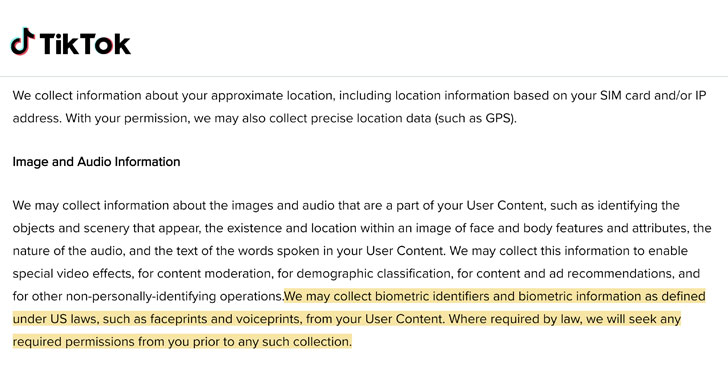
Popular short-form video-sharing service TikTok quietly revised its privacy policy in the U.S., allowing it to automatically collect biometric information such as faceprints and voiceprints from the content its users post on the platform.

The policy change, first spotted by TechCrunch, went into effect on June 2. TikTok users who reside in the European Economic Area (EEA), the U.K., Switzerland, and other geographies (excluding India) where the service operates are exempted from the changes.

“We may collect biometric identifiers and biometric information as defined under U.S. laws, such as faceprints and voiceprints, from your User Content. Where required by law, we will seek any required permissions from you prior to any such collection,” the ByteDance-owned company said in a newly introduced section called “Image and Audio Information.”

On top of this, the company’s privacy policy also notes that it may collect information about “the nature of the audio, and the text of the words spoken in your User Content” so as to “enable special video effects, for content moderation, for demographic classification, for content and ad recommendations, and for other non-personally-identifying operations.”

Besides not clearly defining the exact nature of biometrics being collected or offering a convincing reason as to why this data gathering is necessary in the first place, the vaguely worded language could allow TikTok to amass such sensitive data without users’ explicit consent.

Given that only a handful of states in the U.S. — California, Illinois, New York, Texas, and Washington — have laws restricting companies from collecting such data, the move could mean that TikTok doesn’t have to ask permission from its users in other states, as noted by TechCrunch. In other words, users are consenting to have their biometric data collected simply by agreeing to its terms of service.

The revisions to its privacy policy come months after TikTok agreed to pay $92 million to settle a class-action lawsuit that alleged the app violated the Illinois’ Biometric Information Privacy Act (BIPA) by clandestinely capturing biometric and personal data from users in the U.S. to target ads without meeting the informed consent requirements of the state law.

As part of the settlement, TikTok complied to avoid collecting or storing biometric information, biometric identifiers, geolocation, or GPS data unless expressly disclosed in its privacy policy. Viewed in this light, it’s possible that the changes are a result of the lawsuit agreement.

Found this article interesting? Follow THN on Facebook, Twitter and LinkedIn to read more exclusive content we post.

Read More

The post TikTok Quietly Updated Its Privacy Policy to Collect Users’ Biometric Data appeared first on Malware Devil.


https://malwaredevil.com/2021/06/05/tiktok-quietly-updated-its-privacy-policy-to-collect-users-biometric-data-2/?utm_source=rss&utm_medium=rss&utm_campaign=tiktok-quietly-updated-its-privacy-policy-to-collect-users-biometric-data-2

Break Into Ethical Hacking With 18 Training Courses For Just $42.99

It is predicted that 3.5 million jobs will be unfilled in the field of cybersecurity by the end of this year. Several of these jobs pay very well, and in most cases, you don’t even need a college degree to get hired.
The most important thing is to have the skills and certifications. The All-In-One 2021 Super-Sized Ethical Hacking Bundle helps you gain both, with 18 courses covering all aspects
Read More

The post Break Into Ethical Hacking With 18 Training Courses For Just $42.99 appeared first on Malware Devil.


https://malwaredevil.com/2021/06/05/break-into-ethical-hacking-with-18-training-courses-for-just-42-99-2/?utm_source=rss&utm_medium=rss&utm_campaign=break-into-ethical-hacking-with-18-training-courses-for-just-42-99-2

Break Into Ethical Hacking With 18 Training Courses For Just $42.99

It is predicted that 3.5 million jobs will be unfilled in the field of cybersecurity by the end of this year. Several of these jobs pay very well, and in most cases, you don’t even need a college degree to get hired.

The most important thing is to have the skills and certifications. The All-In-One 2021 Super-Sized Ethical Hacking Bundle helps you gain both, with 18 courses covering all aspects of cybersecurity. Normally, you pay $3,284 for this training, but you can get it now for only $42.99 via The Hacker New Deals.

The purpose of ethical hacking is to find weaknesses in the system that a malicious hacker may exploit. A certified expert can work either full-time or freelance, earning up to $149,000 a year, according to PayScale.

This bundle would be perfect for anyone interested in the field of cybersecurity, offering the opportunity to start off on the right foot.

Starting with the fundamentals, the beginner-friendly instruction will take you all the way to high-level techniques used by professionals.

With the help of 1,686 different tutorials, you will discover how to set up a secure Kali Linux system and start hacking with Python.

Python 3 Ethical Hacking Course — Zero to Mastery: In this course, you will learn how to code 10+ penetration testing tools from scratch.
Ethical Hacking & Penetration Testing — This course focuses on the practical side of penetration testing and ethical hacking, but you will also learn the theoretical side of each attack.
Website Hacking in Practice: Hands-On Course 101 — This training is more about understanding today’s top hacking threats: How to prevent and respond. With 21 different hacking techniques, you’ll learn how to apply them in real-world scenarios. This course will teach you the fundamentals of ethical hacking in a practical way.
Hacking Wireless Networks: Theory & Practice — In this course, you will learn the basics of hacking networks with examples.
Hacking in Practice: Certified Ethical Hacking Mega Course — Take the time to learn about today’s cyber threats & shut them down with over 20 hours of hands-on training.
Hack People, Systems & Mobile Devices — Learn how to hack mobile devices through advanced social engineering.
Learn Burp Suite for Advanced Web Penetration Testing — Get hands-on experience with Burp Suite, to gain practical experience of web penetration testing.
Learn Server Security with BitNinja — Detect and respond to threats in real time, handle false positives, and deal with false positives automatically.
All-in-One Hacking Guide: From Zero to Hero — Learn the methods and techniques used in penetration testing.
PenTesting with OWASP ZAP: Mastery Course — A must for hackers, PenTesters, developers, coders, and Security Professionals with years of experience.
Mastering Burp Suite Community Edition — Exploring Burp Suite Community Edition from a bug hunter’s perspective.
Kali Linux Hacker Tools, Tricks & Techniques — A Beginner’s Guide to Kali Linux for ethical hackers new to this world.
Bug Bounty: Web Hacking — Last year Facebook paid $5 million to independent hackers and Google paid over $6 million as part of its Bug Bounty programs. In this course, you’ll learn how to hack big companies like Facebook, Google, and PayPal and get paid for it.
Learn Network Attacks & Security — learn about different types of network attacks and how to protect yourself.
Master in Hacking with Metasploit — Metasploit is a powerful tool that contains 458 payloads, 1604 exploit modules, 913 helper modules and 275 post exploit modules. All tricks and techniques in this course have been tested and are 100% effective.
Introduction to Python & Hacking with Python — With this course, you can learn Python and then develop your own hacking tool using Python. This is an introductory course, you can sign up even if you don’t have any experience with Python.
Ethical Hacker Certification Course — In this course, you will learn about ethical hacking from A to Z; you can even write certification exams!
Full NMAP — In this course you will learn the secrets of Ethical Hacking and Network Discovery with NMAP.

With some coding knowledge under your belt, you dive into real-world techniques. In full-length courses, students learn how to hack web pages, wireless networks, and mobile devices.

Throughout the course, you will also learn how to automate tests, use popular hacker tools, and apply social engineering techniques.

This course is taught by a team of experts, including Gabriel Avramescu, rated at 4.4 stars on Udemy for his information security consulting work.

Take advantage of our lifetime access offer for just $42.99 and save well over $3,000 by purchasing the training today.

Found this article interesting? Follow THN on Facebook, Twitter and LinkedIn to read more exclusive content we post.

Read More

The post Break Into Ethical Hacking With 18 Training Courses For Just $42.99 appeared first on Malware Devil.


https://malwaredevil.com/2021/06/05/break-into-ethical-hacking-with-18-training-courses-for-just-42-99/?utm_source=rss&utm_medium=rss&utm_campaign=break-into-ethical-hacking-with-18-training-courses-for-just-42-99

TikTok Quietly Updated Its Privacy Policy to Collect Users’ Biometric Data

Popular short-form video-sharing service TikTok quietly revised its privacy policy in the U.S., allowing it to automatically collect biometric information such as faceprints and voiceprints from the content its users post on the platform.
The policy change, first spotted by TechCrunch, went into effect on June 2. TikTok users who reside in the European Economic Area (EEA), the U.K., Switzerland,
Read More

The post TikTok Quietly Updated Its Privacy Policy to Collect Users’ Biometric Data appeared first on Malware Devil.


https://malwaredevil.com/2021/06/05/tiktok-quietly-updated-its-privacy-policy-to-collect-users-biometric-data/?utm_source=rss&utm_medium=rss&utm_campaign=tiktok-quietly-updated-its-privacy-policy-to-collect-users-biometric-data

ALERT: Critical RCE Bug in VMware vCenter Server Under Active Attack

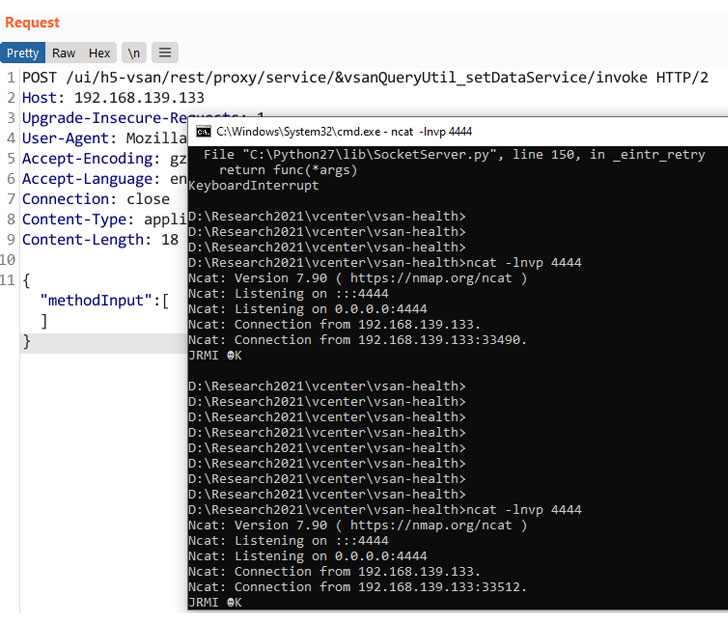
Malicious actors are actively mass scanning the internet for vulnerable VMware vCenter servers that are unpatched against a critical remote code execution flaw, which the company addressed late last month.

The ongoing activity was detected by Bad Packets on June 3 and corroborated yesterday by security researcher Kevin Beaumont. “Mass scanning activity detected from 104.40.252.159 checking for VMware vSphere hosts vulnerable to remote code execution,” tweeted Troy Mursch, chief research officer at Bad Packets.

The development follows the publication of a proof-of-concept (PoC) RCE exploit code targeting the VMware vCenter bug.

Tracked as CVE-2021-21985 (CVSS score 9.8), the issue is a consequence of a lack of input validation in the Virtual SAN (vSAN) Health Check plug-in, which could be abused by an attacker to execute commands with unrestricted privileges on the underlying operating system that hosts the vCenter Server.

Although the flaw was rectified by VMware on May 25, the company strongly urged its customers to apply the emergency change immediately. “In this era of ransomware it is safest to assume that an attacker is already inside the network somewhere, on a desktop and perhaps even in control of a user account, which is why we strongly recommend declaring an emergency change and patching as soon as possible,” VMware said.

This is not the first time adversaries have opportunistically mass scanned the internet for vulnerable VMware vCenter servers. A similar remote code execution vulnerability (CVE-2021-21972) that was patched by VMware in February became the target of cyber threat actors attempting to exploit and take control of unpatched systems.

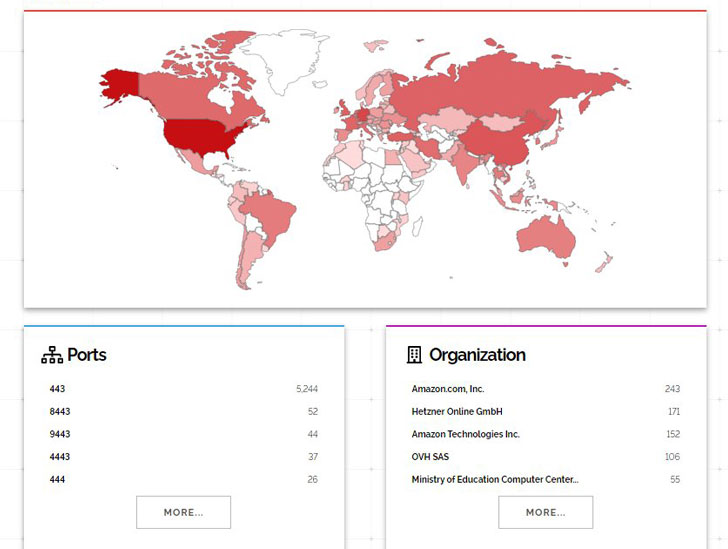
At least 14,858 vCenter servers were found reachable over the internet, according to Bad Packets and Binary Edge.

What’s more, a new research from Cisco Talos earlier this week found that the threat actor behind the Python-based Necro bot wormed its way into exposed VMware vCenter servers by abusing the same security weakness to boost the malware’s infection propagation capabilities.

Found this article interesting? Follow THN on Facebook, Twitter and LinkedIn to read more exclusive content we post.

Read More

The post ALERT: Critical RCE Bug in VMware vCenter Server Under Active Attack appeared first on Malware Devil.


https://malwaredevil.com/2021/06/05/alert-critical-rce-bug-in-vmware-vcenter-server-under-active-attack-2/?utm_source=rss&utm_medium=rss&utm_campaign=alert-critical-rce-bug-in-vmware-vcenter-server-under-active-attack-2

ALERT: Critical RCE Bug in VMware vCenter Server Under Active Attack

Malicious actors are actively mass scanning the internet for vulnerable VMware vCenter servers that are unpatched against a critical remote code execution flaw, which the company addressed late last month.
The ongoing activity was detected by Bad Packets on June 3 and corroborated yesterday by security researcher Kevin Beaumont. “Mass scanning activity detected from 104.40.252.159 checking for
Read More

The post ALERT: Critical RCE Bug in VMware vCenter Server Under Active Attack appeared first on Malware Devil.


https://malwaredevil.com/2021/06/05/alert-critical-rce-bug-in-vmware-vcenter-server-under-active-attack/?utm_source=rss&utm_medium=rss&utm_campaign=alert-critical-rce-bug-in-vmware-vcenter-server-under-active-attack

Researchers Uncover Hacking Operations Targeting Government Entities in South Korea

A North Korean threat actor active since 2012 has been behind a new espionage campaign targeting high-profile government officials associated with its southern counterpart to install an Android and Windows backdoor for collecting sensitive information.

Cybersecurity firm Malwarebytes attributed the activity to a threat actor tracked as Kimsuky, with the targeted entities comprising of the Ministry of Foreign Affairs, Ambassador of the Embassy of Sri Lanka to the State, International Atomic Energy Agency (IAEA) Nuclear Security Officer, and the Deputy Consul General at Korean Consulate General in Hong Kong.

The attacks also involved collecting information about other organizations and universities in the country, including the Korea Internet and Security Agency (KISA), Seoul National University, and Daishin Securities. Malwarebytes, however, noted that there is no evidence of active targeting or compromise by the adversary.

The development is only the latest in a series of surveillance efforts aimed at South Korea. Believed to be operating on behalf of the North Korean regime, Kimsuky (aka Velvet Chollima, Black Banshee, and Thallium) has a track record of singling out South Korean entities while expanding their victimology to the U.S., Russia, and various nations in Europe.

Last November, the adversary was linked to a new modular spyware suite called “KGH_SPY,” which allows it to carry out reconnaissance of target networks, log keystrokes, and steal confidential information, as well as a stealthy malware under the name “CSPY Downloader” that’s designed to thwart analysis and download additional payloads.

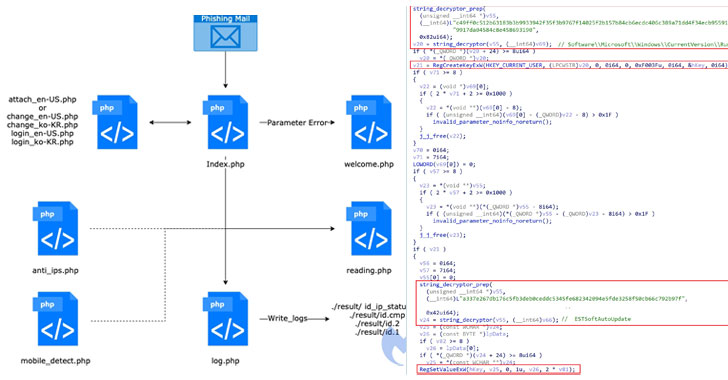
Kimsuky’s attack infrastructure consists of various phishing websites that mimic well known websites such as Gmail, Microsoft Outlook, and Telegram with an aim to trick victims into entering their credentials. “This is one of the main methods used by this actor to collect email addresses that later will be used to send spear-phishing emails,” Malwarebytes researcher Hossein Jazi said.

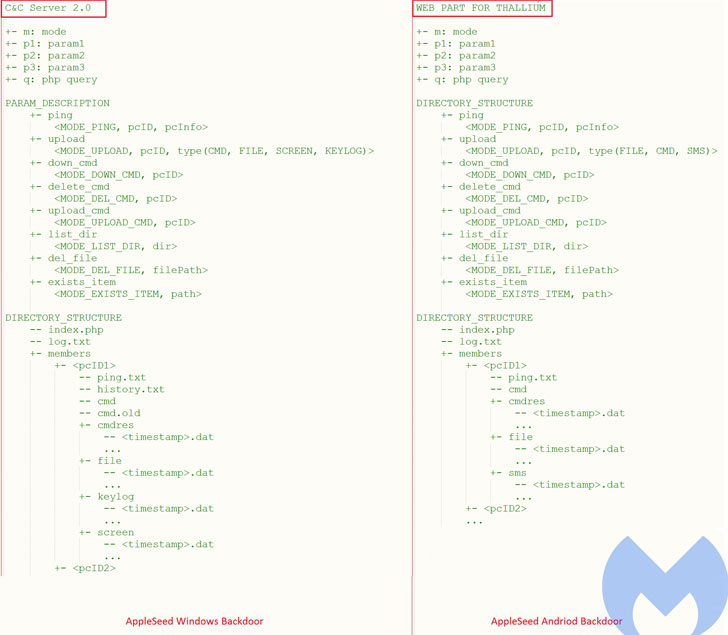
In using social engineering as a core component of its operations, the goal is to distribute a malware dropper that takes the form of a ZIP archive file attached to the emails, which ultimately leads to the deployment of an encoded DLL payload called AppleSeed, a backdoor that’s been put to use by Kimsuky as early as 2019.

“Besides using the AppleSeed backdoor to target Windows users, the actor also has used an Android backdoor to target Android users,” Jazi noted. “The Android backdoor can be considered as the mobile variant of the AppleSeed backdoor. It uses the same command patterns as the Windows one. Also, both Android and Windows backdoors have used the same infrastructure.”

AppleSeed has all the hallmarks of a typical backdoor, with myriad capabilities to record keystrokes, capture screenshots, collect documents with specific extensions (.txt, .ppt, .hwp, .pdf, and .doc), and gather data from removable media devices connected to the machine, all of which are then uploaded to a remote command-and-control server.

But perhaps the most interesting discovery of all is that the threat actor calls themselves Thallium in the malware source code, which is the moniker assigned by Microsoft based on its tradition of naming nation-state hacking groups after chemical elements.

Found this article interesting? Follow THN on Facebook, Twitter and LinkedIn to read more exclusive content we post.

Read More

The post Researchers Uncover Hacking Operations Targeting Government Entities in South Korea appeared first on Malware Devil.


https://malwaredevil.com/2021/06/05/researchers-uncover-hacking-operations-targeting-government-entities-in-south-korea-3/?utm_source=rss&utm_medium=rss&utm_campaign=researchers-uncover-hacking-operations-targeting-government-entities-in-south-korea-3

Strange goings on with port 37, (Thu, Jun 3rd)

Similar to Yee Ching’s diary on Thursday, I noticed an oddity in the Dshield data last weekend (which I had hoped to discuss in a diary on Wednesday, but life got in the way) and thought it was worth asking around to see if anyone knows what is going on. As soon as I saw it, I reconfigured my honeypots to try to capture the traffic, but wasn’t able to. I’m always very interested when I see some of the legacy ports and protocols pop up. In this case, %%port:37%% is the time protocol which operates on both TCP and UDP and is one of the many services that frequently ran on the low ports of Unix machines I administered back in the 1980s and 1990s. In recent years, most operating systems have disabled these services since they only seemed to be used for DDoS purposes. On Thursday, I took another look at the graph.

By default, we normally only show the Targets/Day and Sources/Day, but I’ve added in the Reports/Day and TCP Ratio for this analysis. The first thing that I noticed was the huge spike in reports. Our baseline was in the 200-500 reports/day range, but on 26 May, this jumped to around 46,000. So someone, was very actively looking, the other oddity to me was, that prior to the spike, nearly all of the probes were TCP, but from 25 May – 2 Jun, nearly all the attack traffic was UDP (the gold line on the graph above, ranges from 0 = all UDP to 100 = all TCP), which then seemed to disappear and return to the mostly TCP probes on 3 Jun when I took this snapshot. Since I was unable to capture any of the packets, I don’t know if there was some strange data there that might have shed some light on the purpose of this activity. The total number of sources was still pretty small ranging from a low of 69 on 25 May to 176 on 2 Jun. Meanwhile the number of targets ranged from 156 on 25 May to almost 700 on 27 May, which is right in the range of targets we’ve seen for the past 10 months (there was a flurry of activity on the port last June and July that spiked regularly around 2400-2500 targets, not shown in the graph above). 

So, I’m not sure what to make of it, especially without any packets. If any of you managed to capture any of this traffic last weekend and early this past week and care to share, we’d love to have a look. Otherwise, if you have any insight into what was going on, please share below or via our contact form. I’m always very curious about these traffic oddities.

—————
Jim Clausing, GIAC GSE #26
jclausing –at– isc [dot] sans (dot) edu

(c) SANS Internet Storm Center. https://isc.sans.edu Creative Commons Attribution-Noncommercial 3.0 United States License. Read More

The post Strange goings on with port 37, (Thu, Jun 3rd) appeared first on Malware Devil.


https://malwaredevil.com/2021/06/05/strange-goings-on-with-port-37-thu-jun-3rd/?utm_source=rss&utm_medium=rss&utm_campaign=strange-goings-on-with-port-37-thu-jun-3rd

Estadísticas globales del trabajo remoto en el 2020 para el futuro de TI

En el 2020, la pandemia forzó a las grandes corporaciones a ejecutar los planes que la mayoría había estado preparando desde hacía muchos años: tener una fuerza de trabajo híbrida.

Pero hacer que toda o parte de la fuerza de …

The post Estadísticas globales del trabajo remoto en el 2020 para el futuro de TI appeared first on ManageEngine Blog.

The post Estadísticas globales del trabajo remoto en el 2020 para el futuro de TI appeared first on Security Boulevard.

Read More

The post Estadísticas globales del trabajo remoto en el 2020 para el futuro de TI appeared first on Malware Devil.


https://malwaredevil.com/2021/06/04/estadisticas-globales-del-trabajo-remoto-en-el-2020-para-el-futuro-de-ti/?utm_source=rss&utm_medium=rss&utm_campaign=estadisticas-globales-del-trabajo-remoto-en-el-2020-para-el-futuro-de-ti

Qualys Helps Organizations Manage Risk with Cybersecurity Asset Management

You can’t protect what you can’t see. Yes, it is a tad trite at this point. As vendors have focused on comprehensive visibility in recent years, the phrase has almost become something of a buzzword. That in no way changes the truth of the statement, though. It is a simple fact. An accurate inventory of […]

The post Qualys Helps Organizations Manage Risk with Cybersecurity Asset Management appeared first on TechSpective.

The post Qualys Helps Organizations Manage Risk with Cybersecurity Asset Management appeared first on Security Boulevard.

Read More

The post Qualys Helps Organizations Manage Risk with Cybersecurity Asset Management appeared first on Malware Devil.


https://malwaredevil.com/2021/06/04/qualys-helps-organizations-manage-risk-with-cybersecurity-asset-management/?utm_source=rss&utm_medium=rss&utm_campaign=qualys-helps-organizations-manage-risk-with-cybersecurity-asset-management

Friday, June 4, 2021

Ask Chloé: Where to Begin In InfoSec

Welcome to the Ask Chloé column on Security Boulevard! Each week, Chloé provides advice to readers’ questions to help guide them as they navigate the technology industry. This week, Chloé helps a newbie explore the world of InfoSec.   Dear Chloé, I’ve been looking into cybersecurity, but don’t know where to even begin. What are the first..

The post Ask Chloé: Where to Begin In InfoSec appeared first on Security Boulevard.

Read More

The post Ask Chloé: Where to Begin In InfoSec appeared first on Malware Devil.


https://malwaredevil.com/2021/06/04/ask-chloe-where-to-begin-in-infosec/?utm_source=rss&utm_medium=rss&utm_campaign=ask-chloe-where-to-begin-in-infosec

Contextual Concurrency Control

Read More

The post Contextual Concurrency Control appeared first on Malware Devil.


https://malwaredevil.com/2021/06/04/contextual-concurrency-control/?utm_source=rss&utm_medium=rss&utm_campaign=contextual-concurrency-control

The High Cost of Privacy By Default

In the ongoing “war” between Facebook and Apple over privacy, Apple’s new operating system, iOS 14.5 contains a feature that most people assumed—incorrectly—was already part of the operating system; the ability to choose which apps collected and shared personal information about them. For a long time, Apple OS users have had the ability to tweak..

The post The High Cost of Privacy By Default appeared first on Security Boulevard.

Read More

The post The High Cost of Privacy By Default appeared first on Malware Devil.


https://malwaredevil.com/2021/06/04/the-high-cost-of-privacy-by-default/?utm_source=rss&utm_medium=rss&utm_campaign=the-high-cost-of-privacy-by-default

Google Chrome to Help Users Identify Untrusted Extensions Before Installation

Google on Thursday said it’s rolling new security features to Chrome browser aimed at detecting suspicious downloads and extensions via its Enhanced Safe Browsing feature, which it launched a year ago.
To this end, the search giant said it will now offer additional protections when users attempt to install a new extension from the Chrome Web Store, notifying if it can be considered “trusted.”
Read More

The post Google Chrome to Help Users Identify Untrusted Extensions Before Installation appeared first on Malware Devil.


https://malwaredevil.com/2021/06/04/google-chrome-to-help-users-identify-untrusted-extensions-before-installation/?utm_source=rss&utm_medium=rss&utm_campaign=google-chrome-to-help-users-identify-untrusted-extensions-before-installation

Compromised Cloud Costs Orgs $6.2 Million Annually

Compromised cloud accounts cost companies an average of $6.2 million each year according to the Ponemon Institute, and more than two-thirds of professionals said the compromised accounts represented a “significant security risk” to their companies. Organizations experience 138 hours of application downtime per year due to compromised cloud accounts, according to the Ponemon Institute report,..

The post Compromised Cloud Costs Orgs $6.2 Million Annually appeared first on Security Boulevard.

Read More

The post Compromised Cloud Costs Orgs $6.2 Million Annually appeared first on Malware Devil.


https://malwaredevil.com/2021/06/04/compromised-cloud-costs-orgs-6-2-million-annually/?utm_source=rss&utm_medium=rss&utm_campaign=compromised-cloud-costs-orgs-6-2-million-annually

Barbary Pirates and Russian Cybercrime

In 1801, the United States had a small Navy. Thomas Jefferson deployed almost half that Navy—three frigates and a schooner—to the Barbary C...