Malware Devil

Monday, June 7, 2021

Qualcomm IPQ40xx: Breaking into QSEE using Fault Injection

We’ve identified multiple critical software vulnerabilities in QSEE, Qualcomm’s Trusted Execution Environment (TEE), on Qualcomm IPQ40xx-based devices (see blog #1 and blog #2). We exploited these vulnerabilities in order to disable the secure range checks performed by QSEE in order to execute arbitrary code at the highest privilege (see blog #4). As these vulnerabilities are software vulnerabilities, they were easily fixed by Qualcomm after we disclosed them responsibly.

As you may have already raelized, at Raelize we like to look further than just software vulnerabilities. Therefore, we decided to analyze the resilience of the Qualcomm IPQ40xx-family of chip towards Electromagnetic Fault Injection (EMFI). We used the Linksys EA8300 WiFi router (see blog #2).

We are fully aware that FI attacks are typically out of scope for a TEE threat model. Actually, ARM specifies this very clearly in their documentation. However, TEEs are also used for devices where FI attacks are considered a reasonable threat. Therefore, even if FI attacks are out of scope for a TEE according to ARM, they may not be for specific devices. The TEE on such devices, may be used to protect assets interesting for an attacker, making it an (very) interesting attack surface. Whenever the underlying platform (i.e. hardware) is vulnerable to FI attacks, the security of a TEE can be (easily) compromised as we will see in this post.

At first, you may think that the ARM TrustZone hardware primitives (e.g. NS bit, TrustZone controllers, …) are the most interesting target for a FI attack. However, we decided to target the processor executing the QSEE software in order to show that other approaches are very effective as well.

EMFI

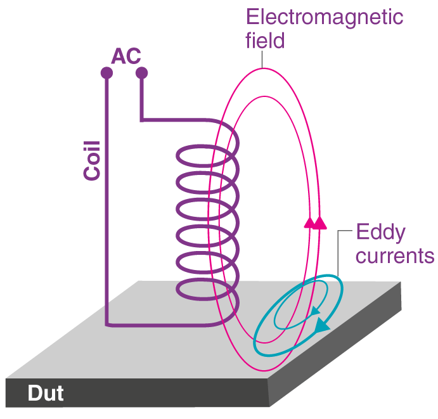
We use Riscure’s EMFI tooling to inject EM glitches in the chip. This tooling drives a high voltage through a coil in order to generate an electromagnetic field. This allows us to introduce faults at the transistor level due to eddy currents within the chip’s circuitry. The concept of EMFI is shown in the picture below (source).


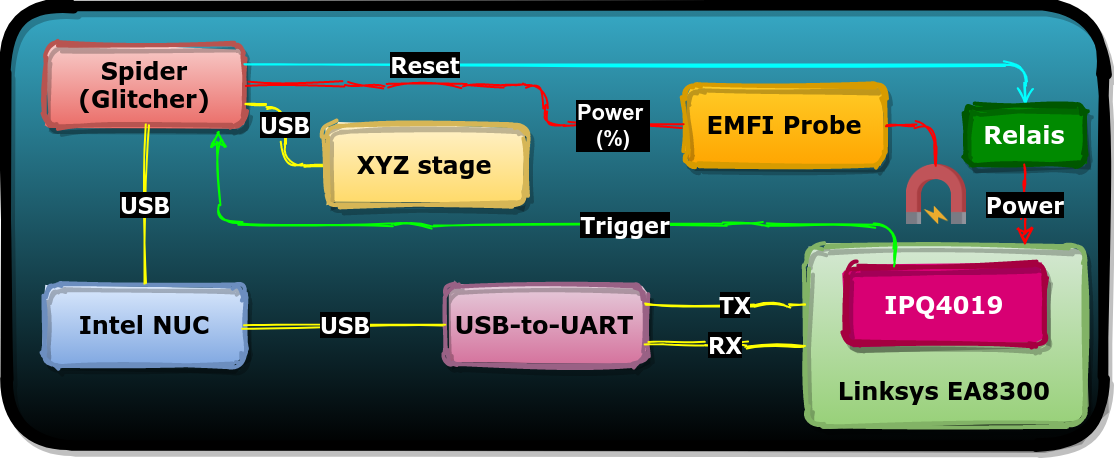
A diagram of our setup is shown below. We used the Riscure Spider, Riscure EMFI Probe and Riscure XYZ stage. Additionally, we use a solid-state relay to control the external power supply of the target. We control the all hardware using Riscure’s Inspector FI Python framework in order to, among others, the glitch parameters (i.e. position, timing and glitch power) completely automatically.


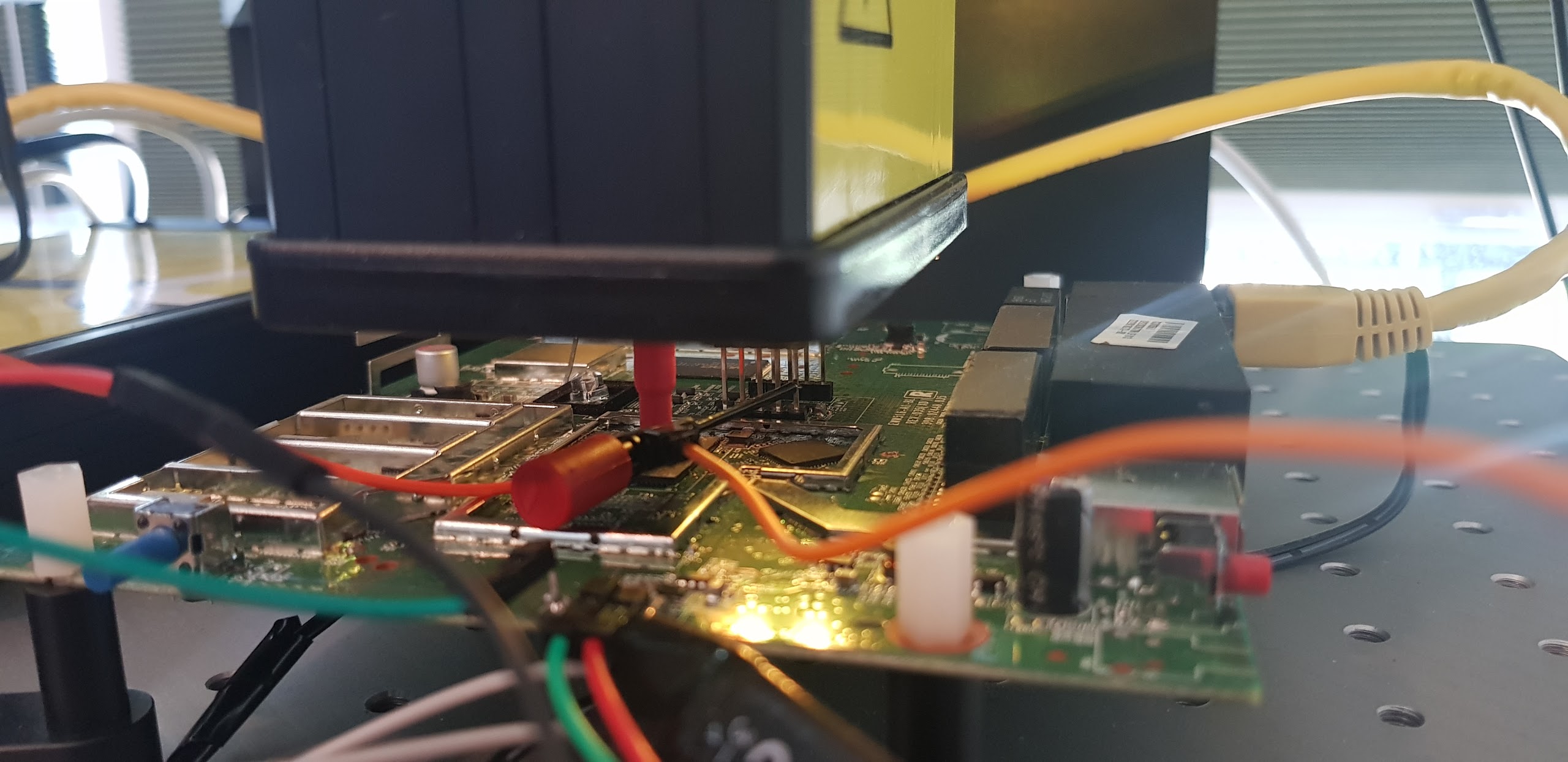
We perform the EMFI attack by placing the EM probe directly on the chip’s surface. In order to do so, we opened up the target and removed the chip’s heatsink. We made no other physical (invasive) modifications. An actual picture of the chip is shown below.


We often get asked if our lab-grade tooling made by Riscure is really required to perform our attacks. We believe it’s definitely possible to perform the same type of attacks using easier to obtain tooling like NewAE’s ChipShouter or to build your own tooling. However, the tooling we use makes it easier to identify and reproduce the attacks. Nonetheless, we would love to hear from you if you’re working on reproducing our research using other tooling.

Characterization

Whenever possible, we like to start with a FI characterization test in order to determine if the target is vulnerable. We implement the characterization code, which is shown below, as an U-Boot standalone application. The goal of this characterization test is to identify good glitch parameters (i.e. location and power) in a semi-controlled environment. By repeating the target instruction (i.e. add instruction) we increase the chances for success.

uint32_t *trigger = (uint32_t *)(0x0102f004);
if(cmd == ‘A’) {
uint32_t counter;
*trigger = 0x0; // 1. set trigger high
asm volatile (
“mov r0, #0;” // 2. set counter to 0
“add r0, r0, #1;” // 3. increase counter
< repeat 10,000 times>
“mov %[counter], r0;”
: [counter] “=r” (counter)
:
: “r0” );
*trigger = 0x3; // 4. set trigger to low
printf(“AAAA%08xBBBBn”, counter); // 5. print counter on UART
}

We use a GPIO pin of the target as a trigger to time the characterization test. This allows us to exactly inject glitches when the add instructions are executed. If the resulting counter value that’s printed on the serial interface is differently than expected, we know we successfully modified the expected behavior of the software.

After performing roughly 20,000 experiments across the chip’s surface, we observed different output, some of which are shown below. Most interesting of course, are the experiments where a modified counter value is returned. An indication that the target is vulnerable.

Type
Response
Expected
AAAA 00002710 BBBB
Reset/Mute
no output
Success
AAAA 0000270f BBBB
Success
AAAA 0000270e BBBB
Success
AAAA 0000270b BBBB

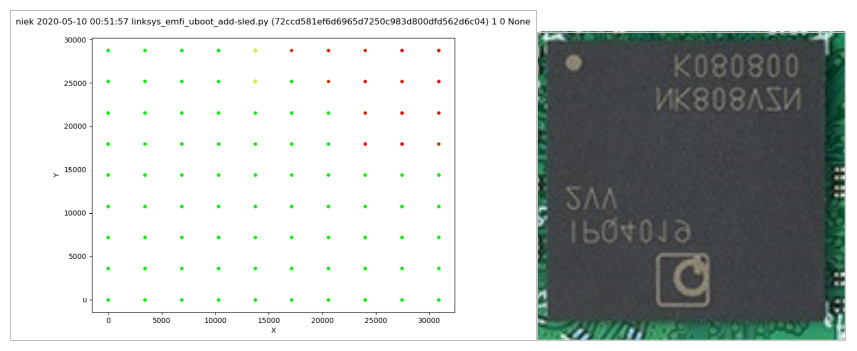
We plot the experiments based their classification in order to determine what’s a good location for the EMFI probe, which is shown below. Interestingly, we observe that all successful experiments occurred in a specific area on the chip’s surface.


Even though we determined that the target is vulnerable to EMFI, we don’t know yet if we can actually alter the QSEE software itself as we targeted only U-Boot code so far. However, as both U-Boot and QSEE are executed by the same processor, just with a different NS bit, we are confident the vulnerable locations we identified will yields faults in QSEE software too. Therefore, we place the probe on one of the locations where we observed a successful glitch. This allows us to target QSEE software without moving the probe, effectively removing the spatial parameter from the glitch parameter search space.

Disabling secure ranges

As earlier mentioned, we decided to target the QSEE software instead of the the underlying ARM TrustZone hardware primitives (e.g. NS-bit, TZASC).

We know from our earlier conducted QSEE software analysis that various security enforcements are entirely implemented by software. This includes for example the secure range checks which are performed by the SMC handler routines on the arguments received from the Rich Execution Environment (REE).

We decided to target a SMC handler routine that does not include any software vulnerability. One of the candidates that we identified is tzbsp_fver_get_version for which the decompilation is shown below.

int tzbsp_fver_get_version(uint32_t a1, uint32_t *a2, uint32_t a3)
{
uint32_t v4 = 0;
if ( !is_ree_range(off_87EAB290, a2, a2 + 3) ) // range check
return 0xFFFFFFEE;
if ( a3 < 4 || !a2 ) // argument check
return 0xFFFFFFF0;
*a2 = 0; // NULL-write
do {
if ( dword_87EABB48[2 * v4] == a1 ) // must fail
*a2 = dword_87EABB48[2 * v4 + 1];
++v4;
} while ( v4 < 0xC );
return 0;
}

The is_ree_range function checks if a2 and a2 +3 point to non-secure memory. This argument is passed from the REE and we assume that this argument is under control of the attacker. Simpler said, this function verifies if the buffer provided from the REE overlaps with secure memory. If it does, tzbsp_fver_get_version will immediately return 0xFFFFFFEE.

Using an EM glitch, we aim to to bypass the restrictions enforced by the is_ree_range function. This allows us to execute the remainder of tzbsp_fver_get_version in order to write NULL to an arbitrary address (incl. secure memory).

We communicate with tzbsp_fver_get_version from the REE using an U-Boot standalone application, which is shown below.

uint32_t a1 = 0xdeadbeef; // pass argument check
uint32_t a2 = 0x87EAB204; // secure memory address
uint32_t a3 = 4; // pass argument check
uint32_t a4 = 0; // NA
uint32_t *trigger = (uint32_t *)(0x0102f004);
// trigger up
*trigger = 0x0;
// calling tzbsp_fver_get_version()
uint32_t ret1 = scm_call_r(0x6, 0x3, a1, a2, a3, a4, 3);
// trigger down
*trigger = 0x3;
// calling tzbsp_fver_get_version()
uint32_t ret2 = scm_call_r(0x6, 0x3, a1, a2, a3, a4, 3);
// printing to serial interface
printf(“AAAA%08x%08x%08xBBBBn”, ret1, ret2, *(uint32_t *)a2);

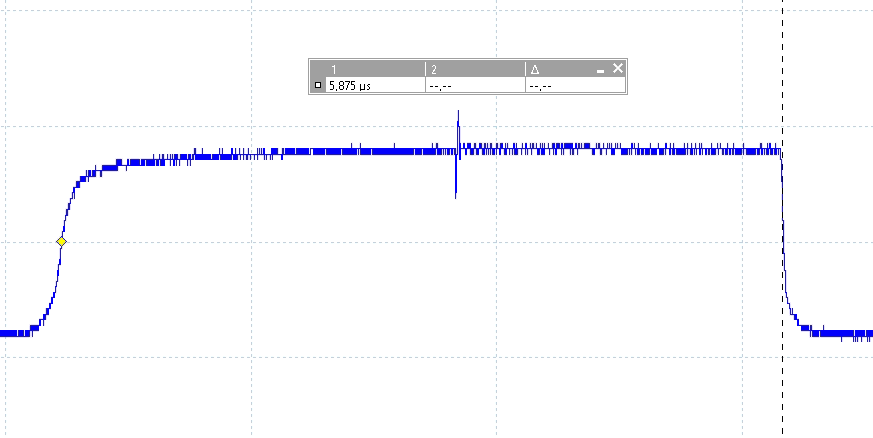
We use a GPIO signal as a trigger to time exactly when tzbsp_fver_get_version exactly is executed. The EM glitch is injected exactly between the moment the trigger is set high and set low, which takes approximately 5.875 microseconds (see picture below).


In the above code example, by writing NULL to 0x87EAB204, we disable one of the secure ranges defined in the secure range table. More details on how this exactly works will be explained in more detail in blog #4 of this series. For this post, it’s sufficient to raelize that a successful attack will disable the restrictions enforced by the secure range check for each SMC handler routine.

We execute tzbsp_fver_get_version a second time, with the same destination address, without injecting any glitch, in order to verify whether the attack was successful. If the secure range is successfully disabled, is_ree_range will consider any address passed from REE in a2 as valid, including secure memory addresses. The write to the secure memory address will then successfully complete as well.

Moreover, in the last line of the code, we dereference the secure range flag field from REE. This is done in order to verify that the malicious TEE write actually happened. It should be noted that, due to the (mis)configuration of the target, we are able to read secure memory from the REE.

Typically, this is not possible, or should NOT be possible, as, otherwise, any secret handled by QSEE would be exposed to the REE. In our setup, we only use this mis-configuration to double verify if an experiment is successful or not.

We expect at least the following type of results: expected, successful, processor exception and reset/mute experiments. The table below indicates the serial interface output we expect to receive for each result.

Type
Response
Expected
AAAAffffffeeffffffee00000002BBBB
Success
AAAA000000000000000000000000BBBB
Exceptions
undefined instruction
Reset/Mute
no output

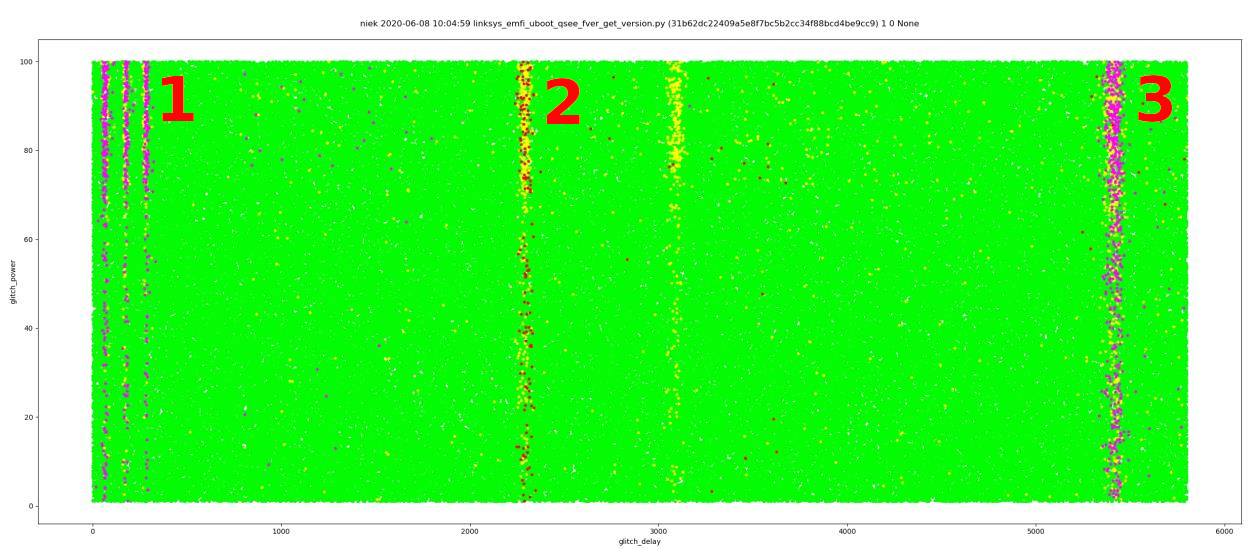
We performed roughly 300,000 experiments where we inject EM glitches within the entire attack window. We give each experiment a randomized power between 10% and 100%. The EM probe itself is fixed to a vulnerable location on the chip’s surface that we identified earlier. This entire campaign lasted roughly 12 hours. We plotted all experiments as is shown in the figure below.


We can summarize the plot as follows:

In area 1 we observe many processor exceptions. An indication that the glitch is injected while U-Boot code is being executed. In other words, we inject the glitch too soon.
In area 2 we observe many successful experiments. An indication that this is exactly the moment where we wan to inject the glitch. Moreover, this proves that this is the moment where tzbsp_fver_get_version is executed.
In area 3 we observe many processor exceptions. An indication that the glitch is injected while U-Boot code is being executed. In other words, we inject the glitch too late.

The success rate is fairly low. Most experiments, where we observe the expected response, are not successful. Nonetheless, we observe a success rate of 0.05%, which, at our testing speeds, translates to roughly 1 successful experiment every 5 minutes.

However, if we set the glitch parameters (i.e. glitch delay and glitch power) to that of a successful experiment, we observe a success rate of 5%, or roughly 1 successful experiment every 20 seconds. This shows that the reproducibility of bypassing the range check is very high. We feel comfortable saying that we are able to bypass any of the configured range checks, by using an EM glitch.

Achieving code execution

We know from our software vulnerability analysis that we are able to achieve code execution after the secure ranges are disabled. This will be described in full details in blog #4 (will be released soon).

Conclusion

We demonstrated that the Qualcomm IPQ40xx family of chips are vulnerable to EMFI. We exploited this vulnerability in order to bypass a secure range check performed by QSEE. This allows us to write a restricted value to an arbitrary address (incl. secure memory).

The attack can be described using our FIRM, as shown in the figure below. Once the optimal glitch parameters are found, the attack can be reproduced once every 20 seconds, which is a very high success rate.


We targeted the processor executing the QSEE software instead of the ARM TrustZone hardware primitives. This means that hardening these hardware primitives is not sufficient protection for hardening a device against FI attacks. We believe that hardening the processor itself is fundamental.

The impact of software vulnerabilities is typically much larger than (hardware) attacks that require physical access. Mass exploitation is for example typically not possible with FI attacks. Nonetheless, we like to stress that these type of attacks should not immediately be considered a harmless threat. For instance, they are often used to gain access to secured code or data in order to identify easier to exploit (software) vulnerabilities.

As a TEE is used to secure important assets, it will always be a very interesting target, also for FI-capable attackers. Of course, especially for devices where FI attacks are specifically included in the threat model and other components (e.g. ROM, bootloaders) are already hardened.

We’ve disclosed this vulnerability responsibly to Qualcomm using a coordinated disclosure process. They indicated that FI attacks are out of scope for the Qualcomm IPQ40xx family of chips and therefore the vulnerability will not be fixed. This choice is understandable, considering the typical TEE threat model. However, as a result, these chips will be vulnerable forever…

– Raelize.

Read More

The post Qualcomm IPQ40xx: Breaking into QSEE using Fault Injection appeared first on Malware Devil.


https://malwaredevil.com/2021/06/07/qualcomm-ipq40xx-breaking-into-qsee-using-fault-injection/?utm_source=rss&utm_medium=rss&utm_campaign=qualcomm-ipq40xx-breaking-into-qsee-using-fault-injection

The Cybersecurity Hero’s Journey is Ours

One of the oldest clichés in security is “security is a journey, not a destination.” It is clear that, when it comes to defending ourselves and the enterprise, we never reach the end. There is always going to be a new challenge. Life is that way. We are always moving. One theme associated with life’s..

The post The Cybersecurity Hero’s Journey is Ours appeared first on Security Boulevard.

Read More

The post The Cybersecurity Hero’s Journey is Ours appeared first on Malware Devil.


https://malwaredevil.com/2021/06/07/the-cybersecurity-heros-journey-is-ours/?utm_source=rss&utm_medium=rss&utm_campaign=the-cybersecurity-heros-journey-is-ours

Malware Can Use This Trick to Bypass Ransomware Defense in Antivirus Solutions

Researchers have disclosed significant security weaknesses in popular antivirus software applications that could be abused to deactivate their protections and take control of allow-listed applications to perform nefarious operations on behalf of the malware to defeat anti-ransomware defenses.

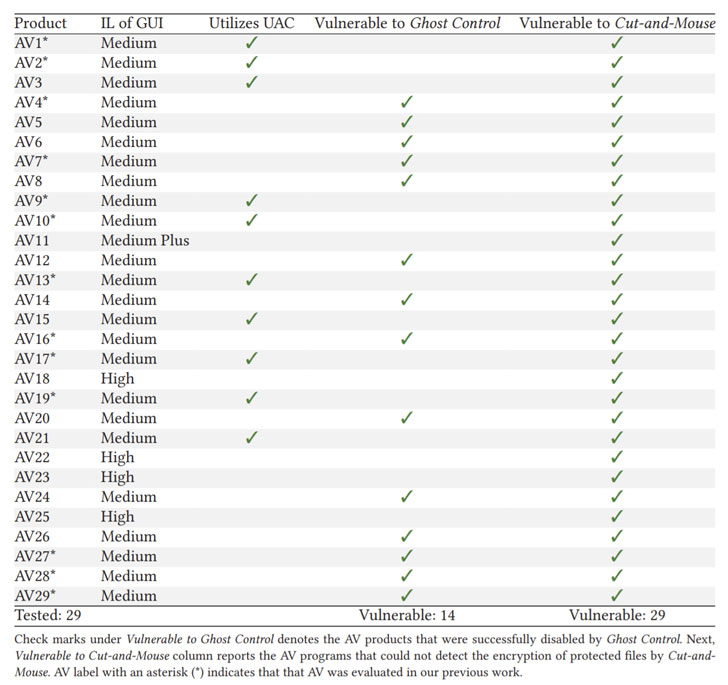
The twin attacks, detailed by academics from the University of Luxembourg and the University of London, are aimed at circumventing the protected folder feature offered by antivirus programs to encrypt files (aka “Cut-and-Mouse”) and disabling their real-time protection by simulating mouse “click” events (aka “Ghost Control”).

“Antivirus software providers always offer high levels of security, and they are an essential element in the everyday struggle against criminals,” said Prof. Gabriele Lenzini, chief scientist at the Interdisciplinary Center for Security, Reliability, and Trust at the University of Luxembourg. “But they are competing with criminals which now have more and more resources, power, and dedication.”

Put differently, shortcomings in malware mitigation software could not just permit unauthorized code to turn off their protection features, design flaws in Protected Folders solution provided by antivirus vendors could be abused by, say, ransomware to change the contents of files using an app that’s provisioned write access to the folder and encrypt user data, or a wipeware to irrevocably destroy personal files of victims.

Protected Folders allow users to specify folders that require an additional layer of protection against destructive software, thereby potentially blocking any unsafe access to the protected folders.

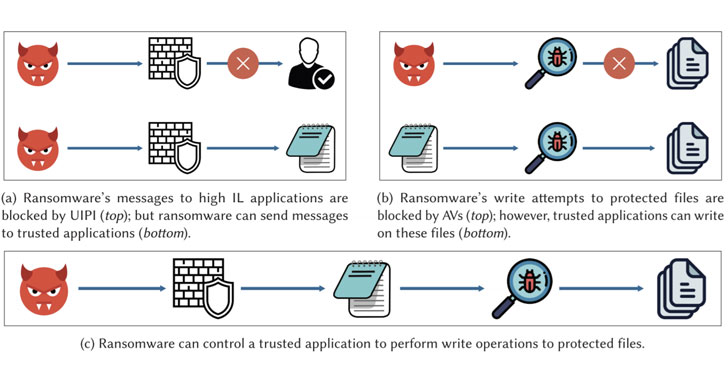
“A small set of whitelisted applications is granted privileges to write to protected folders,” the researchers said. “However, whitelisted applications themselves are not protected from being misused by other applications. This trust is therefore unjustified, since a malware can perform operations on protected folders by using whitelisted applications as intermediaries.”

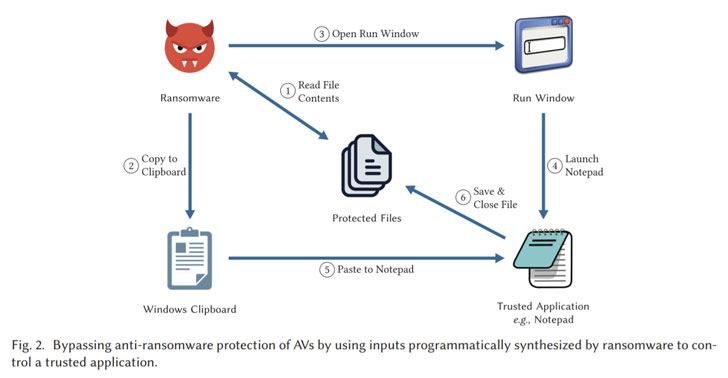
An attack scenario devised by the researchers revealed that malicious code could be used to control a trusted application like Notepad to perform write operations and encrypt the victim’s files stored in the protected folders. To this end, the ransomware reads the files in the folders, encrypts them in memory, and copies them to the system clipboard, following which the ransomware launches Notepad to overwrite the folder contents with the clipboard data.

Even worse, by leveraging Paint as a trusted application, the researchers found that the aforementioned attack sequence could be used to overwrite user’s files with a randomly generated image to destroy them permanently.

Ghost Control attack, on the other hand, could have serious consequences of its own, as turning off real-time malware protection by simulating legitimate user actions performed on the user interface of an antivirus solution could permit an adversary to drop and execute any rogue program from a remote server under their control.

Of the 29 antivirus solutions evaluated during the study, 14 of them were found vulnerable to the Ghost Control attack, while all 29 antivirus programs tested were found to be at risk from the Cut-and-Mouse attack. The researchers didn’t name the vendors who were affected.

If anything, the findings are a reminder that security solutions that are explicitly designed to safeguard digital assets from malware attacks can suffer from weaknesses themselves, thus defeating their very purpose. Even as antivirus software providers continue to step up defenses, malware authors have sneaked past such barriers through evasion and obfuscation tactics, not to mention bypassing their behavioral detection using adversarial inputs via poisoning attacks.

“Secure composability is a well-known problem in security engineering,” the researchers said. “Components that, when taken in isolation, offer a certain known attack surface do generate a wider surface when integrated into a system. Components interact one another and with other parts of the system create a dynamic with which an attacker can interact too and in ways that were not foreseen by the designer.”

Found this article interesting? Follow THN on Facebook, Twitter and LinkedIn to read more exclusive content we post.

Read More

The post Malware Can Use This Trick to Bypass Ransomware Defense in Antivirus Solutions appeared first on Malware Devil.


https://malwaredevil.com/2021/06/07/malware-can-use-this-trick-to-bypass-ransomware-defense-in-antivirus-solutions-3/?utm_source=rss&utm_medium=rss&utm_campaign=malware-can-use-this-trick-to-bypass-ransomware-defense-in-antivirus-solutions-3

Security Alert: [Updated] Alert Regarding Vulnerabilities (CVE-2021-21985, CVE-2021-21986) in VMware vCenter Server

JPCERT-AT-2021-0025
JPCERT/CC
2021-05-25(Initial)
2021-06-07(Update)

I. Overview

On May 25, 2021 (US Time), VMware has released advisory(VMSA-2021-0010) regarding vulnerabilities in VMware vCenter Server.A remote attacker with network access to port 443 may execute commands with unrestricted privileges on the underlying operating system by leveraging these vulnerabilities. For more information, please refer to the information provided by VMware.

VMware
VMSA-2021-0010
https://www.vmware.com/security/advisories/VMSA-2021-0010.html

If you are using a product which is affected by these vulnerabilities,please apply the measures by referring to “III. Solution” and”IV. Workarounds”.

JPCERT/CC has confirmed that proof of concept code that exploits the vulnerability (CVE-2021-21985) to execute arbitrary code on the affected system has been made public. In addition, information regarding scanning activities that search for the vulnerability (CVE-2021-21985) has been observed since May 28, 2021.

If you are using a product that is affected by this vulnerability, and especially if the product can be directly accessed from the Internet,it is highly recommended to apply countermeasures or workarounds immediately.

II. Affected Products and Versions

Affected products and versions are as follows:

– vCenter Server versions 7.0 prior to 7.0 U2b
– vCenter Server versions 6.7 prior to 6.7 U3n
– vCenter Server versions 6.5 prior to 6.5 U3p
– Cloud Foundation (vCenter Server) versions 4.x prior to 4.2.1
– Cloud Foundation (vCenter Server) versions 3.x prior to 3.10.2.1

III. Solution

VMware has released versions that address the vulnerability.Please consider updating to an updated version.

– vCenter Server version 7.0 U2b
– vCenter Server version 6.7 U3n
– vCenter Server version 6.5 U3p
– Cloud Foundation (vCenter Server) version 4.2.1
– Cloud Foundation (vCenter Server) version 3.10.2.1

IV. Workarounds

The following measures are mentioned as workarounds. For detailed steps and notions when applying the workarounds, please refer to the information provided by VMware.

– Disable the affected plugin by setting it to incompatible

VMware
How to Disable VMware Plugins in vCenter Server (83829)
https://kb.vmware.com/s/article/83829

V. References

VMware
VMSA-2021-0010: What You Need to Know
https://blogs.vmware.com/vsphere/2021/05/vmsa-2021-0010.html

VMware
Questions & Answers for VMSA-2021-0010
https://core.vmware.com/resource/vmsa-2021-0010-faq

If you have any information regarding this alert, please contact JPCERT/CC.

2021-05-25 First edition
2021-06-07 Updated “I. Overview”

JPCERT Coordination Center (Early Warning Group)
MAIL: ew-info@jpcert.or.jp
https://www.jpcert.or.jp/english/

Read More

The post Security Alert: [Updated] Alert Regarding Vulnerabilities (CVE-2021-21985, CVE-2021-21986) in VMware vCenter Server appeared first on Malware Devil.


https://malwaredevil.com/2021/06/07/security-alert-updated-alert-regarding-vulnerabilities-cve-2021-21985-cve-2021-21986-in-vmware-vcenter-server/?utm_source=rss&utm_medium=rss&utm_campaign=security-alert-updated-alert-regarding-vulnerabilities-cve-2021-21985-cve-2021-21986-in-vmware-vcenter-server

Amazon Sidewalk, NFTs and Cybersecurity, Norton 360 Cryptocurrency Mining

Is Amazon Sidewalk the latest threat to our privacy? Also, what’s the big deal about NFTs, and why mining cryptocurrency through your anti-virus software is a horrible idea. ** Links mentioned on the show ** What Does Amazon Sidewalk Mean for Your Privacy? https://www.makeuseof.com/what-does-amazon-sidewalk-mean-for-your-privacy/ https://thehackernews.com/2021/05/your-amazon-devices-to-automatically.html Token Resistance: Tackling the New NFT Threat Landscape https://securityintelligence.com/articles/new-threat-landscape-nfts/ A […]

The post Amazon Sidewalk, NFTs and Cybersecurity, Norton 360 Cryptocurrency Mining appeared first on The Shared Security Show.

The post Amazon Sidewalk, NFTs and Cybersecurity, Norton 360 Cryptocurrency Mining appeared first on Security Boulevard.

Read More

The post Amazon Sidewalk, NFTs and Cybersecurity, Norton 360 Cryptocurrency Mining appeared first on Malware Devil.


https://malwaredevil.com/2021/06/07/amazon-sidewalk-nfts-and-cybersecurity-norton-360-cryptocurrency-mining/?utm_source=rss&utm_medium=rss&utm_campaign=amazon-sidewalk-nfts-and-cybersecurity-norton-360-cryptocurrency-mining

ESB-2021.1913.2 – UPDATE [Win][UNIX/Linux] McAfee Database Security (DBSec): Multiple vulnerabilities

—–BEGIN PGP SIGNED MESSAGE—–
Hash: SHA256

===========================================================================
AUSCERT External Security Bulletin Redistribution

ESB-2021.1913.2
Security Bulletin – Database Security update fixes five vulnerabilities
7 June 2021

===========================================================================

AusCERT Security Bulletin Summary
———————————

Product: McAfee Database Security (DBSec)
Publisher: McAfee
Operating System: Windows
UNIX variants (UNIX, Linux, OSX)
Impact/Access: Administrator Compromise — Remote/Unauthenticated
Access Privileged Data — Existing Account
Cross-site Scripting — Existing Account
Reduced Security — Existing Account
Resolution: Patch/Upgrade
CVE Names: CVE-2021-31831 CVE-2021-31830 CVE-2021-23896
CVE-2021-23895 CVE-2021-23894

Original Bulletin:
https://kc.mcafee.com/corporate/index?page=content&id=SB10359

Revision History: June 7 2021: Vendor changed CVE-2021-23897 to CVE-2021-31830, and CVE-2021-23898 CVE-2021-31831.
June 3 2021: Initial Release

– ————————–BEGIN INCLUDED TEXT——————–

Security Bulletins ID : SB10359

Last Modified : 6/2/2021

Summary

First Published: June 1, 2021

Recent updates to this article
+——————-+———————————————————+
| Date | Update |
+——————-+———————————————————+
| June 2, 2021 | Changed CVE-2021-23897 to CVE-2021-31830, and |
| | CVE-2021-23898 CVE-2021-31831. |
+——————-+———————————————————+

To receive email notification when this Security Bulletin is updated, click
Subscribe on the right side of the page. You must be logged on to subscribe.
+—————-+———+————–+—————–+——–+——–+
| | | | | |CVSS |
| |Impacted | |Impact of |Severity|v3.1 |
|Product: |Versions:|CVE ID: |Vulnerabilities: |Ratings:|Base/ |
| | | | | |Temporal|
| | | | | |Scores: |
+—————-+———+————–+—————–+——–+——–+
|Database |Prior to | |CWE-502: | |9.6 / |
|Security ( DBSec|4.8.2 |CVE-2021-23894|Deserialization |Critical|8.6 |
|) | | |of Untrusted Data| | |
+—————-+———+————–+—————–+——–+——–+
| |Prior to | |CWE-502: | |9.0 / |
|DBSec |4.8.2 |CVE-2021-23895|Deserialization |Critical|8.1 |
| | | |of Untrusted Data| | |
+—————-+———+————–+—————–+——–+——–+
| | | |CWE-319: | | |
| |Prior to | |Cleartext | |3.2 / |
|DBSec |4.8.2 |CVE-2021-23896|Transmission of |Low |2.9 |
| | | |Sensitive | | |
| | | |Information | | |
+—————-+———+————–+—————–+——–+——–+
| | | |CWE-79: Improper | | |
| | | |Neutralization of| | |
|DBSec |Prior to |CVE-2021-31830|Input During Web |Medium |5.9 / |
| |4.8.2 | |Page Generation | |5.3 |
| | | |(‘Cross-site | | |
| | | |Scripting’) | | |
+—————-+———+————–+—————–+——–+——–+
| | | |CWE-552: Files or| | |
|DBSec |Prior to |CVE-2021-31831|Directories |Medium |4.9 / |
| |4.8.2 | |Accessible to | |4.4 |
| | | |External Parties | | |
+—————-+———+————–+—————–+——–+——–+
|Recommendations:|Install or update to DBSec 4.8.2 |
+—————-+————————————————————+
|Security | |
|Bulletin |None |
|Replacement: | |
+—————-+————————————————————+
|Location of | |
|updated |http://www.mcafee.com/us/downloads/downloads.aspx |
|software: | |
+—————-+————————————————————+

Article contents:

o Vulnerability Description
o Remediation
o Frequently Asked Questions (FAQs)
o Resources
o Disclaimer

Vulnerability Description
DBSec is designed to be installed on a private network. As such all
administrative, and server to database, connections are within a secured
network.

1. CVE-2021-23894
Deserialization of untrusted data vulnerability in McAfee Database Security
( DBSec ) prior to 4.8.2 allows a remote unauthenticated attacker to create
a reverse shell with administrator privileges on the DBSec server via
carefully constructed Java serialized object sent to the DBSec server.
https://web.nvd.nist.gov/view/vuln/detailvulnId=CVE-2021-23894
https://cve.mitre.org/cgi-bin/cvename.cginame=CVE-2021-23894
2. CVE-2021-23895
Deserialization of untrusted data vulnerability in McAfee Database Security
( DBSec ) prior to 4.8.2 allows a remote authenticated attacker to create a
reverse shell with administrator privileges on the DBSec server via
carefully constructed Java serialized object sent to the DBSec server.
https://web.nvd.nist.gov/view/vuln/detailvulnId=CVE-2021-23895
https://cve.mitre.org/cgi-bin/cvename.cginame=CVE-2021-23895
3. CVE-2021-23896
Cleartext Transmission of Sensitive Information vulnerability in the
administrator interface of McAfee Database Security ( DBSec ) prior to
4.8.2 allows an administrator to view the unencrypted password of the
McAfee Insights Server used to pass data to the Insights Server. This user
is restricted to only have access to DBSec data in the Insights Server.
https://web.nvd.nist.gov/view/vuln/detailvulnId=CVE-2021-23896
https://cve.mitre.org/cgi-bin/cvename.cginame=CVE-2021-23896
4. CVE-2021-31830
Improper Neutralization of Input During Web Page Generation (‘Cross-site
Scripting’) vulnerability in McAfee Database Security ( DBSec ) prior to
4.8.2 allows an administrator to embed JavaScript code when configuring the
name of a database to be monitored. This would be triggered when any
authorized user logs into the DBSec interface and opens the properties
configuration page for this database.
https://web.nvd.nist.gov/view/vuln/detailvulnId=CVE-2021-31830
https://cve.mitre.org/cgi-bin/cvename.cginame=CVE-2021-31830
5. CVE-2021-31831
Incorrect access to deleted scripts vulnerability in McAfee Database
Security ( DBSec ) prior to 4.8.2 allows a remote authenticated attacker to
gain access to signed SQL scripts which have been marked as deleted or
expired within the administrative console. This access was only available
through the REST API.
The scripts are retained to allow them to be used when analyzing older
events should they be required in the future. The impact has been judged to
be low as it is expected that the scripts are created in good faith.
https://web.nvd.nist.gov/view/vuln/detailvulnId=CVE-2021-31831
https://cve.mitre.org/cgi-bin/cvename.cginame=CVE-2021-31831

Remediation
To remediate this issue, update to DBSec 4.8.2.

Go to the Product Downloads site , and download the applicable product update
file:
+——-+——-+——+————+
|Product|Version|Type |Release Date|
+——-+——-+——+————+
|DBSec |4.8.2 |Update|June 1, 2021|
+——-+——-+——+————+

Download and Installation Instructions
For instructions to download McAfee product updates and hotfixes, see: KB56057
– – How to download Enterprise product updates and documentation . Review the
Release Notes and the Installation Guide for instructions on how to install
these updates. All documentation is available at https://docs.mcafee.com .
Frequently Asked Questions (FAQs)
How do I know if my McAfee product is vulnerable or not
For endpoint products:
Use the following instructions for endpoint or client-based products:

1. Right-click the McAfee tray shield icon on the Windows taskbar.
2. Select Open Console .
3. In the console, select Action Menu .
4. In the Action Menu, select Product Details . The product version displays.

What is CVSS
CVSS, or Common Vulnerability Scoring System, is the result of the National
Infrastructure Advisory Council’s effort to standardize a system of assessing
the criticality of a vulnerability. This system offers an unbiased criticality
score between 0 and 10 that customers can use to judge how critical a
vulnerability is and plan accordingly. For more information, visit the CVSS
website at: https://www.first.org/cvss/ .

When calculating CVSS scores, McAfee has adopted a philosophy that fosters
consistency and repeatability. Our guiding principle for CVSS scoring is to
score the exploit under consideration by itself. We consider only the immediate
and direct impact of the exploit under consideration. We do not factor into a
score any potential follow-on exploits that might be made possible by the
successful exploitation of the issue being scored.

What are the CVSS scoring metrics

1. CVE-2021-23894: Unauthorized deserialization of untrusted data in DBSec
+————————+——————–+
|Base Score |9.6 |
+————————+——————–+
|Attack Vector (AV) |Adjacent Network (A)|
+————————+——————–+
|Attack Complexity (AC) |Low (L) |
+————————+——————–+
|Privileges Required (PR)|None (N) |
+————————+——————–+
|User Interaction (UI) |None (N) |
+————————+——————–+
|Scope (S) |Changed (C) |
+————————+——————–+
|Confidentiality (C) |High (H) |
+————————+——————–+
|Integrity (I) |High (H) |
+————————+——————–+
|Availability (A) |High (H) |
+————————+——————–+
|Temporal Score (Overall)|8.6 |
+————————+——————–+
|Exploitability (E) |Proof-of-Concept (P)|
+————————+——————–+
|Remediation Level (RL) |Official Fix (O) |
+————————+——————–+
|Report Confidence (RC) |Confirmed (C) |
+————————+——————–+

NOTE: The below CVSS version 3.1 vector was used to generate this score.
https://nvd.nist.gov/vuln-metrics/cvss/v3-calculatorvector=AV:A/AC:L/PR:N/
UI:N/S:C/C:H/I:H/A:H/E:P/RL:O/RC:C&version=3.1
2. CVE-2021-23895: Authorized deserialization of untrusted data in DBSec
+————————+——————–+
|Base Score |9.0 |
+————————+——————–+
|Attack Vector (AV) |Adjacent Network (A)|
+————————+——————–+
|Attack Complexity (AC) |Low (L) |
+————————+——————–+
|Privileges Required (PR)|Low (L) |
+————————+——————–+
|User Interaction (UI) |None (N) |
+————————+——————–+
|Scope (S) |Changed (C) |
+————————+——————–+
|Confidentiality (C) |High (H) |
+————————+——————–+
|Integrity (I) |High (H) |
+————————+——————–+
|Availability (A) |High (H) |
+————————+——————–+
|Temporal Score (Overall)|8.1 |
+————————+——————–+
|Exploitability (E) |Proof-of-Concept (P)|
+————————+——————–+
|Remediation Level (RL) |Official Fix (O) |
+————————+——————–+
|Report Confidence (RC) |Confirmed (C) |
+————————+——————–+

NOTE: The below CVSS version 3.1 vector was used to generate this score.
https://nvd.nist.gov/vuln-metrics/cvss/v3-calculatorvector=AV:A/AC:L/PR:L/
UI:N/S:C/C:H/I:H/A:H/E:P/RL:O/RC:C&version=3.1
3. CVE-2021-23896: Cleartext Transmission of Sensitive Information in DBSec
+————————+——————–+
|Base Score |3.2 |
+————————+——————–+
|Attack Vector (AV) |Adjacent Network (A)|
+————————+——————–+
|Attack Complexity (AC) |Low (L) |
+————————+——————–+
|Privileges Required (PR)|High (H) |
+————————+——————–+
|User Interaction (UI) |Required (R) |
+————————+——————–+
|Scope (S) |Unchanged (U) |
+————————+——————–+
|Confidentiality (C) |Low (L) |
+————————+——————–+
|Integrity (I) |Low (L) |
+————————+——————–+
|Availability (A) |None (N) |
+————————+——————–+
|Temporal Score (Overall)|2.9 |
+————————+——————–+
|Exploitability (E) |Proof-of-Concept (P)|
+————————+——————–+
|Remediation Level (RL) |Official Fix (O) |
+————————+——————–+
|Report Confidence (RC) |Confirmed (C) |
+————————+——————–+

NOTE: The below CVSS version 3.1 vector was used to generate this score.
https://nvd.nist.gov/vuln-metrics/cvss/v3-calculatorvector=AV:A/AC:L/PR:H/
UI:R/S:U/C:L/I:L/A:N/E:P/RL:O/RC:C&version=3.1
4. CVE-2021-31830: Cross site Scripting (XSS) vulnerability in DBSec
+————————+——————–+
|Base Score |5.9 |
+————————+——————–+
|Attack Vector (AV) |Adjacent Network (A)|
+————————+——————–+
|Attack Complexity (AC) |Low (L) |
+————————+——————–+
|Privileges Required (PR)|High (H) |
+————————+——————–+
|User Interaction (UI) |Required (R) |
+————————+——————–+
|Scope (S) |Unchanged (U) |
+————————+——————–+
|Confidentiality (C) |High (H) |
+————————+——————–+
|Integrity (I) |High (H) |
+————————+——————–+
|Availability (A) |None (N) |
+————————+——————–+
|Temporal Score (Overall)|5.3 |
+————————+——————–+
|Exploitability (E) |Proof-of-Concept (P)|
+————————+——————–+
|Remediation Level (RL) |Official Fix (O) |
+————————+——————–+
|Report Confidence (RC) |Confirmed (C) |
+————————+——————–+

NOTE: The below CVSS version 3.1 vector was used to generate this score.
https://nvd.nist.gov/vuln-metrics/cvss/v3-calculatorvector=AV:A/AC:L/PR:H/
UI:R/S:U/C:H/I:H/A:N/E:P/RL:O/RC:C&version=3.1
5. CVE-2021-31831: Incorrect access to deleted scripts vulnerability in DBSec
+————————+——————–+
|Base Score |4.9 |
+————————+——————–+
|Attack Vector (AV) |Adjacent Network (A)|
+————————+——————–+
|Attack Complexity (AC) |Low (L) |
+————————+——————–+
|Privileges Required (PR)|Low (L) |
+————————+——————–+
|User Interaction (UI) |Required (R) |
+————————+——————–+
|Scope (S) |Unchanged (U) |
+————————+——————–+
|Confidentiality (C) |Low (L) |
+————————+——————–+
|Integrity (I) |Low (L) |
+————————+——————–+
|Availability (A) |Low (L) |
+————————+——————–+
|Temporal Score (Overall)|4.4 |
+————————+——————–+
|Exploitability (E) |Proof-of-Concept (P)|
+————————+——————–+
|Remediation Level (RL) |Official Fix (O) |
+————————+——————–+
|Report Confidence (RC) |Confirmed (C) |
+————————+——————–+

NOTE: The below CVSS version 3.1 vector was used to generate this score.
https://nvd.nist.gov/vuln-metrics/cvss/v3-calculatorvector=AV:A/AC:L/PR:L/
UI:R/S:U/C:L/I:L/A:L/E:P/RL:O/RC:C&version=3.1

Where can I find a list of all Security Bulletins
All Security Bulletins are published on our external PSIRT website at https://
www.mcafee.com/us/threat-center/product-security-bulletins.aspx . To see
Security Bulletins for McAfee Enterprise products on this website click
Enterprise Security Bulletins . Security Bulletins are retired (removed) once a
product is both End of Sale and End of Support (End of Life).

How do I report a product vulnerability to McAfee
If you have information about a security issue or vulnerability with a McAfee
product, visit the McAfee PSIRT website for instructions at https://
www.mcafee.com/us/threat-center/product-security-bulletins.aspx . To report an
issue, click Report a Security Vulnerability .

How does McAfee respond to this and any other reported security flaws
Our key priority is the security of our customers. If a vulnerability is found
within any McAfee software or services, we work closely with the relevant
security software development team to ensure the rapid and effective
development of a fix and communication plan.

McAfee only publishes Security Bulletins if they include something actionable
such as a workaround, mitigation, version update, or hotfix. Otherwise, we
would simply be informing the hacker community that our products are a target,
putting our customers at greater risk. For products that are updated
automatically, a non-actionable Security Bulletin might be published to
acknowledge the discoverer.

View our PSIRT policy on the McAfee PSIRT website at https://www.mcafee.com/us/
threat-center/product-security-bulletins.aspx by clicking About PSIRT .
Resources
To contact Technical Support, log on to the ServicePortal and go to the Create
a Service Request page at https://support.mcafee.com/ServicePortal/faces/
serviceRequests/createSR :

o If you are a registered user, type your User ID and Password, and then
click Log In .
o If you are not a registered user, click Register and complete the required
fields. Your password and logon instructions will be emailed to you.

Disclaimer
The information provided in this Security Bulletin is provided as is without
warranty of any kind. McAfee disclaims all warranties, either express or
implied, including the warranties of merchantability and fitness for a
particular purpose. In no event shall McAfee or its suppliers be liable for any
damages whatsoever including direct, indirect, incidental, consequential, loss
of business profits or special damages, even if McAfee or its suppliers have
been advised of the possibility of such damages. Some states do not allow the
exclusion or limitation of liability for consequential or incidental damages so
the preceding limitation may not apply.

Any future product release dates mentioned in this Security Bulletin are
intended to outline our general product direction, and they should not be
relied on in making a purchasing decision. The product release dates are for
information purposes only, and may not be incorporated into any contract. The
product release dates are not a commitment, promise, or legal obligation to
deliver any material, code, or functionality. The development, release, and
timing of any features or functionality described for our products remains at
our sole discretion and may be changed or canceled at any time.

– ————————–END INCLUDED TEXT——————–

You have received this e-mail bulletin as a result of your organisation’s
registration with AusCERT. The mailing list you are subscribed to is
maintained within your organisation, so if you do not wish to continue
receiving these bulletins you should contact your local IT manager. If
you do not know who that is, please send an email to auscert@auscert.org.au
and we will forward your request to the appropriate person.

NOTE: Third Party Rights
This security bulletin is provided as a service to AusCERT’s members. As
AusCERT did not write the document quoted above, AusCERT has had no control
over its content. The decision to follow or act on information or advice
contained in this security bulletin is the responsibility of each user or
organisation, and should be considered in accordance with your organisation’s
site policies and procedures. AusCERT takes no responsibility for consequences
which may arise from following or acting on information or advice contained in
this security bulletin.

NOTE: This is only the original release of the security bulletin. It may
not be updated when updates to the original are made. If downloading at
a later date, it is recommended that the bulletin is retrieved directly
from the author’s website to ensure that the information is still current.

Contact information for the authors of the original document is included
in the Security Bulletin above. If you have any questions or need further
information, please contact them directly.

Previous advisories and external security bulletins can be retrieved from:

https://www.auscert.org.au/bulletins/

===========================================================================
Australian Computer Emergency Response Team
The University of Queensland
Brisbane
Qld 4072

Internet Email: auscert@auscert.org.au
Facsimile: (07) 3365 7031
Telephone: (07) 3365 4417 (International: +61 7 3365 4417)
AusCERT personnel answer during Queensland business hours
which are GMT+10:00 (AEST).
On call after hours for member emergencies only.
===========================================================================
—–BEGIN PGP SIGNATURE—–
Comment: http://www.auscert.org.au/render.html?it=1967

iQIVAwUBYL2/EONLKJtyKPYoAQiMHA/8Cpy+0iNHIc6J1dXRaFr4WeMLCzSVozn3
4NLHNZw+09Msg7h9O1nONTSS+VTCc1rz3VOFb95aUm/H0DlB21tNb56ZxE6Hv9yu
KII0hC+JHla6WLV8FUXLdllsgRCJZHgSnICJntfP/P5mVz1LsvwMcBVvShVPiJFW
0sGIhv3rvZrosQKF1NkYPzVZeNEe6G8Wukw855e9gS/PQBtrfnjV9RTY/YKioJKB
7fH+i4lbe8Uy6we+wGbL3k/LEVMWhnWu76XKo289r8Ya++vht5drv2NySK3wP8pe
COR6IU6oPdMTkmByl8IHSRC+Ab0K/K0s9DKp3mRtM/zWkctFEQwm+sOZBUCTtrsk
4bIekVKc2U3vg4VBR5Qs4yHfsYd0ct9ySBy36gdMSxqJQKGC+nRI2v0P8wY9xZqO
UzenWzCkTV6k/Ui2xT7SgxZnPeYzO20+4rhFJK3Equs49YOjw8S8OwJU7Fe3S6Qs
iIdsPKD1jx8vAYu4jw826pWKnKQ2ICCRGcSRvetUzZQDGdEKCKpnshxUOzOIlesU
NhzqbCgdHp7YzrhGQxtuheOHthQUjAVR4kal5ZeYWaX0ModAkaaoDHkbI5bGuC3+
Pujo5uPeUBwg5cl5bLdi0bfT8IAscihBINLZMZxXibQlsFyX1SQR+ZtvYwjuYQYo
SMuXruWS+XU=
=KcBt
—–END PGP SIGNATURE—–

Read More

The post ESB-2021.1913.2 – UPDATE [Win][UNIX/Linux] McAfee Database Security (DBSec): Multiple vulnerabilities appeared first on Malware Devil.


https://malwaredevil.com/2021/06/07/esb-2021-1913-2-update-winunix-linux-mcafee-database-security-dbsec-multiple-vulnerabilities/?utm_source=rss&utm_medium=rss&utm_campaign=esb-2021-1913-2-update-winunix-linux-mcafee-database-security-dbsec-multiple-vulnerabilities

ISC Stormcast For Monday, June 7th, 2021 https://isc.sans.edu/podcastdetail.html?id=7530, (Mon, Jun 7th)

(c) SANS Internet Storm Center. https://isc.sans.edu Creative Commons Attribution-Noncommercial 3.0 United States License. Read More

The post ISC Stormcast For Monday, June 7th, 2021 https://isc.sans.edu/podcastdetail.html?id=7530, (Mon, Jun 7th) appeared first on Malware Devil.


https://malwaredevil.com/2021/06/07/isc-stormcast-for-monday-june-7th-2021-https-isc-sans-edu-podcastdetail-htmlid7530-mon-jun-7th/?utm_source=rss&utm_medium=rss&utm_campaign=isc-stormcast-for-monday-june-7th-2021-https-isc-sans-edu-podcastdetail-htmlid7530-mon-jun-7th

ASB-2021.0113 – [Win] Microsoft Edge (Chromium-based): Increased privileges – Remote with user interaction

—–BEGIN PGP SIGNED MESSAGE—–
Hash: SHA256

===========================================================================
AUSCERT Security Bulletin

ASB-2021.0113
Microsoft Edge (Chromium-based) Elevation of Privilege Vulnerability
7 June 2021

===========================================================================

AusCERT Security Bulletin Summary
———————————

Product: Microsoft Edge (Chromium-based)
Operating System: Windows
Impact/Access: Increased Privileges — Remote with User Interaction
Resolution: Patch/Upgrade
CVE Names: CVE-2021-33741

OVERVIEW

The following Chrome CVE has been released on June 4, 2021.

This CVE was assigned by Chrome. Microsoft Edge (Chromium-based)
ingests Chromium, which addresses these vulnerabilities.
Please see Google Chrome Releases for more information. [1]

Edge version: 91.0.864.41
Chromium version: 91.0.4472.77 [2]

IMPACT

The following vulnerability has been addressed:

*CVE-2021-33741

See Security Update Guide Supports CVEs Assigned by Industry Partners [3]
for more information about third-party CVEs in the Security Update Guide.

MITIGATION

It is advised to update Edge to the latest release.

REFERENCES

[1] Google Chrome Releases
https://chromereleases.googleblog.com/2021

[2] Security Update Guide
https://msrc.microsoft.com/update-guide/en-us

[3] Security Update Guide Supports CVEs Assigned by Industry Partners
https://msrc-blog.microsoft.com/2021/01/13/security-update-guide-supports-cves-assigned-by-industry-partners

AusCERT has made every effort to ensure that the information contained
in this document is accurate. However, the decision to use the information
described is the responsibility of each user or organisation. The decision to
follow or act on information or advice contained in this security bulletin is
the responsibility of each user or organisation, and should be considered in
accordance with your organisation’s site policies and procedures. AusCERT
takes no responsibility for consequences which may arise from following or
acting on information or advice contained in this security bulletin.

===========================================================================
Australian Computer Emergency Response Team
The University of Queensland
Brisbane
Qld 4072

Internet Email: auscert@auscert.org.au
Facsimile: (07) 3365 7031
Telephone: (07) 3365 4417 (International: +61 7 3365 4417)
AusCERT personnel answer during Queensland business hours
which are GMT+10:00 (AEST).
On call after hours for member emergencies only.
===========================================================================
—–BEGIN PGP SIGNATURE—–
Comment: http://www.auscert.org.au/render.html?it=1967

iQIVAwUBYL2vOONLKJtyKPYoAQgmvRAAqMOoPTePMErMbWLuhxhTRGn03pKZs5YU
eJ72UGTz8aI7Hv9f9UuZ6fWPMT+tVHsNnsdMD00Bjzl1u9Kkul2RfAjzdKMl1g14
AWB5Af5ZrBNzIlF76C2BB4+cZt348UPu/gDOCQmLrX2HGg2OEPXAcGPDeFRUnO6q
yqs4vWFMJR6xeQssKVwt+Bf/Y3spi5oJbd0HBV3ogaJubkrl7Ehl+BADkn2sZ87N
x23oe1tEO/TTW3mJvoFNfFGp8EV8JBJ20PtGMoABFNqj7e/uW0ZHZCpx4Pf/+iIE
kJsEels1TbD60i5sg+5B5E4jAOWQ66oW2lQ/5DQH7aLf1+lcyj5YCQUQT+Sb4kie
+JYhFINgIgYecfzQAuJHE++6yueBiKW+SZaihK3tLHbJaqNFVtz4+7fWKkinhTA4
k9nr280lvEru4WHkRpjlUtDRE1cBgcS8APMB6hVOVDb0LNnDrQLAZCeQ3p42go8a
NyZkxC5qrm2o10HaZZc8faTu9vDl4kAAEZQiXOs6uV4M1sAfFt9qsXWDGVr+aJ24
nWAvc+gOGl7G9eBSHfdzbbDbFpL45zD6tWOVr9Hq+TAaSghGPxBJ1/Uo2nvJQ8YS
6oIFcxYiogE/jBhrqU0y11MTLSnDSIGgCAYgKCHhXnMuICmMtZPwDb6vzHVFWv+e
K5z6uTGdwpg=
=hJx8
—–END PGP SIGNATURE—–

Read More

The post ASB-2021.0113 – [Win] Microsoft Edge (Chromium-based): Increased privileges – Remote with user interaction appeared first on Malware Devil.


https://malwaredevil.com/2021/06/07/asb-2021-0113-win-microsoft-edge-chromium-based-increased-privileges-remote-with-user-interaction/?utm_source=rss&utm_medium=rss&utm_campaign=asb-2021-0113-win-microsoft-edge-chromium-based-increased-privileges-remote-with-user-interaction

ESB-2021.1966 – [Debian] python-django: Multiple vulnerabilities

—–BEGIN PGP SIGNED MESSAGE—–
Hash: SHA256

===========================================================================
AUSCERT External Security Bulletin Redistribution

ESB-2021.1966
python-django security update
7 June 2021

===========================================================================

AusCERT Security Bulletin Summary
———————————

Product: python-django
Publisher: Debian
Operating System: Debian GNU/Linux
Impact/Access: Access Confidential Data — Remote/Unauthenticated
Unauthorised Access — Remote/Unauthenticated
Resolution: Patch/Upgrade
CVE Names: CVE-2021-33571 CVE-2021-33203

Reference: ESB-2021.1917

Original Bulletin:
https://lists.debian.org/debian-lts-announce/2021/06/msg00004.html

– ————————–BEGIN INCLUDED TEXT——————–

– —–BEGIN PGP SIGNED MESSAGE—–
Hash: SHA256

– – ————————————————————————-
Debian LTS Advisory DLA-2676-1 debian-lts@lists.debian.org
https://www.debian.org/lts/security/ Chris Lamb
June 05, 2021 https://wiki.debian.org/LTS
– – ————————————————————————-

Package : python-django
Version : 1:1.10.7-2+deb9u14
CVE IDs : CVE-2021-33203 CVE-2021-33571
Debian Bug : #989394

Two issues were discovered in Django, the Python-based web
development framework:

* CVE-2021-33203: Potential directory traversal via admindocs

Staff members could use the admindocs TemplateDetailView view to
check the existence of arbitrary files. Additionally, if (and only
if) the default admindocs templates have been customized by the
developers to also expose the file contents, then not only the
existence but also the file contents would have been exposed.

As a mitigation, path sanitation is now applied and only files
within the template root directories can be loaded.

This issue has low severity, according to the Django security
policy.

Thanks to Rasmus Lerchedahl Petersen and Rasmus Wriedt Larsen from
the CodeQL Python team for the report.

* CVE-2021-33571: Possible indeterminate SSRF, RFI, and LFI attacks
since validators accepted leading zeros in IPv4 addresses

URLValidator, validate_ipv4_address(), and
validate_ipv46_address() didn’t prohibit leading zeros in octal
literals. If you used such values you could suffer from
indeterminate SSRF, RFI, and LFI attacks.

validate_ipv4_address() and validate_ipv46_address() validators
were not affected on Python 3.9.5+.

This issue has medium severity, according to the Django security
policy.

For Debian 9 “Stretch”, this problem has been fixed in version
1:1.10.7-2+deb9u14.

We recommend that you upgrade your python-django packages.

For the detailed security status of python-django please refer to
its security tracker page at:
https://security-tracker.debian.org/tracker/python-django

Further information about Debian LTS security advisories, how to apply
these updates to your system and frequently asked questions can be
found at: https://wiki.debian.org/LTS

– —–BEGIN PGP SIGNATURE—–

iQIzBAEBCAAdFiEEwv5L0nHBObhsUz5GHpU+J9QxHlgFAmC7SrkACgkQHpU+J9Qx
HlhfOxAAmBjCvWfUXv60dy2++hoDImfYP2jr5fhx965OAaHZj1B64pxwN8Le8gZR
ivEc/GpPsexkiLxyGKGzswcb/qJeRTHeu0hurpuXN2ICg2ZE8p1II3WzGaURip5I
JbOkOJ4tZdL6/KauNRAuRJpjA56yfdAl1kgavTB9KWD+f1FtuMLT88S/xPtnVBRc
nNUYv5oqkcDwfY+KfyegemEYYsyqhUbd0+g5yhjiJyCz+nI2woumfJTsS1E4Xvof
hvyOx2p4GVK2FKP4+gA/9DgGlZzZfe+7xKu+aw7iINEFidakl6kvAri7r2ew0KS2
drBn7qj5mEIbr+QbjdOWemwFy2nJpQvSmYGS86srSil2znObrJnBtNrhae3vyEqI
3QyQDlFanyNHPuf+7y8MntDBnXm1S09sEL0CGe8dn5IPpqTXfqRpfRDN1In3eKkj
BZ5P1rgVBKXlHDj2vF5SJdo6VXcMFMF1Sm8hfkbZ+JBbeXA7e8pv+0Chndd85VL1
UgNpy7DZtIQyEUTfqZbBf2yAjoxs/rUZ5eZZTg+nSLwimqhP+Vff4f6wagS+zCC6
hRbdlhAbVrRlVZa0Yqa7BY4UnIthq/5cjC1AR0KIwxHTOoR3p5g1UHFsv8+Nyx6v
FG8mbsMwqWaZX0J8hZ8JsXH5ZjhCw122G8mauEKi9BZSNFVeDXw=
=3FDW
– —–END PGP SIGNATURE—–

– ————————–END INCLUDED TEXT——————–

You have received this e-mail bulletin as a result of your organisation’s
registration with AusCERT. The mailing list you are subscribed to is
maintained within your organisation, so if you do not wish to continue
receiving these bulletins you should contact your local IT manager. If
you do not know who that is, please send an email to auscert@auscert.org.au
and we will forward your request to the appropriate person.

NOTE: Third Party Rights
This security bulletin is provided as a service to AusCERT’s members. As
AusCERT did not write the document quoted above, AusCERT has had no control
over its content. The decision to follow or act on information or advice
contained in this security bulletin is the responsibility of each user or
organisation, and should be considered in accordance with your organisation’s
site policies and procedures. AusCERT takes no responsibility for consequences
which may arise from following or acting on information or advice contained in
this security bulletin.

NOTE: This is only the original release of the security bulletin. It may
not be updated when updates to the original are made. If downloading at
a later date, it is recommended that the bulletin is retrieved directly
from the author’s website to ensure that the information is still current.

Contact information for the authors of the original document is included
in the Security Bulletin above. If you have any questions or need further
information, please contact them directly.

Previous advisories and external security bulletins can be retrieved from:

https://www.auscert.org.au/bulletins/

===========================================================================
Australian Computer Emergency Response Team
The University of Queensland
Brisbane
Qld 4072

Internet Email: auscert@auscert.org.au
Facsimile: (07) 3365 7031
Telephone: (07) 3365 4417 (International: +61 7 3365 4417)
AusCERT personnel answer during Queensland business hours
which are GMT+10:00 (AEST).
On call after hours for member emergencies only.
===========================================================================
—–BEGIN PGP SIGNATURE—–
Comment: http://www.auscert.org.au/render.html?it=1967

iQIVAwUBYL2abuNLKJtyKPYoAQgnlg/8DoHC0PN6fL57eFY3ngW7BdvkNQlbZmV8
ptzu7iNxr8wxElyOW5Q7wkkvitIqXyJ78cL8E1Bj1Na6DNSkr6xFhYV7QZS49Lgo
bULi3EtlaigwU1XY26WXidoBKHnVsMOOi+BYnpnL+RW7RhappY8qemXO7rSq82E/
keKxkZFcsQMDBrqATZ4mVOT3RY2n4uV7y7cGNLGad1GL6pOMB+rVKr5CrPOOV/2L
MXZsoy4g/T0xXmUSj75713JxcyB+tejyL9MKH/jtEUyw5EGKJQ7Zu85wnDikW/c3
3FOvqAbEIu8gacSmWp+XL5V471/ZRqLwwK6j8rEYGtOA/Jgj+U2g+h6y2ufDcxE4
SEKdiX6j6ZaJ2JKLhjUwQUgC4uVs1UL45vM8teHNJ4zFxJrZkykkaJLQnkLVRBd/
5cClWpz8yjF6ncFS3UWRZiJV77G9bDa3Rce88lr4m17z8qLwJkRBSIu7nTULJjMf
sEi/M8bQVpEFpImmHzu5GPjYeLLHbkgpYCenBukq2S1wZVVjyKo6xzsXLnjL1SES
kgtc3wkBajDPwLKrTrcSSJ5/FxZ67F8+hsjBTilFhXj3k4lendXRk89qJ3gs+VjN
V1lD+XfqWmfTyHW12OOMb4Z8gXVo/XrMILF26tRFYsGA6PpJJUrN2rLvrrJvgqeF
jQOxZcEKhfA=
=YQpN
—–END PGP SIGNATURE—–

Read More

The post ESB-2021.1966 – [Debian] python-django: Multiple vulnerabilities appeared first on Malware Devil.


https://malwaredevil.com/2021/06/07/esb-2021-1966-debian-python-django-multiple-vulnerabilities/?utm_source=rss&utm_medium=rss&utm_campaign=esb-2021-1966-debian-python-django-multiple-vulnerabilities

ESB-2021.1967 – [Debian] ruby-nokogiri: Multiple vulnerabilities

—–BEGIN PGP SIGNED MESSAGE—–
Hash: SHA256

===========================================================================
AUSCERT External Security Bulletin Redistribution

ESB-2021.1967
ruby-nokogiri security update
7 June 2021

===========================================================================

AusCERT Security Bulletin Summary
———————————

Product: ruby-nokogiri
Publisher: Debian
Operating System: Debian GNU/Linux
Impact/Access: Access Confidential Data — Existing Account
Reduced Security — Existing Account
Resolution: Patch/Upgrade
CVE Names: CVE-2020-26247

Reference: ESB-2021.0345
ESB-2021.0285

Original Bulletin:
https://lists.debian.org/debian-lts-announce/2021/06/msg00007.html

– ————————–BEGIN INCLUDED TEXT——————–

– ————————————————————————-
Debian LTS Advisory DLA-2678-1 debian-lts@lists.debian.org
https://www.debian.org/lts/security/ Markus Koschany
June 06, 2021 https://wiki.debian.org/LTS
– ————————————————————————-

Package : ruby-nokogiri
Version : 1.6.8.1-1+deb9u1
CVE ID : CVE-2020-26247
Debian Bug : 978967

An XXE vulnerability was found in Nokogiri, a Rubygem providing HTML, XML, SAX,
and Reader parsers with XPath and CSS selector support.

XML Schemas parsed by Nokogiri::XML::Schema were trusted by default, allowing
external resources to be accessed over the network, potentially enabling XXE or
SSRF attacks. The new default behavior is to treat all input as untrusted.
The upstream advisory provides further information how to mitigate the problem
or restore the old behavior again.

https://github.com/sparklemotion/nokogiri/security/advisories/GHSA-vr8q-g5c7-m54m

For Debian 9 stretch, this problem has been fixed in version
1.6.8.1-1+deb9u1.

We recommend that you upgrade your ruby-nokogiri packages.

For the detailed security status of ruby-nokogiri please refer to
its security tracker page at:
https://security-tracker.debian.org/tracker/ruby-nokogiri

Further information about Debian LTS security advisories, how to apply
these updates to your system and frequently asked questions can be
found at: https://wiki.debian.org/LTS

– —–BEGIN PGP SIGNATURE—–

iQKTBAABCgB9FiEErPPQiO8y7e9qGoNf2a0UuVE7UeQFAmC9G2tfFIAAAAAALgAo
aXNzdWVyLWZwckBub3RhdGlvbnMub3BlbnBncC5maWZ0aGhvcnNlbWFuLm5ldEFD
RjNEMDg4RUYzMkVERUY2QTFBODM1RkQ5QUQxNEI5NTEzQjUxRTQACgkQ2a0UuVE7
UeRilRAAtbkOrvtzNZYPsMDC8QMgDt7SZc6nkgych1dVFCXmniKX3P3/TUpDtc8x
ofzdElUbyxRxxAbto3ttvc+L+K9vrBx6YLIM/qd0+HJyxF/XjD/jlEDnJ/GOo5a6
QAhpWcyVIr7utRFa69K+9EoeIXvLLWjlzmUKUk2EkFVocb7NJ/oHFH2/kBHVmlqm
L7odXl/3E8stmdsO+XixdxrX0gjBvaco4EARTN1Fwa9dq28RtuV7kK1WOEq57f49
wOG/N7cPAR/QURDNhrJKDAMh1PVLSk/j3pI+0hXJ9LXzQTu+SjFb7fDyCTQ3YPjS
LzDqGQebvnhTDivHKkEwuwzX6gYPOfBFvhGy+Z1ZnIszcqAO7zwXnofWDH6zxAf6
Tp+lNt9y37Ib7zDo0jZhkeVwCHEM+9PqxbPdno/sHfvyQntZEt5MszlPd5/MHQZv
txgI8GL2KuYLV8URn8rE9Imd0RPjU5jMm6f60sBiiCcC8NPd8rhbS4246AYYf+P9
TJzPuLX25ARDYjdX9XB5B6pz9RFdZRdieHp5m0Z4GBxsMvTW/ca4yN4Qpsa39r5z
fV+hw2+1E1ds3S6fA0SX9palSMiM8LP9PeUA9OMpV9JY6+uzy/MSSvlkJN5D8tSu
x2hcFG/aHAnOjkTUMmMD+5rejwtqp12r0HXqU+KUfrsGpjyYk6A=
=TZhT
– —–END PGP SIGNATURE—–

– ————————–END INCLUDED TEXT——————–

You have received this e-mail bulletin as a result of your organisation’s
registration with AusCERT. The mailing list you are subscribed to is
maintained within your organisation, so if you do not wish to continue
receiving these bulletins you should contact your local IT manager. If
you do not know who that is, please send an email to auscert@auscert.org.au
and we will forward your request to the appropriate person.

NOTE: Third Party Rights
This security bulletin is provided as a service to AusCERT’s members. As
AusCERT did not write the document quoted above, AusCERT has had no control
over its content. The decision to follow or act on information or advice
contained in this security bulletin is the responsibility of each user or
organisation, and should be considered in accordance with your organisation’s
site policies and procedures. AusCERT takes no responsibility for consequences
which may arise from following or acting on information or advice contained in
this security bulletin.

NOTE: This is only the original release of the security bulletin. It may
not be updated when updates to the original are made. If downloading at
a later date, it is recommended that the bulletin is retrieved directly
from the author’s website to ensure that the information is still current.

Contact information for the authors of the original document is included
in the Security Bulletin above. If you have any questions or need further
information, please contact them directly.

Previous advisories and external security bulletins can be retrieved from:

https://www.auscert.org.au/bulletins/

===========================================================================
Australian Computer Emergency Response Team
The University of Queensland
Brisbane
Qld 4072

Internet Email: auscert@auscert.org.au
Facsimile: (07) 3365 7031
Telephone: (07) 3365 4417 (International: +61 7 3365 4417)
AusCERT personnel answer during Queensland business hours
which are GMT+10:00 (AEST).
On call after hours for member emergencies only.
===========================================================================
—–BEGIN PGP SIGNATURE—–
Comment: http://www.auscert.org.au/render.html?it=1967

iQIVAwUBYL2al+NLKJtyKPYoAQg3ag/8DBghx/S66qSxha7ESIkxjViRCQpW7Ne8
FjyWmKAFd/1MdtgRRieylCRpjnafn7r8gudkA02XJ/JwjrA+yakX8W2xfbh8eILu
b2DIJRfe77oRnldHju4lVs71wU2xRl/pDV4uBwnXehOOGReW/UK4VRf015bajSct
NMgHUMuI+lW2aFyF4SrKXR5sGtsXkrjTZpo/IY9EzcaRosxiSuIY5DPycf7cajDl
903dD3/+PK61MFygvSequM9VhRvxQFRYIgfyoHvzLZ9qFXHefrBcqmtVcwT0NoWx
2peQgAFTjIW9pA2hZGJiM1e7eKuj8IaplU+Nwc9ek6BaSyuSIt8Dx6oo1IBl7g47
kJY+00iERNFPSHFBi22tV1Ok6XoULsGDSmxcUybJlcr0fZPj/KS4mrrjZM+W/zKg
4oHwbME4HVNKvUYJTfH0PbOqc6Pp481ZjhbREsraWAhrEzRttb6hIWOp5U6J/zZV
gORRWaTOX48/NSY8QRh2QgBnONUd9EyR0Xc8qz7pFccR/DWKESOEAe0PUEl0g8zX
b70SMDrehaYxZfyvXERIOdMbA4a29SZEwExLhlRHd9ZYX4JjF0Av0tn/Y7rOBLhO
XpRA8Y7GhZcgc+9f6Ti4KSh5Gsm7zWYXtNDJW43+Hl9Obxz+3wMbhWblsTmYVTsQ
nxhw7i7wmDM=
=SY1I
—–END PGP SIGNATURE—–

Read More

The post ESB-2021.1967 – [Debian] ruby-nokogiri: Multiple vulnerabilities appeared first on Malware Devil.


https://malwaredevil.com/2021/06/07/esb-2021-1967-debian-ruby-nokogiri-multiple-vulnerabilities/?utm_source=rss&utm_medium=rss&utm_campaign=esb-2021-1967-debian-ruby-nokogiri-multiple-vulnerabilities

ESB-2021.1968 – [Debian] thunderbird: Multiple vulnerabilities

—–BEGIN PGP SIGNED MESSAGE—–
Hash: SHA256

===========================================================================
AUSCERT External Security Bulletin Redistribution

ESB-2021.1968
thunderbird security update
7 June 2021

===========================================================================

AusCERT Security Bulletin Summary
———————————

Product: thunderbird
Publisher: Debian
Operating System: Debian GNU/Linux
Impact/Access: Execute Arbitrary Code/Commands — Remote with User Interaction
Denial of Service — Remote with User Interaction
Access Confidential Data — Existing Account
Reduced Security — Remote with User Interaction
Resolution: Patch/Upgrade
CVE Names: CVE-2021-29967 CVE-2021-29957 CVE-2021-29956

Reference: ESB-2021.1955
ESB-2021.1949

Original Bulletin:
http://www.debian.org/security/2021/dsa-4927

– ————————–BEGIN INCLUDED TEXT——————–

– —–BEGIN PGP SIGNED MESSAGE—–
Hash: SHA512

– – ————————————————————————-
Debian Security Advisory DSA-4927-1 security@debian.org
https://www.debian.org/security/ Moritz Muehlenhoff
June 05, 2021 https://www.debian.org/security/faq
– – ————————————————————————-

Package : thunderbird
CVE ID : CVE-2021-29956 CVE-2021-29957 CVE-2021-29967

Multiple security issues were discovered in Thunderbird, which could
result in the execution of arbitrary code. In adddition two security
issues were addressed in the OpenPGP support.

For the stable distribution (buster), these problems have been fixed in
version 1:78.11.0-1~deb10u1.

We recommend that you upgrade your thunderbird packages.

For the detailed security status of thunderbird please refer to
its security tracker page at:
https://security-tracker.debian.org/tracker/thunderbird

Further information about Debian Security Advisories, how to apply
these updates to your system and frequently asked questions can be
found at: https://www.debian.org/security/

– —–BEGIN PGP SIGNATURE—–

iQIzBAEBCgAdFiEEtuYvPRKsOElcDakFEMKTtsN8TjYFAmC6rD0ACgkQEMKTtsN8
Tjavzg//S2Uxk9jji7X4W1v2Tf36KiBcLJpN8PyxiXBCbeerihWdZLHpJlcgStw4
+wFKGT4KFL1dz0aH9728x3nUxOOVIWb2jplTrEHqjQkb90nwnnBdlzpwHEjDje3c
a7rZKv0Xxa//+BeRVJQzSmqs3XZKXnoKKGS/j5HZ+hR6XWRTlyjXfk3XHReFUs38
SA5IVYYyONPng/43eOyUCjrlEuxnC1/jJAhpMz32b5tdZ5bxObh6vwRcF1M2a0Ph
I/D1t88i0idXnI6/LXuVbL0HBwF07vinPG4yydFZJEOUAUHzFwjzbTFqR1AYDV+5
XH1yu5mmc3DZgAJ7l4Nr9A7IvoYF/OAn4nxivNUnM6TQSnUVPHRFSelFZiKo53pE
3nIuWgxbyiXDSOR991IoYVGqn5wACuWOc6QU3x5Bpvj4s5TsiIMaOfLcwSiKIhBb
VowKQmEKE7DDTe7FDsOFwY7j5k6f/+uKfjijzQUQk1O9xmmdM+C+joN55Ew5Fegv
DX/6Nh4YXSK+q66QMEtsyjuHShakteI2PoBmU3MAwUMrksOvqKiINdjo9EeeR8gV
Phh9ydjQ0hhlv2OxBFwiyGA7bnyaiyx1TQis5aJ+c2kxnTA8bv86BuLc54a2e6XF
epbP9MGf25+fxjgAj+2ymnylTmfSeJEHWbSK/q1KFcv5HwClsps=
=erHX
– —–END PGP SIGNATURE—–

– ————————–END INCLUDED TEXT——————–

You have received this e-mail bulletin as a result of your organisation’s
registration with AusCERT. The mailing list you are subscribed to is
maintained within your organisation, so if you do not wish to continue
receiving these bulletins you should contact your local IT manager. If
you do not know who that is, please send an email to auscert@auscert.org.au
and we will forward your request to the appropriate person.

NOTE: Third Party Rights
This security bulletin is provided as a service to AusCERT’s members. As
AusCERT did not write the document quoted above, AusCERT has had no control
over its content. The decision to follow or act on information or advice
contained in this security bulletin is the responsibility of each user or
organisation, and should be considered in accordance with your organisation’s
site policies and procedures. AusCERT takes no responsibility for consequences
which may arise from following or acting on information or advice contained in
this security bulletin.

NOTE: This is only the original release of the security bulletin. It may
not be updated when updates to the original are made. If downloading at
a later date, it is recommended that the bulletin is retrieved directly
from the author’s website to ensure that the information is still current.

Contact information for the authors of the original document is included
in the Security Bulletin above. If you have any questions or need further
information, please contact them directly.

Previous advisories and external security bulletins can be retrieved from:

https://www.auscert.org.au/bulletins/

===========================================================================
Australian Computer Emergency Response Team
The University of Queensland
Brisbane
Qld 4072

Internet Email: auscert@auscert.org.au
Facsimile: (07) 3365 7031
Telephone: (07) 3365 4417 (International: +61 7 3365 4417)
AusCERT personnel answer during Queensland business hours
which are GMT+10:00 (AEST).
On call after hours for member emergencies only.
===========================================================================
—–BEGIN PGP SIGNATURE—–
Comment: http://www.auscert.org.au/render.html?it=1967

iQIVAwUBYL2at+NLKJtyKPYoAQhmFBAAmj3w1ei8qTDvCQFkRBpHZgsp7sbye+i+
Di4IjY7mSuSHJ/j352ZUoZEWO83iYi8AQjL4bMVSqK4NE/unRN96Aw7ihUCC0yXK
kCQlFVPYgzZaTylnYw/WO9pC72xIlX9SQxSrvscgzq1m+BToF4OrQF92QvRg8ZXJ
QP6c0PfMyZYrDNml2plpZYWSVQrczerLQquMN3tKUC67JCZbUThUIduLdn/R279z
Y1IrTWqd2j0DOsq+j6Oo4x7B+ZsQ0j+3a+AUg7g6IKSntkiJBIL20FWVqwdn3Ft4
mvszI+lLpC3AU8s0EibFVtzU8jEVV8R/Q7T6g5EnVJNibfceNORXU5HkUUEUTkrA
n6/9ucgujOf1TkvfUp8DU3LpqpRsCVAcd5IS80cWhOyzHoU27mQ468ZOjtW/MNz9
TzB0Dhc56sygIyxjLv3JzcDJg4xiU7U72/OCPHBf3hWYY17bvnO4vLTxTYBw14x6
YzMS+jduiKX07qsEds+3miJDZ6ct1yTWh3dATKKdt7bSqa1QmOyqmbl2Zw1gnGbr
cTqPWjaMfFunQugYw6Zrquvo5Vc8xo/LaX37tkU4geqapGN7QksJzEpNFIlx+BG4
tonBLNrXuhqilTpeip7qZllVrdoXz4qHMMxCvqFMl9yIYlPPGtfoi5mdUAfHI4vm
yIL93vbBxUk=
=5EMN
—–END PGP SIGNATURE—–

Read More

The post ESB-2021.1968 – [Debian] thunderbird: Multiple vulnerabilities appeared first on Malware Devil.


https://malwaredevil.com/2021/06/07/esb-2021-1968-debian-thunderbird-multiple-vulnerabilities/?utm_source=rss&utm_medium=rss&utm_campaign=esb-2021-1968-debian-thunderbird-multiple-vulnerabilities

ESB-2021.1969 – [Win][Linux][IBM i][HP-UX][Solaris][AIX] WebSphere Application Server: Multiple vulnerabilities

—–BEGIN PGP SIGNED MESSAGE—–
Hash: SHA256

===========================================================================
AUSCERT External Security Bulletin Redistribution

ESB-2021.1969
Security Bulletin: WebSphere Application Server ND is vulnerable to
Directory Traversal vulnerability (CVE-2021-20517)
7 June 2021

===========================================================================

AusCERT Security Bulletin Summary
———————————

Product: WebSphere Application Server
Publisher: IBM
Operating System: AIX
HP-UX
IBM i
Linux variants
Solaris
Windows
z/OS
Impact/Access: Delete Arbitrary Files — Remote/Unauthenticated
Access Confidential Data — Remote/Unauthenticated
Resolution: Patch/Upgrade
CVE Names: CVE-2021-20517

Original Bulletin:
https://www.ibm.com/support/pages/node/6456955

– ————————–BEGIN INCLUDED TEXT——————–

WebSphere Application Server ND is vulnerable to Directory Traversal
vulnerability (CVE-2021-20517)

Document Information

Document number : 6456955
Modified date : 27 May 2021
Product : WebSphere Application Server
Software version : 8.5, 9.0
Operating system(s): AIX
HP-UX
IBM i
Linux
Solaris
Windows
z/OS
Edition : Advanced, Enterprise,Network Deployment

Summary

WebSphere Application Server ND is vulnerable to a directory traversal
vulnerability. This has been addressed.

Vulnerability Details

CVEID: CVE-2021-20517
DESCRIPTION: IBM WebSphere Application Server Network Deployment could allow a
remote authenticated attacker to traverse directories. An attacker could send a
specially-crafted URL request containing “dot dot” sequences (/../) to read and
delete arbitrary files on the system.
CVSS Base score: 6.4
CVSS Temporal Score: See: https://exchange.xforce.ibmcloud.com/vulnerabilities/
198435 for the current score.
CVSS Vector: (CVSS:3.0/AV:N/AC:H/PR:L/UI:N/S:U/C:L/I:H/A:L)

Affected Products and Versions

+——————————-+———-+
|Affected Product(s) |Version(s)|
+——————————-+———-+
|WebSphere Application Server ND|9.0 |
+——————————-+———-+
|WebSphere Application Server ND|8.5 |
+——————————-+———-+

Remediation/Fixes

The recommended solution is to apply the interim fix, Fix Pack or PTF
containing the APAR for each named product as soon as practical. For WebSphere
Application Server ND traditional and WebSphere Application Server ND
Hypervisor Edition:

For V9.0.0.0 through 9.0.5.7:
. Upgrade to minimal fix pack levels as required by interim fix and then apply
Interim Fix PH35098
– –OR–
. Apply Fix Pack 9.0.5.8 or later (targeted availability 2Q2021).

For V8.5.0.0 through 8.5.5.19:
. Upgrade to minimal fix pack levels as required by interim fix and then apply
Interim Fix PH35098
– –OR–
. Apply Fix Pack 8.5.5.20 or later (targeted availability 3Q2021).

Additional interim fixes may be available and linked off the interim fix
download page.

Workarounds and Mitigations

None

Acknowledgement

This vulnerability was reported to IBM by Alessio Dalla Piazza.

Change History

27 May 2021: Initial Publication

– ————————–END INCLUDED TEXT——————–

You have received this e-mail bulletin as a result of your organisation’s
registration with AusCERT. The mailing list you are subscribed to is
maintained within your organisation, so if you do not wish to continue
receiving these bulletins you should contact your local IT manager. If
you do not know who that is, please send an email to auscert@auscert.org.au
and we will forward your request to the appropriate person.

NOTE: Third Party Rights
This security bulletin is provided as a service to AusCERT’s members. As
AusCERT did not write the document quoted above, AusCERT has had no control
over its content. The decision to follow or act on information or advice
contained in this security bulletin is the responsibility of each user or
organisation, and should be considered in accordance with your organisation’s
site policies and procedures. AusCERT takes no responsibility for consequences
which may arise from following or acting on information or advice contained in
this security bulletin.

NOTE: This is only the original release of the security bulletin. It may
not be updated when updates to the original are made. If downloading at
a later date, it is recommended that the bulletin is retrieved directly
from the author’s website to ensure that the information is still current.

Contact information for the authors of the original document is included
in the Security Bulletin above. If you have any questions or need further
information, please contact them directly.

Previous advisories and external security bulletins can be retrieved from:

https://www.auscert.org.au/bulletins/

===========================================================================
Australian Computer Emergency Response Team
The University of Queensland
Brisbane
Qld 4072

Internet Email: auscert@auscert.org.au
Facsimile: (07) 3365 7031
Telephone: (07) 3365 4417 (International: +61 7 3365 4417)
AusCERT personnel answer during Queensland business hours
which are GMT+10:00 (AEST).
On call after hours for member emergencies only.
===========================================================================
—–BEGIN PGP SIGNATURE—–
Comment: http://www.auscert.org.au/render.html?it=1967

iQIVAwUBYL2guuNLKJtyKPYoAQhckA/5Afyv1wq7QzW9xjDEy5NYj8jC5nvwnP8j
3t3e8YbBEeiKUorvpa0I0C6bQX05CYix32mkrnsw8AC7o0CW0v9BxHO0UeJLq3oh
SDWp+QpZvMVAr5b68lGIDNgJyJbArSqUzXHLaV/2WrQd+s4sV1Zk+pHYbu+kCrPA
Ck9vWxXwXiIDRW1gu3e57RNS5l+bPORAxvsn+sin8z4wACkQ4oDYFcdxpo+55Qip
DCwdKdToORvw0yYObQTf4uLdjrdOCj02d9D0lTBN0Oov3KTh9fA2a9quKwMPRJ4i
M5tZxOsjtZxahA5d2R7Paf47voBVaFrG0Y4QJt8fC3G2r87lfrtPvqvFPJg0Q4Q6
pKbGf5+VxRLg7iREK0Bb/uWoZevOy1VCHlEqEh8G5Qurl+mIZ1DaielI1EfPFo0F
F9KmE40PEYktesOivtwoxwibhlCtS1eFPDrPMr9GZaBH5GYqpmDypgEhEDTk9NMl
JrJP524D9WgWKcNUcDBUCsb+ivixPzVVIP1cU5sFBzmWZZO8O+e1OnJfRQmvpnvx
OJV1ZLAyb1TuaRA1ZY5QCPNGXL4H+ytkNkHA3iZBGXVdXThKW0MfsDcue3B/htDd
mECapBgornjiL29VlS0qm5x04WCvvJFYRiAD+We0l6Avvlzx0dh/W9I6J5zUe+OK
xktwTohY77A=
=lu5Q
—–END PGP SIGNATURE—–

Read More

The post ESB-2021.1969 – [Win][Linux][IBM i][HP-UX][Solaris][AIX] WebSphere Application Server: Multiple vulnerabilities appeared first on Malware Devil.


https://malwaredevil.com/2021/06/07/esb-2021-1969-winlinuxibm-ihp-uxsolarisaix-websphere-application-server-multiple-vulnerabilities/?utm_source=rss&utm_medium=rss&utm_campaign=esb-2021-1969-winlinuxibm-ihp-uxsolarisaix-websphere-application-server-multiple-vulnerabilities

ESB-2021.1970 – [Appliance] Advantech iView: Multiple vulnerabilities

—–BEGIN PGP SIGNED MESSAGE—–
Hash: SHA256

===========================================================================
AUSCERT External Security Bulletin Redistribution

ESB-2021.1970
Advisory (icsa-21-154-01) Advantech iView
7 June 2021

===========================================================================

AusCERT Security Bulletin Summary
———————————

Product: Advantech iView
Publisher: ICS-CERT
Operating System: Network Appliance
Impact/Access: Execute Arbitrary Code/Commands — Remote/Unauthenticated
Access Confidential Data — Remote/Unauthenticated
Resolution: Patch/Upgrade
CVE Names: CVE-2021-32932 CVE-2021-32930

Original Bulletin:
https://us-cert.cisa.gov/ics/advisories/icsa-21-154-01

– ————————–BEGIN INCLUDED TEXT——————–

ICS Advisory (ICSA-21-154-01)

Advantech iView

Original release date: June 03, 2021

Legal Notice

All information products included in https://us-cert.cisa.gov/ics are provided
“as is” for informational purposes only. The Department of Homeland Security
(DHS) does not provide any warranties of any kind regarding any information
contained within. DHS does not endorse any commercial product or service,
referenced in this product or otherwise. Further dissemination of this product
is governed by the Traffic Light Protocol (TLP) marking in the header. For more
information about TLP, see https://us-cert.cisa.gov/tlp/ .

1. EXECUTIVE SUMMARY

o CVSS v3 9.1
o ATTENTION: Exploitable remotely/low attack complexity
o Vendor: Advantech
o Equipment: iView
o Vulnerabilities: Missing Authentication for Critical Function, SQL
Injection

2. RISK EVALUATION

Successful exploitation of these vulnerabilities could allow an attacker to
disclose information and perform remote code execution.

3. TECHNICAL DETAILS

3.1 AFFECTED PRODUCTS

The following versions of Advantech’s iView product are affected:

o iView versions prior to v5.7.03.6182

3.2 VULNERABILITY OVERVIEW

3.2.1 MISSING AUTHENTICATION FOR CRITICAL FUNCTION CWE-306

The affected product’s configuration is vulnerable due to missing
authentication, which may allow an attacker to change configurations and
execute arbitrary code.

CVE-2021-32930 has been assigned to this vulnerability. A CVSS v3 base score of
7.5 has been calculated; the CVSS vector string is ( AV:N/AC:L/PR:N/UI:N/S:U/
C:N/I:N/A:H ).

3.2.2 IMPROPER NUETRALIZATION OF SPECIAL ELEMENTS USED IN AN SQL COMMAND (‘SQL
INJECTION’) CWE-89

The affected product is vulnerable to a SQL injection, which may allow an
unauthorized attacker to disclose information.

CVE-2021-32932 has been assigned to this vulnerability. A CVSS v3 base score of
9.1 has been calculated; the CVSS vector string is ( AV:N/AC:L/PR:N/UI:N/S:U/
C:H/I:N/A:H ).

3.3 BACKGROUND

o CRITICAL INFRASTRUCTURE SECTORS: Multiple
o COUNTRIES/AREAS DEPLOYED: East Asia, Europe, United States
o COMPANY HEADQUARTERS LOCATION: Taiwan

3.4 RESEARCHER

Selim Enes Karaduman @enesdex, working with Trend Micro’s Zero Day Initiative,
reported these vulnerabilities to CISA.

4. MITIGATIONS

Advantech recommends updating firmware to Version 5.7.03.6182 to address these
vulnerabilities.

CISA recommends users take defensive measures to minimize the risk of
exploitation of this vulnerability. Specifically, users should:

o Minimize network exposure for all control system devices and/or systems,
and ensure that they are not accessible from the Internet .
o Locate control system networks and remote devices behind firewalls, and
isolate them from the business network.
o When remote access is required, use secure methods, such as Virtual Private
Networks (VPNs), recognizing VPNs may have vulnerabilities and should be
updated to the most current version available. Also recognize VPN is only
as secure as its connected devices.

CISA reminds organizations to perform proper impact analysis and risk
assessment prior to deploying defensive measures.

CISA also provides a section for control systems security recommended practices
on the ICS webpage on us-cert.cisa.gov . Several recommended practices are
available for reading and download, including Improving Industrial Control
Systems Cybersecurity with Defense-in-Depth Strategies .

Additional mitigation guidance and recommended practices are publicly available
on the ICS webpage on us-cert.cisa.gov in the Technical Information Paper,
ICS-TIP-12-146-01B–Targeted Cyber Intrusion Detection and Mitigation
Strategies .

Organizations observing any suspected malicious activity should follow their
established internal procedures and report their findings to CISA for tracking
and correlation against other incidents.

No known public exploits specifically target these vulnerabilities.

For any questions related to this report, please contact the CISA at:

Email: CISAservicedesk@cisa.dhs.gov
Toll Free: 1-888-282-0870

CISA continuously strives to improve its products and services. You can help by
choosing one of the links below to provide feedback about this product.

– ————————–END INCLUDED TEXT——————–

You have received this e-mail bulletin as a result of your organisation’s
registration with AusCERT. The mailing list you are subscribed to is
maintained within your organisation, so if you do not wish to continue
receiving these bulletins you should contact your local IT manager. If
you do not know who that is, please send an email to auscert@auscert.org.au
and we will forward your request to the appropriate person.

NOTE: Third Party Rights
This security bulletin is provided as a service to AusCERT’s members. As
AusCERT did not write the document quoted above, AusCERT has had no control
over its content. The decision to follow or act on information or advice
contained in this security bulletin is the responsibility of each user or
organisation, and should be considered in accordance with your organisation’s
site policies and procedures. AusCERT takes no responsibility for consequences
which may arise from following or acting on information or advice contained in
this security bulletin.

NOTE: This is only the original release of the security bulletin. It may
not be updated when updates to the original are made. If downloading at
a later date, it is recommended that the bulletin is retrieved directly
from the author’s website to ensure that the information is still current.

Contact information for the authors of the original document is included
in the Security Bulletin above. If you have any questions or need further
information, please contact them directly.

Previous advisories and external security bulletins can be retrieved from:

https://www.auscert.org.au/bulletins/

===========================================================================
Australian Computer Emergency Response Team
The University of Queensland
Brisbane
Qld 4072

Internet Email: auscert@auscert.org.au
Facsimile: (07) 3365 7031
Telephone: (07) 3365 4417 (International: +61 7 3365 4417)
AusCERT personnel answer during Queensland business hours
which are GMT+10:00 (AEST).
On call after hours for member emergencies only.
===========================================================================
—–BEGIN PGP SIGNATURE—–
Comment: http://www.auscert.org.au/render.html?it=1967

iQIVAwUBYL2g4ONLKJtyKPYoAQhApRAAnSsWdjxL+8t8tAej3FmB7S2b/aLBB3y5
mie7gZsm/LIZ2/4Fc9nz1r3u8eujh8SeOsuOfQM+jiPcubyOhjxKOiasSf3KUAH7
0lhzhcUBWTTW+y5wgrFGM+LSPwwEGOPpg3vF5LiUaSWl2Uba71gExdKzwUQ0JhCn
MHJCscbca2ymnpgGRzuoZbW0aSv1MVcgJNuG9hPQndQneTvfiDkjuyReOkURLh93
4WzG51CjwHTR/XKvPvVg+z0h45th89uZo/l0Kt0J6NPW0T8TNWgddjXsROKBVEpW
J9+GXuD0Iw7lN6W4jyB/7zalFugxwNMfHCFnrjQERuh6HZZ0QR5l4VaB+jqMtZHB
gsXGOLqpMWs9Z9S/ILpIDWtLX1O+ceJnTeyK8pu6vk9VtOJHWXFgeMLh2Tp2AWoa
o+BcqeeWx9rUaQLFUUB1ZoP+2W97TXMW3ukc+UgHtb9hOViA4ywt0+i0xNly3Jat
0Im0u9Q3ZejrrkxPJu8VeLBrPf1GoZQl4h4dhr8Ttlq0ZjmUG/9tYKF3xLIHm2gV
7h5wDCfCfEz58qlj38Xp7uRSnE9MOtNc6WZgsqSgsy2ImzZXNkHtsszskB2bloVq
IJ+0ZdMXhVTxaGHk85hP1WyMLjOHV2knPwr2Bm8J4vh9lui/tLLQgpoN7XUSojtp
44406+cMmIk=
=D13E
—–END PGP SIGNATURE—–

Read More

The post ESB-2021.1970 – [Appliance] Advantech iView: Multiple vulnerabilities appeared first on Malware Devil.


https://malwaredevil.com/2021/06/07/esb-2021-1970-appliance-advantech-iview-multiple-vulnerabilities/?utm_source=rss&utm_medium=rss&utm_campaign=esb-2021-1970-appliance-advantech-iview-multiple-vulnerabilities

ESB-2021.1955 – [SUSE] MozillaThunderbird: Multiple vulnerabilities

—–BEGIN PGP SIGNED MESSAGE—–
Hash: SHA256

===========================================================================
AUSCERT External Security Bulletin Redistribution

ESB-2021.1955
Security update for MozillaThunderbird
7 June 2021

===========================================================================

AusCERT Security Bulletin Summary
———————————

Product: MozillaThunderbird
Publisher: SUSE
Operating System: SUSE
Impact/Access: Access Privileged Data — Remote with User Interaction
Denial of Service — Existing Account
Provide Misleading Information — Remote with User Interaction
Reduced Security — Existing Account
Resolution: Patch/Upgrade
CVE Names: CVE-2021-29957 CVE-2021-29956 CVE-2021-29951
CVE-2021-29950

Reference: ESB-2021.1674
ESB-2021.1568
ESB-2021.1507

Original Bulletin:
https://www.suse.com/support/update/announcement/2021/suse-su-20211854-1

– ————————–BEGIN INCLUDED TEXT——————–

SUSE Security Update: Security update for MozillaThunderbird

______________________________________________________________________________

Announcement ID: SUSE-SU-2021:1854-1
Rating: moderate
References: #1185086 #1185633 #1186198 #1186199
Cross-References: CVE-2021-29950 CVE-2021-29951 CVE-2021-29956 CVE-2021-29957
Affected Products:
SUSE Linux Enterprise Workstation Extension 15-SP3
SUSE Linux Enterprise Workstation Extension 15-SP2
______________________________________________________________________________

An update that fixes four vulnerabilities is now available.

Description:

This update for MozillaThunderbird fixes the following issues:

o Mozilla Thunderbird 78.10.2
o CVE-2021-29957: Fixed partial protection of inline OpenPGP message not
indicated (bsc#1186198).
o CVE-2021-29956: Fixed Thunderbird stored OpenPGP secret keys without master
password protection (bsc#1186199).
o CVE-2021-29951: Fixed Thunderbird Maintenance Service could have been
started or stopped by domain users (bsc#1185633).
o CVE-2021-29950: Fixed logic issue potentially leaves key material unlocked
(bsc#1185086).

Patch Instructions:

To install this SUSE Security Update use the SUSE recommended installation
methods like YaST online_update or “zypper patch”.
Alternatively you can run the command listed for your product:

o SUSE Linux Enterprise Workstation Extension 15-SP3:
zypper in -t patch SUSE-SLE-Product-WE-15-SP3-2021-1854=1
o SUSE Linux Enterprise Workstation Extension 15-SP2:
zypper in -t patch SUSE-SLE-Product-WE-15-SP2-2021-1854=1

Package List:

o SUSE Linux Enterprise Workstation Extension 15-SP3 (x86_64):
MozillaThunderbird-78.10.2-8.27.1
MozillaThunderbird-debuginfo-78.10.2-8.27.1
MozillaThunderbird-debugsource-78.10.2-8.27.1
MozillaThunderbird-translations-common-78.10.2-8.27.1
MozillaThunderbird-translations-other-78.10.2-8.27.1
o SUSE Linux Enterprise Workstation Extension 15-SP2 (x86_64):
MozillaThunderbird-78.10.2-8.27.1
MozillaThunderbird-debuginfo-78.10.2-8.27.1
MozillaThunderbird-debugsource-78.10.2-8.27.1
MozillaThunderbird-translations-common-78.10.2-8.27.1
MozillaThunderbird-translations-other-78.10.2-8.27.1

References:

o https://www.suse.com/security/cve/CVE-2021-29950.html
o https://www.suse.com/security/cve/CVE-2021-29951.html
o https://www.suse.com/security/cve/CVE-2021-29956.html
o https://www.suse.com/security/cve/CVE-2021-29957.html
o https://bugzilla.suse.com/1185086
o https://bugzilla.suse.com/1185633
o https://bugzilla.suse.com/1186198
o https://bugzilla.suse.com/1186199

– ————————–END INCLUDED TEXT——————–

You have received this e-mail bulletin as a result of your organisation’s
registration with AusCERT. The mailing list you are subscribed to is
maintained within your organisation, so if you do not wish to continue
receiving these bulletins you should contact your local IT manager. If
you do not know who that is, please send an email to auscert@auscert.org.au
and we will forward your request to the appropriate person.

NOTE: Third Party Rights
This security bulletin is provided as a service to AusCERT’s members. As
AusCERT did not write the document quoted above, AusCERT has had no control
over its content. The decision to follow or act on information or advice
contained in this security bulletin is the responsibility of each user or
organisation, and should be considered in accordance with your organisation’s
site policies and procedures. AusCERT takes no responsibility for consequences
which may arise from following or acting on information or advice contained in
this security bulletin.

NOTE: This is only the original release of the security bulletin. It may
not be updated when updates to the original are made. If downloading at
a later date, it is recommended that the bulletin is retrieved directly
from the author’s website to ensure that the information is still current.

Contact information for the authors of the original document is included
in the Security Bulletin above. If you have any questions or need further
information, please contact them directly.

Previous advisories and external security bulletins can be retrieved from:

https://www.auscert.org.au/bulletins/

===========================================================================
Australian Computer Emergency Response Team
The University of Queensland
Brisbane
Qld 4072

Internet Email: auscert@auscert.org.au
Facsimile: (07) 3365 7031
Telephone: (07) 3365 4417 (International: +61 7 3365 4417)
AusCERT personnel answer during Queensland business hours
which are GMT+10:00 (AEST).
On call after hours for member emergencies only.
===========================================================================
—–BEGIN PGP SIGNATURE—–
Comment: http://www.auscert.org.au/render.html?it=1967

iQIVAwUBYL1zAuNLKJtyKPYoAQg+Bg/8COq1ygVcEMHIbORtRZ7vqFDa5OOg3C1Y
pJZ/slFkWAh38khAvbCzxJt2TnQ58mUlb9VQ+VZDTOqyA3yjVtl9uUaJvZ7uIZ4y
kiocWCdyr5nIfi8uwfcmAaf5I304IUeyK1T8scsdqscc4oELnzw3l+r0akJsSUgp
f4pDf67EjPFDs88UQdqKjhzacYP8wblomv0OMka2CoNtFVh9gDj/EYliv4PIfV+0
vQK+bKROTv8TAcRvnSdBOchL4VcvysmuCa6LED0yePFxLXhQxeqt+nDbhk6PMZoW
WbrAKqCWgWBK+duhXonB9bjgCXAgRlJo8uoqxaVLpUsMruztmKDnB9SiHAGe9+ZA
aoNpNIKGh1MzQiItllKFuzGOr9qp3kueC2SM+kUtZVl6+Sc/apFtK/0Aah4JHukh
QTBmojwYd3sNKDCOnVMiAEcgFp8zooUqiaR9Ti5cyBvP09IZQuJXaj9ePt8GHfam
YCP1CXjpR1FrGelZjSbLu2REJ43Uz2Nn6l44MYvjfrtawo2SXriI3tyXR6jqZAUY
toLt1B6ojZRuus7kBpB0fC8Z2t+4f4bH27Uc+EDSzPsW71iTzMAVaQoX0gR3tF0F
f5UfcPEbeACvEjJHix7VywIdd1pM2x9YsaK9DP97K5ZXXM0QA5aXRVimzkbrekRp
qQqNzTHI7n8=
=770w
—–END PGP SIGNATURE—–

Read More

The post ESB-2021.1955 – [SUSE] MozillaThunderbird: Multiple vulnerabilities appeared first on Malware Devil.


https://malwaredevil.com/2021/06/07/esb-2021-1955-suse-mozillathunderbird-multiple-vulnerabilities/?utm_source=rss&utm_medium=rss&utm_campaign=esb-2021-1955-suse-mozillathunderbird-multiple-vulnerabilities

Barbary Pirates and Russian Cybercrime

In 1801, the United States had a small Navy. Thomas Jefferson deployed almost half that Navy—three frigates and a schooner—to the Barbary C...