Malware Devil

Monday, March 8, 2021

Network Security News Summary for Monday March 8th, 2021

A brief daily summary of what is important in cybersecurity. The podcast is published every weekday and designed to get you ready for the day with a brief, usually about 5 minutes long, summary of current network security-related events. The content is late breaking, educational and based on listener input as well as on input received by the SANS Internet Storm Center. You may submit questions and comments via our contact form at https://isc.sans.edu/contact.html .

The post Network Security News Summary for Monday March 8th, 2021 appeared first on Malware Devil.


https://malwaredevil.com/2021/03/08/network-security-news-summary-for-monday-march-8th-2021/?utm_source=rss&utm_medium=rss&utm_campaign=network-security-news-summary-for-monday-march-8th-2021

Sunday, March 7, 2021

Poison packages – “Supply Chain Risks” user hits Python community with 4000 fake modules

To this “researcher”, even a job not worth doing was worth overdoing. Here’s what you can learn from the incident…
Read More

The post Poison packages – “Supply Chain Risks” user hits Python community with 4000 fake modules appeared first on Malware Devil.


https://malwaredevil.com/2021/03/07/poison-packages-supply-chain-risks-user-hits-python-community-with-4000-fake-modules/?utm_source=rss&utm_medium=rss&utm_campaign=poison-packages-supply-chain-risks-user-hits-python-community-with-4000-fake-modules

PCAPs and Beacons, (Sun, Mar 7th)

I like taking a closer look at captures files posted by Brad. In his latest diary entry, we have a capture file with Cobalt Strike traffic.

With regular expression “^/….$” I look for URIs that are typical for Cobalt Strike shellcode (and Metasploit too):

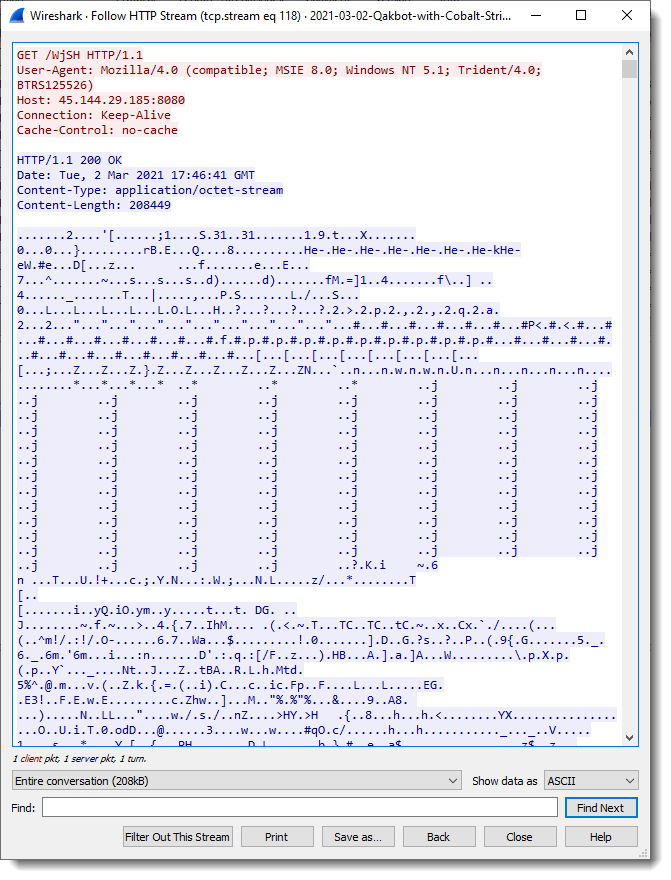
Following this HTTP stream, I see data that looks encoded and has some repetitions, so this might be some kind of XOR encoding:

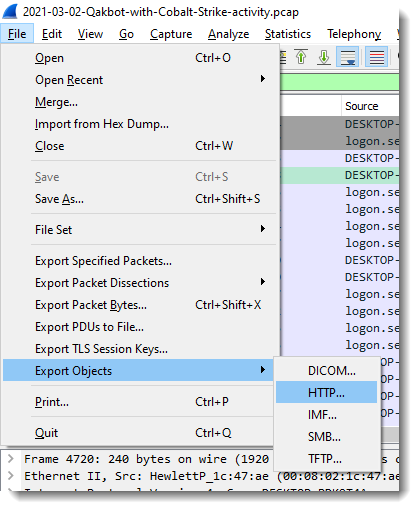
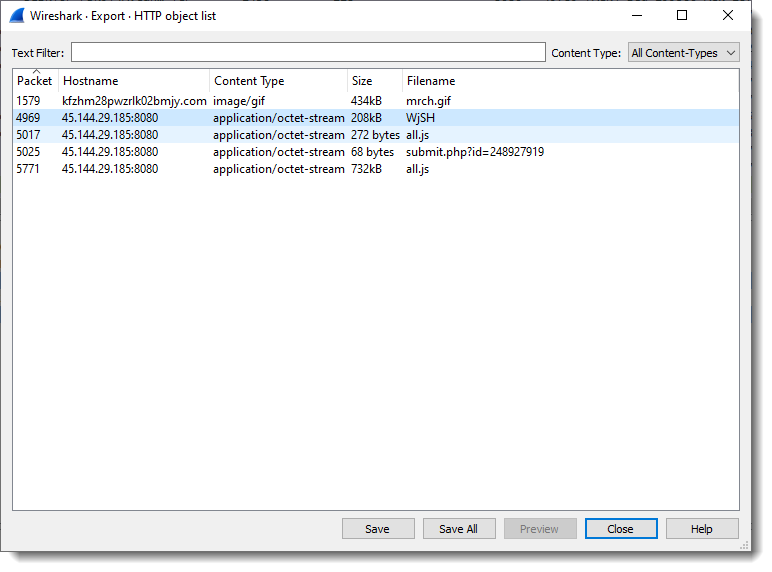
I export this data stream as a file:

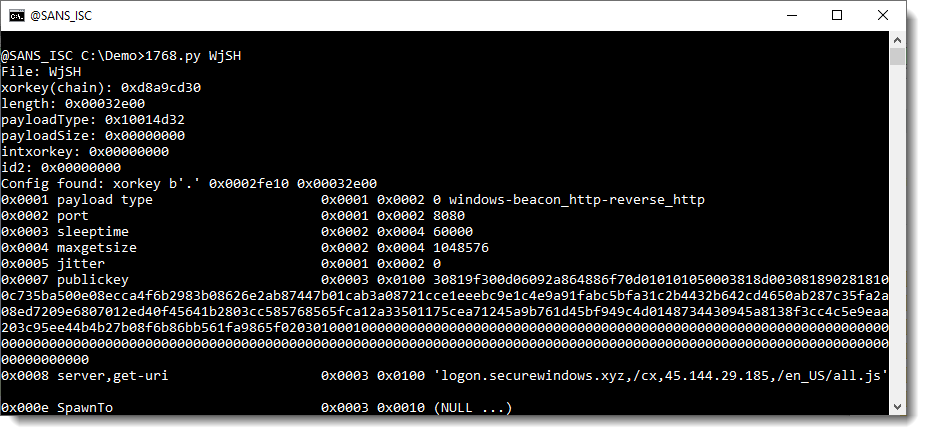
Then pass it through my 1768.py Cobalt Strike beacon analysis tool:

And this is indeed the configuration of a beacon.

Didier Stevens
Senior handler
Microsoft MVP
blog.DidierStevens.com DidierStevensLabs.com

(c) SANS Internet Storm Center. https://isc.sans.edu Creative Commons Attribution-Noncommercial 3.0 United States License. Read More

The post PCAPs and Beacons, (Sun, Mar 7th) appeared first on Malware Devil.


https://malwaredevil.com/2021/03/07/pcaps-and-beacons-sun-mar-7th/?utm_source=rss&utm_medium=rss&utm_campaign=pcaps-and-beacons-sun-mar-7th

Robert M. Lee’s & Jeff Haas’ Little Bobby Comics – ‘WEEK 319’

via the respected information security capabilities of Robert M. Lee & the superlative illustration talents of Jeff Haas at Little Bobby Comics

via the respected information security capabilities of Robert M. Lee & the superlative illustration talents of Jeff Haas at Little Bobby Comics

Permalink

The post Robert M. Lee’s & Jeff Haas’ Little Bobby Comics – ‘WEEK 319’ appeared first on Security Boulevard.

Read More

The post Robert M. Lee’s & Jeff Haas’ Little Bobby Comics – ‘WEEK 319’ appeared first on Malware Devil.


https://malwaredevil.com/2021/03/07/robert-m-lees-jeff-haas-little-bobby-comics-week-319/?utm_source=rss&utm_medium=rss&utm_campaign=robert-m-lees-jeff-haas-little-bobby-comics-week-319

BSides Calgary 2020 -Scott Taylor’s ‘Exploring Common Hacking Techniques’

Our thanks to BSides Calgary and Conference Speakers for publishing their outstanding presentations; which originally appeared at the group’s BSides Calgary 2020 Conference, and on the Organization’s YouTube Channel. Enjoy!

Permalink

The post BSides Calgary 2020 -Scott Taylor’s ‘Exploring Common Hacking Techniques’ appeared first on Security Boulevard.

Read More

The post BSides Calgary 2020 -Scott Taylor’s ‘Exploring Common Hacking Techniques’ appeared first on Malware Devil.


https://malwaredevil.com/2021/03/07/bsides-calgary-2020-scott-taylors-exploring-common-hacking-techniques/?utm_source=rss&utm_medium=rss&utm_campaign=bsides-calgary-2020-scott-taylors-exploring-common-hacking-techniques

BSides Calgary 2020 – Rick Kaun’s ‘Think Global, Act Local In OT Security’

Our thanks to BSides Calgary and Conference Speakers for publishing their outstanding presentations; which originally appeared at the group’s BSides Calgary 2020 Conference, and on the Organization’s YouTube Channel. Enjoy!

Permalink

The post BSides Calgary 2020 – Rick Kaun’s ‘Think Global, Act Local In OT Security’ appeared first on Security Boulevard.

Read More

The post BSides Calgary 2020 – Rick Kaun’s ‘Think Global, Act Local In OT Security’ appeared first on Malware Devil.


https://malwaredevil.com/2021/03/07/bsides-calgary-2020-rick-kauns-think-global-act-local-in-ot-security/?utm_source=rss&utm_medium=rss&utm_campaign=bsides-calgary-2020-rick-kauns-think-global-act-local-in-ot-security

Pandemic Unmasks Vulnerability to Automated Bot Attacks

Change is the one constant in the business world. For most organizations, change often results from market shifts or disruptive technology. Make no mistake, however, the pandemic of 2020 has been a change catalyst. COVID-19 has accelerated digital transformation (DX) across the globe – and at the same time amplified the need to support a […]

The post Pandemic Unmasks Vulnerability to Automated Bot Attacks appeared first on TechSpective.

The post Pandemic Unmasks Vulnerability to Automated Bot Attacks appeared first on Security Boulevard.

Read More

The post Pandemic Unmasks Vulnerability to Automated Bot Attacks appeared first on Malware Devil.


https://malwaredevil.com/2021/03/07/pandemic-unmasks-vulnerability-to-automated-bot-attacks/?utm_source=rss&utm_medium=rss&utm_campaign=pandemic-unmasks-vulnerability-to-automated-bot-attacks

Reducing Cybersecurity Risk With Minimal Resources

*** This is a Security Bloggers Network syndicated blog from Lohrmann on Cybersecurity authored by Lohrmann on Cybersecurity. Read the original post at: https://www.govtech.com/blogs/lohrmann-on-cybersecurity/reducing-cybersecurity-risk-with-minimal-resources.html

The post Reducing Cybersecurity Risk With Minimal Resources appeared first on Security Boulevard.

Read More

The post Reducing Cybersecurity Risk With Minimal Resources appeared first on Malware Devil.


https://malwaredevil.com/2021/03/07/reducing-cybersecurity-risk-with-minimal-resources/?utm_source=rss&utm_medium=rss&utm_campaign=reducing-cybersecurity-risk-with-minimal-resources

AC.1.001 Basic Security Requirements (CMMC Level 1)

Limit information system access to authorized users, processes acting on behalf of authorized users, or devices (including other information systems).

The post AC.1.001 Basic Security Requirements (CMMC Level 1) appeared first on Security Boulevard.

Read More

The post AC.1.001 Basic Security Requirements (CMMC Level 1) appeared first on Malware Devil.


https://malwaredevil.com/2021/03/07/ac-1-001-basic-security-requirements-cmmc-level-1/?utm_source=rss&utm_medium=rss&utm_campaign=ac-1-001-basic-security-requirements-cmmc-level-1

Worldwide Hack: Microsoft Exchange Server Zero-day Exploits

Hundreds of thousands of worldwide organizations are newly hacked via holes in Microsoft’s email software per a Krebs on Security article posted March 5, 2021.

“At least 30,000 organizations across the United States — including a significant number of small businesses, towns, cities and local governments — have over the past few days been hacked by an unusually aggressive Chinese cyber espionage unit that’s focused on stealing email from victim organizations, multiple sources tell KrebsOnSecurity. The espionage group is exploiting four newly-discovered flaws in Microsoft Exchange Server email software, and has seeded 100,000s of victim organizations worldwide with tools that give the attackers total, remote control over affected systems.”

“This is the real deal,” tweeted Christopher Krebs, the former Cybersecurity and Infrastructure Security Agency (CISA) director. “If your organization runs an [Outlook Web Access] OWA server exposed to the internet, assume compromise between 02/26-03/03.”

The post Worldwide Hack: Microsoft Exchange Server Zero-day Exploits appeared first on Security Boulevard.

Read More

The post Worldwide Hack: Microsoft Exchange Server Zero-day Exploits appeared first on Malware Devil.


https://malwaredevil.com/2021/03/06/worldwide-hack-microsoft-exchange-server-zero-day-exploits/?utm_source=rss&utm_medium=rss&utm_campaign=worldwide-hack-microsoft-exchange-server-zero-day-exploits

Large Supermarket Chain Kroger Suffers Data Breach

Kroger, a titan in the US supermarket industry, is the latest company to fall victim to a data breach. In this case, the breach came about via a third-party service the company utilized called Accellion FTA.

Hackers were able to exploit a Zero-Day vulnerability in that software and use it to steal data from vendors using it. Kroger wound up in the crosshairs.

Kroger’s official statement in response to the breach reads in part as follows:

“At this time, based on the information provided by Accellion and our own investigation, Kroger believes the categories of affected data may include certain associates’ HR data, certain pharmacy records, and certain money services records.

Importantly, there was no impact to grocery store data or systems; credit or debit card information; or customer account passwords.”

While it is good news indeed that no payment card information was stolen, the Federal government takes a dim view of anyone who loses control over medical information of any type. So this may land both companies in hot water, depending on the final findings of the investigation into the matter.

In any case, if you are a Kroger shopper, and especially if you make use of Kroger’s pharmacy, be aware that some of your personal information may be compromised. That means that in the weeks and months ahead, you may be targeted by phishing emails in a bid to get enough information from you so that the hackers can steal your identity. Be on your guard against that.

It’s also worth noting that Kroger is a big company, employing more than half a million people in nearly 3000 locations, nationwide, and with sales in excess of $122 billion. That’s significant because it underscores that no company, regardless of how big, is safe from the hackers of the world. Stay vigilant, the year is still young.

Used with permission from Article Aggregator

Read More

The post Large Supermarket Chain Kroger Suffers Data Breach appeared first on Malware Devil.


https://malwaredevil.com/2021/03/06/large-supermarket-chain-kroger-suffers-data-breach/?utm_source=rss&utm_medium=rss&utm_campaign=large-supermarket-chain-kroger-suffers-data-breach

Saturday, March 6, 2021

BSides Calgary 2020 – Richard Rowlandson’s ‘Developing A Holistic Approach To Threat Hunting: Welcome To The Jungle’

Our thanks to BSides Calgary and Conference Speakers for publishing their outstanding presentations; which originally appeared at the group’s BSides Calgary 2020 Conference, and on the Organization’s YouTube Channel. Enjoy!

Permalink

The post BSides Calgary 2020 – Richard Rowlandson’s ‘Developing A Holistic Approach To Threat Hunting: Welcome To The Jungle’ appeared first on Security Boulevard.

Read More

The post BSides Calgary 2020 – Richard Rowlandson’s ‘Developing A Holistic Approach To Threat Hunting: Welcome To The Jungle’ appeared first on Malware Devil.


https://malwaredevil.com/2021/03/06/bsides-calgary-2020-richard-rowlandsons-developing-a-holistic-approach-to-threat-hunting-welcome-to-the-jungle/?utm_source=rss&utm_medium=rss&utm_campaign=bsides-calgary-2020-richard-rowlandsons-developing-a-holistic-approach-to-threat-hunting-welcome-to-the-jungle

Commit Strips’ ‘Call The Police’

via the textual amusements of Thomas Gx, along with the Illustration talents of Etienne Issartia and superb translation skillset of Mark Nightingale – the creators of CommitStrip!

Permalink

The post Commit Strips’ ‘Call The Police’ appeared first on Security Boulevard.

Read More

The post Commit Strips’ ‘Call The Police’ appeared first on Malware Devil.


https://malwaredevil.com/2021/03/06/commit-strips-call-the-police/?utm_source=rss&utm_medium=rss&utm_campaign=commit-strips-call-the-police

Friday, March 5, 2021

Microsoft Adopted an ‘Aggressive’ Strategy for Sharing SolarWinds Attack Intel

Rob Lefferts, corporate vice president for Microsoft 365 Security in Security and Compliance, explains the company’s approach to keeping its customers and the industry apprised and updated on its findings from the now-infamous attack.

The post Microsoft Adopted an ‘Aggressive’ Strategy for Sharing SolarWinds Attack Intel appeared first on Malware Devil.


https://malwaredevil.com/2021/03/05/microsoft-adopted-an-aggressive-strategy-for-sharing-solarwinds-attack-intel-2/?utm_source=rss&utm_medium=rss&utm_campaign=microsoft-adopted-an-aggressive-strategy-for-sharing-solarwinds-attack-intel-2

Microsoft Adopted an ‘Aggressive’ Strategy for Sharing SolarWinds Attack Intel

Rob Lefferts, corporate vice president for Microsoft 365 Security in Security and Compliance, explains the company’s approach to keeping its customers and the industry apprised and updated on its findings from the now-infamous attack.

In the wake of a widespread cyberattack, enterprise IT providers can play a key role in how businesses learn about and mitigate the security threat. That role has evolved as attacks grow more complex – and it presents a tricky challenge when a provider must keep businesses informed of an attack that has infiltrated its own walls and affected tens of thousands of its customers, as Microsoft experienced during the recent SolarWinds incident.

“A lot of the way it [the role] has changed is in the face of ever-increasing complexity and impact,” says Rob Lefferts, corporate vice president for Microsoft 365 Security in Security and Compliance.

Microsoft faced this precise challenge a few months ago, following the major supply chain attack that initially targeted SolarWinds and distributed a backdoor Trojan to some 18,000 organizations via infected software updates. Microsoft was one of thousands affected by the tainted updates; using their access, the attackers were able to view some of its source code.

The company took steps to remediate the internal accounts that were used to view source code “in a number of code repositories.” While security experts pointed out that this access could make some steps easier for attackers, Microsoft maintained that there was no increase in risk. The company has since reported there is no evidence that attackers gained extensive access to services or user data.

Many across the industry refer to this incident as “the SolarWinds attack”; however, it’s worth noting many victims didn’t use SolarWinds at all. The same nation-state behind the malicious SolarWinds Orion updates infiltrated other organizations through their Microsoft 365 and Azure accounts. Malwarebytes also was a victim of this attack vector; Microsoft had alerted the security company to suspicious activity.

“We can confirm the existence of another intrusion vector that works by abusing applications with privileged access to Microsoft Office 365 and Azure environments,” officials said in a blog post on the attack.

It’s one of many attacks to take advantage of Microsoft applications: criminals have begun to target Microsoft 365 accounts as quickly as businesses adopt the platform. And as security pros point out, many of tactics could be avoided by simply turning on features built into Office 365 Enterprise plans – the problem is, attackers seem to know the suite better than defenders do. Some are abusing features that IT admins don’t know exist.

As Microsoft investigated the extent of this attack on its own internal systems, researchers had the added responsibility of sharing intelligence that could be helpful to other organizations who may have also been infected. This took the form of more than a dozen blog posts in which internal Microsoft analysts published information about the SolarWinds attack as they learned it.

“We had a … pretty aggressive all-hands-on-deck approach of, ‘We’re going to take all the information that we get and make it digestible and publish it on our blog and share that,” Lefferts says.

The company last week released a free tool businesses can use to check their software for signs of the SolarWinds attack – the same queries Microsoft used to discover the malware in its own code. Prior to that, it released information it discovered on how attackers activated a second stage payload. Its latest blog post, published this week, details three new types of malware being used in late-stage activity by the threat it now refers to as “Nobelium.”

Threat intelligence-sharing following an attack isn’t new for Microsoft or other large IT providers, but this attack marked “a difference in scale” for its response, Lefferts points out. The size and complexity of the SolarWinds incident meant analysts had to take a deep dive into threat data, learn what was happening, make it accessible, and share it with other organizations.

“The reason that SolarWinds might’ve felt a little different was because of the amount of information and the gravity and significance of it for the industry,” he explains, adding that “we went all the way from overview material to ‘here’s the query, go hunt for this in your environment,’ and [businesses] were really able to take advantage of that.”

In addition to amplifying the amount of information Microsoft shared, this incident amplified businesses’ concerns and questions around security posture. Lefferts says he has had more conversations about identity, and security assertion markup language (SAML), in particular, after the attack. Many are also understandably worried about how to detect and respond to this type of attack; however, oftentimes they’re more worried about one than the other.

“Sometimes the way these events happen causes people to get excited about ‘I just need better detection after the fact,'” he explains, and they don’t think enough about preventing successful attacks in the first place. Some are preoccupied with detection but fail to think about response.

On a broader level, Lefferts says a component of enterprise education is building tools that can help information security teams do their jobs as security threats grow in size and complexity.

“There’s this scale problem that’s sort of endemic to technology – but thinking about security in particular, there’s this real need to make sure that we directly help people because it is hard to hire and train the expertise that they need,” he adds.

As an example, Lefferts describes Microsoft 365 Defender Threat Analytics, released this week in public preview. The tool is a set of reports meant to give security teams multiple perspectives on what’s going on in their environment, as well as steps they should take to address incidents that arise.

“Security is the number one concern IT leaders and CIOs have when they move to the cloud,” says Sid Nag, vice president in Gartner’s Technology and Service Provider Group, referencing a Gartner study. Many organizations have “full faith” in their cloud providers to address security, putting pressure on providers like Microsoft to strengthen their focus on it.

The pressure increases as more organizations move toward multi-cloud environments, he continues. As more businesses use multiple clouds at the same time, it calls into questioin how their security model is transposed across different cloud estates. Nag says the onus is on cloud providers, not business customers, to determine the right approach and offer solutions that companies need.

“The reality is that cloud is an experiment and a journey for most organizations,” Nag explains. “There’s plenty of workloads and applications that are still sitting on prem that have not been moved to the cloud. As these workloads, especially the complex ones, move to the cloud, the challenges arise.”

Cross-Industry Collaboration Can Drive Education

A key lesson learned in the aftermath of SolarWinds was the importance of the security industry working together to share information on threats in a broader effort to educate businesses and the public – a point Microsoft president Brad Smith emphasized in his written testimony for last week’s Senate hearing on the SolarWinds incident.

“Today, too many cyberattack victims keep information to themselves,” Smith wrote. “We will not solve this problem through silence. It’s imperative for the nation that we encourage and sometimes even require better information-sharing about cyberattacks.”

Smith pointed out how the reason organizations know of this attack is because FireEye, which first detected the activity, was open about what it found in its systems. Without this level of transparency, he said, “we would likely still be unaware of this campaign.” In his testimony, Smith called for a national strategy to improve how threat intelligence is shared across the security community, as well as the need for clear disclosure requirements in the private sector.

“There’s some places I do feel that it’s important for the security industry to take a step back and think about how this [attack] impacts the work that we do,” Lefferts says. “Most of the conclusions we have drawn have been to accelerate things that we were already working on”

One of these projects was the implementation of zero trust, especially in a work-from-home environment, as well as new technologies like extended detection and response (XDR), which provides businesses with visibility across their endpoints, network, and cloud environments, he adds.

Kelly Sheridan is the Staff Editor at Dark Reading, where she focuses on cybersecurity news and analysis. She is a business technology journalist who previously reported for InformationWeek, where she covered Microsoft, and Insurance & Technology, where she covered financial … View Full Bio

Recommended Reading:

Comment |

Email This |

Print |

RSS

More Insights

The post Microsoft Adopted an ‘Aggressive’ Strategy for Sharing SolarWinds Attack Intel appeared first on Malware Devil.


https://malwaredevil.com/2021/03/05/microsoft-adopted-an-aggressive-strategy-for-sharing-solarwinds-attack-intel/?utm_source=rss&utm_medium=rss&utm_campaign=microsoft-adopted-an-aggressive-strategy-for-sharing-solarwinds-attack-intel

WordPress Injection Anchors Widespread Malware Campaign

Website admins should patch all plugins, WordPress itself and back-end servers as soon as possible.
Read More

The post WordPress Injection Anchors Widespread Malware Campaign appeared first on Malware Devil.


https://malwaredevil.com/2021/03/05/wordpress-injection-anchors-widespread-malware-campaign/?utm_source=rss&utm_medium=rss&utm_campaign=wordpress-injection-anchors-widespread-malware-campaign

5 Ways Social Engineers Crack Into Human Beings

These common human traits are the basic ingredients in the con-man’s recipe for trickery.

The post 5 Ways Social Engineers Crack Into Human Beings appeared first on Malware Devil.


https://malwaredevil.com/2021/03/05/5-ways-social-engineers-crack-into-human-beings-2/?utm_source=rss&utm_medium=rss&utm_campaign=5-ways-social-engineers-crack-into-human-beings-2

5 Ways Social Engineers Crack Into Human Beings

Enterprise Vulnerabilities
From DHS/US-CERT’s National Vulnerability Database
CVE-2021-27099
PUBLISHED: 2021-03-05

In SPIRE before versions 0.8.5, 0.9.4, 0.10.2, 0.11.3 and 0.12.1, the "aws_iid" Node Attestor improperly normalizes the path provided through the agent ID templating feature, which may allow the issuance of an arbitrary SPIFFE ID within the same trust domain, if the attacker controls the v…

CVE-2021-28038
PUBLISHED: 2021-03-05

An issue was discovered in the Linux kernel through 5.11.3, as used with Xen PV. A certain part of the netback driver lacks necessary treatment of errors such as failed memory allocations (as a result of changes to the handling of grant mapping errors). A host OS denial of service may occur during m…

CVE-2021-28039
PUBLISHED: 2021-03-05

An issue was discovered in the Linux kernel 5.9.x through 5.11.3, as used with Xen. In some less-common configurations, an x86 PV guest OS user can crash a Dom0 or driver domain via a large amount of I/O activity. The issue relates to misuse of guest physical addresses when a configuration has CONFI…

CVE-2021-28040
PUBLISHED: 2021-03-05

An issue was discovered in OSSEC 3.6.0. An uncontrolled recursion vulnerability in os_xml.c occurs when a large number of opening and closing XML tags is used. Because recursion is used in _ReadElem without restriction, an attacker can trigger a segmentation fault once unmapped memory is reached.

CVE-2020-28502
PUBLISHED: 2021-03-05

This affects the package xmlhttprequest before 1.7.0; all versions of package xmlhttprequest-ssl. Provided requests are sent synchronously (async=False on xhr.open), malicious user input flowing into xhr.send could result in arbitrary code being injected and run.

The post 5 Ways Social Engineers Crack Into Human Beings appeared first on Malware Devil.


https://malwaredevil.com/2021/03/05/5-ways-social-engineers-crack-into-human-beings/?utm_source=rss&utm_medium=rss&utm_campaign=5-ways-social-engineers-crack-into-human-beings

Massive Supply-Chain Cyberattack Breaches Several Airlines

The cyberattack on SITA, a nearly ubiquitous airline service provider, has compromised frequent-flyer data across many carriers.
Read More

The post Massive Supply-Chain Cyberattack Breaches Several Airlines appeared first on Malware Devil.


https://malwaredevil.com/2021/03/05/massive-supply-chain-cyberattack-breaches-several-airlines/?utm_source=rss&utm_medium=rss&utm_campaign=massive-supply-chain-cyberattack-breaches-several-airlines

HAFNIUM Exchange Zero-Day Scanning

The Microsoft Exchange Zero-day exploit drop this week is a big one for 2021. The actions everyone needs to take when these exploits are being used in the wild is: 1. Take inventory Do you host an on-prem exchange server? Is the exchange server vulnerable? Most likely unless you applied the latest out-of-band patches released…

The post HAFNIUM Exchange Zero-Day Scanning appeared first on Infocyte.

The post HAFNIUM Exchange Zero-Day Scanning appeared first on Security Boulevard.

Read More

The post HAFNIUM Exchange Zero-Day Scanning appeared first on Malware Devil.


https://malwaredevil.com/2021/03/05/hafnium-exchange-zero-day-scanning/?utm_source=rss&utm_medium=rss&utm_campaign=hafnium-exchange-zero-day-scanning

Barbary Pirates and Russian Cybercrime

In 1801, the United States had a small Navy. Thomas Jefferson deployed almost half that Navy—three frigates and a schooner—to the Barbary C...